
I own a performance marketing company. Translation: I sell leads for a living.
To a lot of people, admitting that places me somewhere on the social hierarchy between pond scum and a person who steals candy from a baby. The public perception of lead generation and data brokerage can be overwhelmingly negative. Even John Oliver did a whole segment on Last Week Tonight exposing data brokers, painting the entire industry as an unsavory cabal of scummy digital parasites trading your private thoughts for a buck.
And look, I get the dig. There are absolutely bad actors out there, as there are in every industry. But John Oliver missed the forest for the trees on that one.
There is a massive difference between blindly hawking scraped data and what actual performance marketers do. Our real goal isn’t to spam humanity; it’s to connect consumers with products and services they have actively expressed interest in purchasing. This practice isn’t some modern, malicious internet invention. It is an essential pillar of trade that is quite literally as old as commerce itself.
The internet didn’t create this ecosystem. It just made it faster.
Long before fiber-optic cables, marketing pioneers were doing exactly what we do today. Take Claude Hopkins, one of the founding fathers of advertising. Over a century ago, Hopkins wasn’t just writing catchy phrases; he was obsessed with hard data. He assigned specific “department codes” or distinct coupon numbers to different newspaper ads. When a consumer clipped the coupon and mailed it in to buy a product, Hopkins knew exactly which ad and which publication generated that specific sale.
He didn’t guess. He didn’t rely on “vibes.” He used those incoming data points to optimize campaigns, pouring money into the winning ads and cutting the losers.
Fast forward a few decades to the 1950s and 1960s, and the optimization process continued. One of the pioneers of modern direct marketing was Lester Wunderman, often called the “Father of Direct Marketing.” Wunderman understood that advertising could not be built on opinions alone. His campaigns used trackable phone numbers, offer codes, direct mail responses, and eventually direct-response television to determine exactly which advertisements generated consumer inquiries and sales. If one campaign outperformed another, budgets shifted immediately. If a campaign failed, it was cut. The technology was primitive by today’s standards, but the process was identical to modern performance marketing: collect data, identify winners, eliminate losers, and reinvest in what works.
When talking to one of my daughters about “internet privacy”, she laughed and said, “Dad, I don’t care about privacy tracking. Because when I’m looking for new Ugg boots, what I really want to see is more cute styles, not an ad for snow tires.”
Fair enough.
We often talk about optimization as a business tool, but it serves consumers too. The entire purpose of optimization is to connect interested buyers with relevant products and services while filtering out the noise.
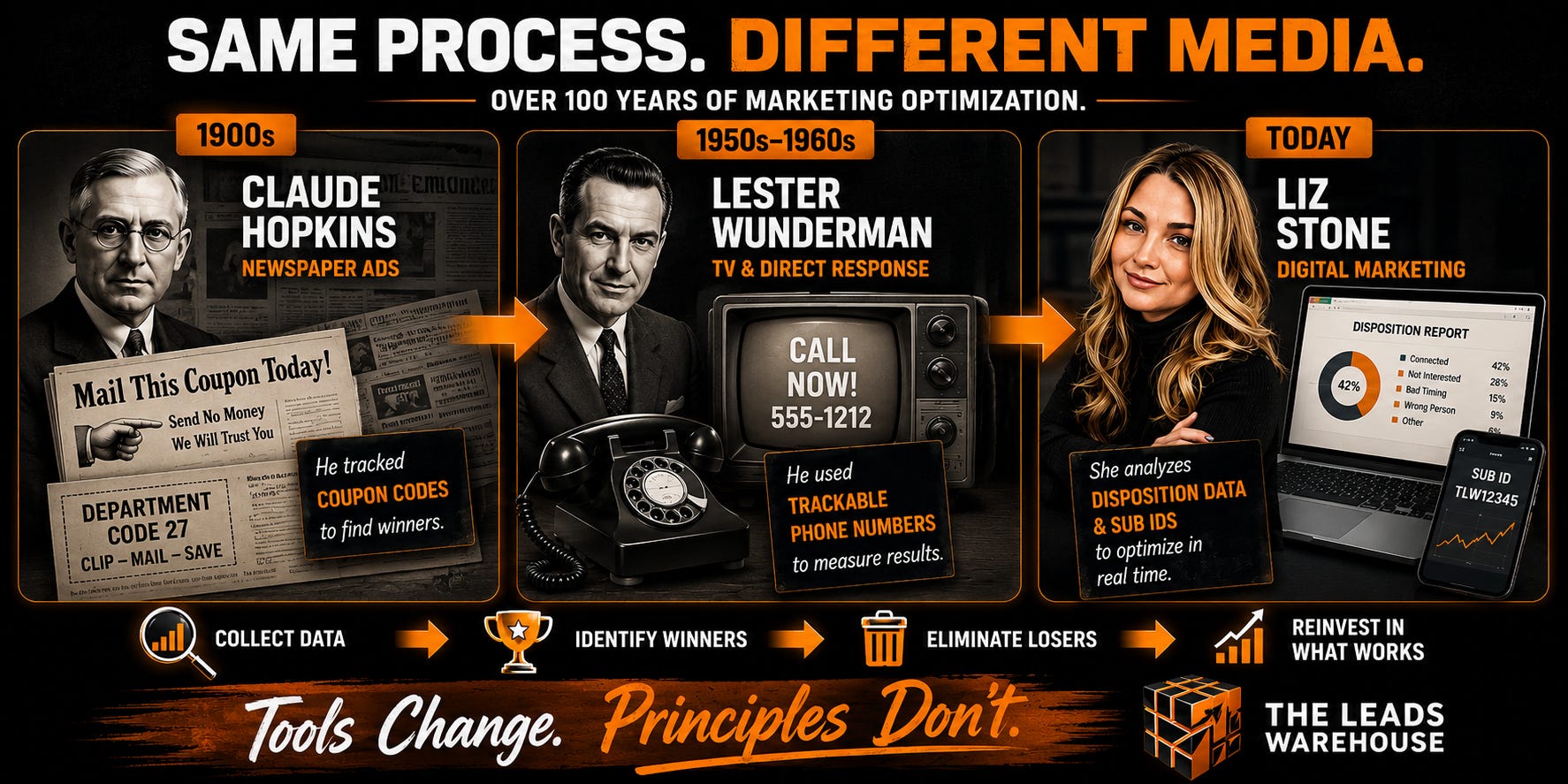
The mechanism changes, but the psychology remains identical: A consumer raises their hand, expresses intent, and a marketer routes them to the solution.
Today, we do the same thing on the internet. Let’s talk about the leads my company sells. We put out an online creative, which is a fancy name for an advertisement. The consumer sees the creative, likely because their own search history shows they are interested in that product or service, and they respond to the creative. Their response could be a phone call, otherwise known as an inbound call. Or, the creative could drive the consumer to a landing page where the consumer fills out a form and hits submit. The consumer is now a lead.
This is not exactly shadowy, scary stuff. It is the modern-day equivalent of newspaper clippers from 100 years ago. Furthermore, our leads come with proof of opt-in, which is a Jornaya or TrustedForm certificate. They are audited, verified, compliant, real-time hand-raisers. They asked for help.
So why do so many companies fail to close them?
When I moved into the performance marketing industry as a fractional C.O.O. for The Leads Warehouse, the prior owner, Matt Marsh, connected me with industry friends to learn about the sector. One of his colleagues, whom he introduced me to, was Liz Stone. Liz owns several companies in the performance marketing industry. Today, Liz is a phenomenal professional friend and a part-time mentor. With her industry experience, when Liz speaks about lead operations, you stop and take notes.
One of the most foundational lessons I ever learned from Liz is the absolute necessity of continuous lead optimization. The lessons she taught me would have made Claude Hopkins proud.
To understand how lead optimization works, you don’t need a degree in data science. It’s highly intuitive. We put creative assets out online - it could be a targeted Meta ad campaign or a display linkout on a partner site. The creative generates a phone call or drives traffic to a landing page where a consumer fills out a form.
Intuitively, every business owner knows not all creatives are born equal. A banner ad displayed on a high-intent financial blog will attract a radically different type of buyer than a Facebook ad scrolled past at 11:00 PM.
Because of that variance, we as lead providers need data to adjust our dials. Just like Claude from 100 years ago, we need data to make this work. We need detailed disposition reports back from our clients to see the cold, hard numbers:
Out of the 100 leads we sent you, which ones were disconnected?
Which ones turned into appointments?
Which exact leads resulted in a signed contract?
When a client shares their disposition data, we cross-reference closed deals back to the specific creative that generated the win. We do this through sub IDs that allow us to track ads, just like 100 years ago from newspaper ads. If Banner A is producing 10% close rates and Banner B is producing zeroes, we shut down Banner B and pour fuel on Banner A.
Likewise, if a specific Meta ad is bringing closes, we clone the winning creative. We look at the time the creative is bringing the closes. We use hard data to optimize the sales funnel.
True optimization isn’t a “one-and-done” setting. It’s an endless, looping process.
Let’s say we find a winning banner linkout on a partner page. That page only has so much traffic; eventually, that audience maxes out. To keep scaling and feeding a sales team, we branch out with new banners on new partner pages, build lookalike audiences, and test new angles.
The moment we scale out to those new pages, the optimization clock resets to zero. We have to start testing, tracking, and filtering all over again based on how those specific new prospects behave.
Proper client-vendor collaboration lowers client cost-per-acquisition, increases close rates, and everybody wins.
Instead of that collaborative, data-driven partnership, we frequently run into a very different type of client.
They call us up screaming. “The leads don’t work! You’re a thief! You’re selling me garbage data!”
We take a deep breath, channel our inner Liz Stone, and ask a very simple, standard operational question: “Can you send over your disposition report so we can see which sources are underperforming for you?”
Silence.
Then come the excuses. They don’t have a report. They don’t track dispositions in their CRM. And then, if we push hard enough, the real truth finally slips out: They haven’t even called half of the leads we sent them. They have zero metrics, zero tracking, and zero operational discipline - but they are 100% certain “the leads don’t work.”
Let’s call this what it actually is. The leads aren’t broken. The 100-year-old process of marketing optimization isn’t broken. The client is broken.
If you are buying real-time, certified leads and expecting them to magically close themselves without giving your vendor the data required to optimize the pipeline, you aren’t running a business. You’re buying a lottery ticket and getting mad at the convenience store clerk when you don’t hit the jackpot.
Stop blaming your vendors. Start tracking your data. Give us the dispos, and let us do the job Claude Hopkins engineered a century ago.
Thanks for reading! This post is public, so feel free to share it.
How does your sales team track lead dispositions? Are you giving your marketing vendors the data they actually need to optimize your campaigns? Let's discuss in the comments below.
No posts
Comments
Nothing yet. Say the first thing.
Sign in to join the conversation.