
Every week, a client meets with me and delivers the exact same line: “Jim, I just want the best leads I can get.”
I always smile, take a deep breath, and tell them the truth, even if it goes against everything they think they know about performance marketing: All leads are good. All leads can work.
Let’s be honest: the local phone book can work to generate revenue. And in the “old days”, it is what we used. In my first-ever sales job, my Dad basically tossed me the phone book and said, “Start dialing”.
The only reason we don’t pick up a phone book today and start dialing page one is that without verified consumer intent, a business will get absolutely buried in TCPA violations and lawsuits. But from a pure sales perspective? It’s a list of humans. It can produce revenue. It doesn’t matter if a business is selling solar, tax resolution, or insurance - guaranteed there are consumers in the local directory that need assistance and would be interested in a pitch.
The problem isn’t the lead source. The problem is that most business owners view lead buying as a cost on the balance sheet rather than what it actually is: a math problem.
To win at this game, you must know your target Cost Per Acquisition (CPA). If you can build and execute a sales plan where the conversion math aligns with your target CPA, then congratulations - you have found the “right” lead for your business.
Let’s look at the cold, hard numbers to show you exactly what I mean.
Let’s say you operate in a vertical where your target Cost Per Acquisition is $600 within the first 2 to 3 weeks of a campaign. To hit that exact $600 math, you have four completely different lead options on the table.
Take a look at how the math balances out across the spectrum:
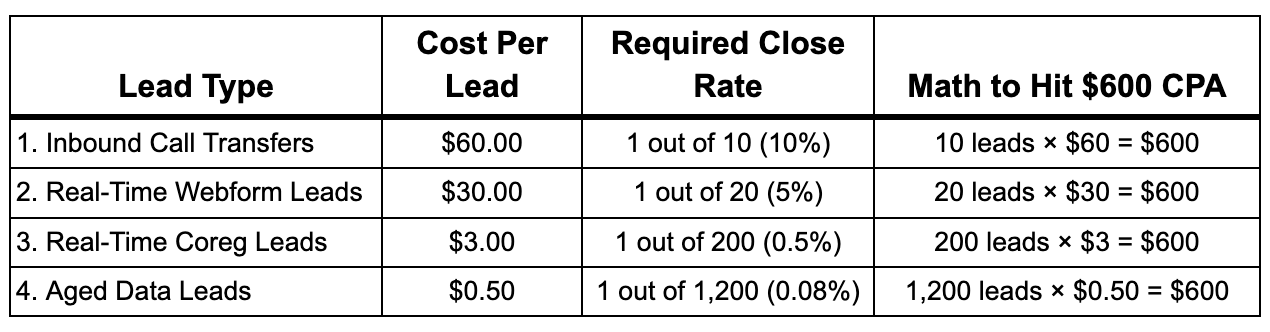
In this math equation, the CPA, $600, is the fixed number. The variables are the cost per lead (CPL) and the number of leads needed to close a deal. Per the final column, the CPA is identical. Every option delivers the $600 target.
So, if the financial destination is exactly the same, how does a business choose? Easy, stop looking at the CPL, and start looking at the sales floor.
To figure out which lead type actually fits your company, sales leadership has to audit three specific operational realities:
The tech stack and raw manpower required to grind through a 1-out-of-1,200 close rate are a completely different beast than taking call transfers.
To make call transfers work, all a sales floor needs is an inbound phone line (DID) and a few capable reps sitting by the phone ready to talk to a live human. To make aged leads work, a company needs high-volume dialers, automated workflows, and an infrastructure capable of churning through thousands of data points a day without destroying caller ID integrity or domain reputation. If an SMS game plan is going to be used, a business needs the right high-volume SMS platform and A2P and 10DLC registration completed. If a business doesn’t have the tech, high-volume coreg real-time leads or aged leads will never produce a close.
What happens to a company’s culture when the sales team has to handle a 1/10 close rate versus a 1/1,200 close rate?
Elite, high-ticket closers absolutely despise 1/1,200 data. Dumping thousands of aged leads onto a veteran closer’s desk and telling them to start dialing will create a mass exodus. Closers want to spend their time presenting and closing, not listening to voicemail greetings.
The Lead-to-Closer Model: If your sales floor routes incoming leads directly to your top closers, sales management should buy $60 transfers or the $30 real-time webform leads. High intent matters for this model.
The Opener/Closer Model: If sales management wants to utilize inexpensive, high-volume leads ($3 or $0.50), an opener/closer model must be used. Low-cost “openers” or dialer reps whose sole job is to sift through the noise, dials to find the active hand-raisers, and transfer the qualified gold to the elite closers. Besides using a human opener, this model can utilize SMS, AI, or RVM to generate inbound calls.
While expensive call transfers feel great because the gratification is instant, they lack long-term asset value.
Let’s look at the hidden math of what happens after your first close:
If sales management buys 10 call transfers and the team closes 1, there are 9 people left to remarket to.
If 20 real-time webform leads are purchased and 1 deal is closed, there are 19 people left to remarket to.
And 1,200 aged leads with 1 close provide 1,199 active prospects for future closes.
Consider the probability. What are the odds of squeezing one more deal out of a pool of 9 people versus a pool of 1,199 people? The volume option builds a massive, highly profitable database asset.
When buying volume, a sales agency is not just buying phone leads. A database of 1,199 data points gives a marketing team the raw fuel needed to scale outside of the sales floor. The records can be used for a targeted SMS drip campaign, run ringless voicemail drops, launch highly specific direct mail flyers, or be uploaded into Meta to build a massive lookalike custom audience.
Volume unlocks channels that low-volume transfers simply cannot touch.
So, let’s look back at the original question: Which lead is the best?
The answer is: They all work.
The real question to ask is: “Are we buying the specific lead type that matches our current sales architecture?”
If you run a lean, high-end shop with three top-tier closers and zero dialer tech, stop buying cheap data and complaining that it’s “garbage.” Pay the premium for inbound transfers.
If you run a heavy-hitting, automated call center with a massive army of hungry openers and omnichannel marketing support, stop burning your margins on expensive transfers. Buy the data, spin up the dialers, and win on volume.
Stop looking for magic. Start doing the math.
Solving marketing is solving a math problem.
What does your sales floor infrastructure look like? Are you forcing your closers to chase aged data, or are you overpaying for transfers when you have the tech to grind out volume? Let's talk about it in the comments below.
No posts
Comments
Nothing yet. Say the first thing.
Sign in to join the conversation.