
I was working for Oneida Foodservice when we were purchased by Monomoy Capital Partners. The play was to merge us with Anchor Hocking, creating a massive, consolidated powerhouse in the tabletop and foodservice industry. To celebrate the merger, integrate the teams, and kick off the new year, we organized a national sales meeting at the JW Marriott Orlando Grande Lakes. The theme of the meeting was “Winning Together.”
The energy was exactly what one would expect from a high-stakes corporate integration. There were hundreds of road warriors, endless stacks of new product catalogs, and an underlying tension as two distinct sales cultures tried to figure out how to work together.
As part of the senior leadership team, I was tasked with leading one of the core breakout training sessions.
The sales reps were scheduled to rotate through a gauntlet of classrooms all weekend: intensive product training, tech stack orientations, and new corporate overviews. My slot was dedicated to general sales training. I was supposed to stand in front of a room full of veteran, tabletop professionals and teach them how to better do their jobs.
As I prepared for my presentation, I reviewed and re-reviewed it, and something seemed off.
The content felt entirely too basic. Actually, scratch that - it felt aggressively elementary. I wasn’t pitching an advanced psychological tabletop installation closing methodology or a revolutionary new way to present dinnerware to an Executive Chef. And worse off, I barely even mentioned tabletop. My slides were filled with bullet points that looked like they belonged in an entry-level handbook:
● Bring physical business cards.
● Confirm your appointment via email 24 hours in advance.
● Review the client’s personal LinkedIn profile before walking through the door.
● Review your internal sales reports to identify 12-month buying trends.
● Unwrap and clean your samples so they are ready to present.
● Know where to park.
That last one sounds ridiculous until it actually happens. There is nothing more lethal to a vital client sales meeting than pulling up to a corporate campus 10 minutes before the appointment time, only to realize the visitor lot is gated, the main structure requires an employee badge, and the walk to the front door is 15 minutes away and uphill. Walking into a meeting late, drenched in sweat, breathing heavily, and disorganized does not scream sophisticated tabletop pro.
The meeting is completely tanked before the briefcase is opened, no matter how beautiful the PowerPoint slides look. Or, in our case, no matter how trendsetting our new dinnerware shape was.
There was nothing high-level, exciting, or sexy about this strategy. I was terrified the room would look at me and think I was wasting their time.
Seeking a sanity check, I went to one of my direct reports, Mike Coggins.
Mike was an industry veteran who had been a mentor to me at various points in my career. Our professional history together was long, winding, and completely devoid of corporate BS. Over the years, our dynamic shifted across almost every structure possible: I had worked for him early on; he had served as a vital personal reference during a major job change; then I transitioned companies and he became a key supplier of mine; after that, we competed fiercely against each other in the open market; and finally, I hired him, and he worked directly for me.
Through every iteration of our relationship, Mike gave it to me straight. I walked him through my presentation layout and confessed my fears that it was just too simple.
Mike listened patiently, leaned back, and smiled.
“Jim, let me ask you something,” Mike said. “What does a Major League Baseball team do the absolute second they walk out onto the diamond for pre-game warm-ups?”
I looked at him, waiting for the punchline.
“They take the field,” Mike continued, “and the first baseman tosses the ball to second. Second throws it to third. Third whips it back to first. They do it over and over again. They aren’t practicing crazy trick plays or hidden squeeze bunts. They are playing catch. Or look at a professional basketball team when they warm up. They aren’t throwing down 360 tomahawk dunks or alley-oops. They are doing basic layups and shooting free throws.”
He leaned forward, dropping the sports analogy right into reality: “It is always about the basics, Jim. Most businesses get so obsessed with looking fancy that they completely forget how to play catch. And that is exactly why they lose.”
It was a flawless piece of advice from a true Buckeye. Mike was an Ohio State alum, and this advice was 3 yards and a cloud of dust. As a sports guy, it resonated immediately because it was undeniably true.
For my presentation, I threw out my generic introduction and started my breakout session with my framework and Mike’s wise counsel in my head. I told a room full of veteran reps: “We are going to spend the next hour talking about the basics. Because if you screw up the basics - like failing to clean samples and presenting a dirty plate or showing up late because you didn’t map out the parking situation - the advanced game plan doesn’t matter.”
The room locked in. The session was a home run because everyone in that room knew, deep down, that execution consistency always beats strategic complexity.
Stepping out of the world of tableware and transitioning into the performance marketing and lead generation ecosystem, this absolute law of the basics remains completely unchanged.
Companies routinely blow hundreds of thousands of dollars on high-level, hyper-complex marketing concepts. They hire data engineering consultants, buy expensive attribution software platforms, and talk endlessly about machine-learning optimization algorithms.
But when peeking under the hood of their actual sales floor operations, one finds out they aren’t even executing basic layups.
If your external marketing system opens a highly profitable door, but your internal sales floor doesn’t possess the operational discipline to walk through it cleanly, your entire business model collapses. Maximizing the intersection of sales and marketing isn’t an esoteric, mysterious science. It’s a grinding, every-day commitment to foundational pillars.
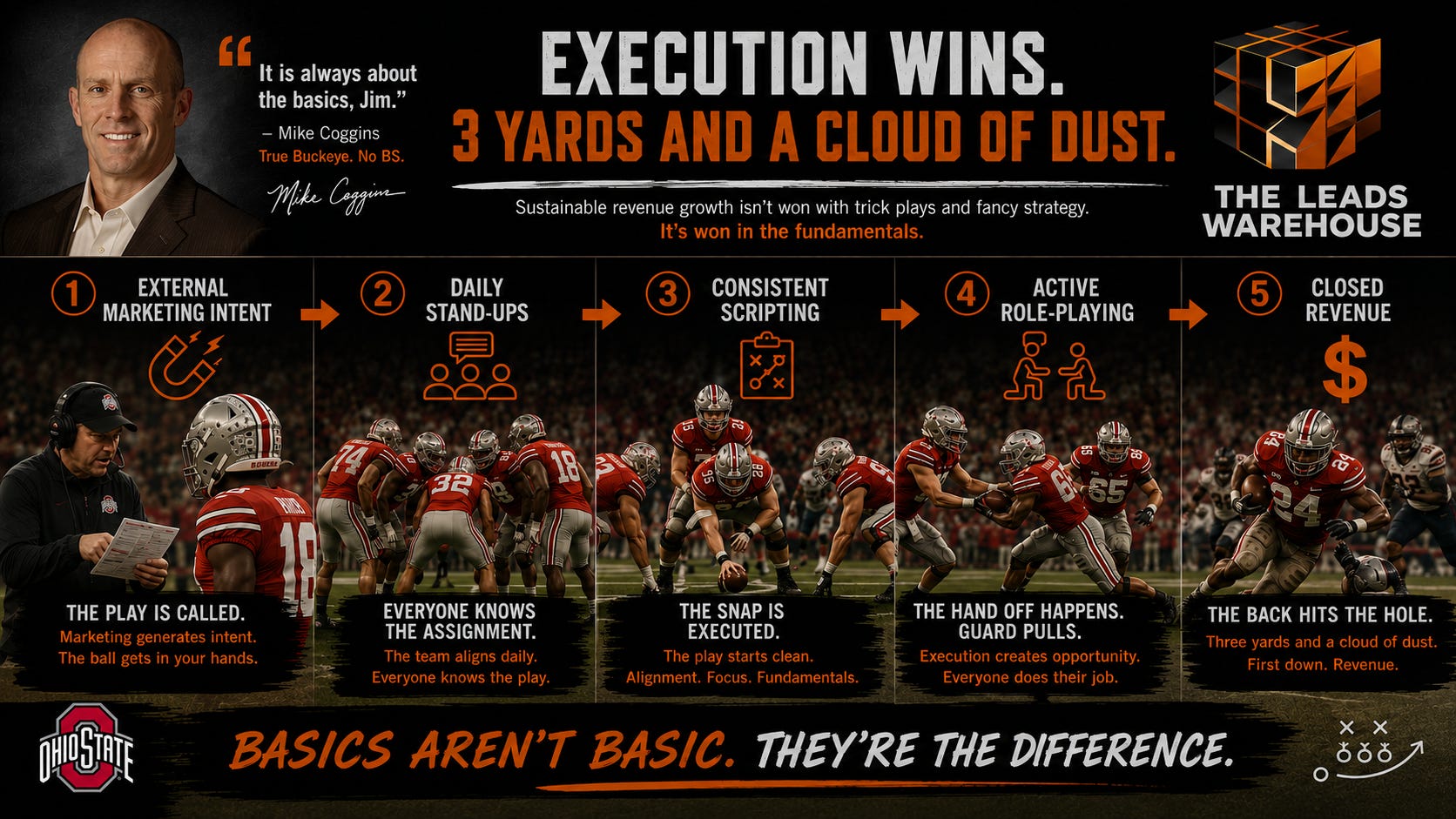
You cannot run a highly synchronized revenue operation if your sales managers and marketing providers only talk once a month during a lagging review call.
The best operations run on daily stand-up meetings. These aren’t long, drawn-out strategy sessions that eat up your morning selling hours. They are fast, 15-minute, high-velocity huddles.
● What happened with yesterday’s data?
● Did the inbound call volume spike at a specific hour?
● Did the reps notice a shift in consumer sentiment on a particular sub-ID?
● Are the dialers running clean, or are we seeing a drop in answer rates?
A daily stand-up forces your team to analyze live data, align expectations, and make minor micro-adjustments before the phones even start ringing. It is the literal equivalent of a baseball team throwing the ball around the horn before the first pitch is thrown. It ensures everyone is awake, synchronized, and ready to handle live traffic.
I routinely speak with business owners who refuse to enforce scripts on their sales floor because they claim their reps are “artists” who need to “flow naturally” with the prospect.
Let’s be completely transparent: that is lazy sales management.
A script isn’t a robotic prison meant to strip away human personality; it is an optimized baseline designed to control the volatile emotional nature of a sales conversation. Your marketing campaign targets a specific type of consumer anxiety or intent. Your script is the exact bridge that resolves that specific intent.
If your marketing angle promises one thing, but your sales rep ad-libs a completely different message on the phone because they “felt like winging it,” you have instantly broken your pipeline consistency. An elite sales professional uses a script the exact same way an NBA superstar approaches the free-throw line: they bounce the ball three times, spin it in their hands, set their feet, and shoot the exact same mechanical shot every single time. Consistency produces predictable results. Ad-libbing produces chaos.
In an opener - closer model, if the opener pitches “A” and the closer is focused on “B” the misalignment will cost sales. I have seen debt sales floors in which the marketing is based on debt elimination, the opener talks about a loan flip, and the closer talks about consolidation. Revenue doesn’t increase; sales blames bad leads, marketing blames poor sales execution, and the team gets burned out and quits.
You should never allow your sales reps to practice on your paid marketing leads.
When a company pays for real-time, compliance-certified hand-raisers, every single phone call represents real corporate capital. Allowing an uncoached, unwarmed-up sales rep to take those calls fresh without practicing their rebuttals is the equivalent of sending a football team into a regular-season game without a single day of practice.
High-performing sales organizations run mandatory, active role-playing sessions. Reps throw the toughest, ugliest, most far-fetched price objections at each other in a controlled room. They test out new script transitions, practice handling defensive gatekeepers, and sharpen their vocal delivery. If your team isn’t pressure-testing their skills in a scrimmage environment, they will inevitably drop the ball when a premium live transfer lands on their headset.
It is incredibly easy to get distracted by the flash of fancy sales skills and the strategy du jour. It feels good to talk about high-level marketing campaigns, complex tech integrations, and trendy new products at luxury resorts in Orlando.
But real revenue generation isn’t built on flash. It is built on the bland, repetitive execution of basic operational disciplines.
If your team doesn’t know how to run a tight daily stand-up, if your reps are ad-libbing their scripts, and if your managers are too lazy to run daily role-play drills, then your multi-million-dollar marketing strategy is completely irrelevant. You are building an expensive engine and forgetting to put oil in the machine.
Stop looking for a magic, complex solution to fix your revenue targets. Look at your floor, audit your fundamentals, and master the basic layups first.
Or, as a Buckeye would say, 3 yards and a cloud of dust will win “The Game” every year.
Thanks for reading! This post is public so feel free to share it.
How often does your sales floor run live role-playing drills? Are your reps executing standard scripts, or are they practicing on your expensive marketing leads? Let's discuss your baseline protocols in the comments below.
No posts
Comments
Nothing yet. Say the first thing.
Sign in to join the conversation.