
The air in the meeting room at Chicago’s Drake Hotel was thick with anticipation. It was May 1996, right before the massive National Restaurant Association (NRA) show. I was a brand-new, straight-commission sales rep, which meant my ears naturally perked up when the company we were representing promised to “double our income” with their shiny new marketing plan. I was making very little money, and anything to increase my income meant more money for Cubs games and Old Style.
Our marketing director, Gary Witek, took the stage. Now, you have to remember, this was 1996. There were no sleek iPads, no automated email sequences, and no PowerPoint presentations. Gary didn’t click through a digital deck; instead, he paced back and forth using an overhead projector to present.
For over an hour, he was completely jacked up. He pointed to his colorful transparencies, highlighted our heavy printed product catalogs, and laid out the corporate strategy with the kind of evangelical fervor that only marketing people can muster. To a room full of road-weary sales veterans, he was pitching a master plan designed to change our lives. But as a new rep, I was frantically scribbling notes in my Franklin Planner thinking “I’m going to be rich!”
When the projector finally stopped humming, Gary turned off the bulb, looked out at the room, and beamed with pride. The audience did what any room of corporate professionals does—everyone politely clapped. It was that safe, lukewarm golf clap meant to acknowledge the effort without committing to the cause.
Gary, sensing the lack of real electricity, looked out at the sea of blank faces. “Are there any questions?” he asked, scanning the room.
Silence. Nobody wanted to volunteer an opinion or stick their neck out. Sensing the hesitation, Gary looked right at the front row to break the ice.
“Ed, you’re never at a loss for words,” Gary joked, targeting Ed Sanders, the legendary and notoriously cantankerous owner of Sanders Marketing Group.
Ed was a towering figure with a slow, deliberate drawl. He took a moment, stretched out his long legs, leaned back, and looked Gary dead in the eye.
“Well, Gary... I’ve never met a marketing person or a marketing plan that sold anything. So I think this is all bullshit. I’m going to go sell the only way I know how: by making sales calls.”
Ed stood up, adjusted his jacket, grabbed his briefcase, and walked right out of the room. Pandemonium ensued. The marketing team was stunned, and the executives were furious. I ripped the pages out of my Franklin Planner, threw them away, and decided I was going to make more sales calls than anyone else.
Look, as someone who sells marketing services for a living, you might expect me to side with Gary. I don’t. But I don’t entirely side with Ed’s delivery, either. Ed wasn’t wrong about the absolute necessity of execution, but the reality of business is much more nuanced. This isn’t a battle of Sales vs. Marketing, or a bitter debate over which discipline reigns supreme.
The truth is much more collaborative:
Marketing opens the door, but the sales professional has to walk through it.
Marketing is the ultimate force multiplier. It warms up the crowd, builds the brand, establishes credibility, and lands a high-quality lead on your desk. A great marketing campaign ensures that when you finally pick up the phone or knock on an office door, the person on the other end already knows who you are and what you do. It turns a freezing-cold interaction into a warm conversation.
But let’s be fiercely honest: marketing cannot sign a contract. It cannot handle a tough objection about price. It cannot look a buyer in the eye and build real, human trust. And it absolutely cannot replace the gritty, interpersonal element of a sales call—whether that’s an inside phone call, a modern Zoom pitch, or an old-school outside sales meeting. All the brilliant marketing and beautifully printed catalogs in the world are just expensive noise if nobody follows up.
To see just how vital that human handoff is, we only have to look at the data. A staggering 27% of sales leads are never followed up on. Think about the sheer waste in that number. An NRA show booth is $100,000 for a large company, plus travel, meals, hotels, and more. The entire show price could be $250,000, for 2000 leads. If 27% of the NRA leads are not followed up on, that is a waste of $67,500 in cost, plus the opportunity cost of lost sales. It is mind-blowing.
Furthermore, 53% of leads won’t respond to a company that under-communicates. Marketing can get a prospect interested and ready to talk, but if the sales side drops the ball or hesitates to stay in constant touch, that prospect quickly assumes your business just doesn’t care. If you want to maximize your marketing investment, you have to embrace the math of the persistence curve.
According to data compiled by The Leads Warehouse, the bridge between a marketing lead and a closed deal is built entirely on outbound stamina:
The Power of Dual Attempts: Making 2 calls instead of just 1 increases your chances of contacting a prospect by a whopping 87%.
The Early Quitters: Despite this clear advantage, the average agent only makes 2 attempts to reach a prospect before throwing in the towel. In fact, 25% of agents stop after that second attempt, leaving an enormous amount of opportunity on the table for their competitors.
The Magic Threshold: If you push past the average and make at least 6 attempts, your chances of making contact skyrocket to 90%.
When we look at when transactions actually occur, the data becomes even more eye-opening. Look at how the conversion percentage scales based on the number of touches and how many calls are required to truly close a deal.
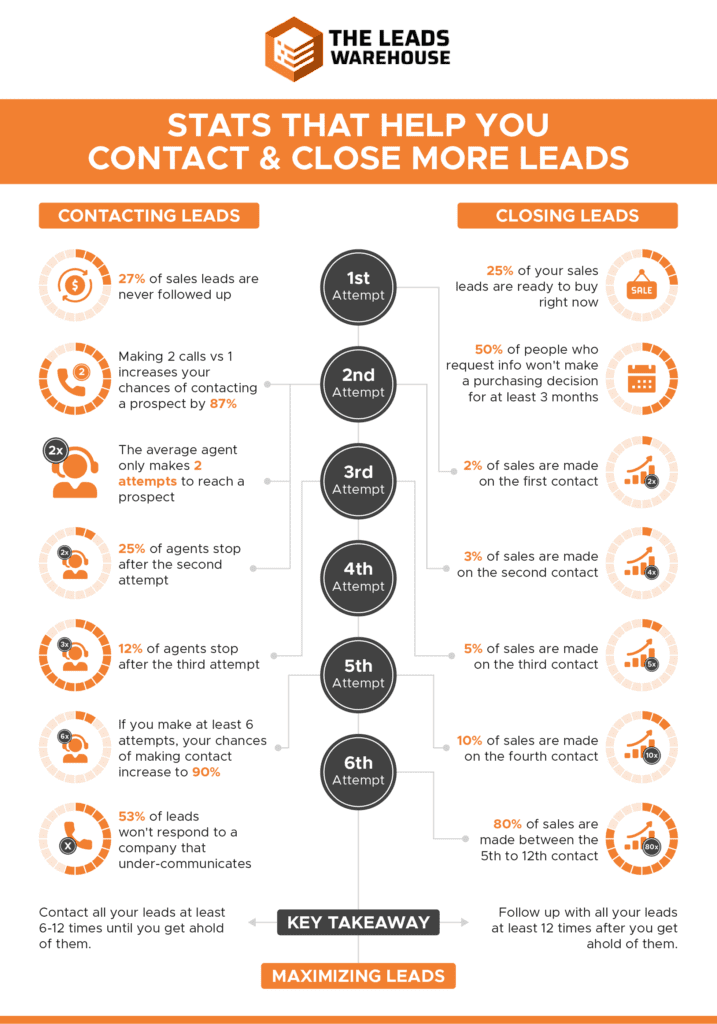
Read that last stat again and let it sink in. 80% of sales are made between the 5th and 12th contact.
This completely dismantles the myth of the “one-call close.” The first four contacts yield a combined total of only 20% of your revenue. If your team is giving up after two or three attempts, you are intentionally missing out on the vast majority of your potential market.
What does this tell us? It tells us that while 25% of your sales leads might be ready to buy right now, and another 50% will take at least 3 months to decide, the deal itself lives and dies on the relentless, systematic execution of the sales call. Marketing gives you the map, but persistence is the vehicle that actually gets you to the destination.
The other point to ponder, subtle but significant, is the value of aged leads. If 27% of leads are never followed up on, a leads file of 10,000 aged leads gives the lead buyer 2700 fresh, uncontacted opportunities. This is a huge value play.
We have all met that one arrogant sales rep who brags about their legendary “one-touch closes.” They boast about walking into a room or picking up the phone, delivering a flawless pitch, and walking away with a signed contract on the spot. It looks like magic. It feels like pure talent.
But it’s an absolute illusion.
What those salespeople completely fail to realize is that they aren’t actually closing the deal on a single touch. By the time they pick up the phone, they are usually the seventh-plus salesperson that the consumer has spoken to.
Before that rep ever uttered a single word, the buyer had already been targeted by deliberate marketing campaigns. They saw a digital ad, browsed a website, skimmed a printed product catalog, read an educational article, and perhaps even fielded a couple of introductory calls from your competitors who eventually dropped the ball. The consumer didn’t miraculously decide to buy on a whim because of a smooth 10-minute pitch; they were steadily guided down the purchasing funnel by an ecosystem of marketing and prior outreach.
When you get a “one-touch close,” you didn’t do all the heavy lifting yourself. You simply reaped the rewards of a long, interconnected chain of touchpoints. You opened the jar of sauce after 6 other people in the kitchen loosened the lid.
When Ed Sanders walked out of the Drake Hotel in 1996, he wasn’t proving that marketing was useless. He was proving that a marketing plan without a relentless execution strategy is just a stack of overhead transparencies. He understood that the real magic doesn’t happen in the corporate boardroom during a presentation; it happens on the pavement and on the phone lines.
If you are relying solely on inbound forms, automated email sequences, or social media impressions to hit your revenue targets, you are leaving 80% of your money on the table. Marketing sets the stage and creates the opportunity, but it cannot carry the weight of a lazy sales process. You need both wheels turning to move the wagon forward.
The key takeaway here is simple and non-negotiable:
Contact all your leads at least 6 to 12 times or until you get in touch with them. Then, let them age naturally to cool down, and go back after them.
Follow up at least 12 times after you make that initial contact.
Stop waiting for the perfect campaign, the perfect market conditions, or a magical influx of effortless inbound sales. Marketing has done its job by opening the door—now it’s time for you to do yours. True sales professionals don’t wait for business to happen; they go out and grab it.
Marketing has done its job by opening the door. Now it’s time for sales to do theirs.
Thanks for reading! This post is public, so feel free to share it.
What has been more important to your success: better marketing or better sales execution?
No posts
Comments
Nothing yet. Say the first thing.
Sign in to join the conversation.