
Most people pick up their smartphones, tap a contact, and expect a voice to appear on the other side within seconds. It feels instantaneous, almost magical. But beneath that simple user interface lies a massive, multi-billion-dollar labyrinth of physical infrastructure, digital handshake protocols, and an escalating technological warfare between major carriers and automated dialers.
Many business owners falsely believe the same logic follows for their B2C phone calls. The complexity and laws surrounding a business-to-consumer call are staggering. To grow revenue, a business makes more sales phone calls. And, to know whom to call, the business buys leads. As the call rate increases, the implications on the business’s ability to connect calls is astounding. The business owner and sales manager don’t realize this, thinking the leads are bad because connections go down. They think the sales team is poor at converting. The result, the business owner throws more effort into more calls, not realizing the telephony abyss that has been entered. In the attempt to raise revenue through more phone calls alone, revenue drops because the business owner does not realize their caller IDs are ruined, and calls are simply not connecting. The leads are great. The salespeople are dialed. The phone system is a literal dumpster fire.
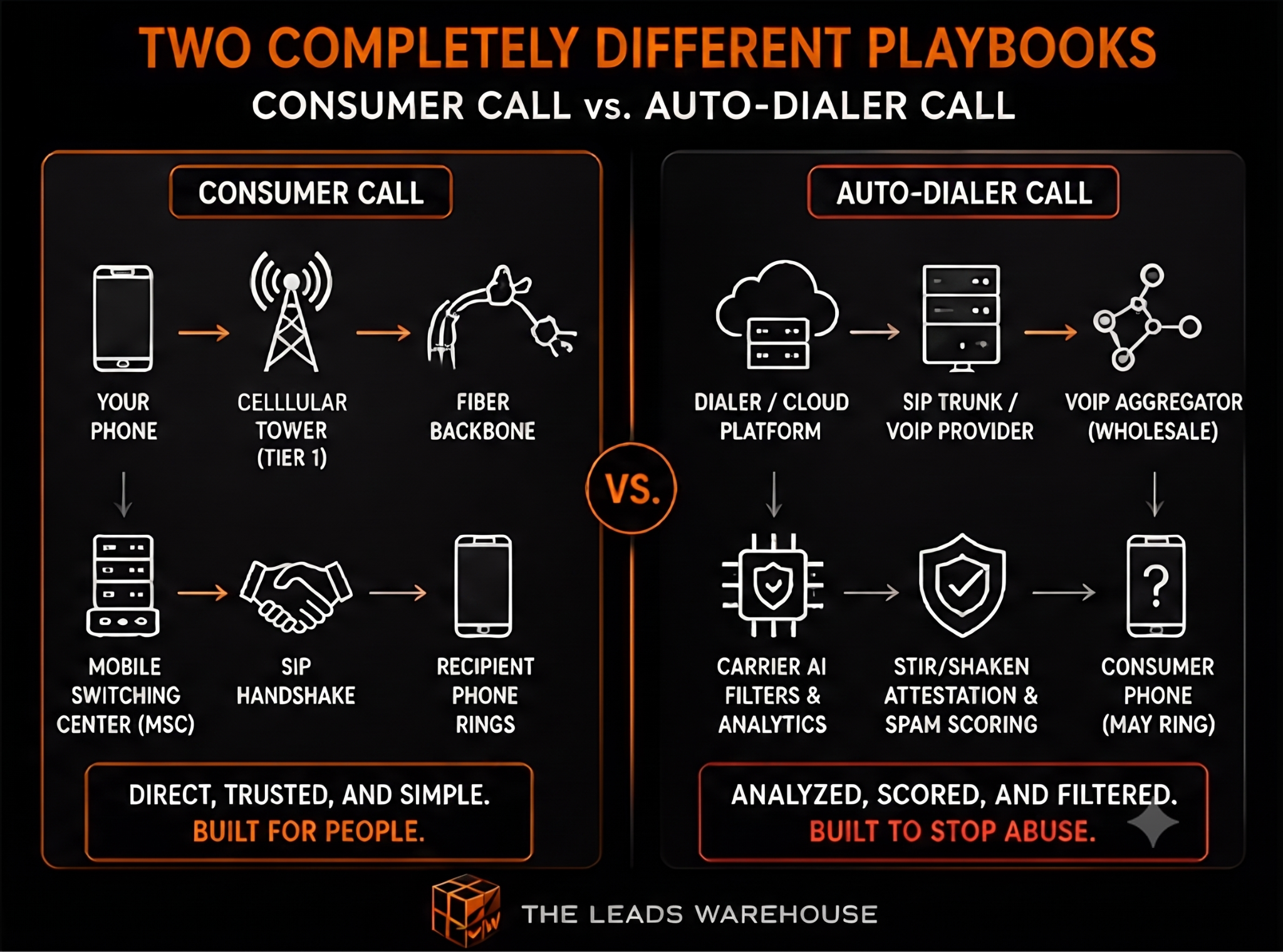
Whether you are a consumer making a casual call or an enterprise auto-dialer blasting out millions of automated alerts, the phone system treats your traffic through two entirely different playbooks.
Here is exactly how the global phone system works under the hood and what a business owner needs to know about their phone system.
To understand how a consumer call travels, you first have to understand who owns the digital highways. The mobile ecosystem is strictly divided into a three-tier hierarchy based on hardware ownership.
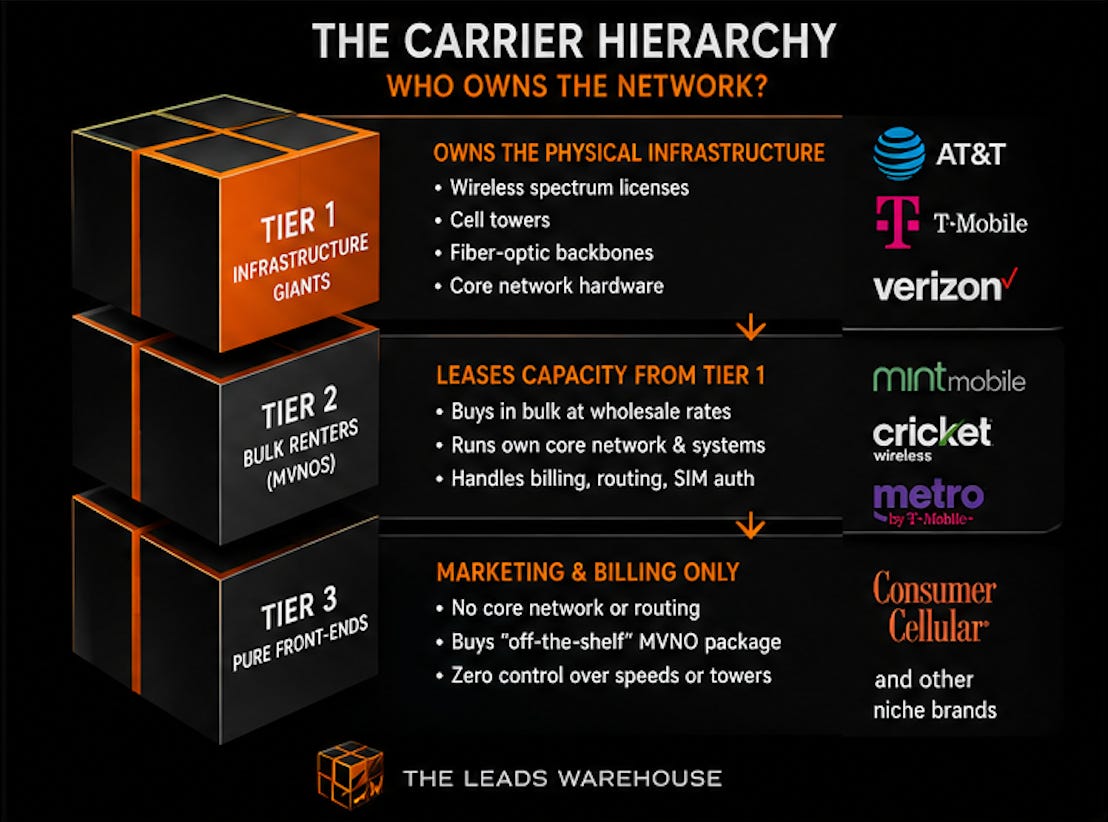
The Big Three—AT&T, T-Mobile, and Verizon—are the lords of the physical realm. They own the actual physical infrastructure. This includes the massive wireless spectrum licenses (the invisible radio frequencies purchased from the government), the hundreds of thousands of cell towers dotting the country, and the underground fiber-optic backbones that connect cities. When you pay them, you are paying for direct access to their hardware.
MVNO stands for Mobile Virtual Network Operator. Tier 2 carriers do not own cell towers. Instead, they buy network capacity in massive bulk from the Big Three at wholesale rates and resell it to consumers at a discount.
Examples include Mint Mobile (owned by T-Mobile), Cricket Wireless (owned by AT&T), and Metro (owned by T-Mobile).
While they use Tier 1 towers, Tier 2 operators are sophisticated enough to run their own core network backend systems. They handle their own customer data routing, SIM card authentications, and billing architectures.
The Catch (Data Deprioritization): Because MVNOs are tenants, Tier 1 carriers protect their own direct customers. During times of heavy network congestion—like a packed football stadium or a crowded downtown core—Tier 1 contracts dictate that true AT&T or Verizon customers get data priority. The Tier 2 (Mint or Cricket) user’s speeds will be intentionally slowed down (”throttled” or “deprioritized”) to keep the primary lines clear.
These are smaller, highly specific MVNOs like Consumer Cellular or local prepaid brands. They rarely own any backend systems or routing infrastructure at all. They are essentially marketing and billing storefronts. They purchase an “off-the-shelf” MVNO package from a Tier 1 or Tier 2 provider, slap their logo on it, and market it to specific demographics (such as seniors). They have zero control over data speeds, routing, or towers.
When you dial a number on your smartphone, your call is converted from sound waves into digital packets, navigating a strict protocol to connect:
The Airwaves to Fiber: Your phone converts your voice into digital data packets and beams them over radio waves to the closest Tier 1 cell tower. The tower instantly dumps that wireless signal into underground, high-speed fiber-optic cables.
The Mobile Switching Center (MSC): The call travels via fiber to a regional MSC—the brain of the carrier network. The MSC looks at the dialed number and determines if the target phone is on its own network or a competitor’s.
The Inter-Carrier Handshake (SIP): If you are on Verizon and call a friend on T-Mobile, Verizon’s MSC connects to T-Mobile’s network using SIP (Session Initiation Protocol).
SIP is the modern internet protocol standard used to establish, manage, and terminate real-time voice, video, and messaging sessions over IP networks. Think of it as the universal digital language that allows different telecom networks to talk to each other.
T-Mobile’s network receives the SIP request, verifies the current location of your friend’s phone via their nearest tower, and commands the handset to ring.
When a call arrives on a consumer handset, the screen displays a phone number and often a text name. This relies on two completely separate mechanisms:
The Number (ANI): Automatic Number Identification passes the raw billing phone number along with the call routing data. You cannot block or mask this from the network layer; carriers require it to route and bill the call accurately.
The Name (CNAM Lookup): The receiving carrier takes that incoming ANI number and queries a centralized database known as the CNAM (Calling Name) database. If a caller paid to register their business or personal name with their original carrier, it sits in this directory.
The Caching Problem: CNAM databases charge a fraction of a cent every time a carrier queries them. To cut operating costs, many consumer carriers do not query the database live for every single call. Instead, they “cache” (store) old data locally. This is why if you change your name, update your business entity, or acquire a new number, your friends or clients might see an old, incorrect name on their caller ID for weeks until their carrier’s cache finally expires and refreshes.
Automated dialers—used for everything from legitimate school closure alerts and bank fraud notifications to relentless spam and telemarketing—operate on a completely different architectural framework. They completely bypass cell phones, SIM cards, and wireless towers. They are purely software-based infrastructure hosted in data centers.
Instead of buying cell phone plans, an auto-dialing operation runs software servers (like Asterisk or FreePBX) inside cloud environments. These servers hook directly into the telephone network via VoIP (Voice over Internet Protocol) Aggregators or Wholesale Telecom Providers (the Tier 2/3 wholesalers of the business world, such as Twilio or Bandwidth).
To bridge the internet with the traditional public telephone network, these servers utilize a technology called SIP Trunking.
SIP Trunking Defined: In traditional telephony, a “trunk” was a physical bundle of copper wires running into a building. A SIP Trunk is the modern, virtual equivalent. It is a digital pipeline provided by a wholesale telecom company that allows an internet-based phone system (VoIP) to send thousands of digital voice channels simultaneously over a single internet connection, bypassing physical lines entirely.
Wholesale VoIP aggregators buy massive millions-of-minutes capacity packages from Tier 1 carriers and resell them to high-volume dialers. They maximize efficiency using LCR (Least Cost Routing). LCR is an automated software algorithm that evaluates the destination of an outbound call and instantly fires it through whichever global telecom pathway happens to be the fraction-of-a-cent cheapest at that exact millisecond.
No private company truly “owns” a phone number permanently. Numbers are a finite public resource managed under a strict custodial chain:
An auto-dialer company does not go to a retail store to get a number. They log into a wholesale carrier’s web portal or use an API to instantly lease thousands of local numbers, known in the industry as DIDs.
DID (Direct Inward Dialing) Defined: A DID is a standard telephone number assigned to a VoIP system. It allows an outside caller to dial a number and route directly to a specific digital extension or software server without needing a physical receptionist. In the auto-dialing world, DIDs are simply the outbound caller ID numbers used to mask the data center origin.
Because phone numbers are scarce, they are relentlessly recycled. If a shady telemarketer or scammer leases a batch of 5,000 DIDs and burns their reputation, they eventually abandon them. The wholesale provider puts those numbers into a “cooling off” period—often as short as 30 to 90 days—before relisting them for lease.
When a completely legitimate business comes along and buys those “fresh” DIDs for customer support, they are hit with an immediate roadblock: their outbound calls instantly display as “Spam Likely.” This happens because the major Tier 1 carrier spam algorithms and third-party safety apps never cleared the negative reputation tied to that number from its previous owner.
Tier 1 carriers protect their consumer networks by running inbound wholesale traffic through rigorous machine-learning filters. If an auto-dialer wants its calls to actually ring on a consumer’s phone, it has to defeat these automated metrics:
Short Duration Calls: If a server fires off 20,000 calls and 95% of them last under 15 seconds, it implies no human conversation is happening. The system is either hitting voicemails or being immediately hung up on.
Call Completion Rate (CCR): The statistical ratio of answered calls to unanswered calls. Real humans have a high CCR because they call people they know. Auto-dialers have an incredibly low CCR because they dial cold or scraped lists.
ASR (Answer Seizure Ratio): This tracks the sheer volume of call attempts trying to connect simultaneously from a single digital source.
To stop scammers from spoofing trusted numbers (like pretending to call from your local bank), the telecom industry implemented a cryptographic framework called STIR/SHAKEN.
When a call is placed via VoIP, the originating carrier must digitally “sign” the call with a certificate of verification, known as an Attestation Level:
A-Level (Full Attestation): The carrier confirms they know exactly who the customer is and certifies that the customer has the legal right to use that specific phone number.
B-Level (Partial Attestation): The carrier knows who the customer is, but cannot verify if they actually own the number they are displaying.
C-Level (Gateway Attestation): The carrier is simply passing the call along from an international gateway or another obscure third-party network. They have no idea who the caller is or if they own the number.
If an auto-dialer sends a call with a C-Level Attestation combined with poor traffic metrics (low call duration, low CCR), Tier 1 algorithms instantly intercept the packet and stamp “Spam Likely” or “Scam Likely” on the consumer’s screen.
To keep their call centers alive, auto-dialer managers employ highly advanced technical workarounds. In response, carriers have built silent, devastating countermeasures.
To avoid triggering the “Short Duration” or volume alarms on a single number, dialers use automated rotation software:
Strict Call Caps: They limit each individual DID to a strict maximum—often no more than 50 to 100 calls per day.
Snowflaking: The dialer system rotates through a massive pool of thousands of numbers. It makes 5 calls from DID #1, 5 calls from DID #2, and spreads the traffic so thin across the country that no single number raises an alarm.
DID Resting: Once a number hits its daily cap, the software “rests” it for 24 to 48 hours to cool down its footprint and mimic natural human behavior.
Dialers eventually realized that even if they bought 20,000 pristine numbers, their calls were still getting flagged. This is because Tier 1 carriers do not just track numbers; they track the originating IP Address.
When SIP trunking traffic passes from a data center into AT&T or Verizon’s network, the digital packet headers reveal the IP address of the underlying server. If Verizon’s security AI sees 100,000 call attempts originating from a single IP address within an hour, the DIDs become irrelevant. The carrier flags the source IP itself. Once an IP is blacklisted, every single phone number routed through that server is instantly penalized, flagged as spam, or dropped entirely. To counter this, advanced auto-dialer operations must constantly lease proxy networks, rotate their server IP addresses, and split their voice traffic across entirely different geographic data centers.
Telecom companies and cybersecurity firms fight back using massive nets called Honey Pots. These are networks consisting of millions of unlisted, “dead” phone numbers that belong to absolutely no one.
Because these numbers are completely dark and unlisted, a human would never accidentally dial them. Therefore, any inbound call to a honey pot is guaranteed to be an automated machine scraping numbers or dialing randomly. The second an auto-dialer hits a honey pot number, the carrier instantly grabs the originating DID, the wholesale routing path, and the underlying server IP address, pushing an immediate blacklist update across the entire national network.
If a carrier completely blocks a bad dialer, the auto-dialer’s software immediately detects the “disconnected” or “busy” error code. The dialer then knows that its DID or IP is burned, prompting it to switch to a fresh batch of numbers.
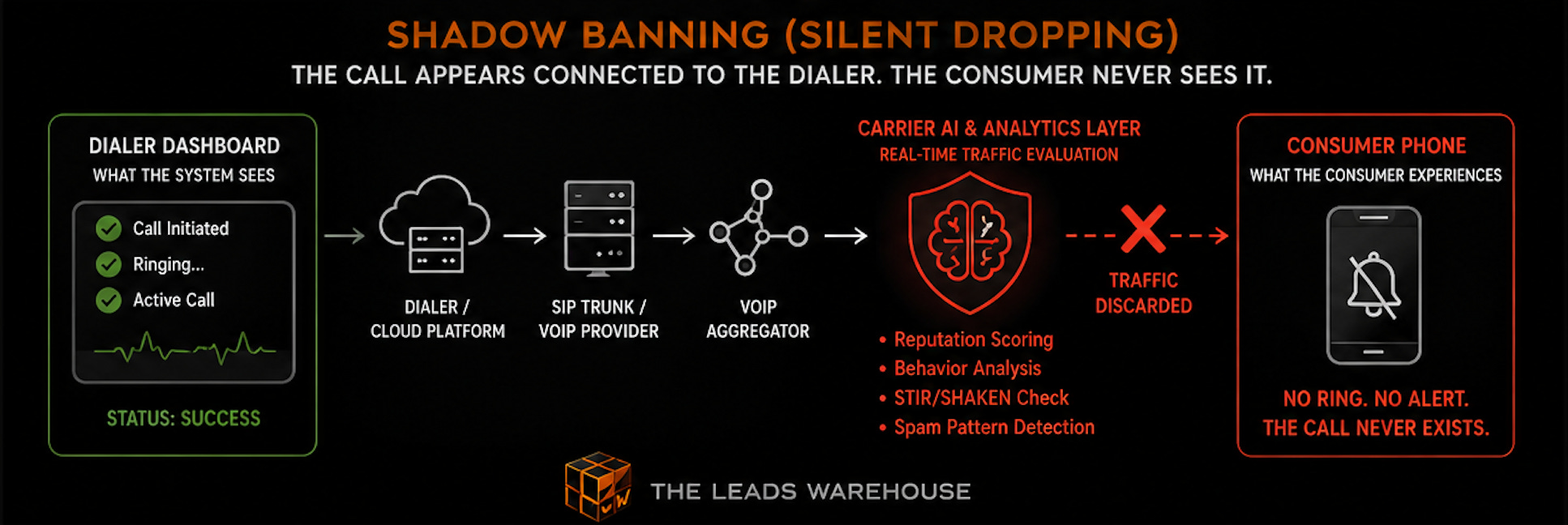
To counter this, carriers use Shadow Banning. Instead of blocking the call or sending an error code, the carrier allows the call to look like it is connecting normally on the dialer’s software dashboard. The dialer’s system sees a status of “Ringing,” consuming their server bandwidth and keeping their channels tied up. However, on the consumer’s end, the phone never actually rings. The carrier silently discards the audio packets, bleeding the dialer’s operational resources dry on empty, phantom connections while protecting the consumer in total silence.
As a leads provider, the number one issue I hear is “the leads don’t work”. It is a categorical rejection of lead quality. The first question I will have of the client is “tell me about your DID management”, and in at least 50% of cases, the client will ask “what is a DID”.
I’m sympathetic to the plight of a modern sales agency. Getting a consumer on the phone is more difficult than ever, and the very actions a company can take to increase revenue - make more phone calls - can be the biggest revenue killer. A company can quickly be caught in a vicious vortex of lower connection rates, creating fewer new opportunities. The traditional and obvious fix is to buy more leads and make more phone calls. But the difficulty is that the fix makes the problem worse.
A telemarketing sales team can be doomed without knowledge of today’s telephony rules.
So, the system can seem stacked against a business, but it is not. It is stacked against spammers and uninformed sales floors. In today’s world, to win deals, surface-level work will not get the job done. Let this article be a call to action to get control of the telephony world and turn leads into deals.
How are you handling your telephone infrastructure? Do you have a handle on your tech, or is your tech running you? Leave a comment below.
No posts
Comments
Nothing yet. Say the first thing.
Sign in to join the conversation.