
A while ago I encountered the following story:
1804. A young English sailor who had escaped from a prison in the interior of France, had succeeded in reaching the coast near Boulogne. Here he made a little skiff, miserably frail, of the branches and bark of trees. This bark he intended to cross the Channel in.
“Did you really intend,” Napoleon said, “to brave the terrors of the ocean in so frail a skiff?”
“Yes,” said the young man, “with your permission I will embark immediately.”
“Have you a sweetheart at home,” asked Napoleon, “that you are so desirous to go to your country again?”
“No,” replied the lad, “but I wish to se my mother, who is aged, poor and infirm.”
Napoleon’s heart was touched. “You shall see her,” he answered, “and give her this purse of gold from me. She can be no common woman to have brought up so good a son.”
A little research informed me that this was a well-known story in the nineteenth century with many versions circulating. Thomas Campbell wrote a poem about it, and in 1908 it was even made into a short film. From the fact that the story is still going around the internet, it has not lost its power.
Is the story true? It might be, though I wouldn’t bet on it. Napoleon was in the area around Boulogne at the time, preparing for an invasion of Britain that never happened. For my purpose here, the truth or lack of truth of the story doesn’t matter.
The story portrays Napoleon in a positive light. He is magnanimous to a man whose courage and love for his mother he respects, even as an enemy. There are many such stories about Napoleon, and by pure statistical probability at least a few of them must have been true. He was certainly a courageous man who also respected courage in others. That is admirable.
But let us not forget his legacy of massive bloodshed. At least three and quite possibly six million people died in the Napoleonic wars, and the name gives a clue as to who was responsible. It is hard to find excuses for Napoleon’s actions, except his lust for glory and power. You do not march your armies over Italy, Egypt, Germany, Spain and Russia for two decades by accident or without knowing the consequences. Napoleon easily betrayed the republican ideals of his youth to crown himself emperor in the same year the above anecdote supposedly took place. As the Swedish poet Esaias Tegnér (in his youth an admirer of Napoleon) allegedly said: “May he suffer in childbirth for everyone he killed!”.

Yet this is easily forgotten when we hear about Napoleon’s kindness to the British sailor. Why?
I believe that it has to do with the vividness of one action and the abstractness of the other. We humans are limited creatures, evolved for life in small tribes of about 150 people. The world of friends, rivals, cousins, siblings, fathers and mothers. These are relations we understand instinctively.
But anything above is just abstractions. The mind adapted to the tribe cannot truly comprehend the death of millions. The best we can do is to convince ourselves that we do. Cities, countries, economies and empires can be understood intellectually, but not instinctively. As Stalin is often quoted as having said: “The death of one man is a tragedy, the death of a million is a statistic”.
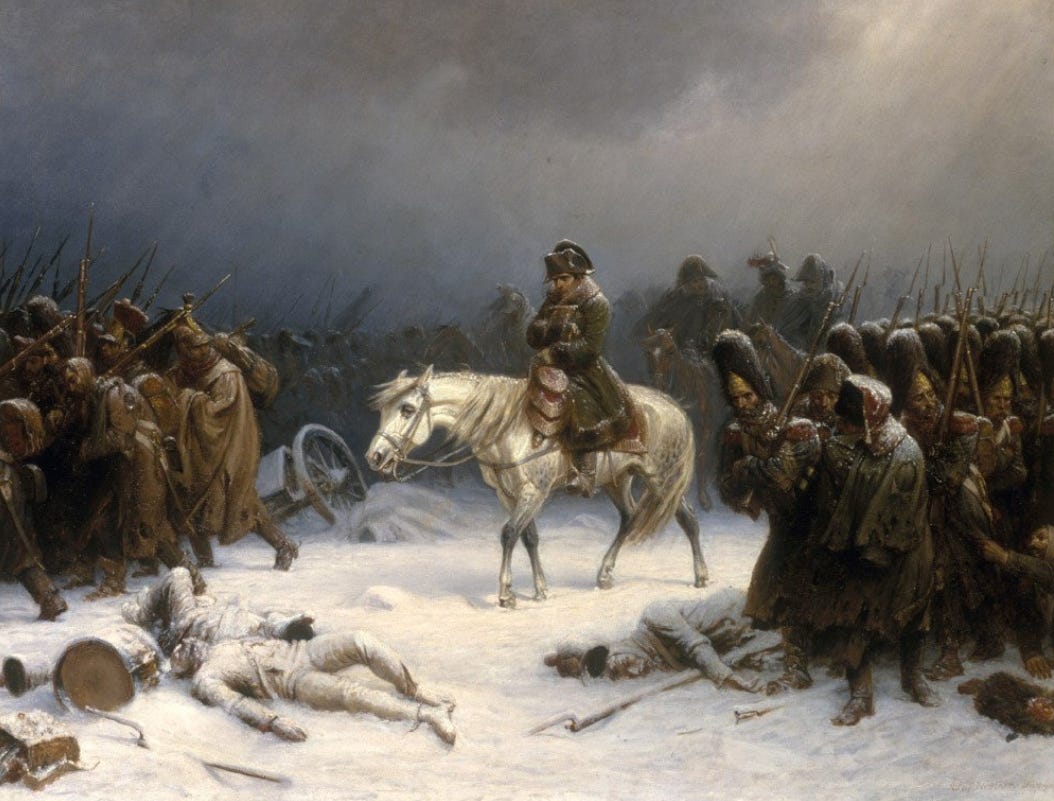
Thus, in our minds, a single concrete act of kindness can outweigh the most enormous crimes. We punish murderers with life in prison, but a corrupt politician who has wasted money that could have saved thousands of lives gets off with a few years. Similarly, too many of us happily support Communist dictatorships in faraway lands. Piles and piles of bodies are easily forgotten when we see the man responsible hug his daughter.
Suitably enough, the French have a phrase for the kind of magnanimous action that so impresses us: “Beau geste”. Collins English Dictionary defines it as “A noble or gracious gesture or act, especially one that is meaningless”.
Jakob Sjölander
Do you know someone who likes Napoleon? Or who doesn’t? Then:
No posts
Comments
Nothing yet. Say the first thing.
Sign in to join the conversation.