
Some of the most basic questions are also some of the hardest. For instance – who is skilled? This is of fundamental importance to us humans. We constantly strive to be skilled, to associate with skilled people, and if we fail to live up to our own standards, we are devastated.
This text was partly inspired by something I wrote about Donald Trump a few weeks ago. That text made certain people angry, though for different reasons. Some thought it was obvious that Donald Trump was an idiot, and that I was an idiot too for not seeing that. Other people thought it was obvious that Trump was a genius, and that I was an idiot for not seeing that. Considering that the point of that piece was that skill is hard to judge, that was a good reaction.
See also: Is Trump a genius 4D-chess player? - by Jakob Sjölander
At its core, skill is the ability to do something well, to be good at something. Someone who is skilled can do things the unskilled cannot, or at least do them with a higher success rate.
But who is skilled? Sometimes this is easy to tell. In sports, for instance. But in other fields it is harder to identify skill. And in the modern world, those fields have seemingly become the most profitable.
For instance, being an idiot on the internet. Today it seems that half the world’s population are influencers in Dubai, making TikTok videos about cats for the other half of the world’s population to ogle at.

This is undoubtedly a skill, as demonstrated by the many people who fail to succeed in this cutthroat business. But often it is very, very hard to tell exactly what this skill is about. Being interesting is hard, and while there are many ways to be interesting, there are apparently many more ways to be uninteresting. Often, the skill of influencers seems to be selling their spectacular lack of skill.
Perhaps I am moralizing. But moral ideas do have a great influence on how we judge people and their skills. Think of the “good thief”, or the “good mobster” or the “good terrorist”. They can be very skilled, but these are skills most people would prefer not to have. For instance, ruthlessness, contempt for the law, and lying.
There is also the excellent example of the many martial arts with the emphasis on the “art”. It is just a fact that most venerable martial arts, such as aikido and tai chi, are mostly useless against modern martial arts with a real sparring component, such as MMA or Brazilian jiu-jitsu.
See also: The Bizarre World of Fake Martial Arts - YouTube
But this is not quite the same as venerable tai chi masters lacking skill. They are very good at what they do. It is just that what they are really good at isn’t what they (sometimes) claim. They are skilled dancers rather than skilled fighters.
Similar problems occur in all fields, such as finance. In his book Antifragile, Nassim Nicholas Taleb presents the “Green lumber fallacy”. He retells the story of one of the most successful green lumber traders who is so ignorant of green lumber that he thinks it is lumber painted green, rather than lumber that has yet to dry. It turns out that knowing stuff about actual green lumber is not necessary to trade it, or even very useful. The green lumber trader’s skill lay in other things.
Consider also the case of Brigitte Bardot, the famous actress and sex-symbol of the 60s. President Charles de Gaulle is supposed to have said that she was a French export just as important as Renault cars.
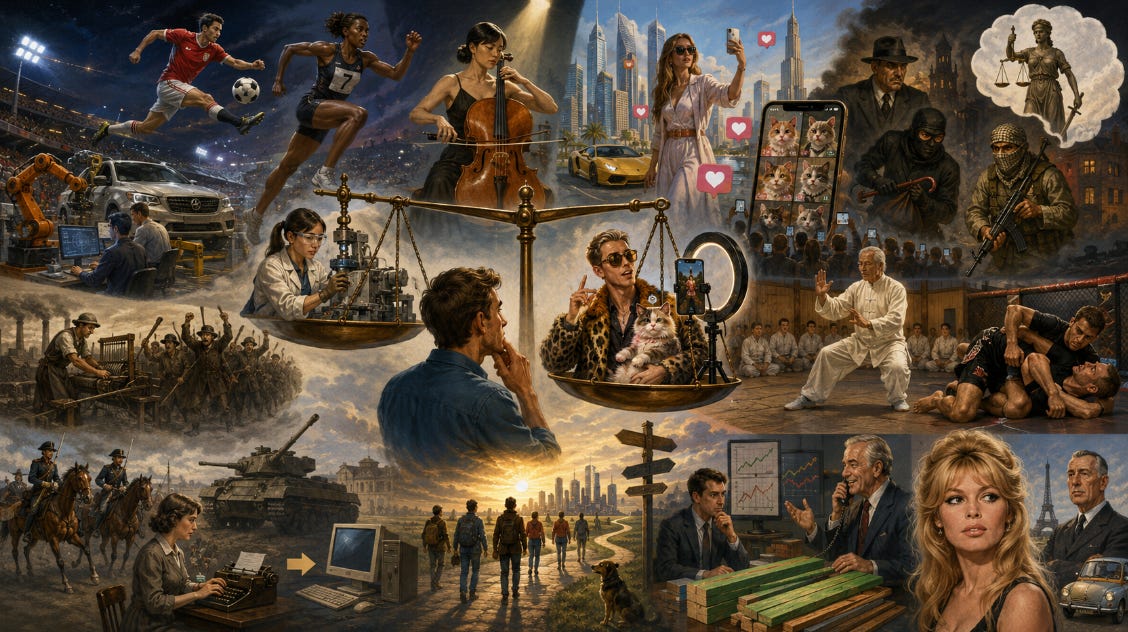
The examples could go on. But this shows how hard it is to define skill, and the kind of mistakes we might make if we try to develop it. The skill of Renault’s engineers and factory workers is easier to see than Bardot’s, which would certainly have been missed by “rational” economic planners.
We just cannot know what skills will be needed in the future. Furthermore, it will constantly change. In a quickly changing world, we do not want to be stuck with the wrong kind of skill, no matter how impressive these are.
Technological change provides infinite examples. Since the first textile workers rebelled against mechanization in the Luddite rebellion of 1811, technology has made many skills obsolete. Consider cavalrymen being replaced by tanks, or secretaries replaced by computers, or the millions of people who now worry about being made obsolete by AI. All of these are justifiably angry that their genuine skills are no longer worth anything. But it doesn’t change facts. Like the proverbial caravan, the world moves on, though the dogs bark.
How do we handle this as a society? We handle it by not handling it. By doing nothing. We have to let people live their lives in freedom, to try new things and new ideas. This is the great advantage of capitalism and freedom over totalitarian systems.
Unfortunately, this is very hard to do. Creative destruction, as economists call it, is a horrible thing. Our desire to be fair, to rationalize, to be kind, gets in the way. It is too easy to lie to ourselves and convince ourselves that those with “merit” should rule and be rewarded. Usually, that just means replacing those who are good at doing with those who are good at talking.
Jakob Sjölander
Word the spread! ;-)
No posts
Comments
Nothing yet. Say the first thing.
Sign in to join the conversation.