
History is cruel in its neglect and forgetfulness, and even people who were legends in their lifetimes soon fade into nothing. Sometimes they are remembered for some oddly obscure achievement.
This is true of the swede Thomas Thorild, who between 1759 and 1808 was a poet, critic, philosopher and proto-feminist. Favored by the king, he was a great intellect who supposedly put his brilliant doctoral thesis together in a matter of hours. But today he is mainly remembered for some obscure words carved into the doorway to the auditorium of his alma mater Uppsala University:
Thinking freely is great
But thinking right is greater
(Sometimes translated as “To think freely is great, but to think rightly is greater”. In the original Swedish: “Tänka fritt är stort men tänka rätt är större”).
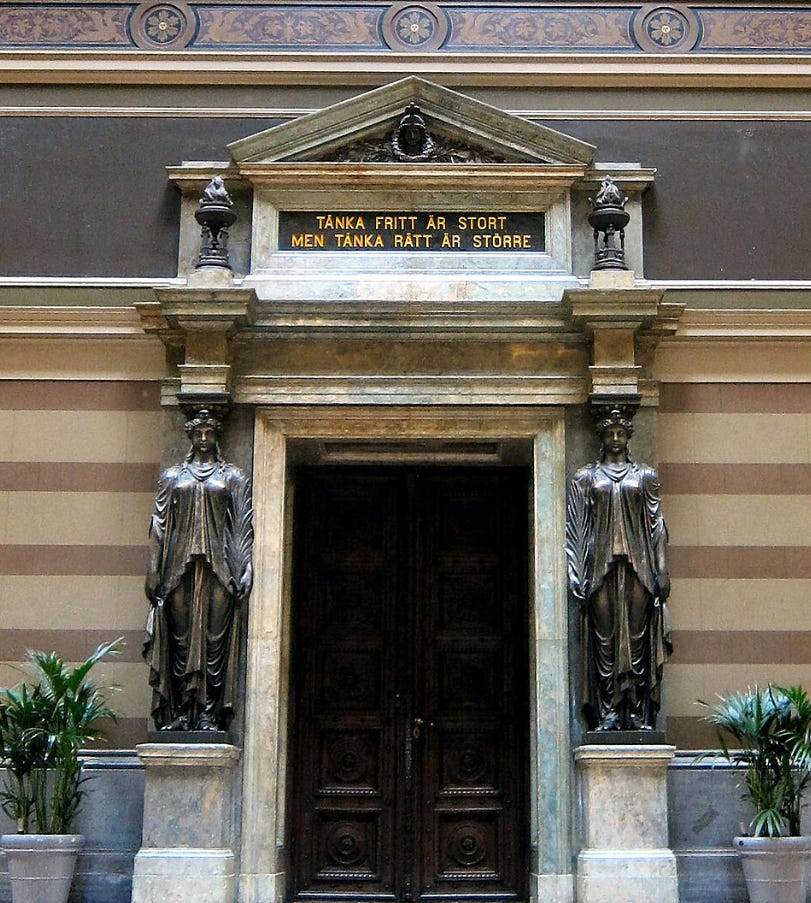
While Thorild himself is largely forgotten, people still wonder at these words. Or more correctly, wonder about them…
To some, the words are a call to conformity. People should stop thinking for themselves, and just do what is “right”. Which is whatever the state, the professors or the media tells them is right.
To others, it is a call to rigor. Free thought, creativity and originality are indeed great things. But if they lose all connection with what is right and true and good it turns into error. Perhaps harmful errors.
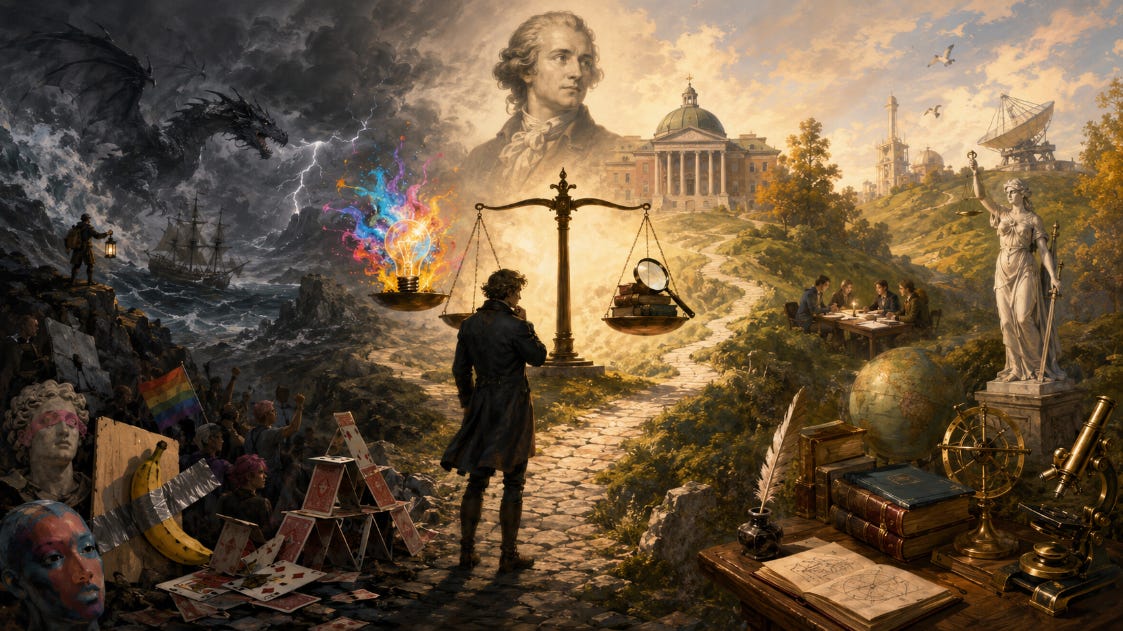
What did Thorild himself mean? Nobody knows, and while one may speculate, it will never be perfectly known. But that doesn’t mean we can’t learn from him.
The words capture an eternal struggle of all science and scholarship – the conflict between creativity and correctness. These are always in tension. This is because all learning, discovery and exploration as a matter of definition means heading into the unknown and uncontrollable chaos. This is dangerous. “Here be dragons”, as the ancient mapmakers wrote in the blank spaces.
If we only wanted to be right, we could be so by never taking any risks. Mathematicians might do nothing but add 2 and 2 together and get 4, over and over again. But whenever we depart from that safety, whenever we leave home literally or metaphorically, we take a risk. The risk of error.
This makes creativity hard. But that only applies as long as we stick to high standards. If we didn’t worry about being right, we could build the most fantastic house-of-cards of ideas and thought – postmodernism is a great example of this both in academia and art. That is what happens when we cut all moorings to reality, and make what we want the only measure of success. That is how we end up with a world where men can be women, where a banana duct-taped to a wall can be art, and where everything is oppression by the racist cis-heteronormative patriarchy.
If we cry “yes!” to everything, we will be right about everything which is true. But we will also be wrong about everything that isn’t true. It is also possible to err on the side of caution, where we say “no!” to everything except that which is absolutely certain. That cripples our ability to expand the field of certainty. The challenge of seeking truth, as a scientist, scholar, journalist, detective, politician or a regular person, is to find a balance between “yes!” and “no!”. We should be open-minded, but not so open-minded that our brains fall out.
No matter how great freedom is, it must still be below the good, the true, the just and the beautiful. Freedom is valuable, but it is not valuable in itself. Instead it is what allows us to quest for truly good things. If we make freedom our only goal, we give ourselves, our wishes and our desires an importance we are not worthy of. Ultimately, whilst freedom is a great thing, being right is greater.
Jakob Sjölander
Share with someone you care about.
No posts
Comments
Nothing yet. Say the first thing.
Sign in to join the conversation.