
Note from Jay
In the last Leverage Economy article, you saw that growth doesn’t have to come from what you already own. You borrowed a resource that belonged to someone else — their audience’s trust, and put it to work.
That was your first move toward what I call the unlimited checkbook: the realization that the resources you need to grow are almost never sitting in your bank account, but they’re available if you know where to look.
When you start to see how easy it is to tap into Other People’s Resources with the right offer, it feels like you have an unlimited checkbook.
In this article, I’m going to share how you can use a resource we’ve talked about before — the lifetime value of your customer — to grow your business.
Does a slow week make you quietly pull back, kill the ad, skip the test, talk yourself out of the hire you know you should make?
Do you decide how hard to chase a lead based on what’s in your account this morning, not on what that lead is actually worth?
If you answered yes, the trouble is that you’re basing those decisions on your bank balance, when the real measure is what a customer is worth over their whole life with you: every repeat purchase, renewal, and referral, not just the first sale.
Once you can see that number, you can put it to work today, before the money even arrives.
After reading this, you’ll stop letting your bank balance dictate how fast you grow and start growing based on what your customers are actually worth. You’ll discover:
The $20-vs-$3,000 Error: Why a customer worth thousands gets treated like pocket change, and how the habit you’re proudest of (never overpaying to win a deal) is quietly capping your growth.
The Future-Funding Move: How to pay for growth out of your customer’s future value instead of the cash in your account.
The 90-Second Test: Three numbers from your last customer that reveal how much you can spend to win the next one and still profit.
Right now, every growth decision runs through the same filter: how much is it going to cost you today?
You see the move you should make: the ad, the test, the hire, the loss leader project that wins a bigger customer. Then you check your bank balance, see how far it would drop by making the move, and talk yourself out of it.
The careful instinct that keeps you safe is the same one keeping you small.
That careful instinct isn’t wrong, by the way.
You have bills to pay and people counting on you. Being careful with money is what got you this far. The problem isn’t the instinct. It’s what you’re being careful about.
Fifteen minutes from now, that filter is adjusted. You’ll know what a customer is really worth, the most you should spend to win the next one, and one move that pays for it without touching your savings.
For the first time the question isn’t “can I afford this?” It’s “why was I letting my bank balance make that call?”
Inside, you’ll find:
The number that ends the rationing: context that helps you see you might be spending a fraction of what you safely could to win a customer.
Why this stayed invisible to you: and why it has nothing to do with discipline or intelligence.
The figure that turns a big spend into a safe bet: so the move you’ve been flinching at starts to feel like the smart one.
Early in my consulting work, I sat down with two brothers who ran a fluid-transmission components distribution business on the West Coast. I’ll call them Sam and Paul.
They were good business owners. Careful with money. Disciplined to a fault.
And they were stuck.
The business had been sitting at break-even for years. Same revenue, same headache, same year end panic. Sam was certain the problem was cash: they couldn’t afford to chase new customers. Paul was certain the problem was staffing: they needed more salespeople.
They were both wrong.
They had six salespeople already, working on a flat 10% commission. The reps were busy. They were just busy with the wrong thing.
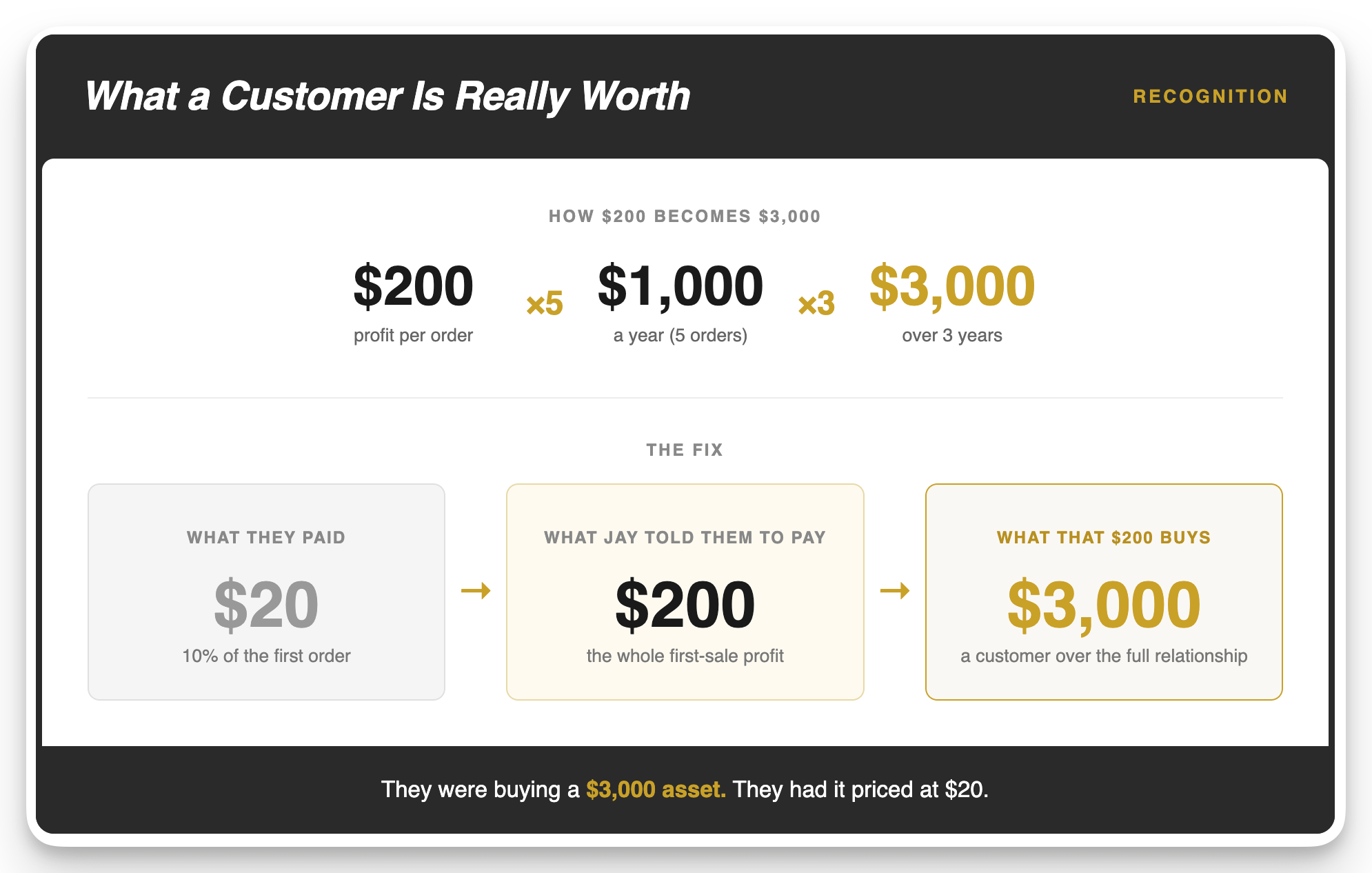
When I asked why the company brought in so few new accounts, the answer was just a math problem. A brand-new customer placed a first order worth about $200 in profit. At 10%, that paid the rep a $20 commission.
Twenty dollars.
For the work of prospecting, pitching, opening, and servicing a cold account, a rep earned twenty dollars, while a single afternoon babysitting their existing big accounts paid far more.
So the reps did the rational thing. They ignored new customers entirely.
Charlie Munger once said that if you showed him the incentive, he’d show you the outcome. Sam and Paul’s commission structure had one outcome built into it: ignore new customers.
As a result, new-customer acquisition didn’t just slow, it completely flatlined.
Now here’s the part the brothers were proud of, and it’s the part that was strangling them.
They had a counter-intuitive rule:
Never pay commission on profit you haven’t actually earned.
Never hand away margin on a first sale.
It sounded like discipline. It felt like prudence.
It was their growth handcuffs.
The very habit they considered their financial backbone was the thing capping the entire business.
Their prudence wasn’t protecting them. It was quietly suffocating them.
So I got them to try something I knew would push them outside their comfort zone. I asked them to run one number they had never run before:
What is a customer actually worth?
The average new buyer delivered about $200 in profit per order. They bought roughly five times a year. That’s $1,000 a year. They stayed about three years. Over a full relationship, a single new customer was worth roughly $3,000 in profit.
And that number wasn’t wishful thinking. Sam and Paul’s customers came back five times a year because the product was worth coming back to. The business had earned that loyalty. It just hadn’t done anything with it.
Not $20.
$3,000.
Sam ran it twice to be sure. “Three thousand,” he said, almost to himself. “We’ve been offering twenty dollars to bring in a relationship worth three thousand.”
Then he looked at me.
“We’ve been treating long-term clients like one-time customers.”
He finally understood the real problem.
He and Paul had never calculated what a customer was actually worth, so the entire commission structure was built around the wrong number.
The reps weren’t walking away from $3,000 relationships. They never even considered starting those relationships, because twenty dollars wasn’t worth the effort.
So I told Sam and Paul to do something that made them physically uncomfortable: give the reps the entire first-sale profit on every new account. All two hundred dollars.
Paul shook his head. “You want us to hand away two hundred dollars on every new customer? That’s our whole margin.”
“That’s your margin on the first sale, but the customer is worth three thousand.”
I gave him a few seconds to absorb that, then added:
“You’re buying a three-thousand-dollar asset for only two hundred.”
He didn’t love it. But they tried it.
Within weeks, the reps were fighting over new accounts. The thing they’d ignored for years suddenly paid real money. Funny what happens when you pay people for the right thing.
New-customer acquisition jumped roughly fivefold. The business tripled within six months. Not a dollar of new capital. The customers funded it themselves. The only thing that changed was which number they were basing their decisions on.
The Future-Funding Law: You don’t fund growth from the money in your account. You fund it from the value a customer will deliver over their whole life with you. That money hasn’t arrived yet, but you can still put it to work today.
Say a customer pays you $4,000 on a first sale. What would you spend to win them? $400? $500? Maybe even $1,000 if you were feeling bold?
Whatever number you just picked, you were probably looking at the margin inside that first $4,000. So you spend a little, and no more.
But here’s what a “short-term” person isn’t thinking about:
That customer buys from you twice more over the next two years. That’s three purchases, $12,000 from one relationship. Now suppose they refer one person who stays just as long. That’s another $12,000. A single customer just put $24,000 on your books. How much would you pay to acquire them then?
If you spent $2,000 to bring in $24,000, that’s less than ten cents on the dollar.
Future-funding isn’t a trick.
Even without a sales team, the move is simpler than it sounds: change how you pay for acquisition.
Give someone who sends you customers the entire profit from the first sale, when the repeat business more than covers it.
Hire a salesperson who only gets paid from the revenue they bring in, not a salary you have to cover before they’ve closed a single deal.
Make a first offer you barely break even on, when the customer it wins will come back for far more.
This isn’t a quirk of one West Coast distributor. It’s a pattern that shows up across industries and eras.
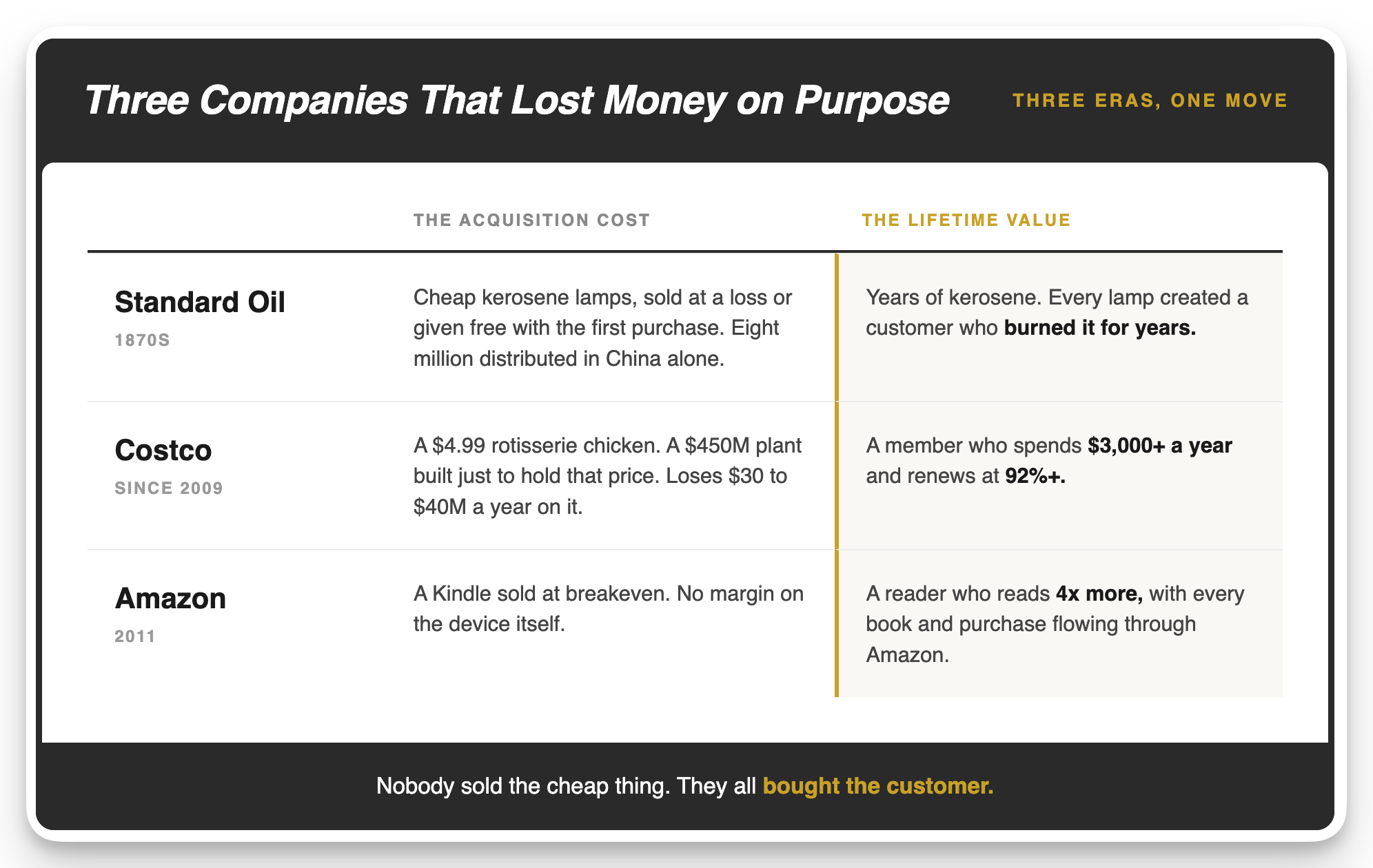
Standard Oil. In the 1870s, Rockefeller had a product the world needed, kerosene, but millions of potential customers had never seen a kerosene lamp. So he gave them away. Standard Oil sold hundreds of thousands of cheap lamps, sometimes handing them out free with the first kerosene purchase. In China alone, they distributed eight million.
The lamp was the acquisition cost. The kerosene was the lifetime value. Every free lamp created a customer who would buy kerosene for years.
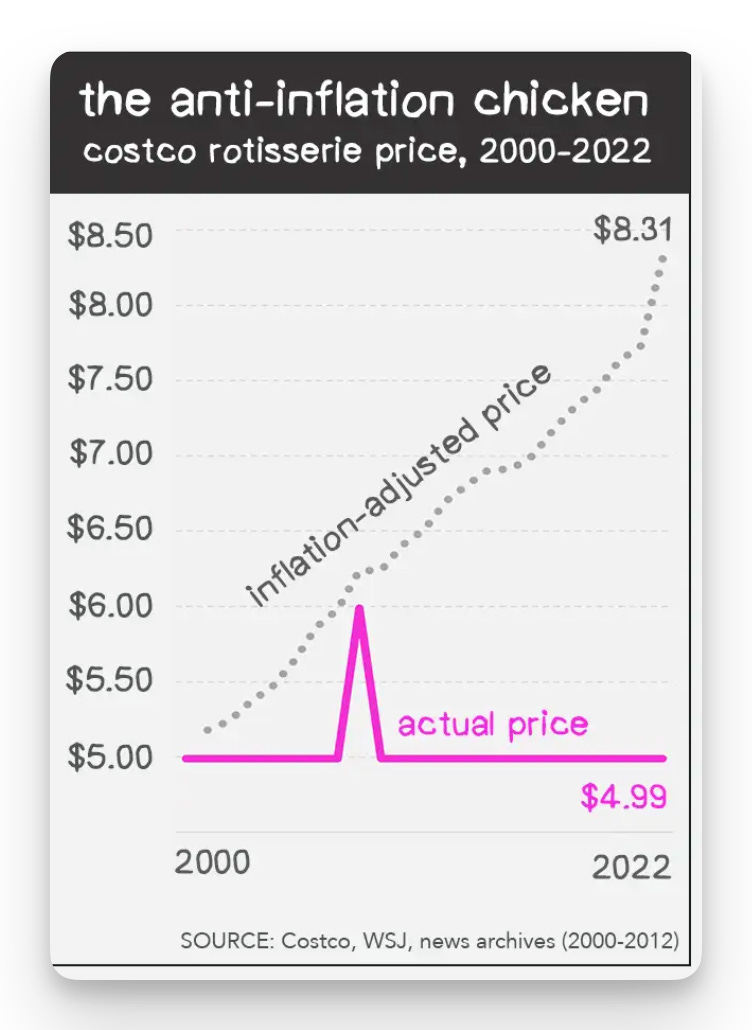
Costco. Since 2009, stores sold its rotisserie chicken for $4.99. Poultry costs have risen every year since. But rather than raise the price, Costco built a $450 million chicken processing plant in Nebraska to make sure they could keep it at $4.99.
Read that again. A $450 million investment to keep a $4.99 price tag. They lose an estimated $30 to $40 million a year on rotisserie chickens alone.
So, why do it?
Because the chicken is the acquisition cost. The membership is the lifetime value. Every $4.99 bird draws a member past hundreds of higher-margin products and keeps them coming back. The average Costco member spends over $3,000 a year. Their U.S. renewal rate sits above 92%.
Costco doesn’t sell chicken. They spend $4.99 per visit to keep a customer worth thousands.
Amazon. When Amazon launched the Kindle Fire tablet in 2011, analysts quickly discovered the company was losing money on every unit sold. In 2012, Jeff Bezos confirmed it: Amazon sold its Kindle devices at roughly breakeven. No margin on the hardware.
Bezos had a name for the strategy. He called it the Amazon Doctrine:
“We want to make money when people use our devices, not when they buy our devices.”
Same principle as Rockefeller, 140 years later. The Kindle was the acquisition cost.
The content ecosystem was the lifetime value. Once a customer owned a Kindle, they read four times more than they had before, and every book, movie, and purchase flowed through Amazon. A single device turned a one-time buyer into years of revenue.
Bezos understood something his competitors didn’t. While other companies made their money when you bought the device, Amazon made theirs every time you picked it up.
Same principle.
Kerosene lamps in the 1870s.
Rotisserie chickens in 2009.
E-readers sold at cost in 2012.
Every one of them was betting on the lifetime value, not the first sale.
What are you betting on in your business?
The competitor who’s outselling you isn’t smarter than you. They’ve just done one calculation you haven’t, and it changed every decision they make.
For example, once your rival knows a customer is worth $16,000, the first sale stops being their payday. They can break even on it. They can deliberately lose money on it.
And they’ll still win, because they’re buying a relationship while you’re pricing a transaction.
They’ll outspend you on the ad. Out-guarantee you. Offer the free trial you can’t justify. Pay to test the sales page you won’t touch. Extend the longer trial you think you can’t afford.
You see the first sale and decide what you can afford to spend. They see the full relationship and decide what they can afford to invest.
That’s why you keep losing to someone who’s playing a longer game. It was never about who had more cash. It was about who knew what their customers were actually worth. Rockefeller knew it in the 1870s. The only question is how long it takes someone in your market to figure it out.

Try this right now. Take 90 seconds and use your most recent customer.
Write down what that customer paid you on the first purchase.
Write down what they’ve paid (or will likely pay) over the full time they stay with you. Include repeat purchases and anyone they’ve sent your way.
Write down the most you’re currently willing to spend to acquire one new customer like them.
Let’s say your first sale brings in $500. Over two years, that customer spends $4,000 and refers someone who does the same. That one customer is now worth $8,000 to your business.
Now look at your third number. If you’ve been spending $100 to acquire that customer, you could have been spending $1,000 and still come out well ahead.
That gap between what you’ve been spending and what you could be spending is what I call your allowable acquisition cost: the maximum you can invest to win one customer and still profit.
If your third number is based on the first sale instead of the full relationship, you’ve just found the ceiling you’ve been putting on your own growth.
The 90-second test just showed you the gap. What it can’t give you is the specific move that closes it.
The Future-Funding Calculator takes your real numbers and works through them until you’ve got two things: a customer value you can defend, and one specific structure, matched to how your business actually works, that pays for growth out of future revenue instead of your cash.
Fifteen minutes. Put real numbers in, get a real plan out.
Your real customer-value number: built on conservative estimates, so you can pressure-check it instead of believing the optimistic version.
Your allowable-spend number: the maximum you can invest to win one customer and still come out ahead.
One future-funding structure, matched to your situation: a referral split, a contractor paid from the revenue they create, or a loss leader that pays for acquisition out of future revenue, not your cash.
Open your AI tool of choice: Claude, ChatGPT, or Jay-I.
Paste in the prompt and answer its questions with real numbers from your business, not round ones that feel good.
Have the conversation. Let it push back on the retention rate you inflated and the referrals you forgot to count, until you’re holding two honest numbers and one move.
Generic AI will cheerfully multiply whatever numbers you feed it and congratulate you on the result. It anchors on your optimism.
Jay-I is built to do the opposite. It starts with the most conservative estimate of what your customer is worth and interrogates every assumption you’d rather skip. It plays the outside strategist you can’t be for yourself: the one with no emotional stake in your first-transaction habit. It asks you the hard questions you’d never ask yourself, and refuses to let you answer them the easy way.
You’ve spent years learning to hold on tight to every dollar. That discipline is exactly why people trust you with their money and their work. But holding on tight to the first sale is just might be what’s been keeping you from the lifetime value you could be receiving.
Notice what just happened when you ran the 90-second test. You saw two numbers side by side, and the distance between them is the growth you’re possibly holding back.
Your discipline was never the problem. You were applying all of it to the first sale instead of the full relationship.
Sam and Paul offered their reps twenty dollars to find new customers because they didn’t know each new relationship was worth three thousand. The reps did the rational thing and walked away.
The brothers were pushing away their most valuable asset without realizing it. Somewhere in your business, you might be doing the same.
Fifteen minutes with the calculator. That’s all it takes to find out.
Jay Abraham
Comments
Nothing yet. Say the first thing.
Sign in to join the conversation.