
Welcome to the third article in The Leverage Economy: the art of building businesses that multiply results without multiplying effort.
In the first article, you saw that the audience you’ve been spending years trying to build already exists on someone else’s list.
The question wasn’t how to build it faster.
It was what to offer the person who already built it: a deal so good that saying no would cost them money.
PayPal used this principle to cut customer acquisition cost from $300 to $20. You learned that trust, once built, can be rented.
In the second article, you discovered that the factor limiting your growth isn’t sitting in your bank account. It’s sitting in your customer’s lifetime value.
Standard Oil, Costco, and Amazon all built empires on the same math: spend against the lifetime, not the first sale. You stopped looking at your bank balance and started looking at the number that actually determines how aggressively you can grow.
The meta-pattern across this entire series is simple: your greatest opportunities are almost always hiding in plain sight, inside what you already have but haven’t activated.
Today, we turn to a group of people who already believe in you, already buy from you, and already, every so often, send someone your way. But have you ever asked them to do it on purpose.
What they could bring you if you did may be the most overlooked number in your business…
Do you ever get a glowing testimonial or five-star review and wonder why it so rarely turns into new business?
Has a customer ever said, “I tell everyone about you,” and you thanked them, knowing full well it hasn’t produced a single new client?
Do you catch yourself avoiding the referral conversation entirely, not because your customers wouldn’t say yes, but because you don’t have a way to ask that doesn’t feel like begging?
After reading this, you’ll stop hoping for referrals and start engineering them. You’ll discover:
Graham’s 500% Shift — How one expert went from sporadic, unpredictable referrals to a referral-driven business by changing how he treated his happiest customers.
The $75,000 Hole — The simple math that reveals how much passive word-of-mouth is actually costing a $400,000 business every year.
Four Referral Machines — Dropbox, Tesla, Harry’s Razors, and Gmail each built a different type of referral engine. One of the four is probably a near-perfect fit for your business.
The 90-Second Diagnostic — A simple exercise that reveals whether you have a referral system or just referral wishes.
Right now, you have customers who would happily recommend you. They’ve told you as much. Some of them have even done it, once or twice, if the moment happened to come up in conversation.
But “happening to come up” isn’t a system. It’s a lottery. And you don’t want to run your growth on lottery tickets.
The diagnostic in this article will probably confirm what you already suspect: you have dozens of happy customers and zero structured incentives.
In 15 minutes, you’ll walk away with:
The offer that makes referring you feel like a favor to their friend, not a favor to you — designed around your specific customers’ motivations, not a generic template.
The words that make the ask feel natural — because the system removes the awkwardness, not your personality.
The momentum of going live in days — not another project that quietly dies in your to-do list.
Let’s call him Graham.
Graham was brilliant. A true expert in selling complex training materials to large corporations. His clients didn’t just respect him; they revered him. They saw him as a partner who delivered immense value.
But his business was completely flat. Stagnant. He was always one bad quarter or one delayed order away from serious financial trouble.
When I sat down with Graham, I asked a simple question: “Where do your new customers come from?”
He told me, with a little pride, that his work was so good it generated referrals. But when we dug into the numbers, those referrals were sporadic. They accounted for a meager 10% of his annual revenue.
Graham was running his business on what I call “Referral Hope”: the passive belief that if you do good work, new business will just show up.
Here was the paradox.
The very thing Graham believed was his greatest asset — his deep, personal relationships with his clients — was actually his greatest vulnerability. That belief made him complacent. It stopped him from seeing the need to build a resilient, predictable system for growth.
He was substituting goodwill for engineering.
So I made a radical intervention. I told Graham where his energy needed to go, and it was not where he expected.
“You’ve already mastered the training. It’s the best in your field,” I said. “It doesn’t need you anymore. Your business does, and from now on, that means generating referrals.”
We completely restructured his core offer. Graham went to new clients with a proposition that was almost impossible to refuse: a premium package of his training materials, valued at $5,000, for just $2,000.
But it came with one non-negotiable condition.
To get the discounted price, the client had to agree, in writing, to a contractual obligation. They had to persuade two of their business friends to attend one of Graham’s live training programs within the next 12 months.
If they failed, they would be “short-rated.”
Graham would bill them for the full $3,000 discount they had received.
The results were immediate.
This structure turned Graham’s passive, satisfied clients into active, financially motivated advocates. They had a clear target, a clear incentive, and a clear consequence. Referrals went from an occasional, happy accident to his primary acquisition channel.
Within one year, the proportion of his business coming from referrals went from 10% to over 60%.
That’s a 500% increase.
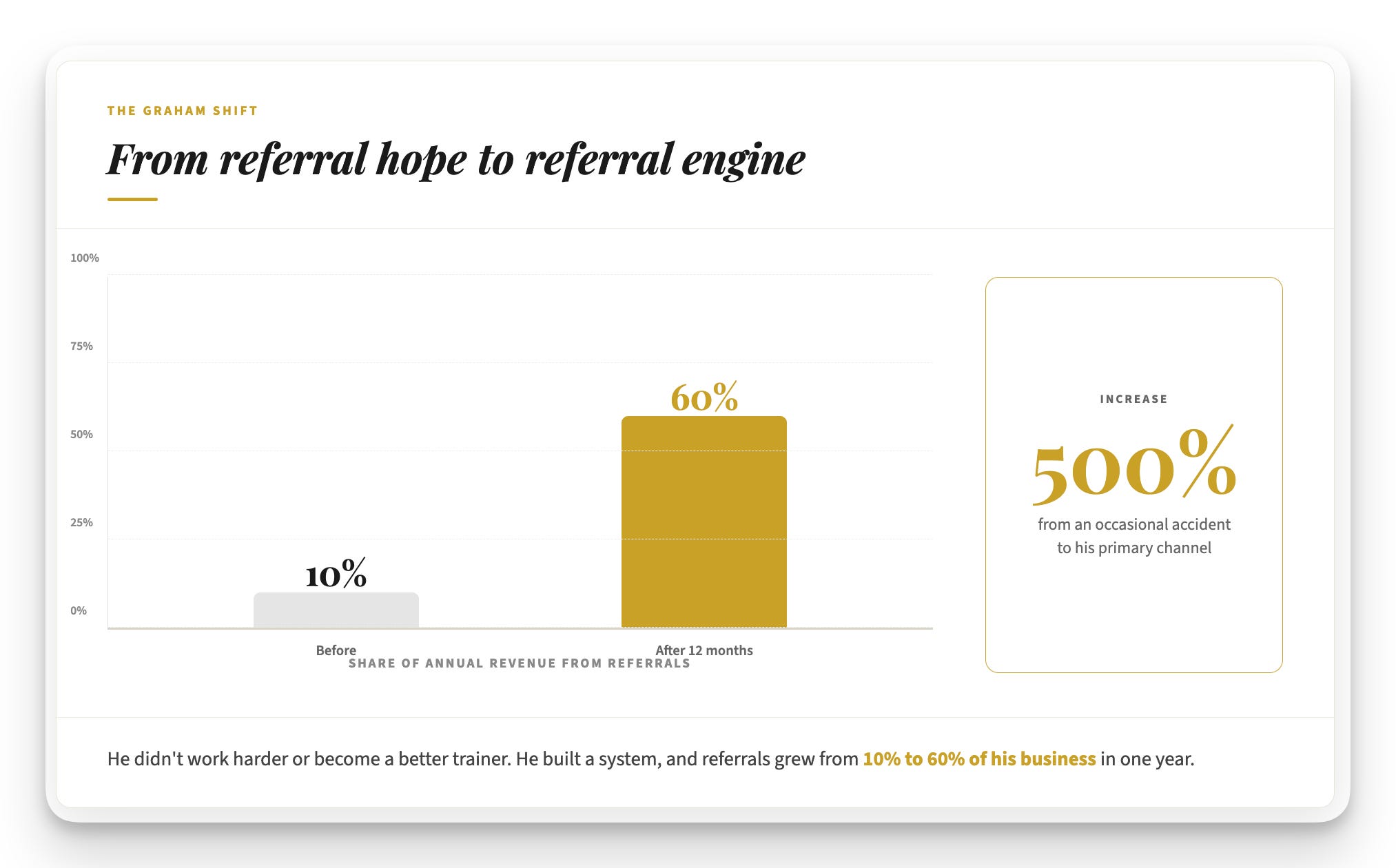
Graham didn’t work harder. He didn’t become a better trainer. He just stopped hoping for growth and started engineering it. He built a system that turned every satisfied customer into a committed member of his sales team.
Now, the penalty clause is an extreme version of the principle. It’s not for every business. But the lesson is universal:
Graham stopped treating referrals as a favor he was asking for and started treating them as a structured, professional exchange of value.
The mechanism can change to suit your business. The principle does not.
Graham went from 10% to 60%. What would even a fraction of that shift look like in your business?
Say you have 50 happy customers and your average sale is $8,000. That’s a $400,000 business.
Right now, maybe 10% of your new business comes from referrals that happen by chance. That’s 5 deals a year. An extra $40,000 you’re grateful for, but can’t predict and can’t count on.
Now imagine a modest system, one that motivates just 10 of those 50 customers to send you one qualified buyer each in exchange for a $500 discount.
$80,000 (new revenue) - $5,000 (discounts to referring customers) = $75,000 profit
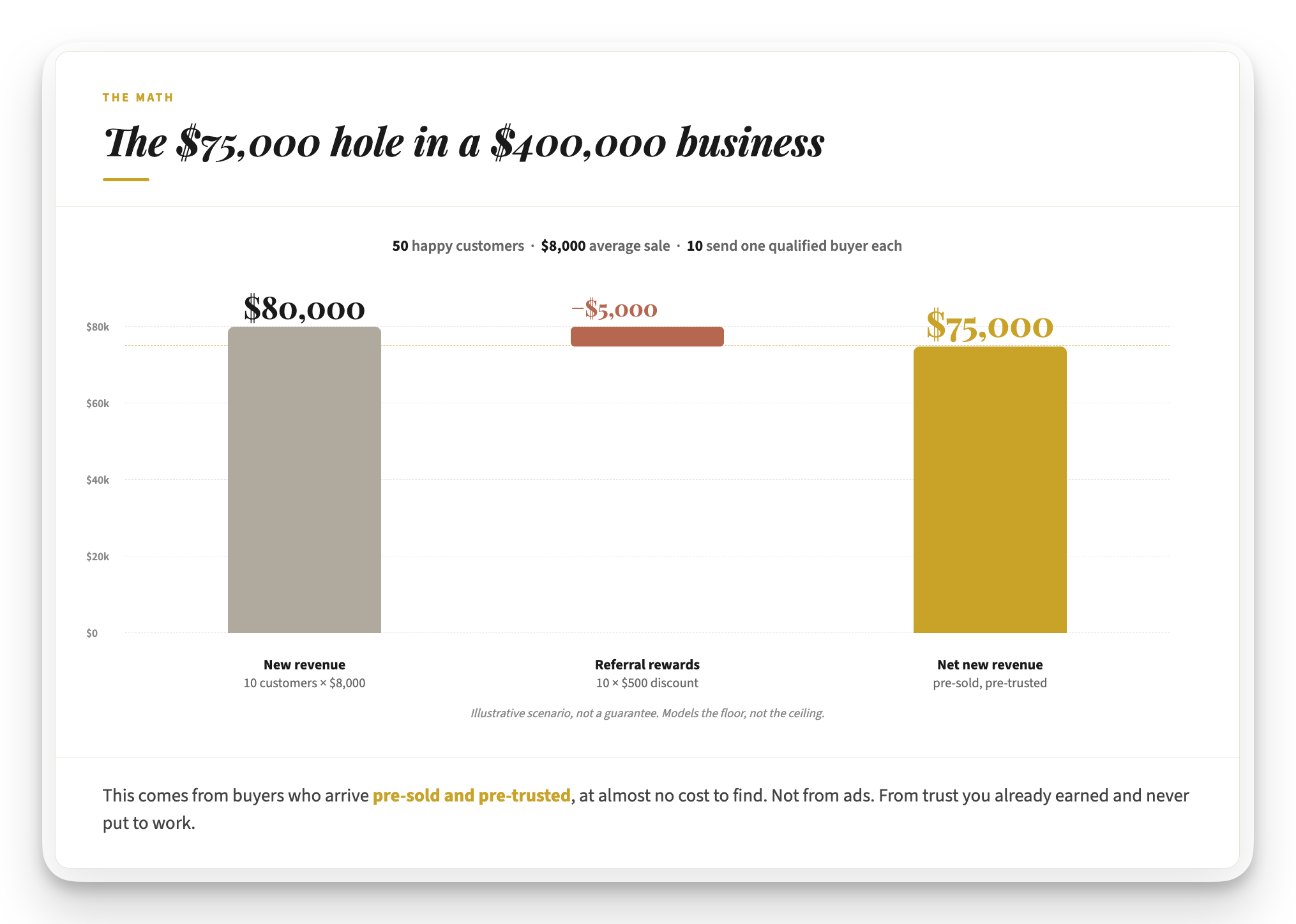
That $75,000 comes from people who arrived pre-sold, pre-trusted, and cost you almost nothing to find. Not from ads. Not from cold outreach. From trust you’ve already earned and haven’t put to work.
Your hope that your customers will make a referral might be costing you at least that much. Possibly more.
The question isn’t whether your customers would refer you.
Most of them would. The question is whether you’ve ever given them a clear reason, a clear mechanism, and a clear reward for doing it.
Graham hadn’t. You might not have, either.
Graham’s referral system worked because it aligned his customers’ self-interest with his growth. But a penalty clause is the aggressive end of the spectrum.
It suits high-ticket businesses with formal, contractual client relationships, and it asks a great deal of the customer. But for many businesses, the same alignment can be created with gentler mechanisms.
The most iconic referral systems of the past twenty-odd years each used a fundamentally different mechanism. Understanding which type fits your business is the difference between a system that runs and one that stalls. You'll recognize all four names. Watch what made each one run.
Dropbox didn’t put a banner on their site that said “Please tell your friends.” They offered every user more of their core product, free storage space, for every friend who signed up, and the friend who joined got free space too, so the reward ran both ways.
The insight was in the asymmetry. Storage space cost Dropbox almost nothing to provide, but it felt genuinely valuable to the user. The perceived value is what made the incentive irresistible and the referral sustainable.
After they rolled it out, Dropbox founder Drew Houston reported that it lifted signups by 60% on a sustained basis, not a one-time spike. Over the program’s first fifteen months the company grew from 100,000 users to 4 million, and at its peak referrals accounted for 35% of all daily signups.
And here is what most case studies leave out: Dropbox did not manufacture that word of mouth. Even before the program launched, roughly a third of new users were already arriving through referrals. The mechanism simply took that accidental flow and made it deliberate, repeatable, and far larger.
Notice what Dropbox also solved: the awkwardness problem. Nobody felt like they were doing Dropbox a favor. The referral was built into the product experience. Users shared because sharing got them something they actually wanted.
For a service business, this is the same principle behind the $500 service credit: “Introduce us to a business that could use our help, and you’ll get $500 toward your next engagement.”
You’re not asking for a favor. You’re presenting a professional offer where:
the customer gets credit toward something they already planned to buy
their contact gets a recommendation they can trust
you get a pre-sold lead at a fraction of what an ad would cost
If you produce something your customers value and you can deliver it at low marginal cost, built-in rewards might be your machine.
Side benefits: When your customer makes a referral, they’re putting their reputation on the line — which means they’re invested in your success. They want you to make them look good by delivering what they’ve promised.
If you do, they become even more loyal, because you’ve boosted their status with their friends, family, and coworkers.
Tesla didn’t offer their owners a cash rebate for referrals. They created a multi-tiered program with high-status rewards: thousands of free Supercharging miles, exclusive wheels, even a chance at a free next-generation Roadster.
The referral wasn’t a transaction. It was a game. Tesla owners competed to unlock the next tier, sharing referral codes not because they needed a discount but because they wanted the status of being a top referrer.
For a smaller business, this isn’t about giving away a car. It’s about recognizing that some of your best customers don’t want a discount. They want to feel like insiders.
What they are really after is belonging: the feeling of being part of the group that helped build this, not just another customer who bought from you. A private workshop invitation, early access to a new offering, a “founding partner” designation: these rewards cost you relatively little and tap into something cash can’t buy.
If your customers are passionate advocates who identify with your brand, status and access might be your machine.
Harry’s Razors hadn’t shipped a single blade when they launched their referral campaign. No product. No reviews. No track record. Just a landing page and a tiered reward system.
Sign up. Get a unique referral link. Five friends who sign up through your link earns you free shave cream. Ten gets a free razor. Twenty-five earns the premium set. Fifty, and you shave free for a year.
The escalation was the engine. People didn’t share once and forget. They checked their count, saw they were two referrals from the next tier, and sent another round of texts. Within one week, 100,000 people had signed up for a product that didn’t exist yet.
A single reward produces a single referral. Tiered rewards create sustained behavior because the customer always sees the next level.
That is the neuroscience underneath it: the brain releases dopamine in anticipation of a reward, not just on receiving one, so every glimpse of the next tier pulls the customer back into action before any prize is won.
For a service business, this might look like: refer one client and get a service credit; refer three and get a private strategy session; refer five and get a seat at your annual retreat.
If you want sustained referral activity over time rather than a one-time ask, tiered gamification might be your machine.
When Gmail launched in 2004, you could not just sign up. You needed an invitation from someone already inside. Google handed each early user a small batch of invites and nothing more. No cash. No discount. No points.
The invite became the reward on both ends. The person who received one got into a 1GB inbox while everyone else was rationing 2MB. The person who gave one got something subtler and stronger: the standing of being the one who could grant access.
Invites sold on eBay for more than $100 at the peak. People paid real money for a thing Google gave away, because the access carried status.
Notice the structure. There was no ladder. Inviting five people did not earn you a prize. The reward was singular and scarce, and the scarcity was the point. A tier system would have flooded the gates and erased the exclusivity that made an invitation feel like membership.
For a service business, this is the model behind a founding-member seat. “I’m building a small advisory circle. Twelve people, no more. Introduce me to someone who becomes a client, and one of those seats is yours.”
You reward the introduction by inducting the referrer into something they cannot buy their way into.
This is the one machine that ignores the network-density problem. The tiered programs need a customer who can produce five or ten introductions. The insider invitation needs one. A single good introduction earns the seat, so a client with a small but high-quality network is exactly who it is built for.
If your best customers want to belong more than they want a discount, and you would rather have a few perfect-fit clients than a flood, the insider invitation might be your machine.
Four different mechanisms.
Four different types of customer motivation.
One shared principle: every one of these systems made referring feel like something the customer wanted to do for their own reasons, not something they were being asked to do as a personal favor.
There is a second principle folded inside the first: in the best of these systems, the referrer is also doing their friend a favor.
The Dropbox user handed a friend free storage. The Gmail user handed a friend the most coveted invitation on the internet. A referral built this way is a gift in both directions, which is exactly why it never feels like a pitch.
Which type fits your business? You’ll pin that down in a minute. First, a 90-second diagnostic to see where you stand right now.
Take 90 seconds. Do this right now.
Write down your ten best customers from the last two years. The ones who got real results. The ones who have told you, unprompted, how much they value working with you.
Now answer one question about that list: for how many of them have you ever made a specific offer, a real reason or reward, to introduce you to someone who needs what you do?
Be honest. For most people, the answer is zero.
If that’s you, don’t worry. It’s completely normal.
Nearly everyone I work with starts in exactly this spot. They have a list just like yours, full of people who would gladly refer them, and they’ve never given them a reason or an easy way to do it.
Those people are the closest thing you have to a world-class sales team. You simply haven’t given them a reason, a method, or a reward to sell for you.
Before you reach for the prompt, do the part only you can do: decide which approach fits. You’ve seen all five now, Graham’s contractual model and the four machines, which one of them aligns with your situation the most?
If you can give customers more of your own product or service at little cost, your machine is Built-In Rewards.
If your customers proudly identify with your brand and like being recognized for it, your machine is Status and Access.
If your customers run in large networks and you want a steady stream of introductions, your machine is Tiered Gamification.
If you would rather have a few perfect-fit clients than a flood, and your people value being on the inside, your machine is the Insider Invitation.
If you sell a high-ticket offer inside formal, contractual client relationships and you want the firmest possible commitment, Graham’s contractual model, a discount traded for a written referral obligation, might be the machine for you.
Then look back at your list and mark the people that are most likely to say yes first: the ones who already rave about you, already know people who need what you do, and already trust you enough to make the introduction without a second thought. Those are where you start.
That is the thinking. The building is the hard part.
You could do it yourself, and most people try: a month of guessing at the right incentive, drafting and redrafting the email, hunting for a way to track who referred whom, until the whole thing slides onto the pile of good intentions that never quite ship.
Or you could hand the building to the prompt below and have the first operational version of your Referral Machine in about 15 minutes. It acts as the strategic partner you can’t be for yourself, asking the questions you wouldn’t think to ask and organizing your answers into a plan simple enough to launch this week.
Your Custom Incentive Design — Which of the four machine types fits your business, with specific reward options calibrated to your margins and your customers’ actual motivations.
Your Activation Scripts — The exact language to introduce your referral offer at the moment of maximum trust: after a result, after a renewal, after a thank-you. Three versions (in-person, email, follow-up) ready to use this week.
Your One-Page Referral Machine Blueprint — The complete system from initial offer through tracking, fulfillment, and weekly review, documented on a single page so it actually gets used.
Open your preferred AI tool (ChatGPT, Claude, etc.).
Copy and paste the entire prompt from this article.
Answer the questions it asks you about your business, your customers, and the value you provide. The prompt will guide the entire conversation.
A generic AI will hand you a list of common referral tactics. It doesn’t know why a penalty clause worked best for Graham, built-in rewards worked best for Dropbox, and nothing but an invitation worked best for Gmail.
It doesn’t know which mechanism fits your business, your margins, your customer relationships, or your capacity to deliver.
Jay-I does. It’s trained on decades of my methods across more than 1,000 industries. It won’t give you a template. It will engineer a referral system that fits the business you’ve actually built.
The prompt shows you the blueprint. Jay-I helps you build it.
You’ve already done the hardest part. You built something people trust enough to recommend.
Now it is time for you to stop treating trust as a compliment and started treating it as a resource.
Every five-star review, every “I tell everyone about you,” is someone raising their hand. The only thing missing is the system that turns that raised hand into a real-life introduction.
Fifteen minutes with the prompt. That’s all it takes to turn passive goodwill into an organic revenue system.
Jay Abraham
Comments
Nothing yet. Say the first thing.
Sign in to join the conversation.