
A note from Jay: This is the first article in a new series I’m calling The Leverage Economy. It’s built on a principle I’ve taught for decades: Other People’s Resources (OPR).
The fastest path to growth isn’t building every asset yourself. It’s borrowing the ones someone else has already built. We’re starting with the most expensive asset most business owners try to build from scratch: their audience.
You’ve been told for years that the path to growth is building your audience. Post more. Publish more. Nurture the list. Earn trust one subscriber at a time.
Meanwhile, someone in your market already has a trusted list of the buyers you need. Those buyers are opening someone else’s emails, taking someone else’s recommendations.
You’ve been trying to build what that person has already built. But the entire time, you could have been paying them to introduce you.
Does scrolling LinkedIn at 11pm feel less like research and more like watching someone else win the race you’re losing?
Does it twist something in your gut when someone who started the same year as you posts another milestone, and the people celebrating with them are the buyers you’ve been trying to reach?
Years of posting. Years of writing newsletters. Years of “thought leadership” that converted to a few warm replies and a slow trickle of inbound. Meanwhile, the next 100 buyers you actually need have been opening someone else’s emails the whole time.
After reading this, you’ll look at every relationship in your industry differently. The competitors, the peers, the adjacent operators you’ve been ignoring or fighting?
You’ll see them the way Jay does: not as competitors, but as people who could introduce you to every buyer you need, if you knew what to offer them.
You’ll discover:
The $660K Email Hidden In One Question — The exact deal Jay walked a desperate business owner through, the math that made a competitor say yes inside an hour, and why the conventional move would have ruined everything.
Why Trust Doesn’t Scale (But It Does Transfer) — How PayPal cut customer acquisition cost from $300 to $20, how Tupperware went from $5.5M to $87M without buying a single retail shelf, and how Amazon turned thousands of people who were already recommending books into a paid distribution network.
The Math From The Other Side Of The Table — The calculation almost no business owner runs, why running it changes who says yes to you, and the 30-second version you can do on a napkin tonight.
The 90-Second Diagnostic — Pen, paper, and one quarter of your sales pipeline. By the end, you’ll know the name of the person whose email could replace six months of cold outreach, and what it would take to convince them to send it.
Once you finish the diagnostic, you’ll see the opportunity sitting right in front of you.
But you still don’t know what to offer them, how much to pay, or how to frame it so the math is irresistible from their side. You could draft something tonight, but it would sound like every other “let’s collaborate” email they’ve already ignored.
Fifteen minutes from now, that changes:
Every relationship in your industry becomes a potential partnership you’ve never considered. The people you’ve been competing with, ignoring, or trading pleasantries with? There’s a fourth category, and it changes who you call first on Monday.
The guessing disappears. You’ll stop wondering what to offer and start knowing exactly why the person across the table would be crazy to say no.
The email you’ve never known how to write finally writes itself. Not a template. Not a “let’s collaborate” pitch. The actual message that makes someone who’s never endorsed you want to start this week.
Take 15 minutes and find out who’s already built the audience you’ve been chasing for years.
In the early 1990s, I sat down with the founder of a high-end education company. We’ll call him Robert. He sold a $1,500 program.
He had a great offer. He had real results. He just couldn’t get his cost of customer acquisition down to a number that worked, and even at scale, the math kept failing him.
He was three months from a serious cash crunch.
I asked him: “Who already has the buyers you need?”
Robert listed five competitors. One of them caught my ear: a direct competitor who was selling a similar program at $150. That competitor had spent years aggregating a list of 10,000 pre-qualified prospects.
People who had already proven they would spend money in this niche.
The conventional move was obvious. Study the competitor. Beat their offer. Run ads against them. Steal customers one at a time. Build your own list over years.
I told Robert to do something different:
Pay the competitor to send one email.
Robert thought I was insane. Until I told him what to pay.
Not a normal affiliate fee. Not a 10% revenue share. I told him to pay $300 per endorsement. Twice what the competitor was asking for their own $150 product.
The competitor would make more money introducing customers to Robert than they would make keeping those customers themselves.
And notice what the competitor’s subscribers experience: they get introduced to a high-value program by someone they already trust. The competitor isn’t selling out their list. They’re creating value for every person on their list by sharing Robert’s deal.
But Robert would make even more, because a personally-vouched email from a trusted source pulls much harder than cold outreach.
Robert just stared at me.
Then he did the math and said, “They make more money sending that email than selling their own product?”
“Yes. And yes is what they’ll say when they do the same math you just did.”
So Robert sent the offer. The competitor said yes within an hour.
Guess what happened?
Robert grossed roughly $660,000 from a single email through his largest competitor’s list after he’d paid the competitor’s share. Zero ad spend. Zero list-building. Zero waiting.
The thing Robert had been treating as his biggest threat, the competitor’s superior list, superior trust, and superior reach, was actually his fastest path to the competitor’s customers.
He’d been competing with his own distribution channel.
Because he had never asked the question I ask every business owner I sit with:
What does the deal look like from the other side of the table?
Robert wasn’t a bad operator. He was an excellent operator asking the wrong question: how do I create from scratch what already exists in my market?
He never thought to ask the one that would have saved him years: what would make someone else introduce me to their customers?
You’ve probably been trying to build:
A list
A brand
A platform
An audience
Just like Robert was. But every one of those things already exists in your market.
Someone else built it.
Someone else is sitting on it.
Someone else can also win by introducing you and bringing you on board.
I call this the Law of Endorsement Economics. Simply put:
The fastest way to earn a buyer’s trust is to be introduced by someone who already has that trust.
Robert was practicing Endorsement Economics, whether he realized it or not.
Most business owners do the math from their own side of the table when they’re looking for ways to get more customers:
“I can pay $50 to acquire a customer worth $200 to me.”
That math is correct. It’s also the wrong math.
The strategist does the math from the other person’s perspective.
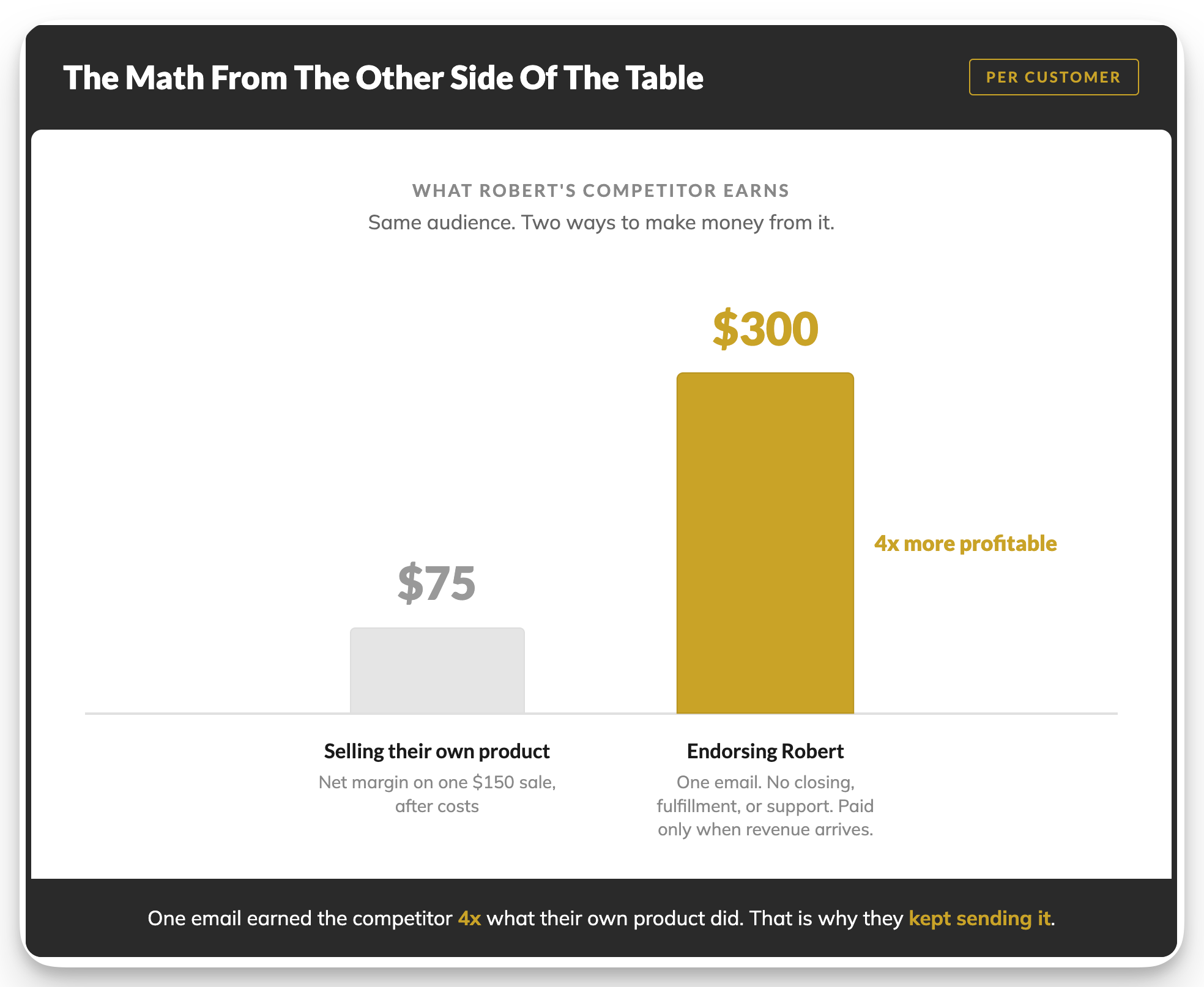
Robert’s competitor sells a $150 product. After costs, they keep about $75 per customer. That’s their ceiling. The only way to raise it is to create another product or grow the list, and both take months.
Robert offers $300 per sale to his competitor. One email. No closing, no fulfillment, no support. Just a recommendation sent to a list the competitor has already built.
One email brings in $300 per sale and the other brings in $75 per sale.
It’s four times more profitable for the competitor to introduce Robert than to sell their own product.
They would have been an idiot to say no.
I see a version of Robert’s situation in my inbox every week. The details change but the shape doesn’t, so let me give you an example.
Let’s say Bridget sells a $15,000 deal. Could be consulting, a SaaS contract, a high-ticket product. Doesn’t matter.
What matters is that there’s a guy in her market named Russ who has a 500-person email list full of exactly the buyers Bridget has been chasing on LinkedIn at 11pm.
Russ has never made a dollar from that list. He built it for thought leadership. In his mind, it’s a sunk cost.
If Bridget came to me, I’d tell her to stop looking at this deal from her side. I’d tell her to walk through it from Russ’s side.
Bridget offers Russ a simple deal: for every $15,000 client that comes from his list, he gets $1,500.
Russ sends one email. One person buys from Bridget. Russ makes $1,500 for 30 minutes of work.
Russ is now incentivized to send a second email. And a third. And to introduce Bridget at the next event he speaks at. And to mention her on the podcast he’s about to record.
The math from Bridget’s side says, “I can afford to pay Russ $1,500.”
The math from Russ’s side says, “I would be insane to say no.”
It doesn’t matter what side of the equation you’re on, you benefit.
You’ve probably tried some version of this before.
Asked a colleague to mention you to their list (they meant to, never did).
Set up an affiliate program with a modest rev share (nobody pushed it).
Proposed a JV that went quiet after one excited call.
Each of those was a single-layer play. Single-layer plays perform like favors.
Robert’s deal worked because three layers were stacked in the same email:
Trust transfer. The competitor’s audience already trusted them. That trust transferred to Robert the moment the competitor wrote: “I personally vouch for this program.”
Performance pricing. Robert paid as soon as revenue arrived. The competitor risked nothing and got an almost-immediate return.
The math that makes saying no irrational. The competitor made $300 per endorsement, roughly four times what they’d earn selling their own $150 product. Endorsing Robert was the most profitable thing they could do that month.
That’s why the competitor didn’t just send one email. They kept sending emails. Within a year, Robert was the largest external revenue source for a company he had spent five years trying to defeat.
When you do this, you’re not adding three tactics together. You’re stacking three layers that multiply each other.

This pattern isn’t new. It isn’t industry-specific.
It isn’t a clever consulting trick I invented for Robert.
It’s the mechanism underlying some of the largest businesses ever built.
Traditional financial services companies were spending roughly $300 to acquire a single customer through advertising. PayPal couldn’t outspend them. So they did the math from the other side of the table.
PayPal offered $10 to every new user who signed up, plus $10 for every friend the new user referred. That changed the social calculus entirely. The referrer wasn’t asking a friend to do them a favor. They were handing a friend $10 and collecting $10 themselves.
The cost of making the recommendation felt like zero, because the referrer looked generous, not salesy.
The math from PayPal’s side was just as clear: every customer acquired this way cost roughly $20, a fraction of the $300 their competitors were spending on advertising to reach the same person with none of the trust. The company grew to over 100 million users and sold to eBay for $1.5 billion.
Translate it: when you structure an endorsement deal, the host’s willingness to follow through on introducing you depends on more than the fee. It depends on how the recommendation makes them feel.
If endorsing you feels like selling, most hosts will hesitate no matter what you pay them.
But if endorsing you feels like giving their audience something valuable, the social friction disappears.
The best deals don’t just make the math work for the host. They make the host look good to the people they care about. These deals are probably already sitting right in front of you. You just need to see them.
Earl Tupper had a great product and no way to sell it. He’d tried retail. Department stores stocked his containers, but they just sat there on the shelves.
The problem wasn’t quality. It was that Tupperware’s airtight seal, the thing that made the product remarkable, needed to be demonstrated to be understood. A box on a shelf couldn’t do that.
A Tupperware dealer named Brownie Wise had been outselling every retail store in the country using home parties: she’d found the solution. She convinced Tupper to abandon retail entirely and let her build a national network of hostesses.
The model was simple: invite your friends over, demonstrate the product, and earn free Tupperware and commissions on every sale.
The math from the hostess’s side was straightforward: one afternoon of socializing (something she was already doing) turned into real, tangible income.
Brownie didn’t have to build a customer list. She already had one. It was her neighborhood, her church group, her circle of friends. And when she held up that container and showed her friends the seal, she wasn’t selling. She was recommending.
Her friends trusted her in a way they would never trust the sales copy on the box.
Tupperware provided the product, the training, and the inventory. The hostess risked nothing but an afternoon. And because she only earned when sales happened, she had every reason to demonstrate well. The earning potential was compelling enough that she hosted a second party, and a third.
Revenue went from $5.5 million in 1950 to $87 million by 1958. Not because Tupper built a better container. Because Wise found the people whose trust was already built and made the math from their side worth it.
In the early days of online retail, Jeff Bezos had a problem every e-commerce founder still faces: how do you get buyers to trust a store they’ve never heard of?
Advertising was expensive and carried no trust. But across the internet, thousands of people were already solving his problem for free.
Book reviewers, hobbyist bloggers, and niche site owners were already writing about books. Already recommending their favorites. Already sending their readers to look things up on Amazon. They were doing the work of endorsement without being paid for it.
Bezos launched the Associates Program: earn a commission on every sale that comes through your link.
The math was elegant on both sides. Amazon paid nothing upfront: commissions only hit when a sale closed. And the bloggers spent nothing new: the reviews were already written, the recommendations already made. All they added was a link.
Before the Associates Program, that expertise earned them zero. After it, the same content became a revenue stream.
Amazon got something advertising couldn’t buy: a recommendation from someone the reader already trusted, embedded in content the reader was already choosing to read.
The website owner got something they’d never had: income from the expertise (and taste) they’d been giving away for free.
The mechanism isn’t industry-specific.
It’s trust transfer.
And it’s available right now to every reader of this article, regardless of business model. The only question is whether you’ll make the first move or wait while a competitor does.
Try this right now.
Take 90 seconds. Pen and paper. No laptop.
Step 1. Name the worst sales quarter you’ve had in the last two years. The one where deals stalled, prospects went silent, the pipeline emptied.
Step 2. Now name the competitor whose business was probably fine that quarter. The one whose name comes up when someone in your market asks for a recommendation. The one who keeps showing up on the same shortlists as you.
Step 3. Ask one question. Has that competitor ever sent an email, posted, or made a recommendation that said: “I personally vouch for [your name]”?
The answer is almost always no.
Not because they wouldn’t. Because no one has ever asked them in a way that made the math impossible to refuse.
Maybe you did the 90-second diagnostic and you already know what you’re going to say in that email to your competitor.
But if you read through without picking up a pen and doing the math…
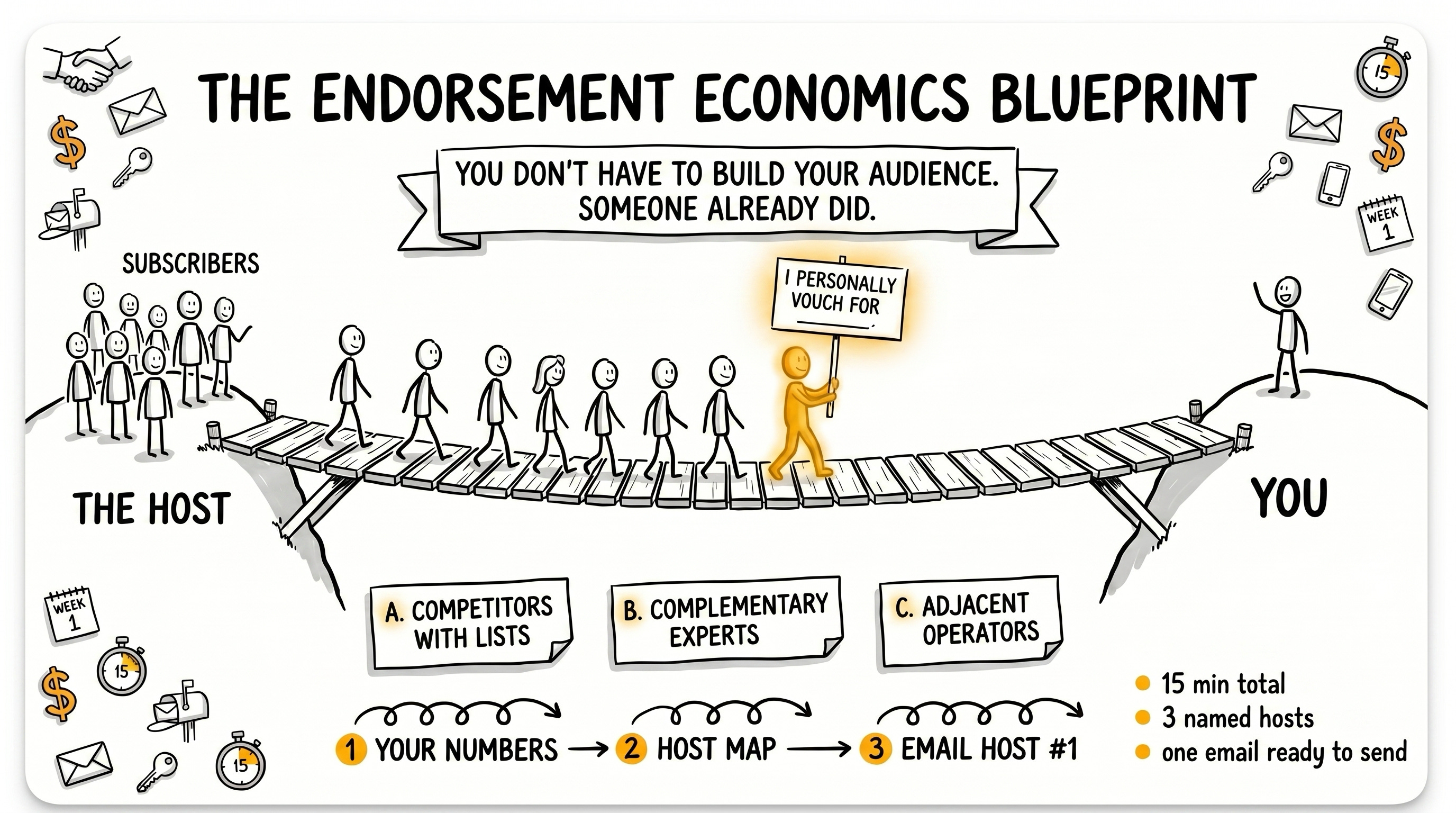
The Endorsement Economics Blueprint prompt will do it for you.
This prompt identifies the three best hosts in your market, calculates the math that makes your offer impossible to refuse, and writes the first email, for your specific business. (Not a template, a real email with your specifics).
The prompt is called The Endorsement Economics Blueprint.
You could do this yourself. List five competitors. List five adjacent peers. Calculate revenue-share math for each. Draft outreach. Three hours of work, if you’re focused.
But chances are, you won’t. So I’ve built this prompt to do it for you.
The prompt asks the questions a Jay-style strategist would ask if you’d paid $25,000 to put one in a room with you. It does the math from the host’s side, not yours. It generates the outreach in your voice, not template language. Fifteen minutes from now, you have three named hosts, three offers, and one first email.
Your Host Map. Potential hosts in your market named, ranked by who can least afford to say no. Not by list size. Not by status. By whose current economics make introducing you the most profitable thing they could do this month. Specific to your offer, your margin, and the audience you actually need.
Your Offer Per Host. A specific fee framework for each, calculated from the host’s side of the table. What the host earns from one of their own sales today. What they earn from one of yours, paid only when revenue arrives. The number that makes the second outcome irrational to refuse.
Your First Email. One outreach email to host #1, drafted in your voice. Plain, direct, no template language. The specific detail about the host as the opener. The inverted math as the body. One 15-minute conversation as the ask. Ready to send this week.
Open Your AI Tool: Use Claude, ChatGPT, or your 24/7 strategic partner, Jay-I.
Copy and Paste The Prompt: The prompt contains the full diagnostic. Just paste it in.
Have the Conversation: Answer the questions honestly. About 15 minutes. Bring rough numbers from your last 12 months.
Generic AI treats endorsement deals as a marketing tactic. It will tell you to “build partnerships,” “find affiliates,” “run JV webinars,” and hand you a templated pitch.
Jay-I understands that an endorsement deal is a math problem on the host’s side of the table. The fastest deal closes when the introduction is the most profitable thing the host does this month.
Generic AI would have told Robert to offer his competitor a 10% affiliate cut. Jay-I would have told him to set the fee at *double* what the competitor earned from one of their own sales, making one introduction outperform the competitor’s own product. Which is exactly why the competitor kept promoting Robert’s course.
That single calculation is what separates a 10% affiliate fee that gets ignored from a $300-per-customer offer that produces a $660,000 email.
You might’ve come in thinking this article was about marketing. About JV deals. About a clever tactic I ran with Robert in the early 90s.
It wasn’t.
It was about the seven years you’ve spent in the slow lane.
You’ve been building your list, but the audience already exists. The trust already exists. The list, the platform, the brand, the relationships, the warm pipeline you’ve been trying to manufacture from scratch — every piece of it has already been built by someone in your market. The only thing that doesn’t exist yet is the email that gives you access to it. Because you never thought to ask the question I asked Robert at that table thirty years ago.
Look at the name you wrote down 90 seconds ago. The competitor whose business was fine the quarter yours wasn’t. The person whose list contains the customers you needed last quarter and need again this quarter.
No one has ever sent that person the email that makes the math impossible to refuse.
You can keep building your audience for another seven years.
Or you can spend fifteen minutes finding out who’s already built it for you.
Jay Abraham
P.S. Robert paid his largest competitor $300 per endorsement and made roughly $660,000 in a single email. The competitor made more money endorsing Robert than selling their own product. They are still doing the deal today. The customer you needed last quarter is sitting on someone else’s list right now.
Comments
Nothing yet. Say the first thing.
Sign in to join the conversation.