
The Success Trap Series — Article 5 of 5 (Series Recap)
If you’ve been following this series, you’ve stress-tested your revenue pillars. You’ve named the invisible process your prospects couldn’t see. You’ve challenged the headline you were certain was right. You’ve run the three numbers hiding in your spreadsheet that could raise your revenue without a single new offer.
Each time, the pattern was the same: The Success Trap.
Something worked for you. You got good at it. So you kept doing it, even when the next step required something different.
Today’s article is the one that ties it all together, and it reveals the thing no individual article could show you:
The four ways the Success Trap shows up in your business aren’t four separate problems. They’re links in an invisible chain that feels like competence.
You’ve spent the last month identifying four ways the Success Trap can hide inside a business. You probably addressed one. Maybe started on a second.
But here’s what you couldn’t see from inside any single article: those four problems aren’t separate. They’re links in a chain that’s strangling your business, and the longer you ignore that chain, the more tightly it squeezes you.
This article shows you:
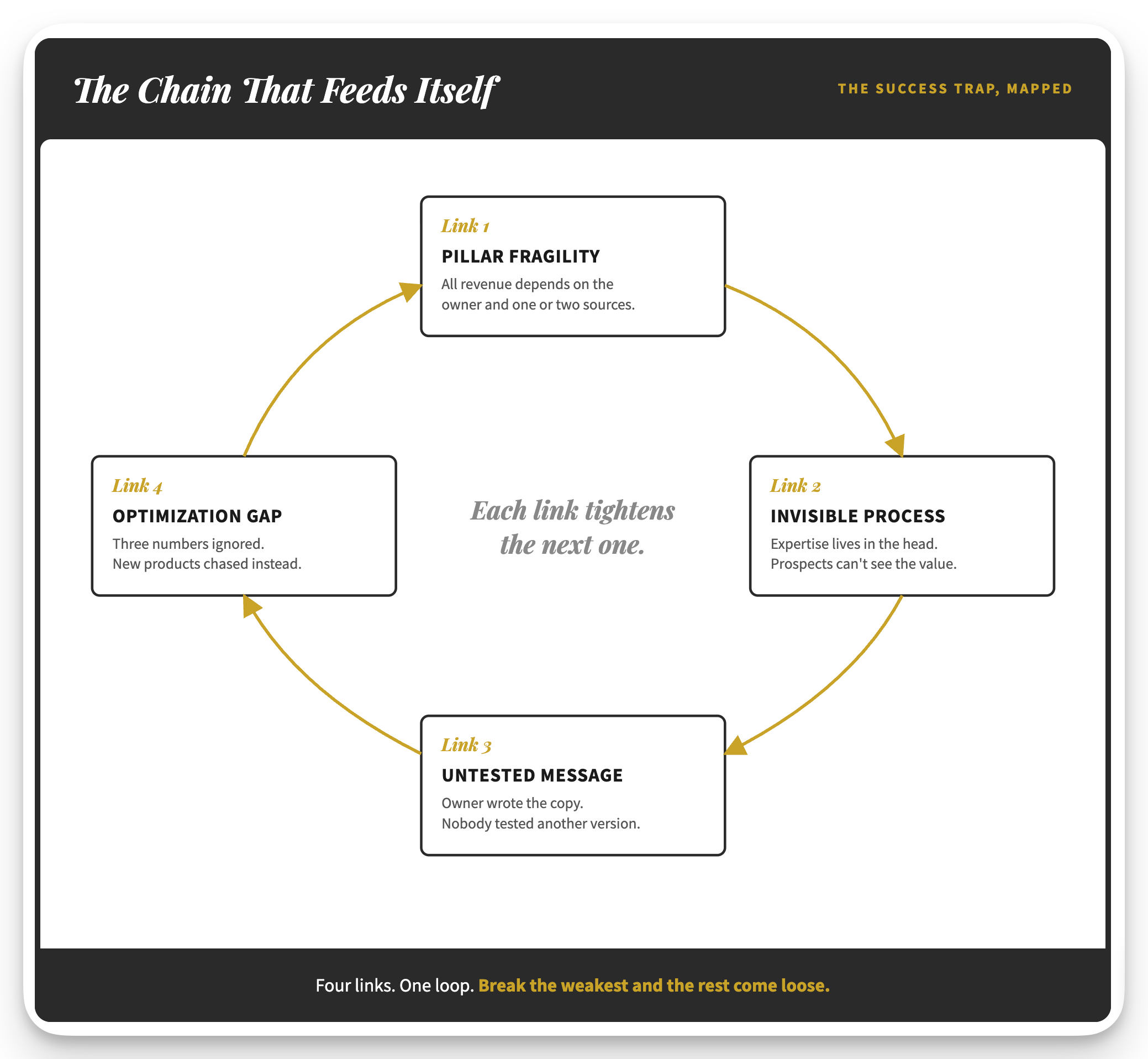
The Chain That Feeds Itself — How a fragile revenue structure keeps your expertise invisible, your invisible expertise keeps your messaging generic, your generic messaging drives you toward new products instead of optimization, and chasing new products keeps your revenue fragile. One loop. Four links. Self-reinforcing.
Two Futures for the Same Business — Same owner. Same skills. Same starting revenue. One version lets the chain tighten for twelve months. The other breaks one link so the rest come loose. The dollar gap between those two futures will make you put down your coffee and rethink each link in the chain.
Your Weakest Link — A self-diagnosis that identifies which of the four links will create the biggest revenue increase with the least effort. That’s where you start.
You’ve identified four ways the Success Trap shows up.
But have you asked the question that determines whether any of it compounds:
Where do I start to get the biggest return?
You can break the chain at any link. But one of those links, in your specific business, will likely produce a bigger revenue increase than the other three. Start there, and each subsequent fix gets easier, faster, and more profitable.
In 15 minutes, you’ll walk away with:
The Link You’ve Been Walking Past — The reason your revenue has been stuck, traced to the single link that’s holding everything else back.
The Order That Changes the Math — Why fixing these four problems in the right sequence produces a compound result that’s dramatically larger than fixing them one at a time, and what that sequence looks like for your business.
Your Two Futures, Side by Side — The 12-month math: what happens if you keep going as you are vs. what happens if you break the chain starting this month. Your numbers. Your gap.
Your Monday Move — The single action that starts the cascade this week.
Over the last four articles, we followed four business owners who were all successful and all stuck. Each one was caught by a different version of the same trap: the assumption that what got them here would get them to the next level.
A Lexus dealer who was his own single point of failure.
A shoe store owner whose craftsmanship was invisible to buyers.
A CEO whose favorite headline was filtering out 80% of his leads.
An A/C repair owner who almost launched a solar division when $2.5 million was sitting in his existing business.
Four success stories gone sideways. And a question none of them answered on their own:
What happens when all four versions of the Success Trap are operating in the same business at the same time?
Let’s find out.
Imagine Gloria, the chef-owner of a 48-seat restaurant called Sable. She opened it seven years ago, after fifteen years cooking in other people’s kitchens. The food is exceptional, the reviews are strong, and on most Friday and Saturday nights, every table is full.
Gloria does about $780,000 a year in revenue. By restaurant standards, that’s a real business. She’s not struggling. She’s not panicking.
But revenue has been flat for two years. She works every dinner service, six nights a week. She can’t remember the last time she took a full weekend off. And she has a nagging feeling that something is wrong but she can’t name it.
Here’s what Gloria would tell you if you sat down across from her:
“The food is the best it’s ever been. My regulars love it. I get great reviews. I just feel stuck. I’ve been thinking about launching a catering line, maybe doing some private events, because I don’t know how else to grow. The restaurant itself feels like it’s hit its ceiling.”
That sounds reasonable. It sounds like a business that needs a new revenue stream.
It’s not.
Gloria doesn’t have a growth problem. But she’s caught in a chain she can’t see. And every link in that chain is something that used to be a strength.

The Success Trap hides in plain sight. Every link in the chain looks like a strength until you see what it’s costing you. Here’s how the chain works:
Link 1: The Fragile Pillar. Gloria’s revenue depends almost entirely on her physical presence in the kitchen and a single local food writer who has featured Sable three times. She has one real pillar: herself. If she got sick for three weeks, or the food writer moved on, there’s no mechanism to replace either one.
The Success Trap: her personal presence built the restaurant, so she assumes that’s what the restaurant needs to keep going. It worked. So she keeps doing it.
Link 2: The Invisible Process. Gloria visits over 40 farms a year, rejects 80% of what she tastes, and rebuilds the menu every week around what the land is producing. None of her diners know any of this. When you ask what makes Sable different, she says, “The food is really good.” That’s the equivalent of the shoe store owner saying, “The leather is obviously better.”
The Success Trap: her instinct evolved through thousands of hours of practice, and it became so natural she forgot it was extraordinary. So she keeps relying on it silently instead of making it visible.
And because she’s working six nights a week holding up the single pillar (Link 1), she has no time to step back and articulate her process, so her process stays invisible.
Link 3: The Untested Message. Sable’s website says “seasonal, locally sourced cuisine in an intimate neighborhood setting.” Three new restaurants within a mile say roughly the same thing. Gloria wrote her copy herself, because she knows her restaurant better than anyone. She’s never tested whether different words would bring in more diners.
The Success Trap: her expert judgment built the restaurant, so she trusts it to write the copy too, but it was untested.
And because her process is invisible (Link 2), she didn’t have anything specific to say. You can’t articulate what you haven’t named.
Link 4: The Optimization Gap. Gloria has been planning a catering line for eight months. Meanwhile, three numbers are sitting in her point-of-sale system that she’s never examined together:
How many new diners she gets per month,
How much the average table spends,
How often a first-time diner comes back.
A 10% improvement on all three would grow her revenue by 33%, or roughly $258,000, without a single new service or a single night of catering.
The Success Trap: she built her career by creating new things (new dishes, new menus, a new restaurant). So when revenue stalls, she reaches for creation instead of optimization. Building something new worked before. So she keeps building.
And the chain tightens: because her messaging isn’t bringing in enough new diners (Link 3), she assumes the existing business has hit its ceiling.
So she builds something new instead of optimizing (Link 4).
And because all her energy goes into the new thing, she never builds additional sources of new customers (Link 1).
The loop is complete. Each link of the chain holds the next one in place:
All her new customers are the direct result of her work → keeps her too busy to articulate her process → so her messaging stays generic → so she thinks the business is maxed out → so she chases something new instead of optimizing → so she’s stuck focusing on bringing in new customers.
Gloria thinks she has one problem: a revenue ceiling. She actually has four, and each one is quietly making the other three worse.
Here’s what could happen to Gloria over the next twelve months if nothing changes.
The food writer who featured Sable three times takes a new position at a national publication. He doesn’t cover local restaurants anymore. There’s no dramatic falling-out. He just moves on.
Gloria doesn’t feel it immediately. The food writer’s last feature ran four months ago, and reservations are still decent. But the bleeding starts slowly and unnoticed. Without the periodic surges of new diners those features created, new customer traffic drops by about 25%. Gloria doesn’t notice for six weeks because she’s in the kitchen every night, not staring at a spreadsheet.
By month three, Friday nights are still strong. But Tuesday through Thursday has gone soft. She starts offering a weeknight prix fixe to fill seats. It works, sort of, but at lower margins.
This is Article 1’s warning, playing out in real time. The Pillar Stress Test would have caught the single-source dependency before the writer left. Gloria never ran the test.
A new restaurant opens two blocks away. The chef is younger, louder on social media, and has a tasting menu that’s getting attention. Gloria eats there once. The food is fine. Not as good as hers. Not even close, if she’s honest.
But the new place has a story. Their website tells you about the chef’s apprenticeship in Japan, the fermentation techniques, the custom ceramic dishes. It has a name for their approach: “The Roots Method.” It sounds impressive. But it’s mostly marketing.
A regular customer mentions the new place to Gloria. “Have you seen their website? It’s really beautiful. They explain everything about how they cook.”
Gloria feels a flash of irritation. She’s been doing deeper, more serious work for seven years. But she’s never described it. Her website still says “seasonal, locally sourced cuisine in an intimate neighborhood setting.” The new place’s website says they “source single-origin ingredients through a curated network of regenerative farms and transform them using time-honored preservation techniques.”
It’s not better cooking. It’s better storytelling. And Gloria is falling short in the comparison.
This is Article 2’s warning. The $500 Stiletto Protocol would have given her the language to describe what makes Sable extraordinary. But she never ran it.
Revenue is down 15% from last year. Gloria decides to invest: a new website, a push on social media, a small budget for online ads to drive reservations.
She writes the copy herself. She’s the expert, after all. Nobody knows Sable better than she does.
The new website is beautiful. The copy says: “At Sable, we believe in letting the seasons guide our table. Every dish is a celebration of local farms and the artisans who tend them.”
It’s lovely. It’s sincere. And it sounds exactly like the thirty-seven other farm-to-table restaurants within a twenty-minute drive.
The ads run for two months. The website gets traffic. But the reservation conversion is 1.8%. For every hundred people who land on her site, fewer than two book a table. The rest click away, because nothing on the page told them why Sable is different from the place they ate at last week.
Gloria blames the platform. She blames the algorithm. She never blames the sentence.
This is Article 3’s warning. The Expert Opinion Override would have shown her that her gut instinct about her own copy was filtering out the very people she wanted to reach. She trusted her gut instead of testing it.
Revenue is now down 20%. Gloria does what ambitious people do when the existing business feels stuck: she builds something new.
The catering line launches. She spends $35,000 on equipment, packaging, and a part-time catering coordinator. She spends nights and weekends developing a catering menu, building a catering website, creating pricing tiers.
The catering business generates $28,000 in its first three months. Not bad, but not enough to offset the $156,000 in lost restaurant revenue over the same period.
And Gloria is now working seven days a week instead of six, splitting her attention between a restaurant that needs her full focus and a catering operation that needs six more months before it’s profitable.
Meanwhile, her existing diners, the ones who love Sable, haven’t received a single email, a single “we miss you” note, a single reason to come back more often. The average spend per table is exactly what it was three years ago.
The three numbers that could have grown Sable by a third are sitting untouched in her point-of-sale system while Gloria folds catering boxes at midnight.
This is Article 4’s warning. The Three-Lever Audit would have shown her that $258,000 in growth was sitting in her existing business. But she reached for a new product instead.
The result: Gloria ends year one at roughly $620,000, down from $780,000. She’s working harder than she’s ever worked. She’s running two businesses instead of one, both underperforming. And the chain is tighter than it’s ever been.
Same skills. Same talent. Same extraordinary food.
The chain just did what chains do when you don’t break them. It tightened.
That was Gloria without the frameworks. Same talent. Same instincts. Same hard work. Just no one to show her the chain.
Same Gloria. Same $780,000. Same four links pulling tight around the business she built. Same day one.
The only difference is that this Gloria sits down with someone who has seen this same chain strangle a thousand businesses, and who knows how to determine which link to break first.
The first thing I’d tell Gloria is to run the Pillar Stress Test from Article 1.
“Gloria, if you disappeared from the kitchen for sixty days, what would keep bringing new people through the door?”
She’d think about it. The food writer? Maybe. Her regulars telling friends? Probably, for a while.
Anything systematic? Anything that runs whether she’s there or not?
No. Nothing.
So we’d build two new pillars using raw materials already sitting inside her business.
Every restaurant has slow nights. Gloria has capacity on Tuesdays and Wednesdays. We’d create a simple partnership with three non-competing businesses that serve her ideal diner: the high-end hair salon two blocks over, the wine shop on the corner, the boutique florist. Each partner gets a standing reservation for a “client appreciation dinner” once a month at Sable, at a modest discount. They bring their best customers. Gloria feeds them beautifully. Those customers become Sable regulars.
She turned three neighboring businesses into a referral system. Same basic idea as the Lexus dealer’s competitor joint venture, adapted for a 48-seat restaurant.
Gloria has served thousands of diners over seven years. She has their email addresses from the reservation system. She’s never sent them a single message after their visit.
We’d build a simple follow-up: a personal note (from Gloria) that goes out three days after every first visit, and a seasonal invitation that goes out quarterly to anyone who hasn’t been back in 90 days.
Not a marketing blast. Not a coupon. A note from the chef telling them what’s extraordinary on the menu right now and why.
Within 90 days, Gloria has four sources of new and returning diners instead of one. Her dependency on any single source drops from nearly 100% to about 40%. And something changes psychologically: for the first time in years, she has breathing room.
The revenue doesn’t jump dramatically in the first quarter. The new pillars are just getting started. But the stability lets Gloria do something she hasn’t done in three years: take a step back and think.
With the return visit system running and the partnerships bringing in steady Tuesday traffic, Gloria has something she didn’t have before: four hours a week she isn’t spending in the kitchen trying to single-handedly fill every seat.
I’d tell her to use one weekend to extract what makes Sable extraordinary. Not “the food is really good.” The actual process.
She visits over 40 farms a year. She rejects 80% of what she tastes. She changes the menu every week based on what’s at its peak, which means she’s essentially creating new dishes constantly, not because it’s trendy, but because she refuses to serve a beet that was better last season. Her roasting temperatures for root vegetables took her two years to calibrate. Her bread program uses a starter she’s maintained for six years.
None of that is on the menu. None of it is on the website. None of it is in any conversation between the server and the diner. It’s all inside Gloria’s head, where no customer can see it.
We’d name it. Something like “The Source Standard”: Gloria’s documented commitment to visiting every farm, tasting before buying, and rebuilding the menu around what the land is actually producing that week.
Not a gimmick. A real description of real work that no competitor within twenty miles is doing at the same level.
Two things happen immediately.
First, the servers can now tell the story. When a diner asks “what’s good tonight?” the answer isn’t “everything.” The answer is “Gloria was at Millcreek Farm on Tuesday, and the snap peas are the best she’s seen in three years. The dish she built around them is on the menu for maybe another week.”
That’s the shoe store owner’s story, adapted for a restaurant. The price objections stop because the value becomes visible.
Second, the partnership pillar from Month 1 gets stronger. The wine shop owner can now describe Sable to her customers in a single sentence: “Gloria visits 40 farms a year and rebuilds the menu every week around what’s at its peak. The food you’ll eat on Tuesday literally didn’t exist as a dish on Monday.”
That’s a referral pitch that sells itself.
Link 2 amplifies Link 1. The chain is loosening, creating compounding in the other direction with every move that’s being made.
Months 7-9: Break Link 3 — Test the Message Instead of Trusting It.
With a named process and clear language, Gloria rewrites her website. But instead of trusting her judgment to write copy (the Expert Liability from Article 3), now she tests it.
She has 2,400 email addresses from her reservation system. She sends two versions of a seasonal email invitation to come back to Sable.
Version A (her original instinct): “Sable’s autumn menu is here. Seasonal dishes celebrating local farms. Reserve your table.”
Version B (informed by The Source Standard): “Three farms. Eleven rejections. One perfect butternut squash. Gloria rebuilt Tuesday’s menu around it. Tables are open this week.”
Version B outperforms by 70%.
She applies the same principle to her website headline.
The old version: “Seasonal, locally sourced cuisine in an intimate neighborhood setting.”
The new version: “40 farms. 80% rejected. Gloria builds the menu around what survived.”
Reservation conversions from the website climb from 1.8% to 3.2%.
That improvement, combined with the new diners coming from her partnership pillar and the returning diners from her follow-up system, means Gloria is now filling tables on Tuesday through Thursday that used to sit empty. Total new and returning diners per month are up roughly 25% from where she started.
And she hasn’t spent a dollar on advertising. She tested her own copy against itself, using the email list she already had.
Link 3 amplifies Links 1 and 2. The compounding just keeps growing.
Months 10-12: Break Link 4 — Optimize the Three Numbers.
Now Gloria runs the Three-Lever Audit from Article 4. She pulls up her point-of-sale data and looks at the three numbers that produce her revenue:
New and returning diners per month. Already up 25% from the new pillars and better messaging.
Average spend per table. Hasn’t changed in three years. Gloria hasn’t raised her prices since opening, and her menu doesn’t suggest wine pairings, dessert additions, or the off-menu tasting option she could easily offer.
How often a first-time diner comes back. The return visit system has already improved this, but there’s room for more. Only 15% of first-time diners returned within six months before the system. Now it’s 22%. The quarterly seasonal invitation could push it to 30%.
She adjusts her menu pricing by 12% (justified by The Source Standard, her named process, which gives diners a reason to understand the premium). She adds a “Chef’s Selection” tasting upgrade at a 40% margin. She keeps the return visit system running.
Now watch the three levers stack.
Diners are up 25% from the new pillars and better messaging. On $780,000 in revenue, that alone would take Sable to roughly $975,000.
Then average spend per table goes up 15%, compounding on top of the new diner count. That pushes revenue to approximately $1,121,000.
Then visit frequency climbs from 1.2 times per year to 1.6, compounding on top of both. The math: 1.25 × 1.15 × 1.33 = 1.91.
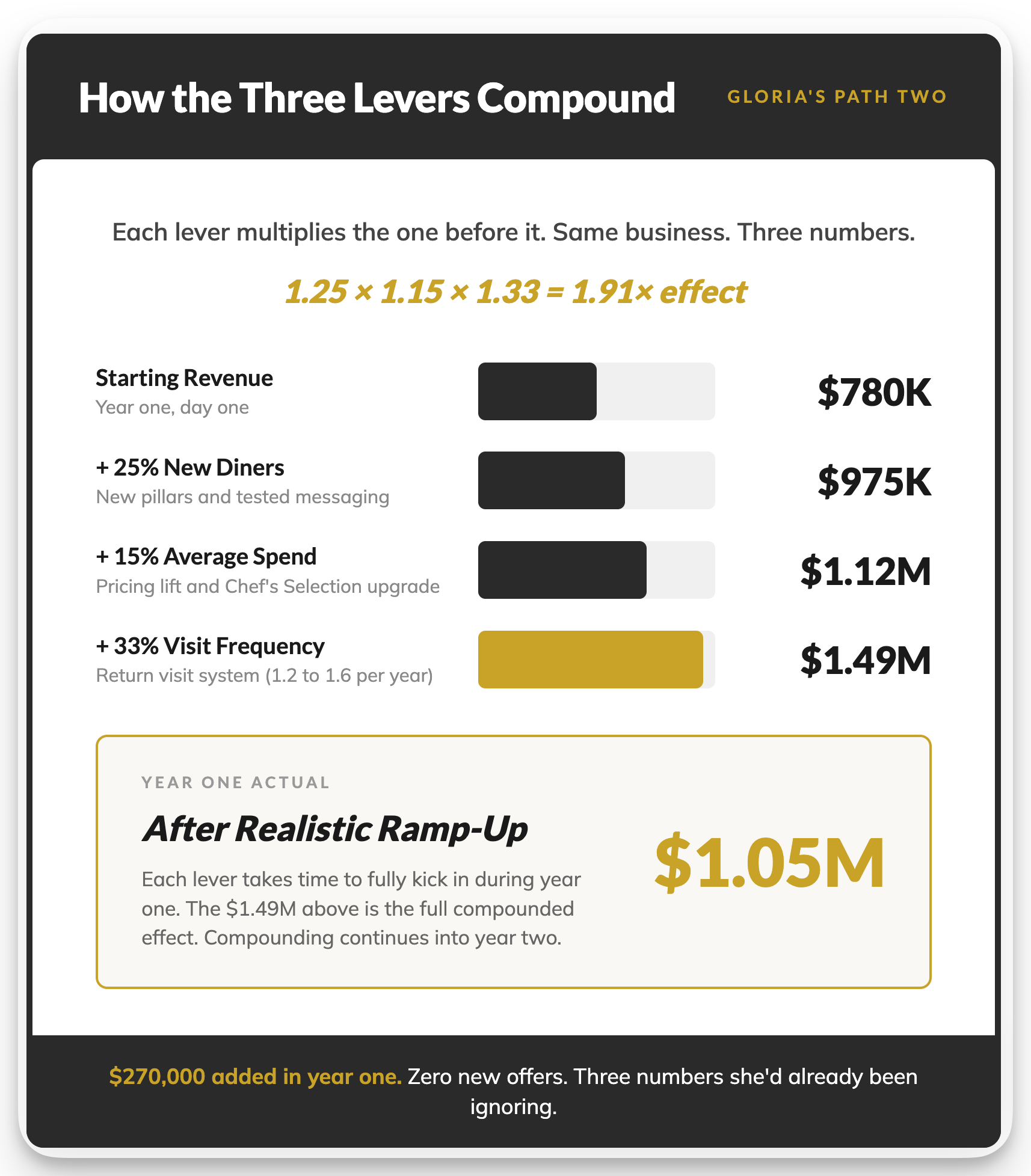
The result: Gloria ends year one at approximately $1,050,000 (after accounting for the ramp-up time on each lever). She crossed a million for the first time without a catering line, without a second location, without a single new hire in the kitchen.
Those numbers are illustrative, not guaranteed. The specific percentages depend on Gloria’s execution and her market. But the directional math, where each fix makes the next one more powerful, is the same pattern I’ve seen play out in thousands of real businesses.
Same food. Same talent. Same 48 seats.
But she was able to break the chain link by link, and each fix made the next one more powerful.

Path One Gloria: $620,000. Working seven days a week. Running two businesses, both underperforming. The chain is tighter than ever.
Path Two Gloria: $1,050,000. Working five and a half days a week (because the system isn’t entirely dependent on her). Running one business that’s firing on all cylinders. The chain is broken, and compounding in her favor.
The gap between those two futures: $430,000.
Not because one Gloria is smarter than the other. Not because one works harder. Because one kept doing what had always worked, and the other recognized that the next step required something different.
That’s the Success Trap. It doesn’t punish laziness. It punishes repetition disguised as discipline.

You spent a month learning four frameworks. Each one works alone. But the real leverage isn’t in any single framework. It’s in the chain between them.
Which version of the chain are you living in right now?
If you lie awake wondering what happens when your biggest client, referral source, or revenue channel disappears — Start with Article 1’s Pillar Stress Test, or let the Chain-Breaker Diagnostic below map it for you.
If prospects keep choosing competitors who aren’t as good as you, or if you struggle to explain what makes your work different — Start with Article 2’s $500 Stiletto Protocol, or let the Chain-Breaker Diagnostic below show you where this link connects to the others.
If your website, proposals, or emails describe what you do instead of the outcome the client gets, and you’ve never tested whether different words would change the result — Start with Article 3’s Expert Opinion Override, or let the Chain-Breaker Diagnostic show you the dollar cost.
If you’ve been “about to launch” something new for months while your existing numbers haven’t moved — Start with Article 4’s Three-Lever Audit, or let the Chain-Breaker Diagnostic show you the side-by-side math.
You can start at any link. But the weakest link is where the chain is creating the most drag on everything else, which means it’s where breaking through will produce the largest revenue increase with the least resistance.
You could absolutely identify your weakest link from the descriptions above, go back to that article, and run the individual diagnostic. That works.
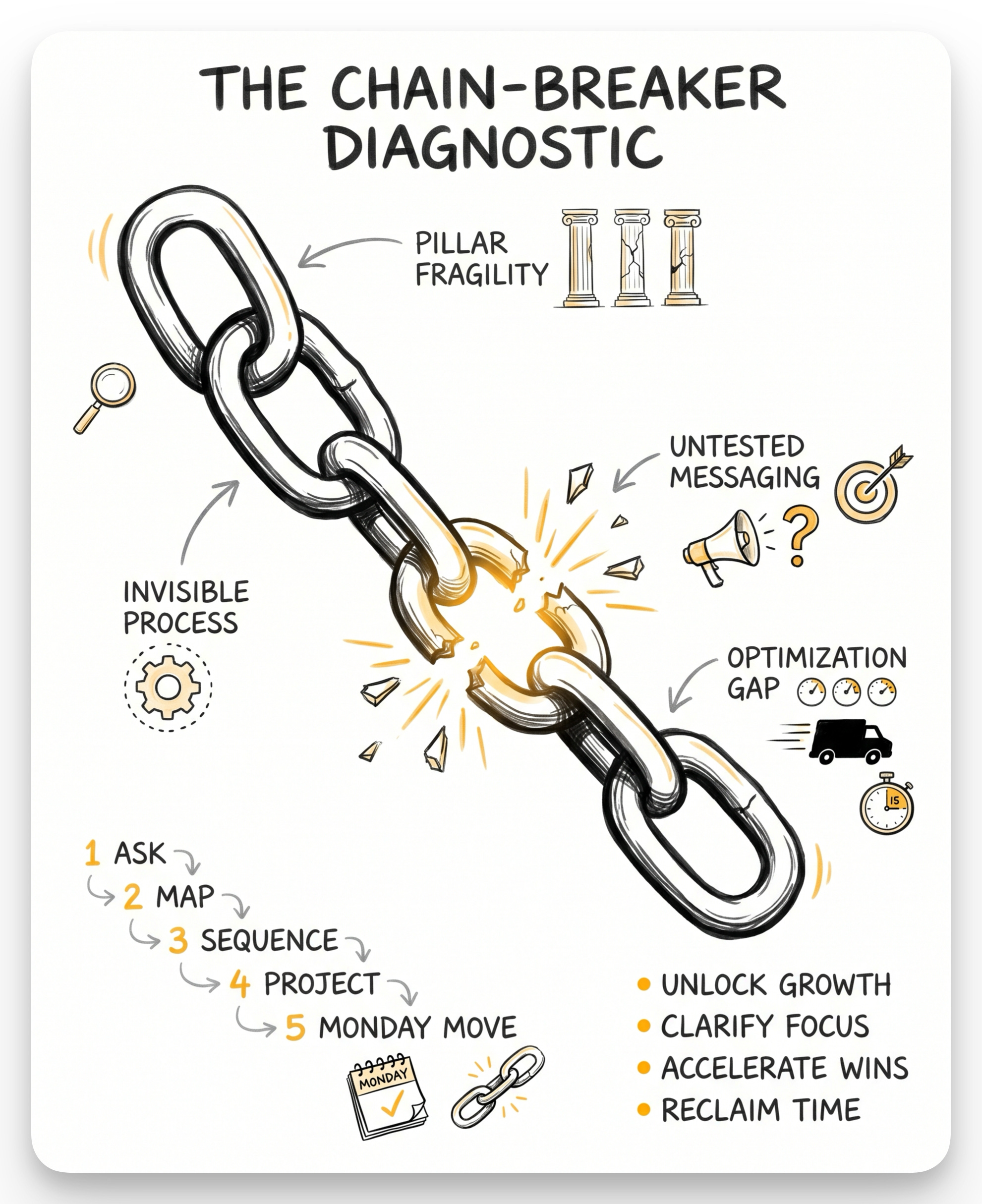
Or you can use the Chain-Breaker Diagnostic Prompt to map your entire chain in fifteen minutes. It identifies the weakest link, builds the break sequence that produces the biggest compound return, and shows you the two-path projection: what happens to your revenue if you keep going as you are, vs. what happens if you break the chain starting this month.
Your Chain Map — Which link is creating the most drag in your business, and how it’s holding the other three in place. Specific to your revenue, your operations, your current setup.
Your Break Sequence — The order in which to address all four links so each fix creates positive compounding conditions for the next one. Customized to your business so each step amplifies what came before.
Your Two-Path Projection — The 12-month dollar math: chain tightens vs. chain breaks. Your numbers, side by side.
Your Monday Move — The single first action, specific to your weakest link, that starts the cascade this week.
Open Your AI Tool: Use Claude, ChatGPT, or your 24/7 strategic partner, Jay-I.
Copy and Paste The Prompt: The prompt contains the full diagnostic. Just paste it in.
Have the Conversation: Answer the questions honestly. About 15 minutes. Bring rough numbers from your last 12 months.
Generic AI will diagnose each link independently and give you four separate to-do lists. Jay-I understands that the four links are a system, and that the order you address them in changes the compound math.
Generic AI would tell Gloria to raise her prices, build an email list, and test her headline. Jay-I would tell her to name her sourcing process first, because that’s what makes the price increase stick and gives the email list something worth saying.
It calculates the chain effect: how breaking Link 1 changes the return on breaking Link 2, how breaking Links 1 and 2 together changes the return on Link 3, and so on. That sequential compounding calculation is what separates a $50,000 improvement from a $430,000 improvement.
Gloria is hypothetical. The chain isn’t.
You’re wearing a version of it right now. Every business owner who built something through skill, effort, and instinct is.
The chain doesn’t form because you did something wrong. It forms because you did something right, and then kept doing it past the point where the next step required something different.
The Success Trap doesn’t announce itself.
It feels like work ethic. It feels like high standards. It feels like doing what you’ve always done, because what you’ve always done has always worked.
You’ve seen the two futures. The gap between them started with one link, broken.
Your chain has a weakest link too.
Which link are you going to break today?
Jay Abraham
Comments
Nothing yet. Say the first thing.
Sign in to join the conversation.