
Last Friday (2/6/2026), a student riding her bike to school was struck by a vehicle and knocked off her bike. The day before, another student reported a near miss. Both incidents occurred very close to <school name> and are alarming—and preventable.
Please slow down, stay alert, and follow all traffic expectations when driving near campus. Our students are walking and biking every day, and safety depends on all of us doing our part.
We received this email from our daughter’s middle school principal. Driving to pick up my daughter from middle school can be nerve-racking. Middle schoolers are streaming out, eager to go home.
Yapping. Laughing. Looking at their phones. Dreaming about dinner. Most importantly, many of them are not paying attention.
You signal to some kids with your hands or your eyes to cross the road, even if they are waiting for you. There are a ton of nonverbal signals that happen at the intersection.
Now imagine that instead of you picking up your kid from school, an autonomous vehicle does.
Given a range of unexpected scenarios and a high level of nonverbal communication, using an autonomous vehicle for a school pickup could be challenging in the near future, as some scenarios are rare, unexpected, and difficult to train for.
A few weeks ago, a child was hit by a Waymo in Santa Monica, California.
The child ran across the street from behind a double-parked SUV towards the school and was struck by the Waymo AV. (Autonomous Vehicle)
This incident prompted an investigation by the National Highway Traffic Safety Administration. The incident was not fatal, and, in fact, based on Waymo’s investigation, Waymo responded more quickly than a human driver would have, potentially saving the child’s life.
These are unknown behaviors or incidents that occur very rarely (also known as edge cases).
Edge cases are rare, bizarre, or highly complex situations that occur perhaps once every 100,000 miles. Edge cases make the news. They are significant roadblocks to customer and regulatory acceptance and mass adoption.
We could use the old Rumsfeld matrix to categorize autonomous vehicle use cases in a 2 x 2 matrix of awareness and knowledge. Unexpected scenarios (also called edge cases) can be pretty challenging for autonomous vehicles like self-driving cars.
The known knowns and the unknown knowns are not easy to train autonomous vehicles on, but compared to the known unknowns and the unknown unknowns, they are a bit easier.
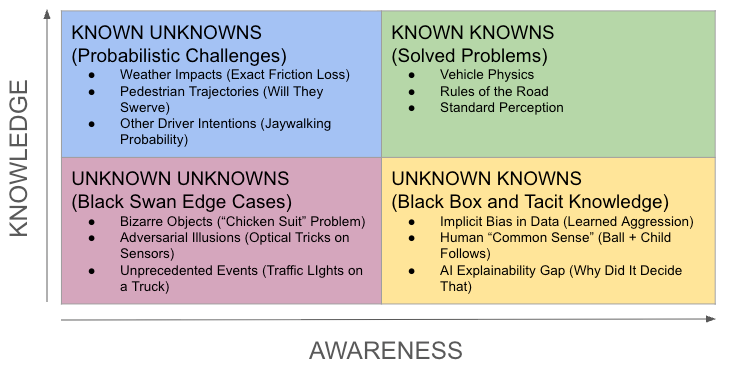
Most self-driving cars are trained using some combination of supervised learning, imitation learning (end-to-end neural networks used for Tesla FSD12), and reinforcement learning. Self-driving cars are very good at doing what they have been trained to do.
I refer to them as the “known knowns”, which is standard stuff like vehicle physics, understanding the rules of the roads like lanes, speed limits, stop signs, traffic lights, etc.
Even though the autonomous vehicle does not know exactly what a pedestrian will do, it knows it has to watch out for her. It uses predictive modeling to proactively slow down. It handles weather by recognizing when the road is wet during or after a rain event and adjusting its braking algorithms and speed accordingly.
When I use Tesla FSD on the freeway and if it is raining hard (like right now), it drops the maximum speed to 65 mph (speed limit on California freeways). From a physics standpoint, it makes sense that if the roads are wet, driving at a lower speed is safer.
But the rest of the cars, which are not using any FSD or self-driving functions, still drive at about the speed limit and sometimes even speed up to get out of the rain quickly. This creates a dangerous situation if you do not keep up with the traffic. This forces me to go to manual mode, and they drive to keep up with the traffic.
It is difficult, but the industry has largely solved this through better sensors (LiDAR/Radar) and faster processors, though Tesla FSD uses only visual sensors.
They struggle with edge cases because they lack the ability to encounter a brand-new situation and apply logic.
Many edge cases are long tail problems (by definition). Other problems arise from a common-sense gap. The system might “know” how to drive, but engineers struggle to guarantee that it does so safely.
The gap in explainability means that the algorithm might make the right decision 99% of the time, but the engineers cannot see how and why it made that decision. Also, as human drivers, we rely on tacit knowledge, which is basically unwritten “common sense.”
It is very difficult to program human intuition and social driving etiquette.
Common sense gaps can trip up autonomous vehicles. For example, if a delivery truck is blocking your lane, you may cross the yellow line to pass it (assuming it is safe). An autonomous vehicle will be stuck, as crossing the yellow line is illegal.
There are different types of “out of distribution” use cases and black-swan edge cases that are much harder to navigate for autonomous vehicles.
The unknown knowns and unknown unknowns that slow the adoption of autonomous vehicles come in different flavors. Here are a few examples of unknown unknowns.
Kids do the darndest things
It is the random stuff that middle schoolers do after school. You know they might do something weird, but you don’t know what. There are other classic examples of people in giant dinosaur costumes (Bay to Breakers!) or construction workers holding STOP signs but waving cars forward with their hands.
Dogs barking at glass doors and mirrors
Our puppy always barks at his reflection in the glass door!
Sensor hallucination because the car’s sensors misinterpret their input. For example, exhaust from a vehicle in front of you on a cold day can look solid, and reflective surfaces can make your car think there is another vehicle it is about to hit. Understanding the context, such as weather, air temperature, and other vehicles' behavior, is critical.
Context Conundrums
Floating plastic bags and funeral processions require the ability to understand context with sufficient certainty and confidence without sacrificing the autonomous vehicle’s performance and safety. Understanding context, especially in edge cases, can be challenging for autonomous vehicles.
It took a certain number of years for autonomous cars to reach 90% reliability, and maybe the same number of years to reach another 9%. The first autonomous vehicles to travel about 150 miles were at the second DARPA Grand Challenge in 2005, in the Mojave Desert. It might take some time to reach higher nines, as finding edge cases is challenging.
This speaks to the gradual rollout of services like Waymo in the US, though their pace is accelerating.
When an autonomous vehicle encounters something it is unsure about, it flags the specific ten-second clip and uploads it to the cloud for human review. For example, a woman in a banana costume walking to a school Halloween party.
When I use FSD on my Tesla Y (it is in supervised driving, not fully autonomous) and switch to manual mode, the car asks me to record a voice note explaining why I switched. I am not always able to do it, but when I do, it provides additional data and context for my car about what I perceived as not working, and I had to manually intervene and override FSD.
Companies estimate uncertainty and then run additional simulations by varying specific variables to test the robustness of the autonomous vehicle’s actions. The goal is to reduce the variance in decision-making.
Some cars run experimental software in the background, and try to find differences between actual decisions made by the human driver, and a predicted decision made by the software, for further review
Another popular training method is to use the existing fleet and share the learnings with the entire fleet. When a car encounters an unusual situation, it triggers a fleet alert (for example, a bump in the road on a rainy day).
It can turn one edge case into a fleet-wide lesson (Waze example of learning from others). I saw this happen to my Tesla FSD experience during my Christmas trip to Palm Springs, when it was raining, and the cross-streets had bumps at intersections.
Once an edge case is found, resimulation will generate 1000s of new variations by adding other elements to the discovered use case. We used this method at Mineral to generate additional in silico data by creating new variations.
For example, when viewing weed images in a field, we varied lighting conditions, soil backgrounds, soil color, angle of view, and other factors to generate additional synthetic scenarios. It helped accelerate the model training at a lower cost.
GenAI or World Models are also used to generate multiple scenarios and to scan the real world to create digital twins, which can then be further manipulated using sophisticated techniques such as NeRFs (reconstructing 3D images from 2D images) and 3D Gaussian Splatting (a real-time rendering technique that models 3D scenes using millions of tiny, translucent, and trainable ellipsoids). (Additional details on these techniques will be covered in a future post.)
The newest tool in the toolkit is the VLA (Vision, Language, Action) models. These models use vision and language to understand context rather than just seeing pixels and objects. For example, a person holding a talk sign but talking to a construction worker. It understands that it should ignore the sign and continue forward while obeying all the other rules.
It allows handling edge cases using “System 2” Thinking (System 2 thinking is named after Daniel Kahneman’s System 1 and System 2 concept, where System 2 is slow, analytical, and deliberate compared to System 1, which reacts quickly without deep thinking). (More on these techniques in a future edition, along with NerF and Gaussian Splatting.)
When an edge case arises, the VLA switches to reasoning mode to generate an internal chain of thought and arrive at a decision. For example, if there is a red light but a human police officer is waving the car forward, people know to override the traffic light and proceed carefully and slowly.
The impact of edge cases is a major factor dictating the speed of the autonomous vehicle rollout (along with regulation). Because of these “unknown unknowns,” the industry has favored a regional and careful rollout. This means the future is already here for some people, while others won’t see it for a decade.
These are environments where edge cases are rare, predictable, or manageable in Sunbelt cities like Phoenix, Austin, Los Angeles, and Miami, where the weather is predictable, and the roads are wide and well-marked. Waymo is aggressively expanding because it is confident it has solved edge cases in dry, grid-like environments.
Texas Highways are high-speed, low-complexity. Everyone is going in the same direction, there are no pedestrians, and no traffic lights. Some edge cases include sudden accidents, blown tires, and big pebbles hitting the windshield.
There are certain environments where the long tail of edge cases is difficult to account for quickly. For example, in snow-belt places like Canada, Chicago, Boston, Minneapolis, and the Great Lakes region, where snow covers lane markets, falling snow can appear as solid obstacles to LiDAR, and ice changes the physics of stopping.
For chaotic international destinations like Rome, Mumbai, and Cairo, traffic lights and lanes are suggestions. Multiple types of vehicles, such as trucks, cars, two- or three-wheelers, bicycles, hand carts, and pedestrians, travel on the same road. There is a lot of nonverbal communication and extremely aggressive driving.
Even though this video shows an autonomous vehicle navigating a road in India, it illustrates how challenging it would be to deploy autonomous vehicles at scale there safely. Though autonomous vehicles would have a massive impact on road safety, the chances of someone dying in an accident are much higher in India than in the US.
Autonomous vehicle companies continually work to reduce the size of the unknown unknowns and improve awareness of the known unknowns, while getting better at known knowns and unknown knowns. That is the whole game.
The first order of factors (outside of regulation and economics) on whether autonomous vehicles can roll out in your area are whether the weather is boring, whether the roads are a grid, whether pedestrians are predictable, whether there is homogeneity in traffic, and whether there is limited nonverbal communication.
No posts
Comments
Nothing yet. Say the first thing.
Sign in to join the conversation.