
I have my automated room vacuum cleaner scheduled to start cleaning every day at 10 AM. It has my house map programmed into it. But a few times a week, I have to go looking for the sneaky guy and rescue it from under the sofa, or stuck between dining table chairs.
It is probably more a reflection of how organized my house is than of the robot's capabilities (?).
But this automation technology makes my life a bit easier (and the house a bit cleaner). (By the way, we name all our appliances, and refer to them by their name. Our vacuum cleaner is named Pushpa!)
Self-checkout lines at grocery stores also rely on human interaction and therefore work less well, as it's not easy to find codes, especially if the sticker is not visible or you are buying from the bulk product section. (Bananas are 4011 by the way, organic bananas are 94011!)
Some forms of automation act as a silent operating system for modern life. They remove friction from our daily routines.
For example, thermostats adjust themselves to the right temperature, toll systems are automated, or you can get cash (if you use it) from an ATM.
Almost all automation today involves computing.
The history of modern computing began with Charles Babbage (1791-1871), who is considered the “father of the computer.” He invented the Difference Engine and the Programmable Analytical Engine.
Some of the most essential ideas of modern computers can be traced back to Babbage’s 1837 Analytical Engine, which included an arithmetic logic unit, control flow with conditional branching and loops, and integrated memory. This was the first design for a general-purpose computer.
Charles Babbage was a polymath and a party animal. If Babbage were around now, he would have a large following on Twitter/X.
In the early 1800s, his parties often attracted scientists, artists, craftsmen, explorers, noblemen, and royalty.
His inspiration for his programmable analytical machine came from an unlikely source.
At a party in 1842, Babbage showed his guests a portrait (shown below) with great excitement. He explained to his guests that the portrait would “greatly assist in explaining the nature of my calculating machine, the Analytics Engine.”
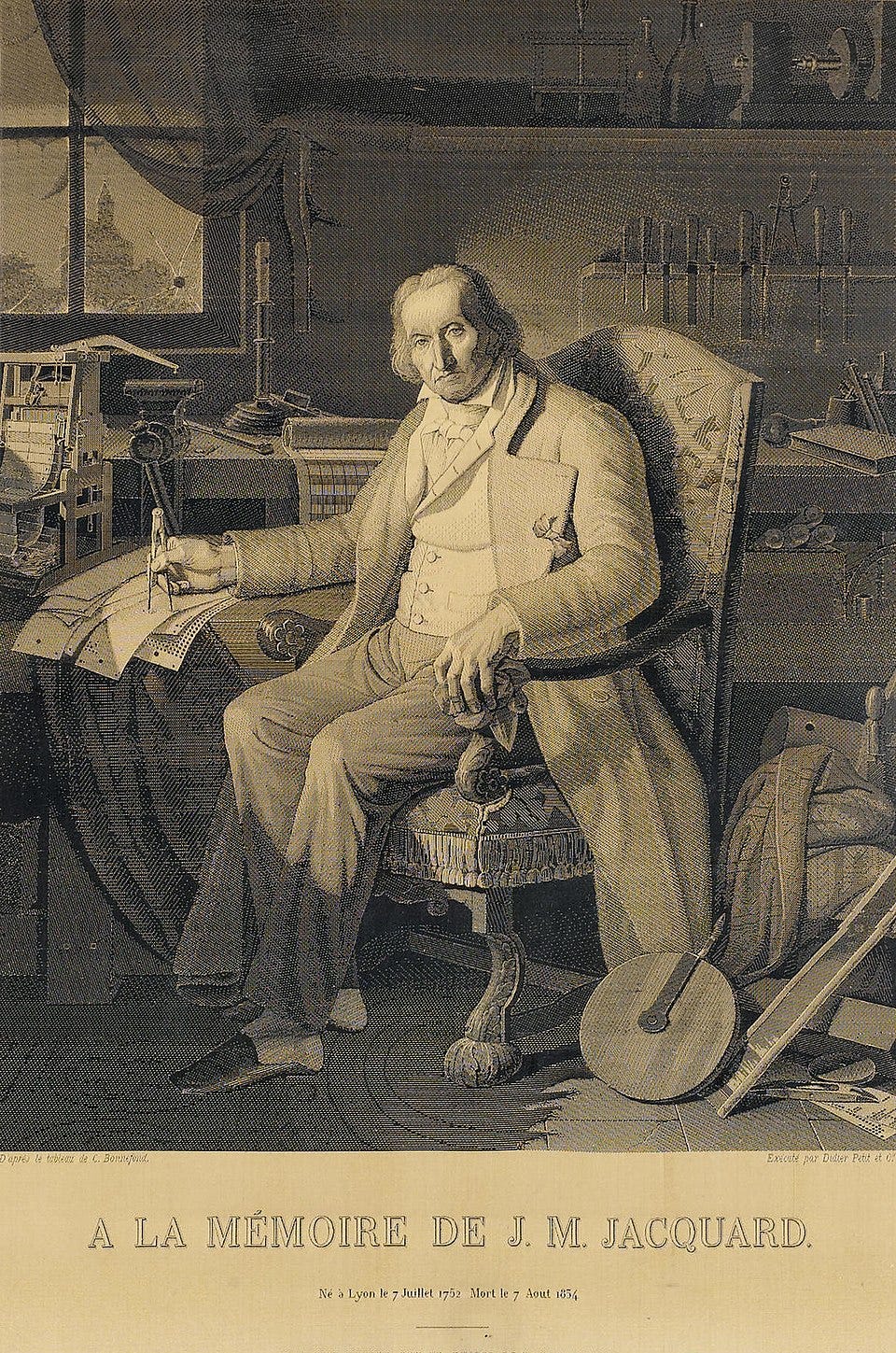
The woven piece of fabric (not an engraving) depicted a French inventor, Joseph Marie Jacquard, who had died six years earlier. He had invented and patented the loom on which this portrait was woven.
The machine (Jacquard’s loom) was controlled by a ‘chain of cards’; a number of punched cards laced together into a continuous sequence. Multiple rows of holes were punched on each card, with one complete card corresponding to one row of the design.
In effect, the Jacquard Loom was the world’s first automatic machine for weaving elaborate and beautiful images into silk.
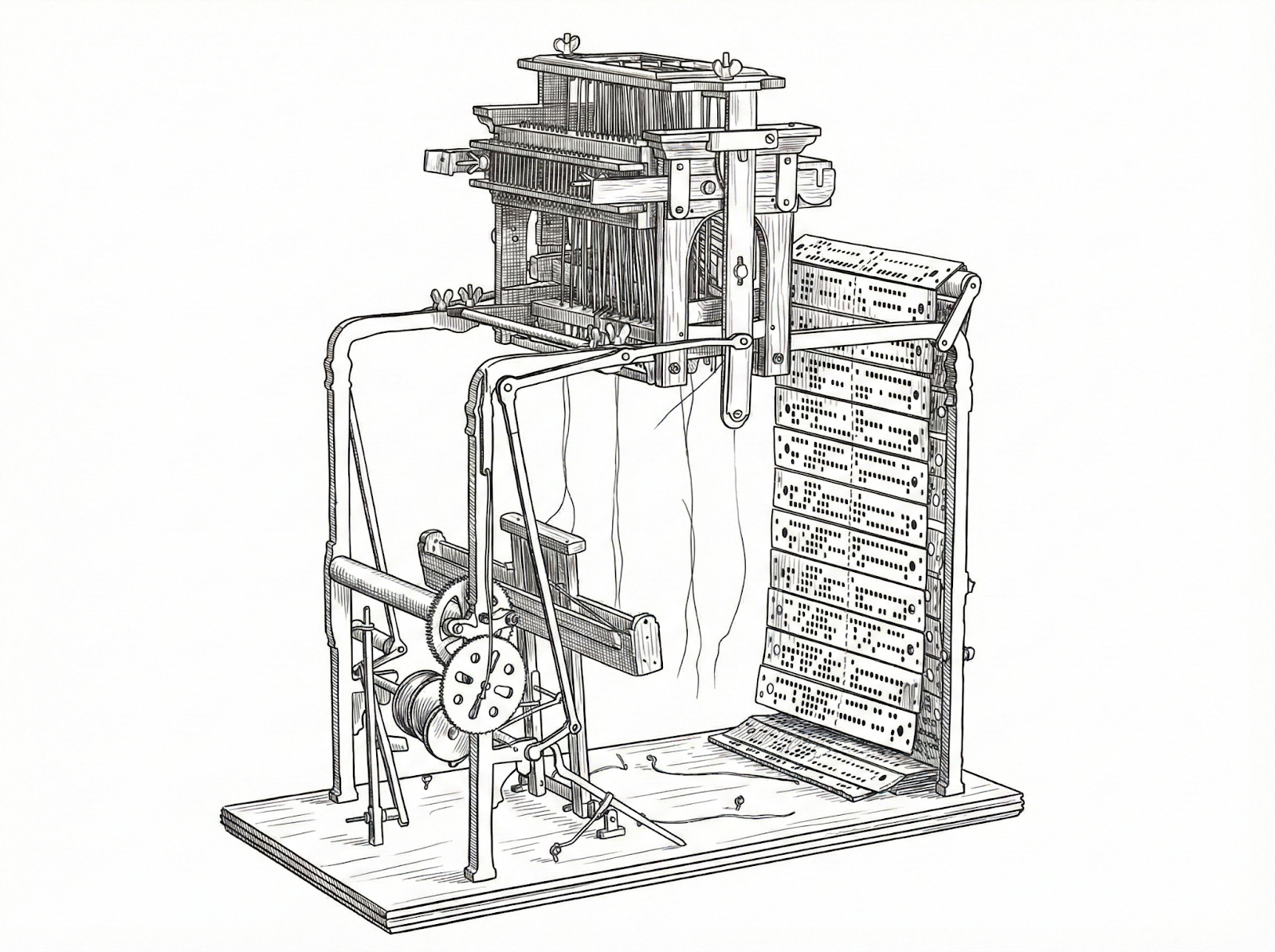
The loom made possible the automatic production of an unlimited variety of complex patterned weaves for silk fabrics, and the portrait above was woven on a Jacquard Loom.
The loom increased the speed of silk weaving by 20X. This was one of the earliest examples of using “computing” for automating a physical task.
Charles Babbage’s analytical engine was programmed using the principles of Jacquard’s Loom.
Lady Ada Lovelace (yes that Ada Lovelace, who was a close friend and associate of Babbage. She was 24 years younger than Babbage, but died 19 years before Babbage!) wrote the following about the design of Babbage’s Analytical Engine in 1843.
The distinctive characteristics of the Analytical Engine, and that which has rendered it possible to endow mechanism with such extensive faculties as bid fair to make this engine the executive right-hand of abstract, algebra, is the introduction into it of the principle which Jacquard devised for regulating, by means of punched cards, the most complicated patterns in the fabrication of brocaded stuffs. It is in this that the distinction between the two engines lies. Nothing of the sort exists in the Difference Engine. We may say most aptly that the Analytical Engine weaves algebraical patterns just as the Jacquard-loom weaves flowers and leaves. [Ada’s italics.]
In essence, one can draw a straight line from Jacquard’s Loom to Babbage’s analytical engine to modern computing, automation, and physical AI of the 21st century.
For all the AI-scepticism in Europe, p(doom)’ing, and GDPR nonsense, the origins of modern computing lay in France! Who would have thunk??
Automation and physical AI are poised to transform our lives over the coming years, whether it is self-driving cars, humanoid robots, (non-humanoid robots), automated tractors, medical procedures and diagnosis, or smart homes.
Powerful AI, coupled with sophisticated computing hardware, materials science, and advances in energy, will drive this evolution and revolution.
Much of the writing on automation and AI, and their impact on the physical world, focuses either on the underlying technology alone, on business strategy, or on extreme versions of their economic and cultural impact, whereas these topics are closely related.
“Jacquard’s Loom” will take a holistic approach by examining the how, why (and sometimes why the hell not?), what, and when of automation and physical AI.
Jacquard’s Loom is for anyone curious about how automation and physical AI will impact our daily lives. If you are curious about the future of the world, Jacquard’s Loom is for you.
Some future posts will analyze developments in the evolving landscape of automation and physical AI.
Some everyday and fun examples of automation, like robots used in restaurants to assist wait staff.
How technology has automated textiles and clothes manufacturing (in honor of Jacquard).
The difference in the Waymo and Tesla approaches when it comes to self-driving vehicles, the underlying technologies, and their implications.
Jacquard’s Loom will discuss topics in depth that are useful yet accessible to students, teachers, product managers, investors, business leaders, everyday consumers, and (maybe) policy folks as well.
As we begin this journey together, I would love to know which automation you are most excited about.
So saddle up as we go exploring the world with automation and physical AI!
Rhishi Pethe
No posts
Comments
Nothing yet. Say the first thing.
Sign in to join the conversation.