
Electric Vehicles have upended the automobile manufacturing process.
The automobile manufacturing process was perfected by Toyota in the 1970s and 80s, with principles such as Just-In-Time manufacturing, jidoka (automation with a human touch), Kaizen (continuous incremental improvement), and many others.
Tesla was one of the early pioneers in throwing the old automobile manufacturing handbook out the window. Chinese electric vehicle maker BYD has taken Tesla’s playbook to extremes, and now Toyota is learning from Tesla and BYD as it pursues its own electric vehicle ambitions.
But a different car technology (electric vehicles), a different manufacturing approach from innovators like Tesla, and the use of AI in the end-to-end design and manufacturing process have changed the manufacturing systems for automobiles over the last few years.
Electric cars are better than gas-powered cars across many dimensions of the user experience, manufacturing, and maintenance. Rory Sutherland does a great job of explaining why electric vehicles are better in this video!
The benefits mentioned by Rory have a profound impact on how the manufacturing and assembly process for electric vehicles is different from gas-powered vehicles

Nic Cruz Patane@niccruzpatane
Just a reminder why electric vehicles are better than gas cars:
2:38 PM · Feb 22, 2026 · 13.9M Views
1.5K Replies · 2.64K Reposts · 14.4K Likes
Electric vehicles have far fewer parts than internal combustion engine (ICE) vehicles. ICE vehicles (not the ICE in Minneapolis) are more complicated.
A gas-powered car like a Toyota Camry can have up to 30,000 parts, whereas an electric vehicle like the Tesla Y has between 10,000 and 15,000 parts. Chinese electric vehicle manufacturer BYD’s vehicles are supposed to have even fewer parts than a Tesla Y.
The bill of materials for a gas-powered car is like a CVS receipt, whereas with a Tesla or a BYD electric vehicle, you pay with Apple Pay and receive a receipt URL via text.
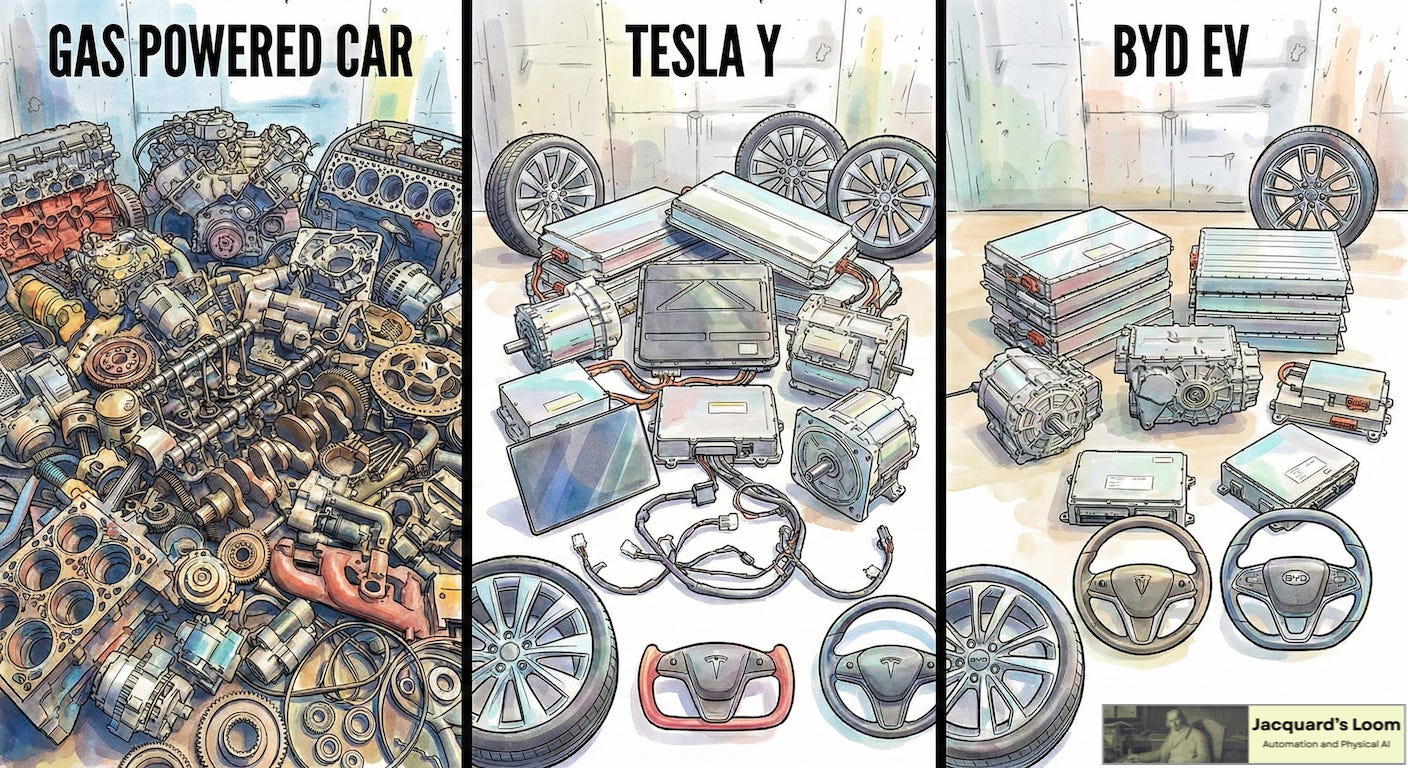
Given the fewer parts in an electric vehicle, it is much easier to maintain a reliable, predictable manufacturing and assembly process, as you are less reliant on ensuring all parts are available.
Tesla and BYD have taken advantage of electric vehicle technology and have pushed it to the extreme when it comes to manufacturing simplification. Tesla has pioneered Unboxed manufacturing, also known as Gigacasting.
Tesla’s “Unboxed Process” is a revolutionary, non-linear manufacturing method designed to replace traditional assembly lines. It aims to cut production costs by up to 50% and factory footprints by 40%.
It involves assembling large, modular sub-assemblies simultaneously, such as pre-painting and equipping doors, seats, and chassis components separately, before joining them together in a final, rapid assembly stage.
“Gigacasting” is complimentary to Unboxing. For example, to make the car’s back chassis, a traditional manufacturing process uses 80-90 sheet-metal parts and welds them together. It is a time-consuming process that requires precision.
Instead of welding 80 to 90 individual sheet-metal parts to make the rear of a car, Tesla injects molten aluminum into a single mold, creating the entire rear underbody in about 3 minutes. It eliminates about 80-90 parts and dramatically speeds up the manufacturing process.
Tesla starts with solid bricks of a custom-formulated aluminum alloy rather than a flat sheet of metal. These bricks are melted down in a giant furnace, the molten aluminum is sucked into a chamber, and then shot into a massive, closed metal mold.
The machine clamps down with thousands of tons of pressure and forces the liquid metal into every tiny crevice of the mold. In less than a couple of minutes, the mold is opened, and a robotic arm pulls out the entire rear third of the car’s chassis as one single, continuous piece of solid metal.
The exterior body of the car still uses an old method called metal stamping, even for electric vehicles like the Tesla Y.
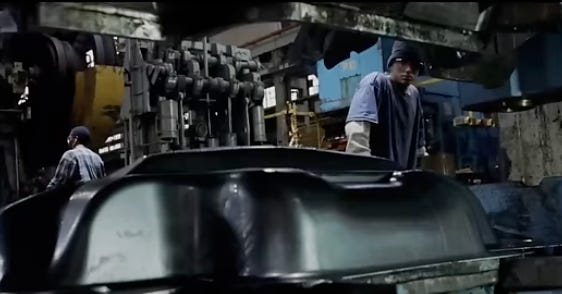
If you saw the movie 8 Mile, you might remember that Eminem’s character worked in a Detroit stamping plant. The movie perfectly captures how loud, tedious, and heavy traditional auto stamping work can be. To be fair, Eminem was most likely working on the car’s outer body, not the inner chassis.
Have you ever tried to organize a meeting with 10 people in different parts of the world, each with different availability and preferred topics? It is challenging to coordinate.
Now imagine doing this for 500 suppliers, making sure they get you all the parts you need in the right quantities at the right times so you can assemble a car. Toyota managed to do this, and it was one of the miracles of the Toyota Production Systems in the 1970s and 1980s.
Traditional internal combustion engine car manufacturers were classic assemblers and relied on other suppliers for a majority of their parts. With more than 30,000 parts, a company like Toyota acts as a master orchestrator.
For a single platform like a Toyota Camry, Toyota typically relies on about 300 to 500 Tier-1 suppliers. These suppliers sell fully assembled systems like seats, brakes, or entertainment systems directly to Toyota.
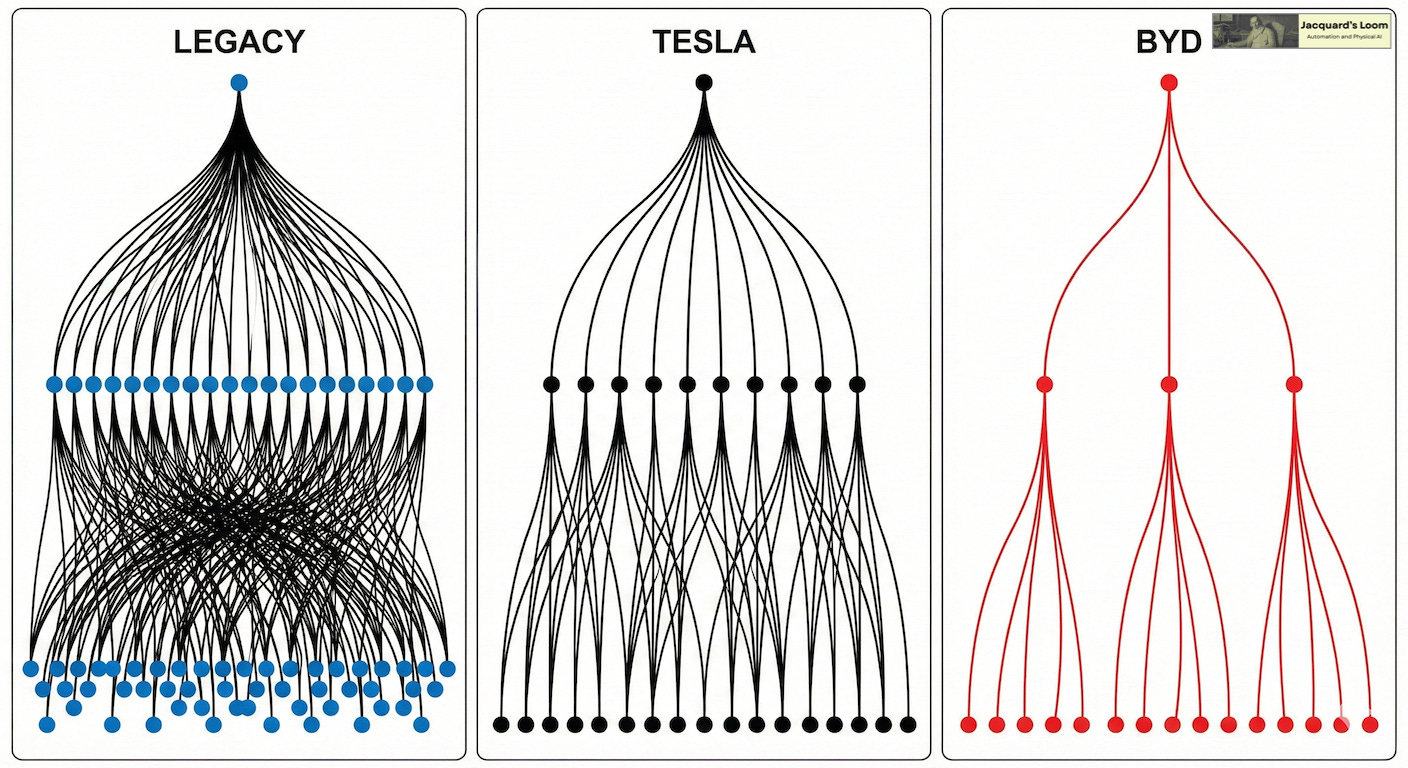
These Tier-1 suppliers, in turn, rely on thousands of Tier-2 and Tier-3 suppliers for individual screws, microchips, and other components. Toyota mastered the management of this massive supplier system (Keiretsu) while ensuring that each of those 30,000 parts arrived at the assembly line “just-in-time.”
Along with a drastic reduction in parts, Tesla and BYD have deliberately brought more of their manufacturing and assembly in-house and have drastically reduced the number of Tier 1 and Tier 2/Tier 3 suppliers.
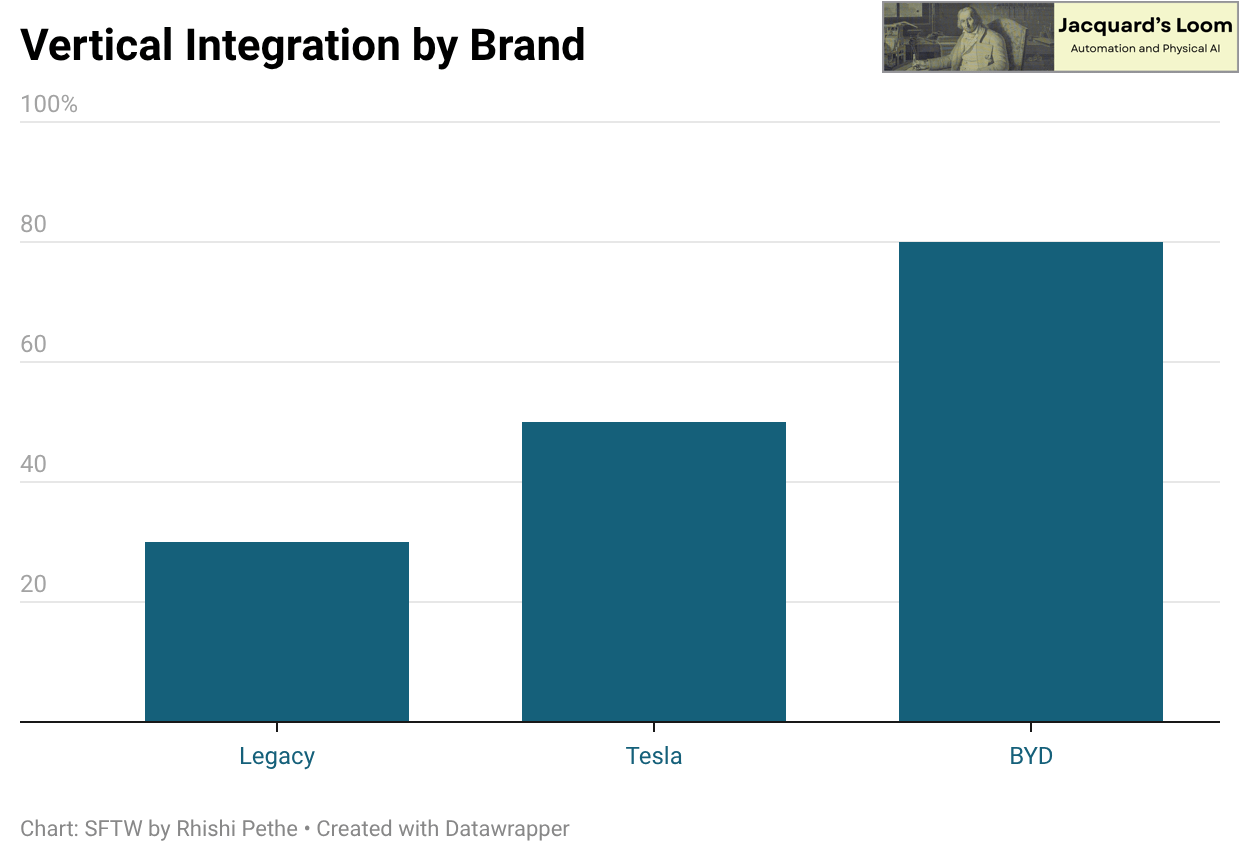
By simplifying the bill of materials for an electric vehicle, Tesla has pushed for greater vertical integration. Tesla makes its own seats, writes its own software, designs its own AI chips, builds its own electric motors, and has brought many other aspects of the car manufacturing process in-house. Tesla builds high-value tech in-house (software, motors, AI chips) and buys commodities from suppliers.
The only other manufacturer that beats Tesla at vertical integration is China’s BYD. They started as a battery company. They mine their own lithium. They manufacture their highly efficient “Blade” batteries in-house, design and build their own ships, and even own their own shipping vehicles!
BYD takes vertical integration seriously and does it mostly in-house, from raw materials to the shipping vessels. Vertical integration works best for high-volume, high complexity production like electric vehicles.
Video of BYD’s ship reaching Brazil with more than 7000 cars
BYD has found significant success in China, the Middle East, and other ex-US markets. According to Andrew Miller (August 2025) in his Changing Lanes newsletter,
In China, the Chinese EV firm BYD outsells Tesla by almost four to one. One might say that the government manipulates the market to protect a domestic firm. But in Australia, a nation without a domestic automotive sector to protect, BYD now consistently outsells Tesla. Globally, BYD recorded $107 billion in revenue for 2024, surpassing Tesla’s $98 billion.
The biggest unseen revolution happening inside modern world-class factories is driven by software. A software-defined factory represents a shift in how the entire manufacturing and assembly process is controlled, monitored, and dynamically configured by a centralized software layer.
Even though both Tesla and BYD operate highly automated, software-driven factories, their approaches differ.
Given Tesla’s closeness to Silicon Valley, Tesla runs a code-driven factory. Tesla famously wrote its own software, called Warp Drive, from scratch rather than relying on stodgy, bulky ERP software from companies like SAP and Oracle. Some of my most frustrating moments in life have been working with ERP software!
Warp Drive connects supply chain data with factory-floor robotics and direct-to-consumer sales in a single unified system. Tesla can react to demand and supply changes quickly and efficiently by taking a holistic view.
This is combined with real-time monitoring and alerting systems that enable cross-functional teams to debug issues quickly.
BYD, on the other hand, given its massive scale in battery manufacturing, heavily uses AI to analyze live sensor and visual data from assembly lines. It is old-school statistical quality control, but on AI steroids.
BYD extensively uses digital twins through accurate in-silico modeling of physical factories and associated processes. As a result, they can simulate a process change, test it, tweak it, and learn from it before pushing the changes to the shop floor.
For example, they can run a virtual wind tunnel and, using physics AI, test and adjust on the fly. Digital twins are and can be used throughout the automotive lifecycle. The importance of digital twins is to significantly accelerate the pace of experimentation and learning.
The importance of this cannot be overstated, as you can get many more cycles of iteration and improvement in the same time period than your competitors.
AI combined with sensors and IoT devices enables predictive maintenance, as every robot, stamping press, and conveyor belt is equipped with IoT devices. The predictive maintenance capability, tied to the overall factory operation AI tools, and a simplified, shorter supply chain help reduce unplanned and catastrophic line stoppages, which lead to short demand and erosion of customer loyalty.

Massimo@Rainmaker1973
Fun fact. BYD new factory in Zhengzhou will cover 50 square miles, which is larger than San Francisco's surface at 46.9 square miles.
6:40 AM · Feb 22, 2026 · 35.7K Views
22 Replies · 149 Reposts · 745 Likes
Even though Toyota has spent a few decades perfecting a large supply chain network of suppliers, the electric vehicle revolution is forcing it to rewire its playbook. They understand that outsourcing the battery and software means outsourcing the car’s core value.
Toyota is shifting towards vertical integration and adopting manufacturing processes that are similar to or better than those of Tesla and BYD. Tesla is probably taking a back seat on electric vehicle manufacturing. Tesla has discontinued two models, and is ramping up its capacity for robotics production, though they have taught some unique lessons to the industry.
As more and more car manufacturers shift to electric vehicles, they will have to reconfigure their supply chains and manufacturing processes to compete effectively with other electric vehicle manufacturers.
We will look at details of automation in each of these manufacturing processes in future posts.
No posts
Comments
Nothing yet. Say the first thing.
Sign in to join the conversation.