
I love Washington, D.C. As far as urbanism goes, it’s one of the strongest cities I’ve experienced in the United States, and I don’t say that lightly. I’ve spent time in most of the major cities, Boston, New York, Philadelphia, Portland (Maine), London, Taipei, Amsterdam and I’ve built much of my advocacy work in Pittsburgh around the same questions of mobility, safety, and public space. D.C. stands out.
But the infrastructure alone doesn’t tell the whole story. What really sets D.C. apart is its political structure.
Because D.C. is a federal district rather than a state-controlled city, it operates under a completely different governance model. That creates a strange dual reality. On one hand, it allows the federal government to treat the city as a kind of testing ground for national policy, sometimes with disruptive consequences, as we see today under the Trump administration’s handling of the National Guard, 15th St Bike Lane, and Mayoral Election. We’ve seen moments where federal intervention overrides local control entirely, with decisions imposed on the city without meaningful input from the mayor or local government.
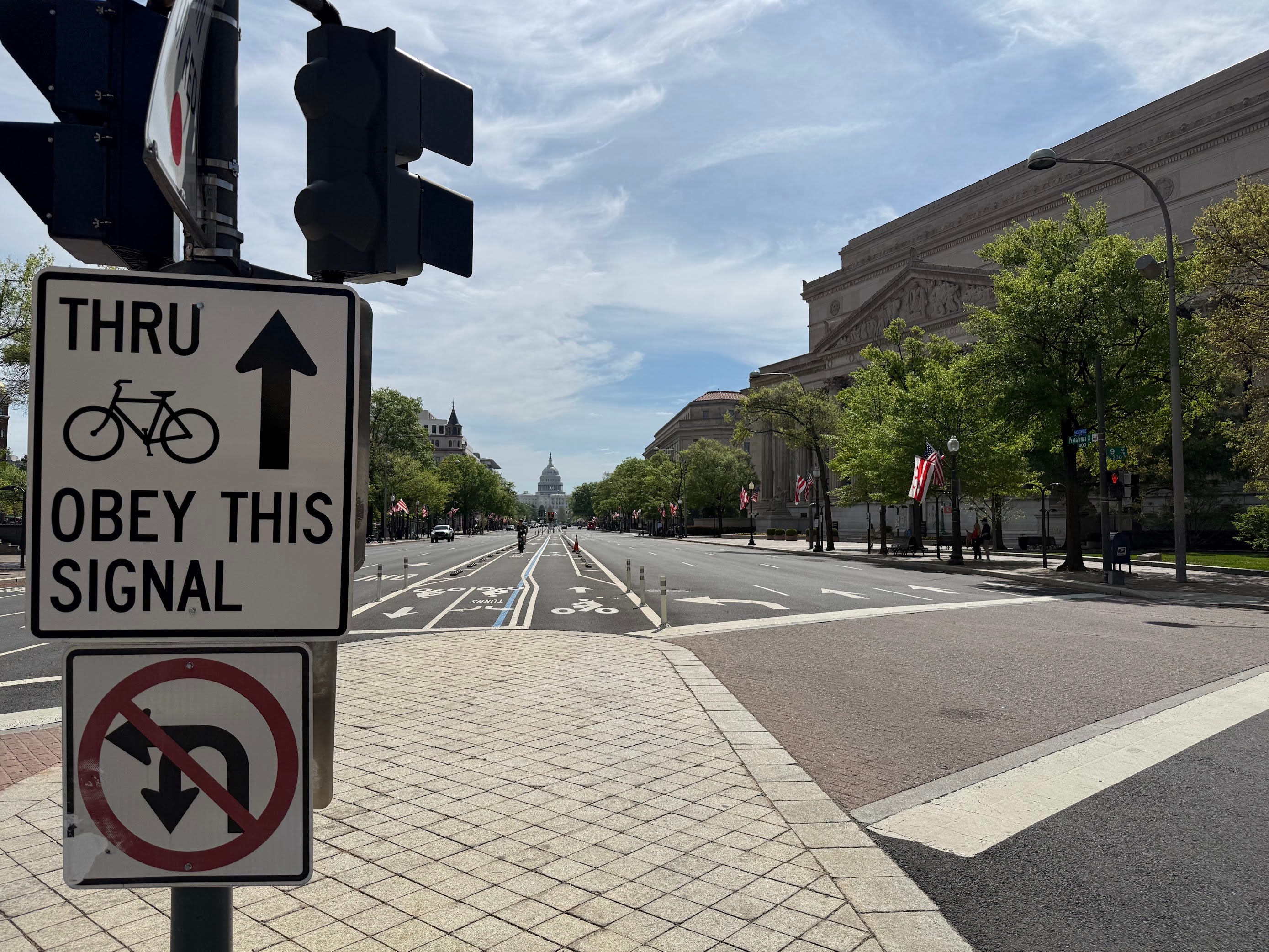
On the other hand, that same structure allows for an unusual level of speed and ambition. Federal alignment can unlock funding, policy experimentation, and implementation capacity that most cities simply don’t have. When the U.S. Department of Transportation rolls out new grant programs or policy frameworks, especially in areas like bike and pedestrian infrastructure, D.C. is uniquely positioned to take immediate advantage. Its workforce is deeply tied to federal expertise, with many staff moving between national and local roles. That matters when navigating complex grant processes or piloting new initiatives.
Compare that to cities like Pittsburgh or Boston. These cities operate within state systems, which fundamentally shapes what they can and cannot do. Even in progressive states, cities must align with broader political coalitions that include suburban and rural areas. Massachusetts is often held up as a model of progressive governance, but Boston is still constrained by the priorities of the entire state, from Western Massachusetts to the Cape. In every debate I have seen in the process of Maura Healey’s first election, there were multiple questions about policies, such as farming, that only affect Western Mass. The same dynamic is even more pronounced in Pennsylvania, where divided government makes it difficult for urban priorities to translate into statewide policy.
D.C. doesn’t have that problem. Its policies are designed for an entirely urban jurisdiction. When the city lowers speed limits, redesigns streets, or implements safety standards, those decisions are not filtered through rural or suburban concerns. That creates a level of policy clarity that is almost impossible to replicate in state-governed cities.
New York City offers an interesting middle ground. While it is subject to state authority, its sheer size and political weight give it far more leverage. The city and its surrounding metro region make up a dominant share of New York State’s population, which translates into influence. More importantly, New York has institutional structures that give it greater autonomy.
The Metropolitan Transportation Authority (MTA), for example, operates not only subways and buses like other transit authorities, but also bridges and tunnels that have independent revenue streams, such as tolls, which can then be reinvested in the city’s transportation systems. That level of control allows transit funding to stay within the system rather than being filtered through state-level priorities. Similarly, New York City’s Department of Transportation has significant authority over streets within city limits, enabling more cohesive planning across modes.
In contrast, Pittsburgh’s transit agency lacks that breadth of authority. It does not control major roadways (apart from the busways) or generate independent revenue through mechanisms like tolling. Funding and decision-making are more fragmented, requiring constant coordination with the state. That slows things down and limits what’s possible.
All of this points to a broader takeaway: governance structure shapes urban outcomes just as much as physical infrastructure does. D.C.’s success as an urbanist city isn’t just about bike lanes or transit, it’s about the institutional conditions that make those investments easier to implement.
At the same time, that structure comes with tradeoffs. The same federal oversight that enables rapid progress can also undermine local autonomy. D.C.’s model is powerful, but it isn’t entirely democratic in the way state-controlled cities are.
Still, as a testing ground for what American urban policy can look like when barriers are removed, D.C. offers a compelling case study, one that cities like Pittsburgh, Boston, and even New York can learn from, even if they can’t fully replicate it.
Thanks for reading Jacob Bikes! This post is public so feel free to share it.
Comments
Nothing yet. Say the first thing.
Sign in to join the conversation.