
Ask any owner or marketer who their best customer is and you’ll get a name in about three seconds.
Push on it — best how? — and it falls apart just as fast. Biggest invoices? Longest relationship? Nicest bloke? Nobody actually knows, because almost nobody has looked.
We carry a mental league table of customers built from memory and politeness, and then we make real decisions with it: who gets priority when capacity is tight, who gets the discount, whose calls get returned first.
I’ve watched this from the inside with a retailer whose stores covered practically every corner of the country. The logic ran the same way in every meeting: they serve the whole nation, so they must be our most important customer. Then you look at the account honestly and the story falls apart. The discounts they demanded had eaten most of the margin, serving that many locations came wrapped in red tape that swallowed hours nobody was counting, and they had no interest in growing us — we were a line in their system, not a partner. So the special treatment stopped, and the effort went to customers who gave back far more for every hour we put in. Their size, it turned out, was their achievement. Not ours.
The pattern, every time you do this exercise properly, is the same: the account everyone treats as royalty is often big revenue with thin margin, slow payment and heavy servicing. And somewhere in the middle of the list is a quiet, undemanding customer making you more actual profit than the royalty — getting none of the attention.
Loyalty isn’t a criterion. Fifteen years of thin margin and slow payment isn’t loyalty, it’s a fifteen-year subsidy.
Before any spreadsheet, try this on your top five customers by revenue. Score each question yes/no:
After their discounts and the cost of serving them, do they clear your target margin?
Do they pay on terms without being chased?
If they left tomorrow, would you replace the profit (not the revenue) within a quarter?
Three yeses — a genuinely good customer, protect them. One or none — you don’t have a customer, you have a dependency with a logo.
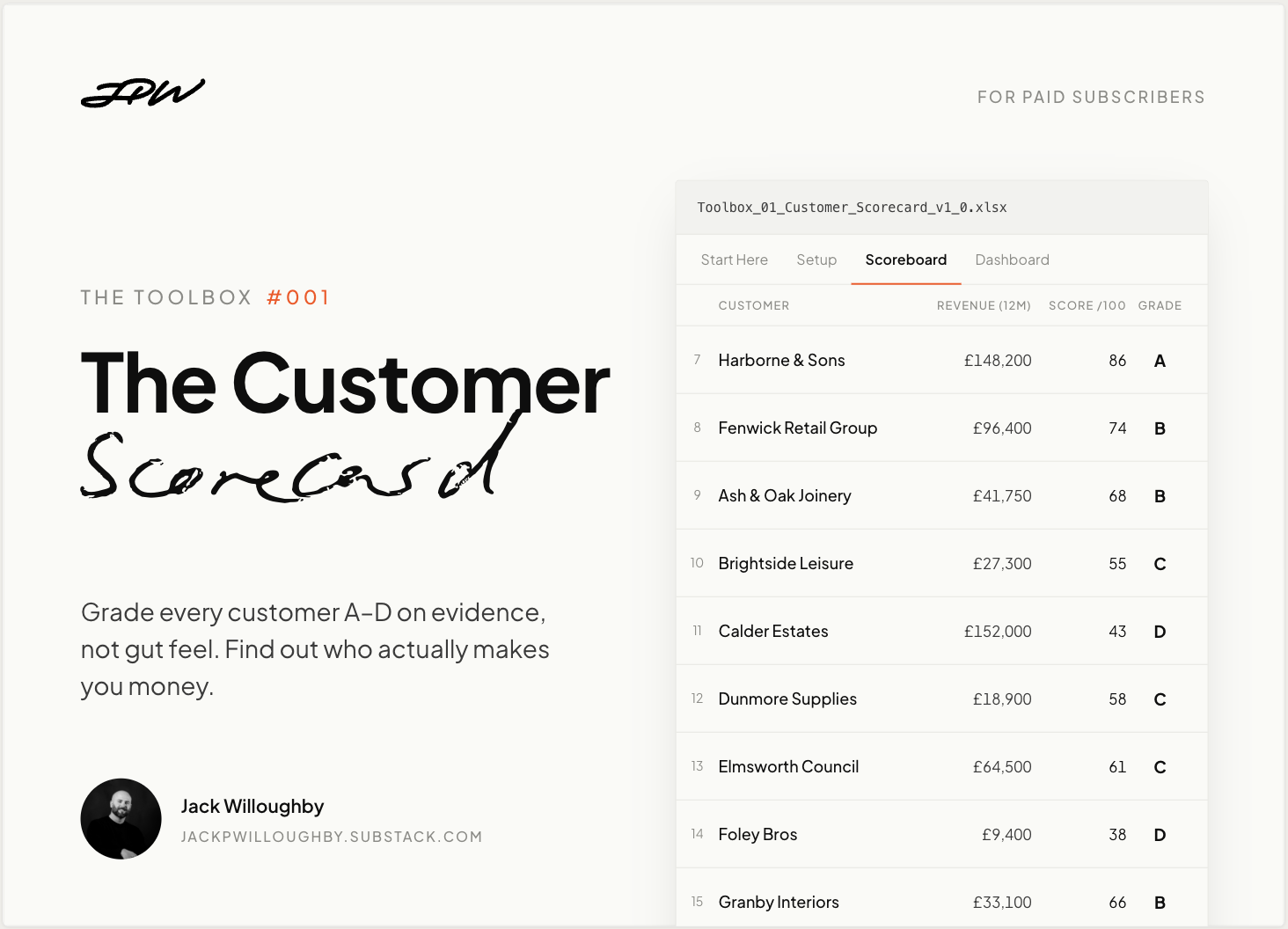
That gut check is useful and crude. The full version is a weighted scorecard: every customer scored 1–5 across eight criteria — revenue, margin, payment behaviour, cost to serve, growth potential, strategic fit, referral value, order reliability — each weighted for how much it matters to your business, producing a 0–100 score, an A–D grade, and a dashboard showing where your revenue really sits.
I’ve built it as a working Excel tool, with a guide that takes you from download to a fully graded customer base in about an hour. It’s the first drop in The Toolbox — one working tool a month for paid subscribers, each one built and used inside real businesses before it gets anywhere near this newsletter. Essays stay free. The tools are the paid tier.
Comments
Nothing yet. Say the first thing.
Sign in to join the conversation.