
I was first introduced to ‘close looking’ as an undergraduate student working in museum education. It was the golden standard of museum pedagogy through which we guided visitors through visually informed analysis of works across media. Now as a PhD student in the History of Art, I would say that it should perhaps be considered the foundation of all art historical inquiry. Close looking is key to unlocking how the things we see convey and create meaning.
It this new series, I’ll walk readers through ‘close looks’ at a variety of media from Roman visual culture. I’ll unpack exactly what we see and what it meant in a Roman context. On the one hand, this series will help you become a more astute observer of visual cultures, old and new. And on the other hand, you will learn more about Rome through the physical traces left behind across modern Europe. As a thank you to my paid subscribers, this series will be mostly a paid subscriber exclusive.
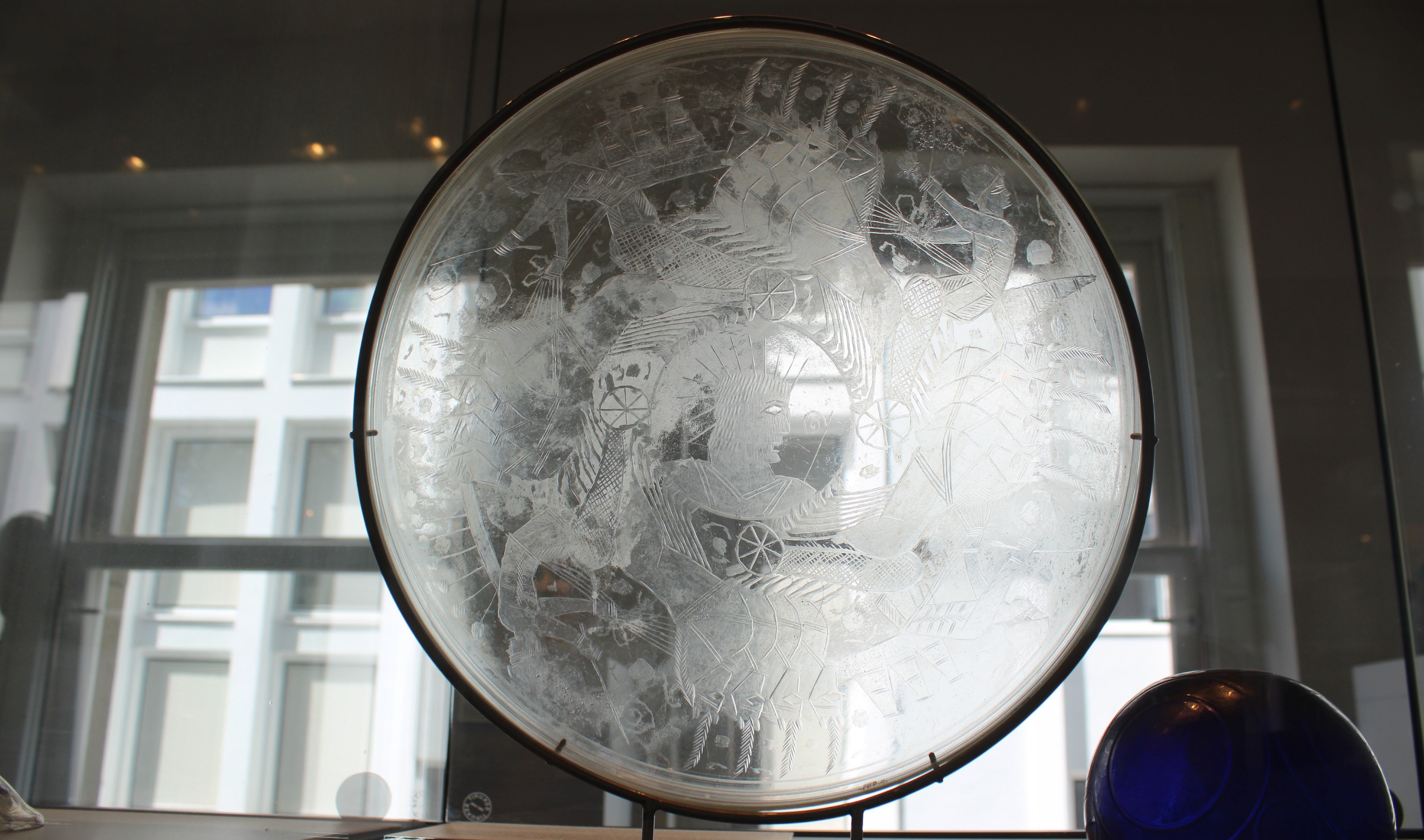
In the first installment of ‘Close Looking,’ we will look simultaneously at and through a 4th century plate from a late antique burial outside of Cologne. Known as the Colonia Claudia Ara Agrippeninensum, the city became a hub of innovative glasswork in early empire. It maintained this status into the medieval period.
Among the many techniques that seem to have been developed here is ‘cut decoration,’ or images incised into the surface of glass vessels. The subject of today’s investigation, shown above, was decorated with this technique, which was indeed quite popular in the 4th century.
With this minimal context, we are primed to take a (close) look at this magnificent object. Let’s begin with a properly art historical description.
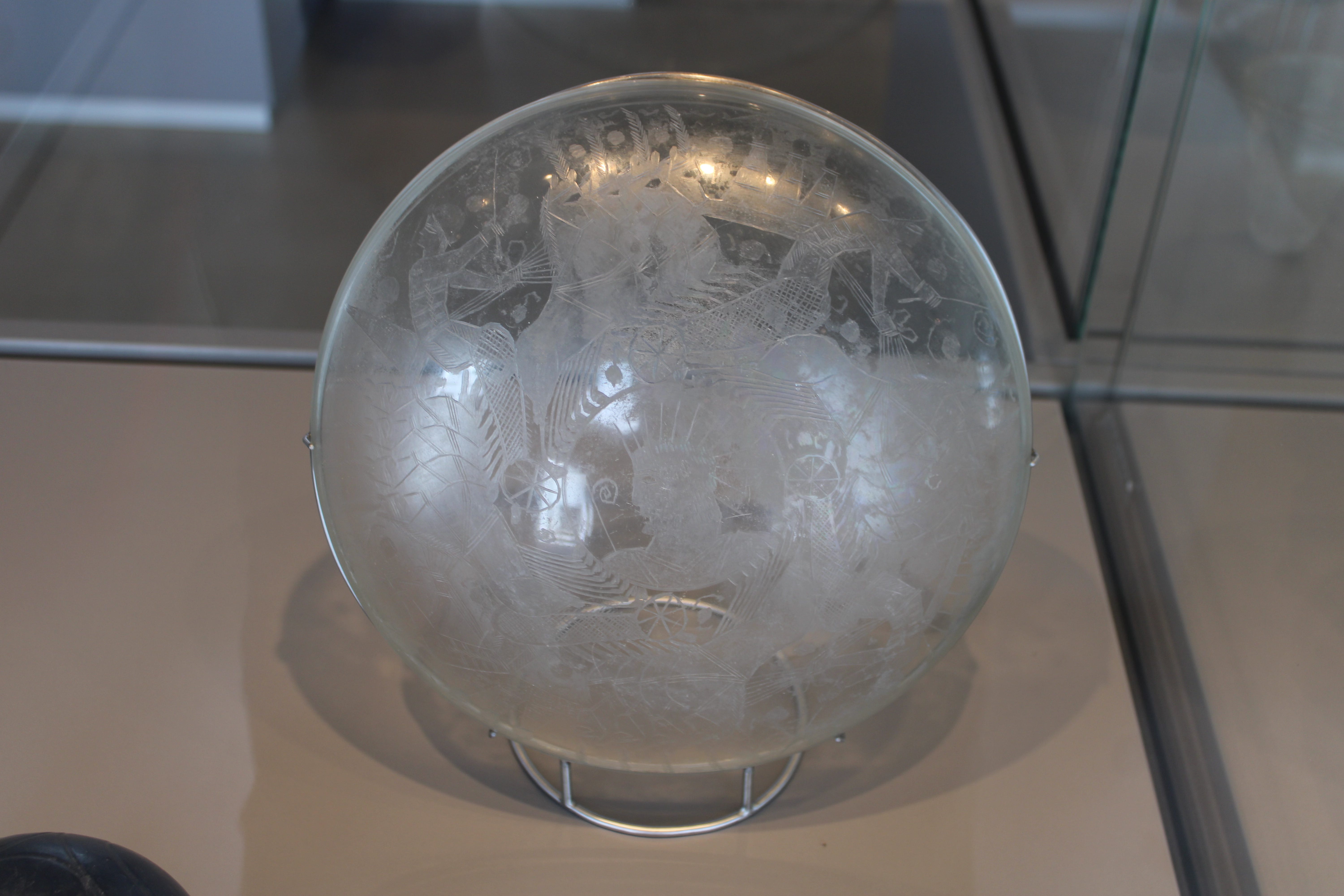
A concave bowl made of clear glass sits within a metal ring-stand in a glass vitrine. Rather than sitting on a table top, as the vessel’s form might permit, the plate stands vertically. Viewers thus have a prime view of the figural imagery incised upon its surface. It seems like the visual program is best experienced from the side of the vessel’s interior; the incisions were made on the exterior body of the form.
At the center of the bowl, a the bust of a male figure is depicted in profile. He wears a crown with twelve spikes and holds a horse-whip, or a flagellum. These are the attributes of Helios, the pagan sun god, depicted often in the late empire in both imperial and early christian contexts. At times, the god is depicted driving his chariot forward, guiding the sun around its earth-orbiting path. Yet here, he is depicted in isolation, reigning over the bowl and perhaps its user.
The sun god is not depicted alone. Outside of his isolated medallion, what we might call a tondo portrait, another register of forms tells a distinct story. Four men dressed in texture-laden garments drive their own quadriga, four-horse chariots, forward. They eagerly lean forward urging the equines with whips. Their whips are formally identical to that held by the charioteers nearby, a rigid stick attached to a curving textile, likely leather.
Each horse dons a feathered headpiece, visualizing the luxury and pageantry of the race. Indeed, the background features spina, pyramidal structures that defined the center of the circus track. Spatially, however, this composition is senseless. In a Roman circus, the spina lined the center of the elongated oval track; here, they line two distinct zones near the outer boundaries of the Rim, the divider itself is entirely elided. The spina do not serve a practical spatial purpose, they function as markers of location. They tell a viewer that the scene occurs within the raucous circus.
Having identified the images and some interesting notes about their formal arrangement, what else can we say about this plate? What did it mean for a Roman viewer? How does the depiction of Sol in the central Roundel relate to the encircling circus scene? How (if at all) does the material — transparent glass — add meaning to the imagery? Both Sol Invictus and the Circus have long legacies of holding special significance in Roman visual culture. Let’s explore some possibilities.
Comments
Nothing yet. Say the first thing.
Sign in to join the conversation.