
As a student of Roman art and culture, there are some cities that feel a bit like pilgrimage sites. Among them is, of course, the empire’s former capital, Trier, Germany. Naturally, I made time for a two-day trip to the ancient Roman capital city during my week based in Cologne. Without much planning, I booked a (non-changeable) ticket for a trip from Sunday to Monday.
There was a bit of a problem.
Nearly every museum with Roman art and artifacts was closed on Monday. This meant that I had a lot to see in quite little time on Sunday. Join me for my very Roman day in Trier, Germany. I managed to visit all of the major collections and most sites of interest to those of us inclined towards the ancient world. As I recount my day, I’ll share a bit about the history of the site, its importance in Roman culture, and some of my favorite finds from the day. All of the photos are my own.
Trier is considered to be among the oldest cities in Germany. It was founded as Augusta Treverorum, named for Augustus who founded the settlement and the Celtic Trevers who occupied the region. It gained the status of Colonia under Claudius. Though, the first century was a tumultuous time as local populations occasionally pushed back against Roman colonization.
The second century was a period of peace and prosperity. Monumental architecture, like the Porta Nigra, and public works, like the Barbara baths cropped up across the city. It became a hub of early Christianity, with the city becoming the seat of a bishop as early as the latter half of the 3rd century.
In the third century, again, chaos reigned. Germanic sacks left the city in turmoil. At the later end of the this century it seems that Gaul had ruled itself separately from the Roman Empire until Probus and Maximianus reconquered the territory. Once Diocletian divided the empire into quarters under the tetrarchy, Trier served as the capital of the Northwest administrative region under the leadership of a Caesar that included Gaul, Brittania, and Hispania. At this point, Trier was equipped with imperial infrastructure like sprawling villas, the ‘Imperial Baths, and Constantine’s basilicae.
Now, without further ado, let’s take a look at many of this monuments and other incredible objects I encountered during my day in Trier!
10:30 AM
My train arrived at Trier’s Hauptbahnhof, the main train station. I set off on a ten minute walk towards the Porta Nigra, the monumental northern gate of the Roman city. In addition to being a legendary Roman monument, my hotel was conveniently next-door. I dropped off my bag and set off for a day of exploring.
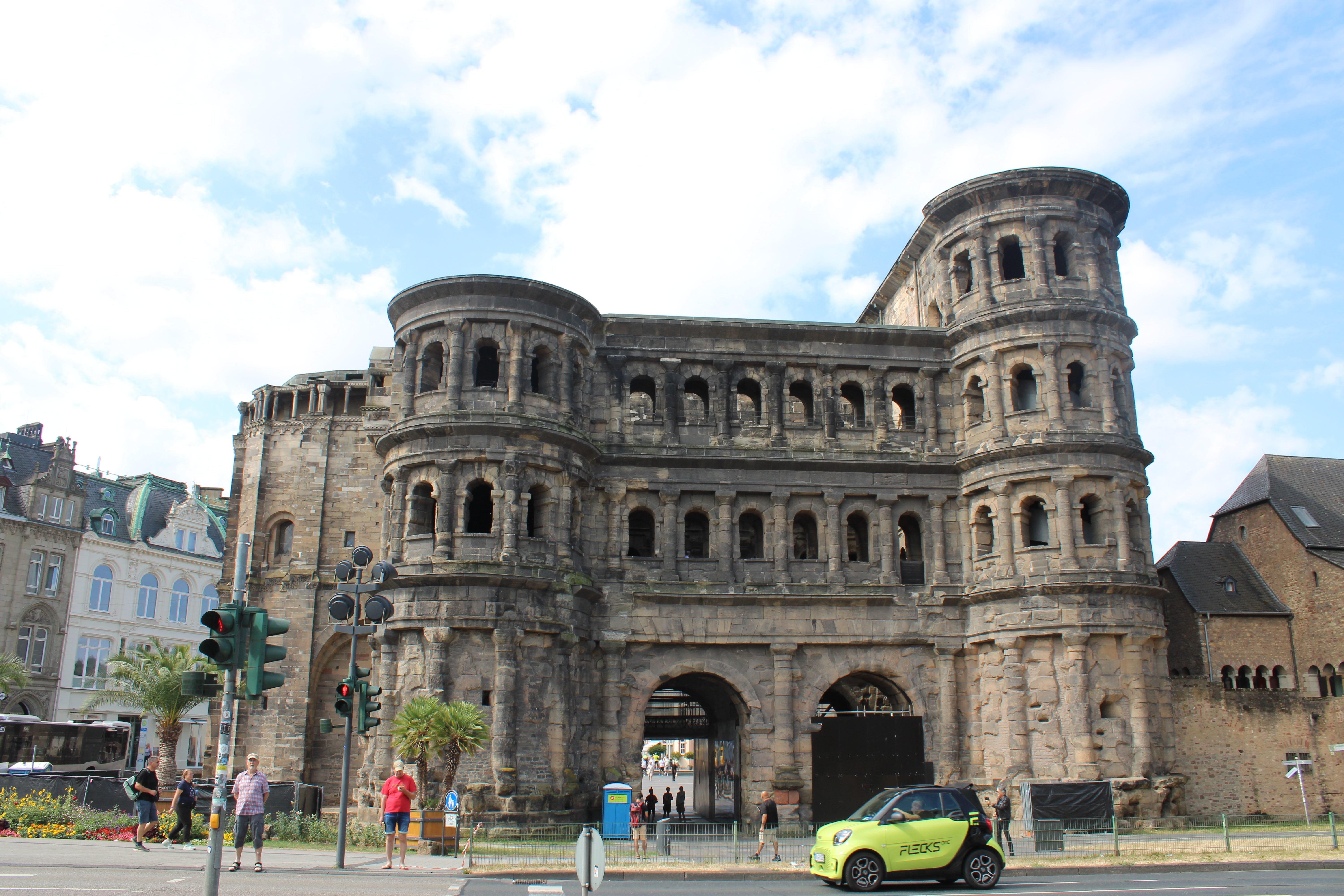
Unsurprisingly, I walked through the gate on my way into the heart of Trier’s Altstadt, or old city. It is currently undergoing restoration on the interior and south side. But, based on the north side shown above, we can see the general form and grandeur of the Roman gate. The extensions on the left and right, differentiated by brick type and scale are later in date, and the upper story of the left tower is now lost.
The Porta Nigra was built around 170 from local stone by order of Marcus Aurelius. The double arches facilitated the management of traffic into and out of the city. It leads directly onto modern Simeonstrasse, named for the hermit monk who called the gate his home in late antiquity. Simeonstrasse aligns with the Roman cardo, the central road running North to South in the Roman city. Meanwhile, the decumanus, the central road running east to west, corresponds to modern day Kaiserstrasse.
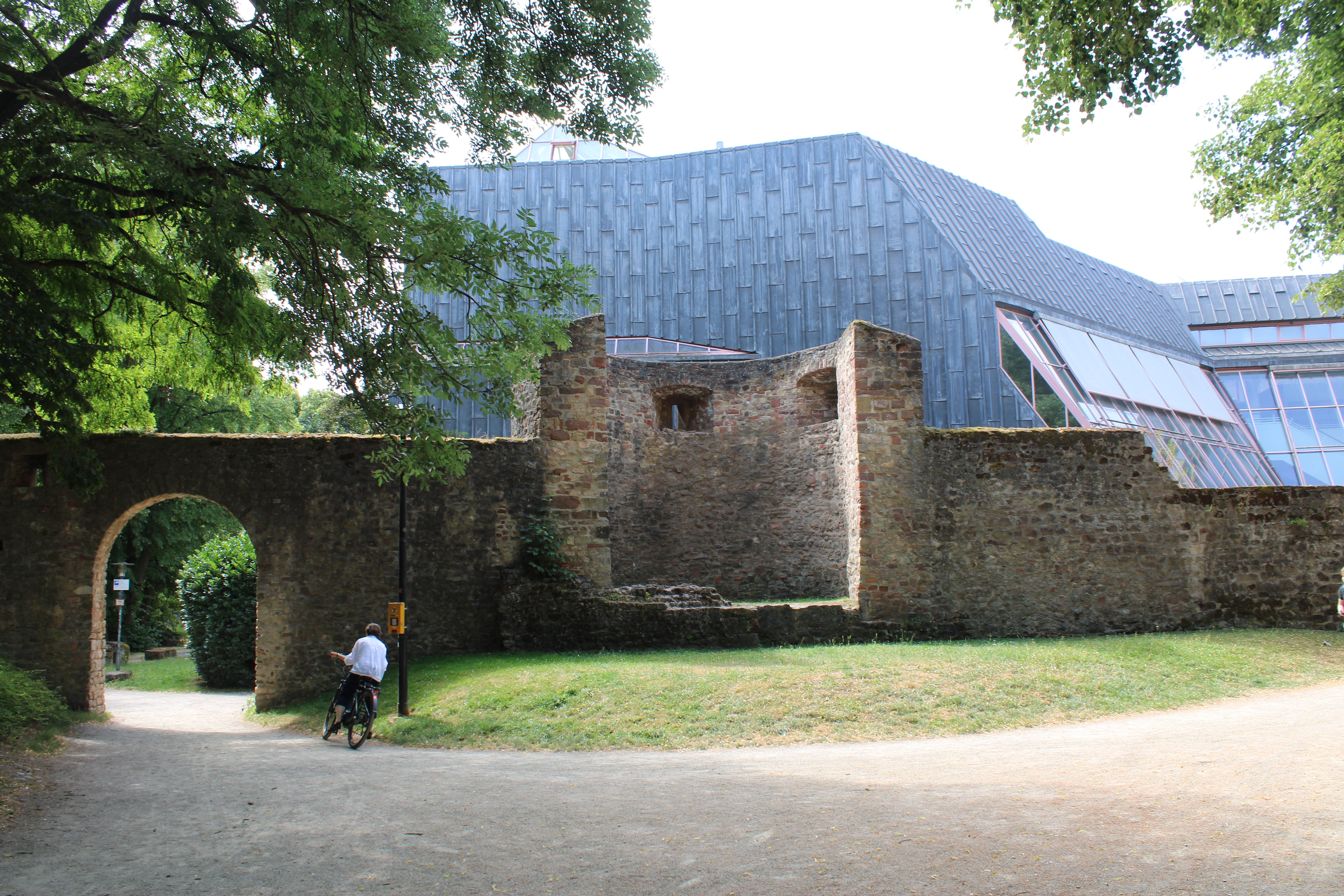
11:00 AM
I wandered down Simeonstrasse and passed some of the monuments which I’ll return to later; eventually veering eastwards, I found myself at Trier’s Landesmuseum. The collection here is one that a student of Roman Art History certainly encounters during their undergraduate study. Some of the most iconic grave monuments of Roman visual culture are displayed here.
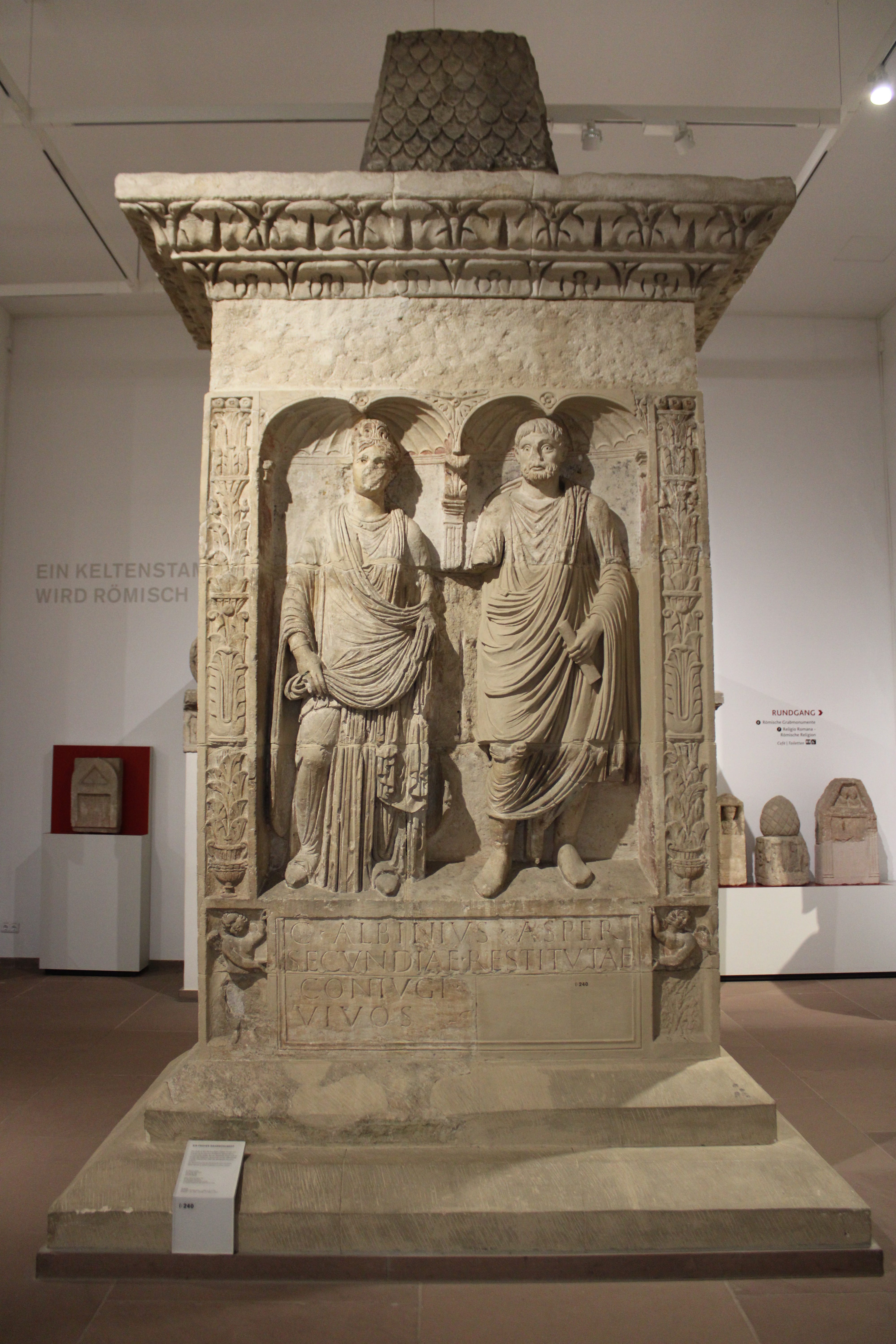
Obviously, I made my way directly to the Roman galleries. There was no time to spare. Upon entering, visitors are immediately confronted by this massive monumen: the tomb for husband and wife, Gaius Albinius Asper and Secundia Restituta. Each figure is represented standing within a conch-roofed apse. They are named in the inscription that survives below.
Secundia dons an intricate updo, while Gaius’ hair and mustache place us squarely in the first half of the 2nd century. Some aspects of the tomb are quite common in Roman funerary culture: the portraits, Gaius’ scroll, the architectural setting. Yet others, especially Secundia’s pose, hiking up her chiton, seemed unique to me. Monumental tombs were commonplace in cities across the Roman Empire, they lined the major roads leading towards the center of the city, showcasing the personal and political powers that waited within the walls.
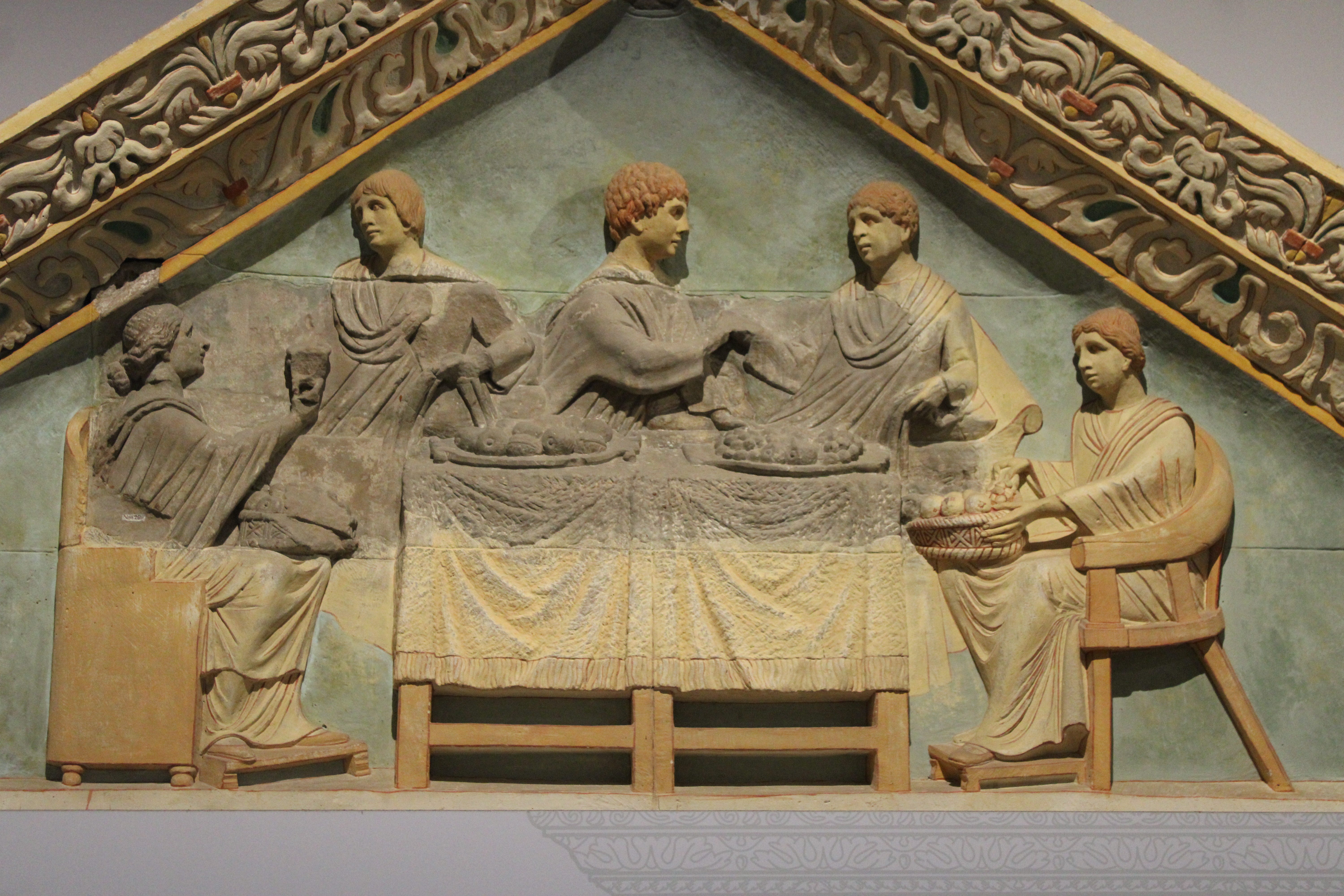
I was especially intrigued by the restoration practices in this museum. Lost fragments were recreated in color. This managed to effectively delineate between modern and ancient, while also offering an idea of the impression of ancient polychromy. Surely, these colors are not based on any p-XRF analysis or pigment residue. At the very least, they offered a poignant reminder that these monuments were not monochrome as they survive today.
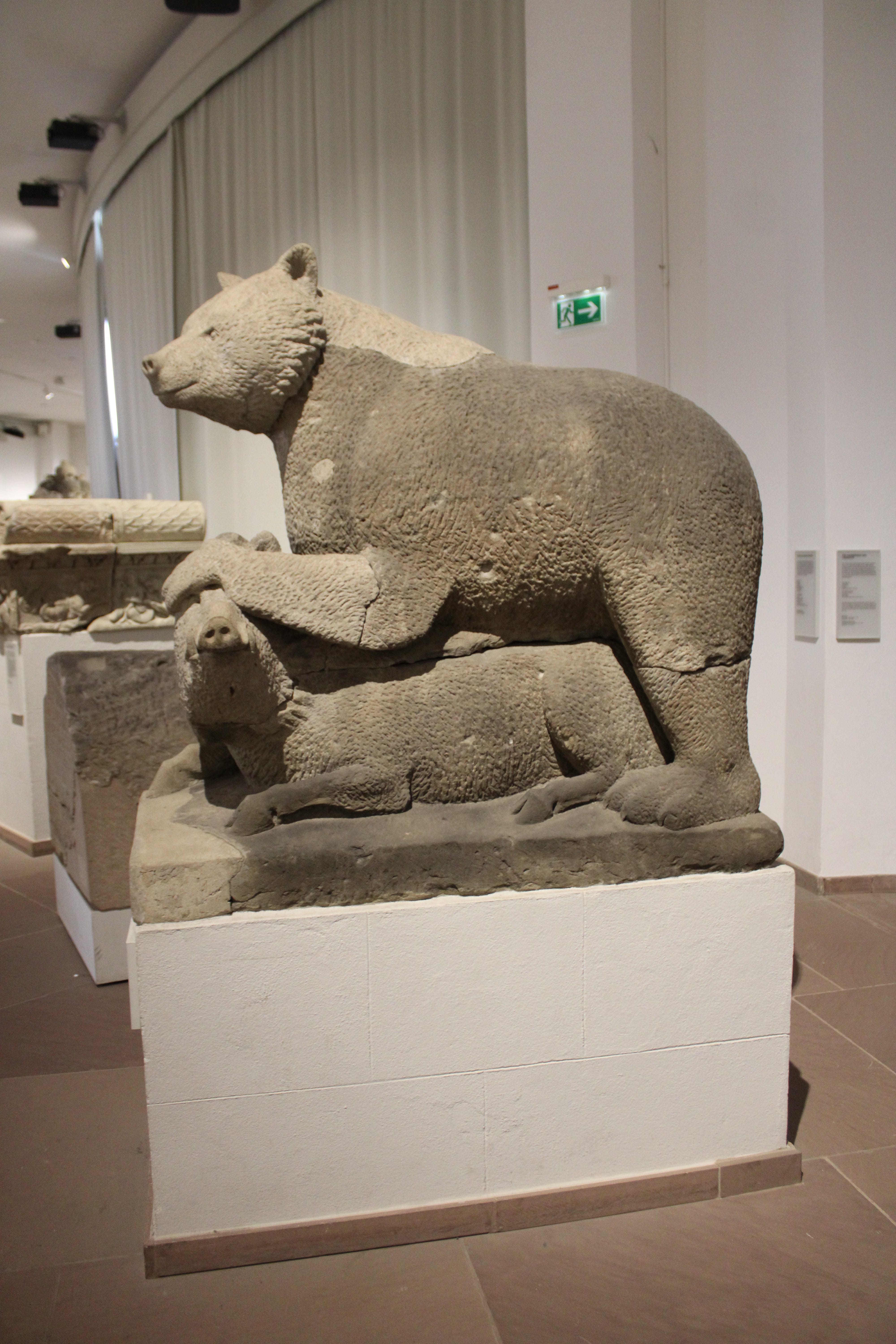
One of my favorite monuments here in Trier is the bear attacking the boar. To think that someone decided to memorialize themself or family with what could be perceived as a gruesome and violent image is a bit unsettling. However, the bear looks quite… tranquil, so I find it mildly amusing. I’m curious if modern restoration might be the culprit there, but I have not been able to clarify (I’ll update this if I can figure it out).
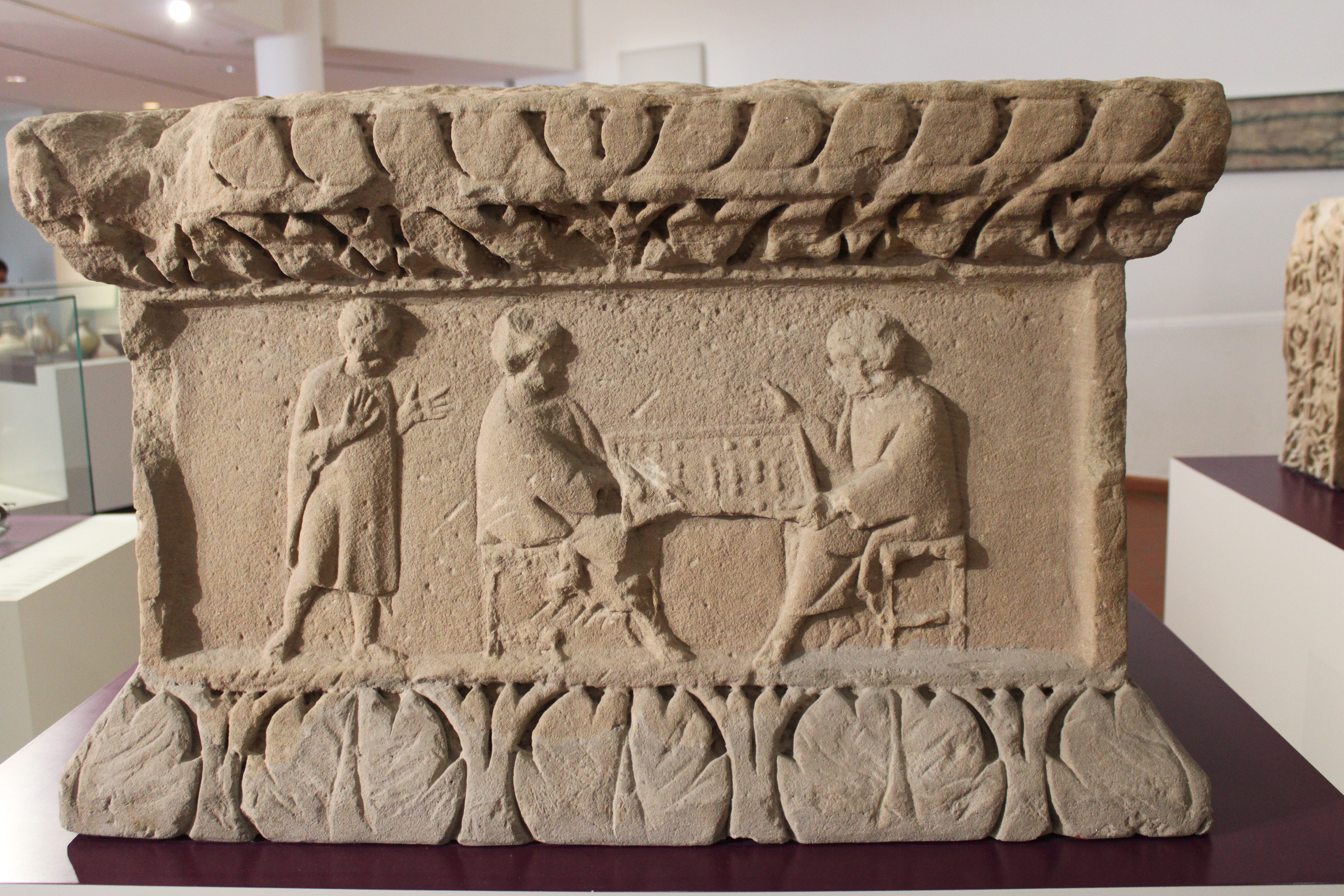
Next, this sweet monument depicts some lads sitting down for a game of ‘tabula,’ something akin to Backgammon today. The archaeological record is replete with small tokens of glass, ceramic, and metal. It seems that such tokens were used regularly in games like this. The small beads on the table tops are representations of such tokens.
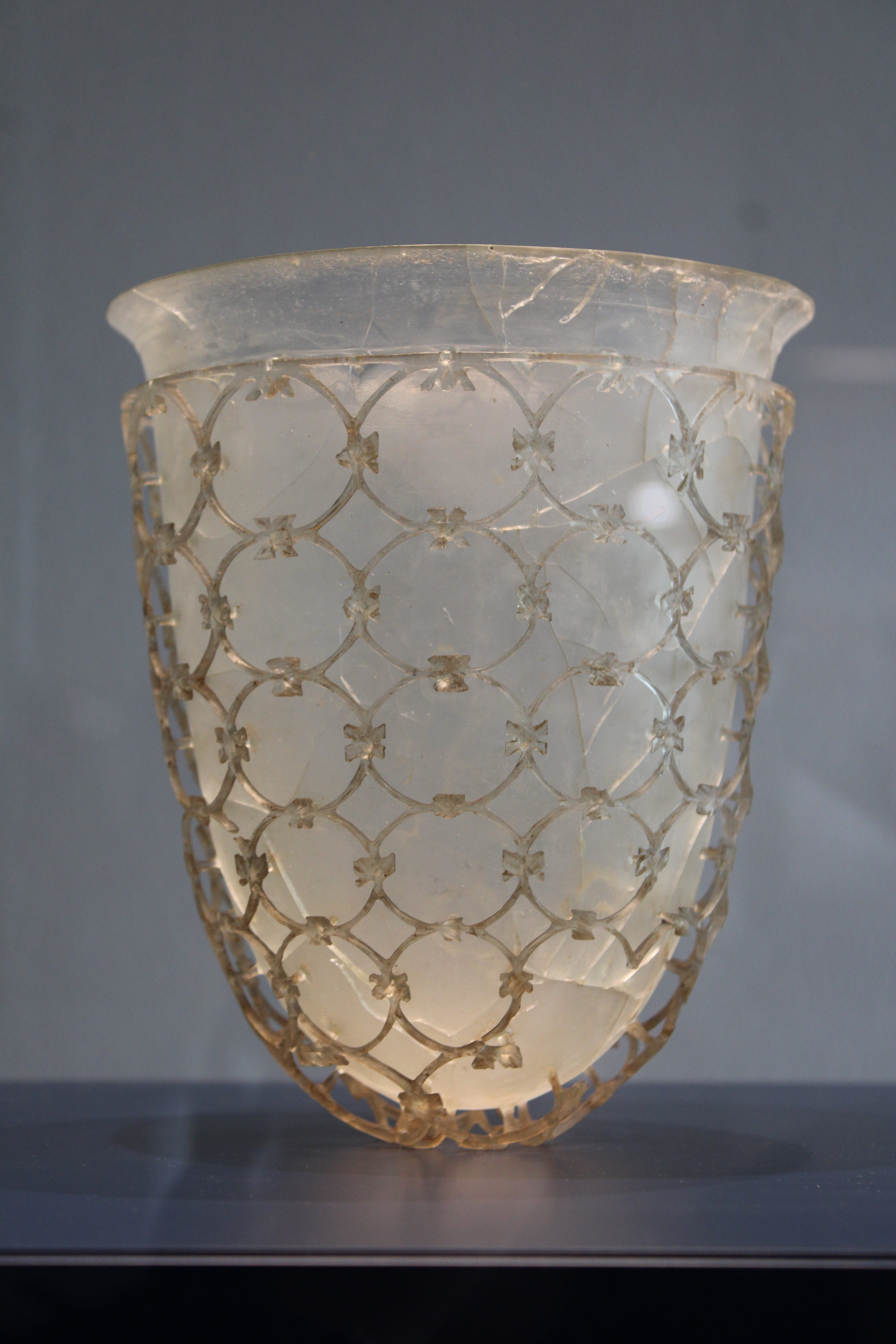
I eventually wandered upstairs to the glass collection. I was thrilled and surprised to find another example of Diatreta, or cut-work glass. These vessels were the epitome of late antique luxury; carved from a single monolith of glass, artisans needed superb control of their lathe to remove just the right amount and form of glass to create a delicate ‘cage.’ This example is quite large and it was unearthed from a tomb outside of Trier. Other examples are preserved in Cologne, Munich, the British Museum, and the Corning Museum of Glass. There is a concentration of such objects in Gaul; some scholars think that they may have been produced nearby in Cologne.
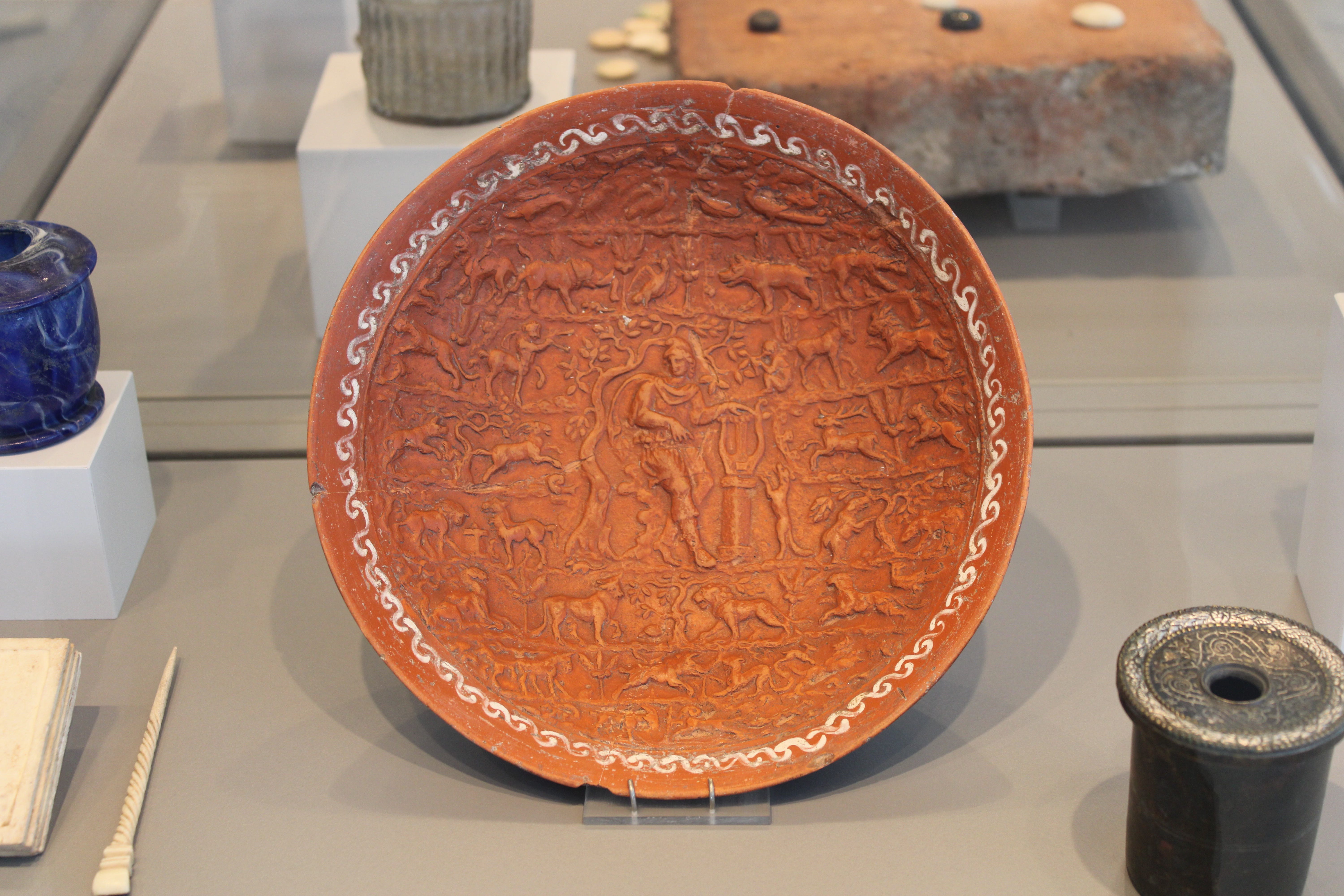
Something else that was an extraordinarily incredible connection to Cologne is this rather unassuming mould (below). This was used to create finely decorated ceramics by pressing the clay into the form. The scene features Orpheus amidst fauna sitting among a series of horizontal registers. Immediately upon noticing it, I realize that image was quite familiar.
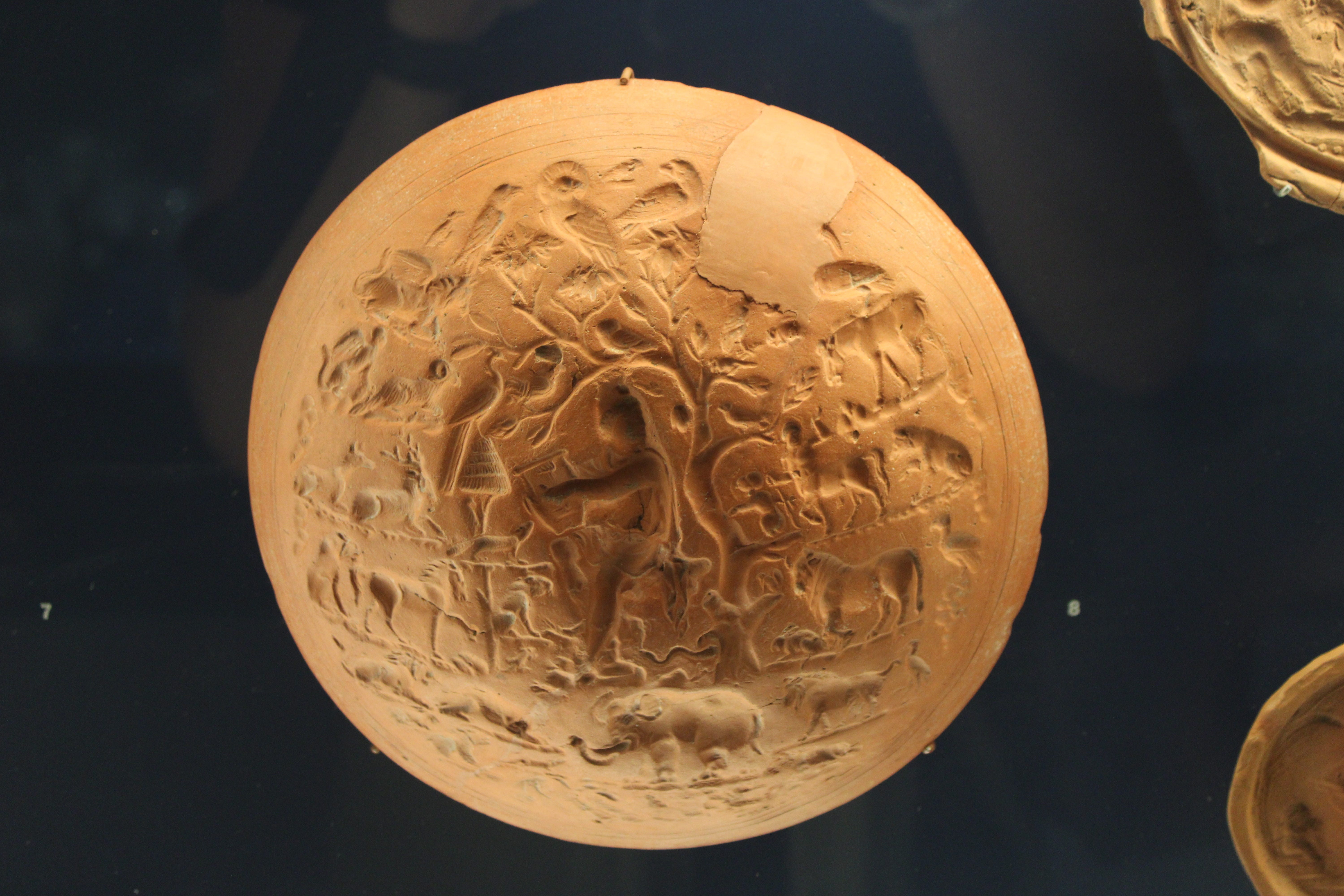
Indeed, I had just seen the reverse image in Cologne on Friday. Their collection holds a vessel made from this very mould! Notice how the Cologne bowl has added details in white pigment; the wave motif encircles the forrest-scene with an aqueous border, as if to suggest a body of water encircles the mythical landscape.
1:00 PM
I needed a lunch break. I wandered to a cute restaurant nearby and whipped out my notebook to take some notes and reflect on the many incredible monuments and images I saw here. I’ve shared just a handful of many.
Before I knew it, I had to get on to my next adventure, the Museum am Dom. This museum preserves local history from antiquity to the early modern period. Again, with my lack of time and waning energy, I devoted my time here to finds from the early church which make up a bulk of the Roman collection.
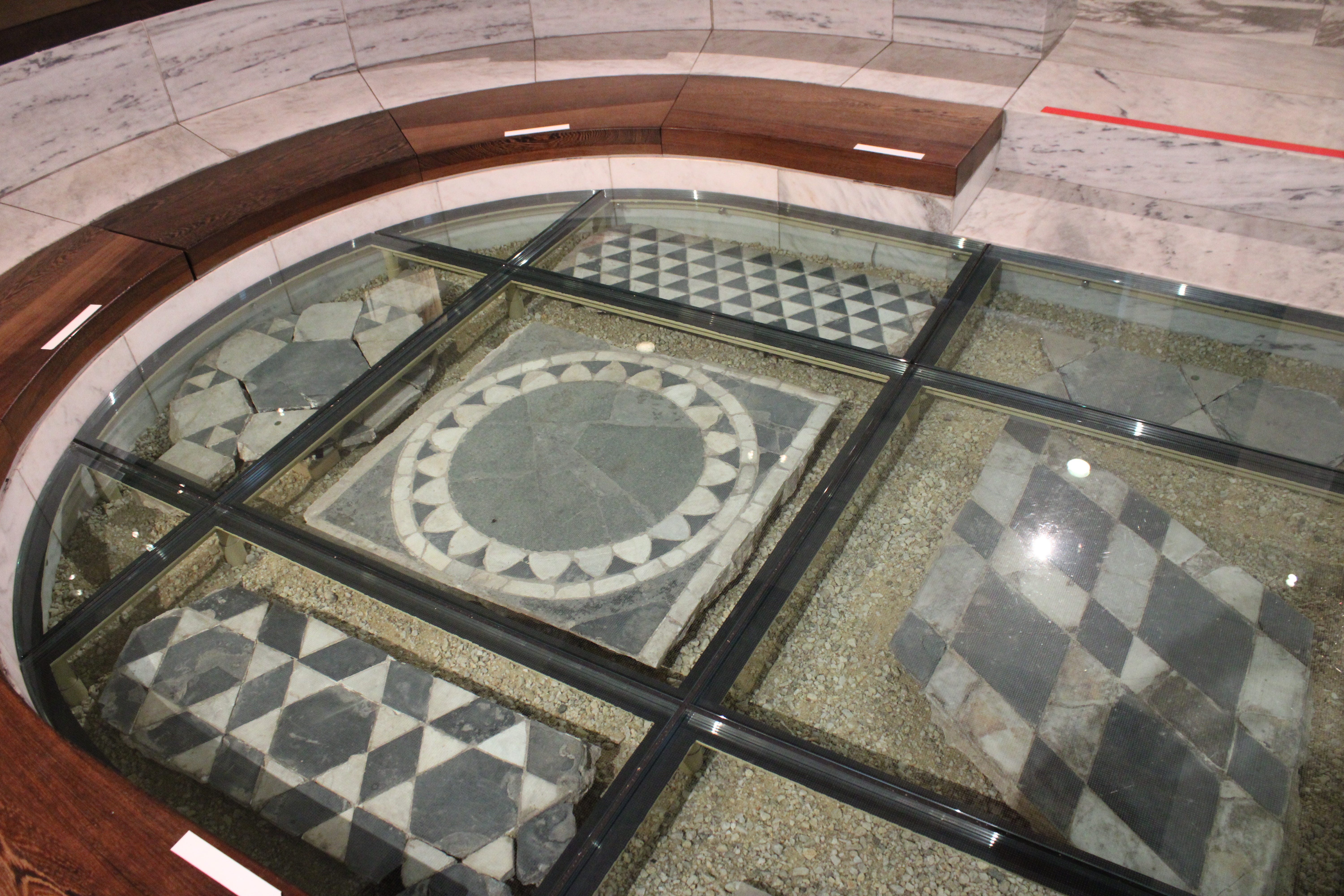
Some of the finds on display included an opus sectile, or cut stonework floor, from the basilica. I appreciate being able to walk over the floor pieces while they were protected by the clear plexiglass.
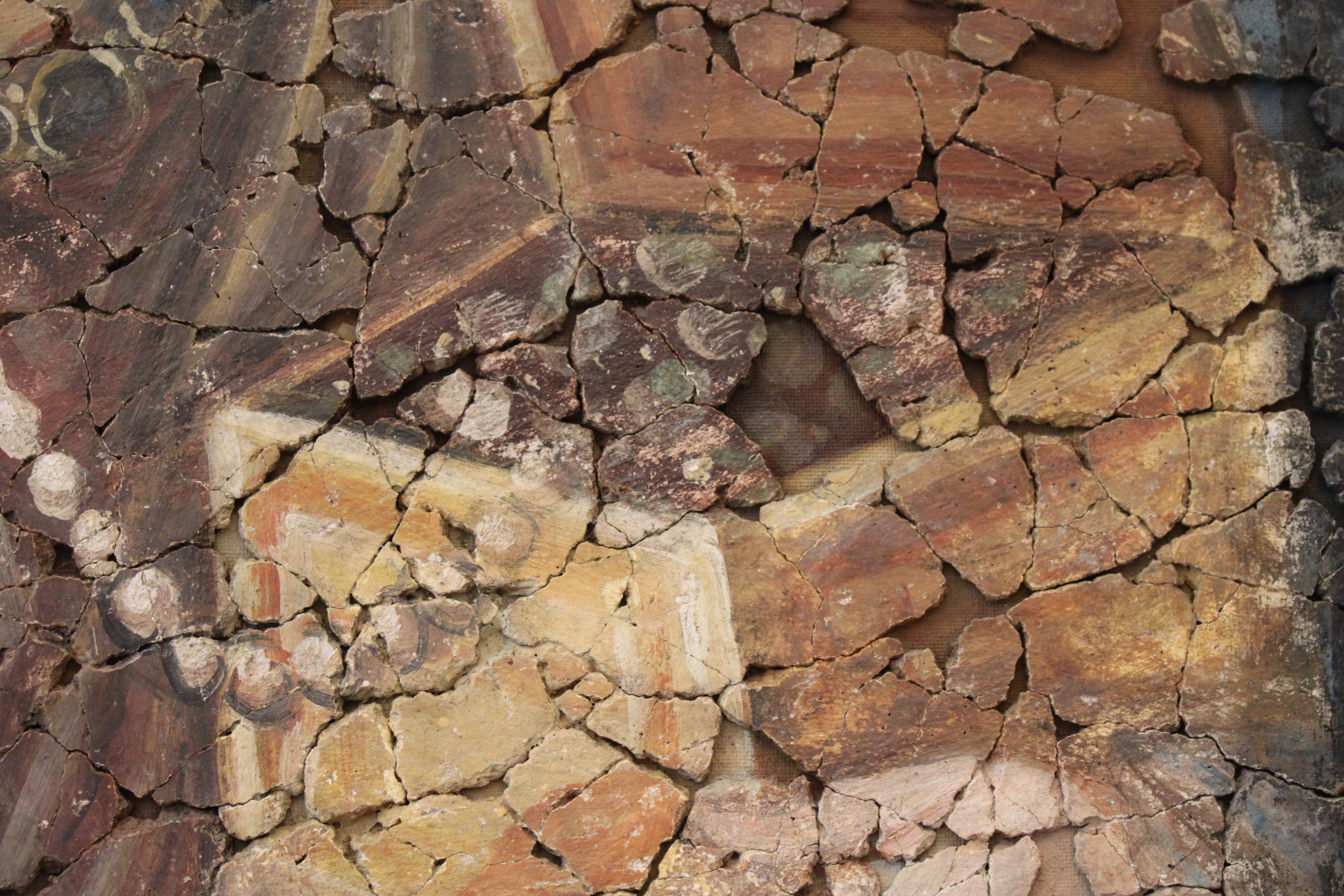
The museum, perhaps most impressively, preserves a series of reconstructed painting panels. They were recovered in fragments from excavations below the Trier Cathedral and seem to come from the ceiling of a large villa that was demolished to construct the sacred building. The cycle includes seven pairs of winged mythological figures, including Cupid and Psyche, four women crowned by nimbi, and three philosopher-poets. I’ve selected one panel and some details to show here. The quality of the painting and their scale is simply astounding.
While the subjects of the portraits are debated, it is clear that they were meant to be quite wealthy. Other than her gem-filled casket, she wears a necklace defined by large green gems encrusted in golden settings. She wears a golden floral crown while holding a string of pears between her fingers.
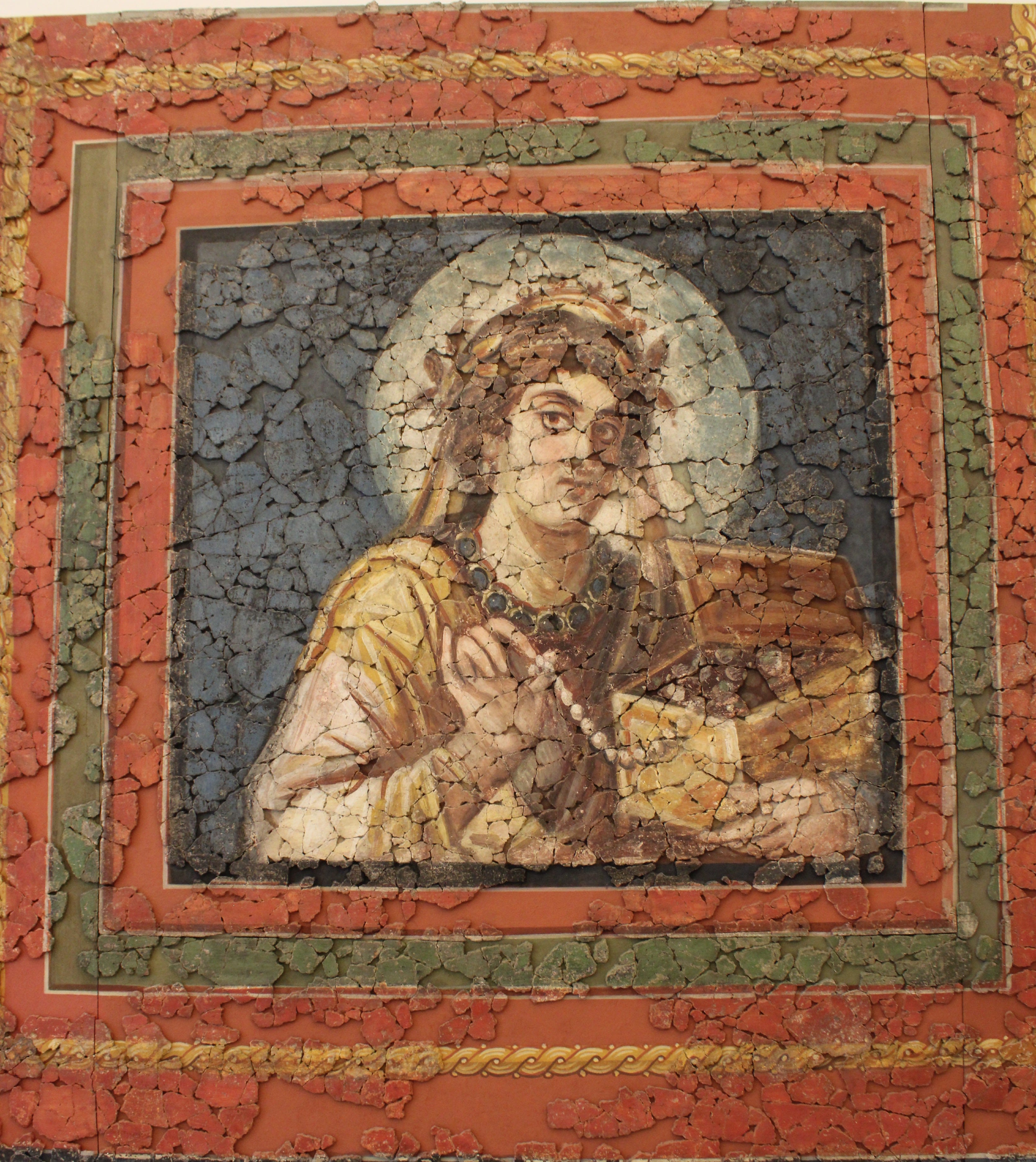
This iconography reminded me of popular funerary images in which wealthy women grasp their fine jewels as an attendant holds their jewelry box. Here, however, there is no attendant and the subject looks right at us. Since this was on the ceiling, she would have been looking down at us. I wish I had more to say about the image, but I’ll be thinking about it for a while. I’d love to hear your thoughts!
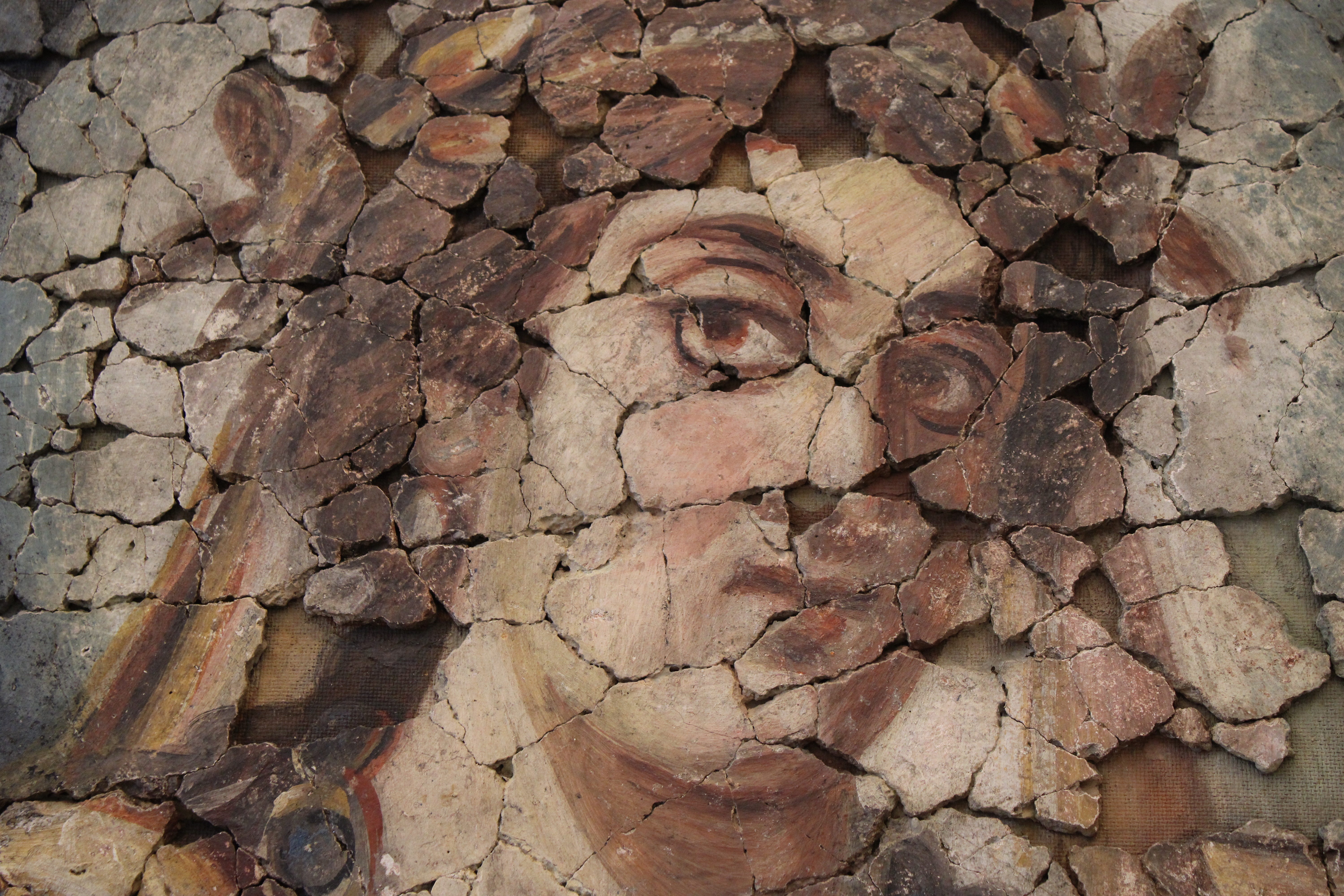
I’ve never seen life-size figural paintings from late antiquity. I also honestly had no idea that these paintings existed. It was truly such a surprise to encounter these images, and I am excited to continue thinking about them and what they suggest about late antique domestic space and visual culture.
I also took some time to explore the Romanesque Cathedral while I was there. The interior was surprisingly open; it was great to visit the Gothic cathedral in Cologne just a few days ago. This was the first time I had visited a true Gothic and Romanesque church, the comparative experience has been a helpful art historical baseline.
2:30
At this point, there was one more monument I needed to see: the Aula Palatina. The single-nave basilica was first built by Constantine in the 4th century. Although the other Constantinian basilica in Trier, on the site of the present Cathedral, does not survive intact, this one stands. Although severely damaged during a fire during the Second World War (1944), restoration work salvaged the ancient site. Indeed the interior Roman brick was only revealed after these repairs.
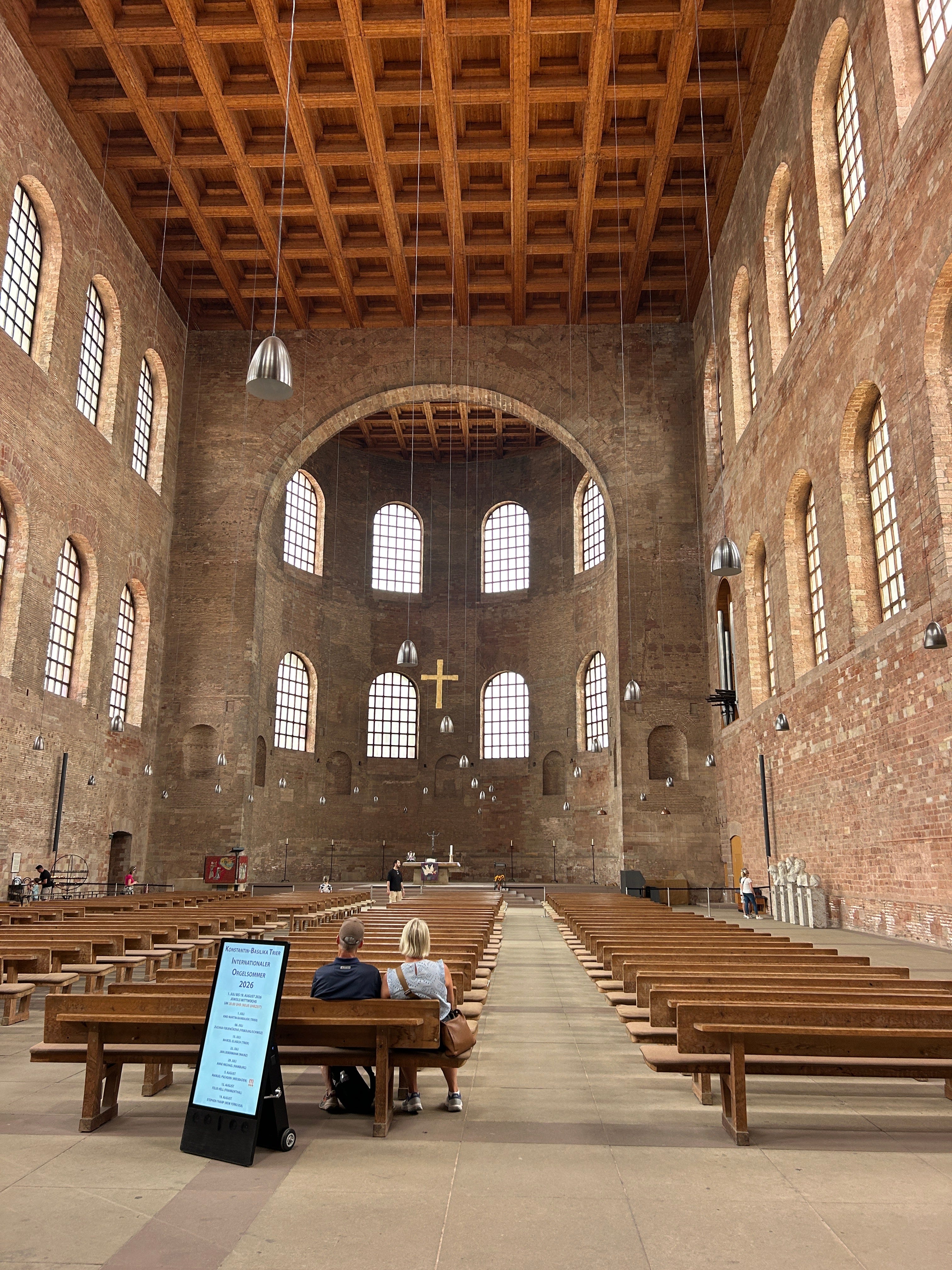
Like other Roman Basilicae, it was not constructed as a site of worship but as a site to conduct imperial and financial business.
3:00
At this point, I needed a break. I wandered to the nearby Palace Gardens, found bench and pulled out Robert Graves’ I Claudius. I’ve been enjoying my slow read through the fictional tales of Claudius; he’s quite sassy and loves a long sentence. It’s also been interesting to see how Graves’ narratives about Roman legends have popularized certain narratives about famous Roman figures, like Livia being extremely evil. While this is obviously based in the writings of Roman annalists, I wonder how much this book has popularized that narrative in popular culture.
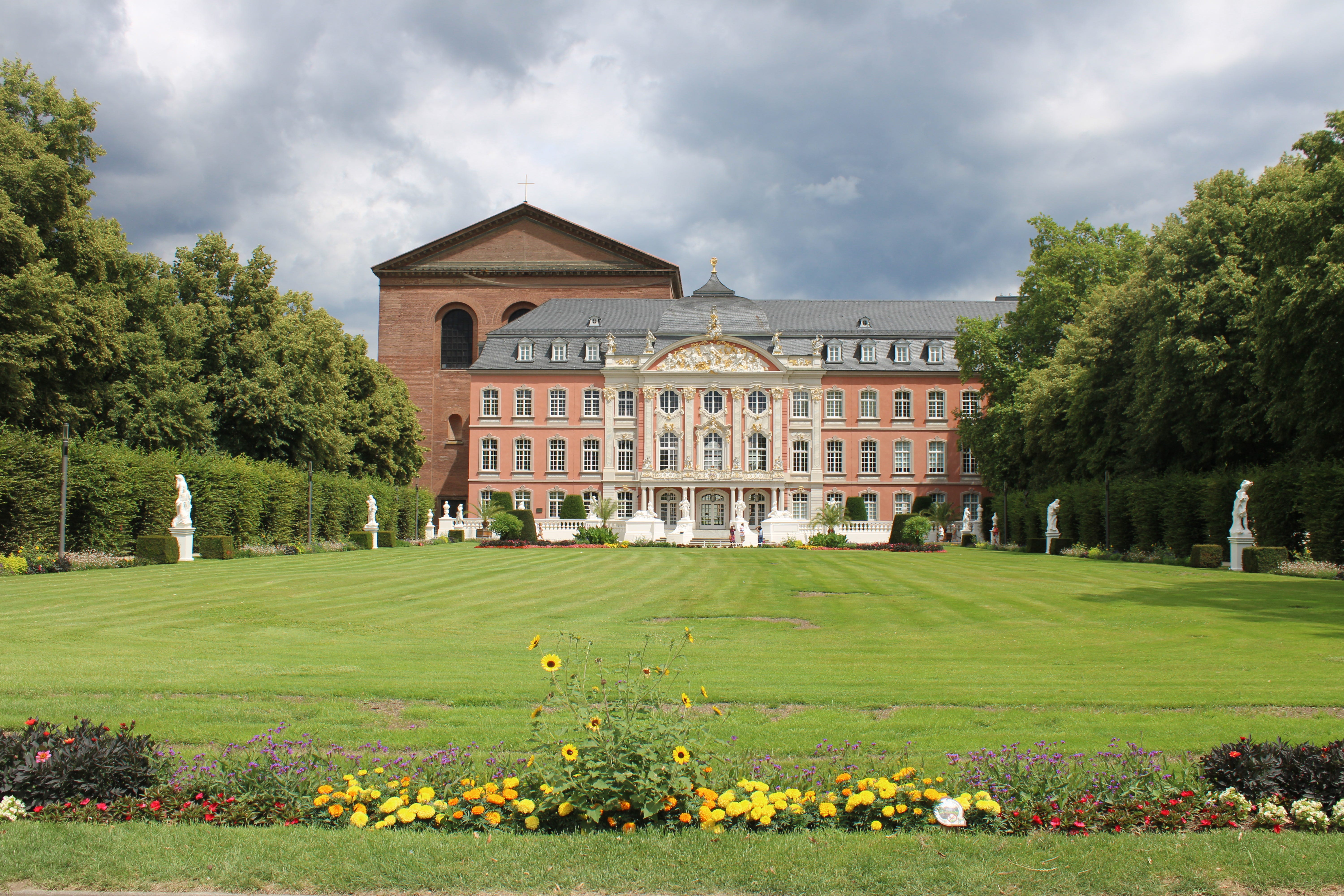
After twenty minutes of enjoying my book (and the view if I am being honest), I decided to check out my final stop for the day: The Imperial Baths. They date to the 3rd century but they were never quite finished. There is indeed another, larger bath complex in Trier’s Aldstadt, the Barbara baths, and I plan to visit them (and the amphitheater) tomorrow.
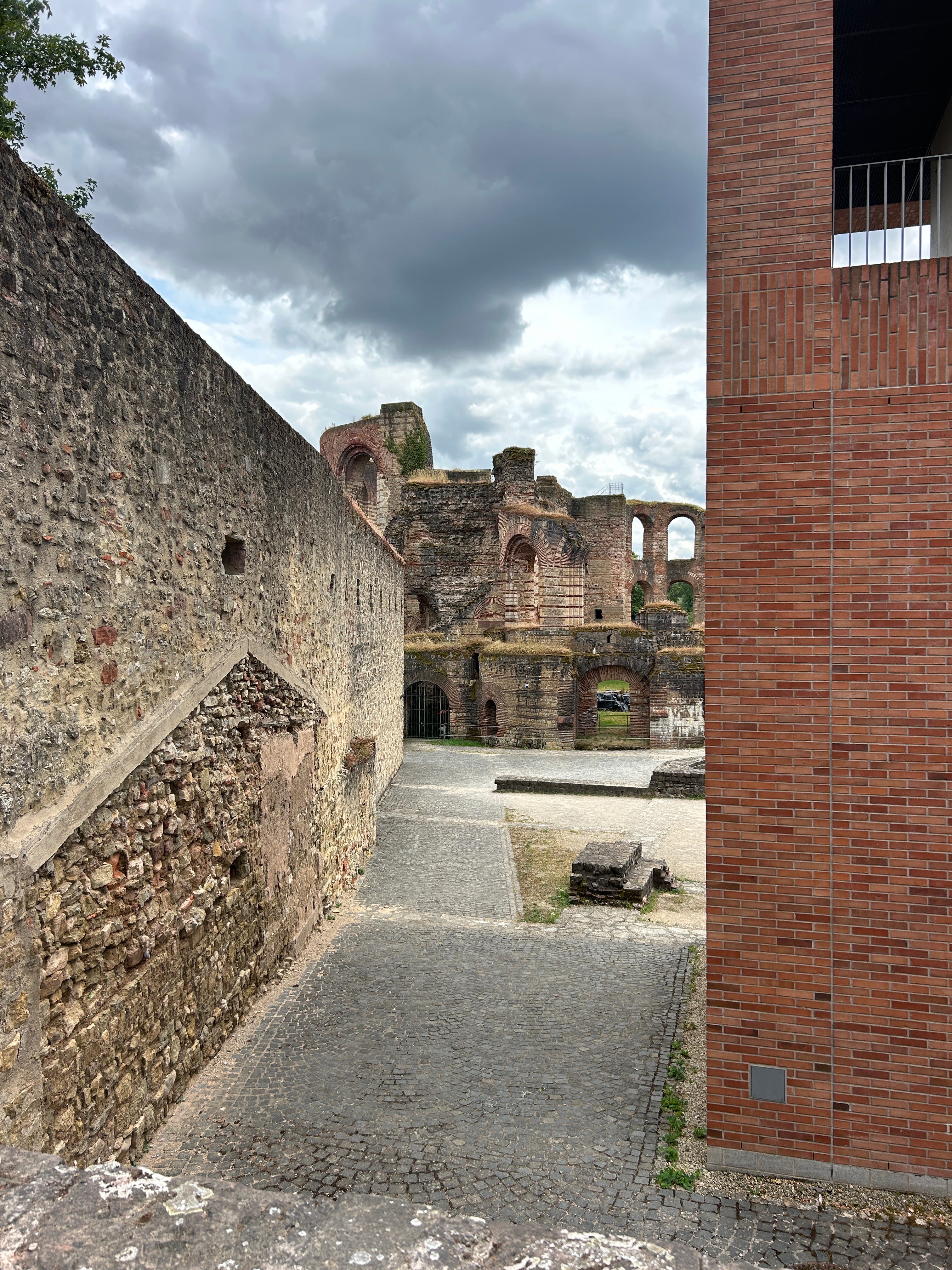
Anyways, the Imperial baths were ultimately converted into Equestrian barracks. They retained this function into the Medieval period, though a small area was converted into a castle.
3:30
I decided to check into my hotel and walk back down the Simeonstrasse, following the footsteps of many ancient and modern people before me. On the way, I got a gelato while marveling at the many Roman objects and monuments I encountered in such a short span.
Honestly, it would have been ideal to space out these trips over the two days I had intended to. Yet, I managed to enjoy myself while running around (and through) some of the most important archaeological remains of the Roman world. I would highly recommend a trip to Trier for anyone interested in Roman culture.
Would you want to read more about Roman Trier? Let me know and stay tuned for more!
“Close Looking” installment #1 offers a detailed analysis of a cut-glass plate in the collection of the Romisch-Germanisches Museum in Cologne; we’ll think about early Christianity, the materiality of glass, and the difficulties of interpreting funerary objects. I’m also working on the next installment of Letters from Vesuvius, which will cover different classes of archaeological finds and what they might tell us about life in Rome.
What else would you like to see on All About Ancient Art?
No posts
Comments
Nothing yet. Say the first thing.
Sign in to join the conversation.