
Welcome to All About Ancient Art where I share newsletters about ancient Mediterranean art, museums, and more! You can support this publication as a free or paid subscriber and interacting with newsletters through comments and likes. I also have a KoFi tip jar that you can access here.
In 1872, the German art historian August Mau published his Geschichte der decorativen Wandmalerei in Pompeji. Within the legendary book, he laid out a chronological four-part developmental scheme of Roman wall paintings. Often referred to as “the four styles,” his framework remains the dominant typology for the painted walls of the Roman world.
The four styles are based off of the corpus of evidence that survives from Pompeii, but they are often applied to wall paintings across the empire. However, there is a bit of an imbalance in what survives of Roman wall paintings. After the tragic eruption of 79 AD, the splendid paintings of Pompeii were preserved to an extent that is unheard of elsewhere in the ancient Mediterranean. While we can compare these Pompeian styles to the paintings of other sites, we should remain cautious in making assumptions about their validity elsewhere.
This remainder of this newsletters offers a beginner-friendly introduction to the four styles. I do not present a comprehensive survey of Roman painting, nor do I fully outline the scope of relevant academic debate.
The ‘First Style’ of Roman wall painting is often called the masonry style or the encrustation style. These paintings are defined by series of faux-stone slabs that reify the flatness and density of a wall. Scholars have debated whether these were meant to visualize actual masonry stones, suggesting that the wall was built from exotic stones, or if they were intended to represent revetment, flat slabs attached to the wall.
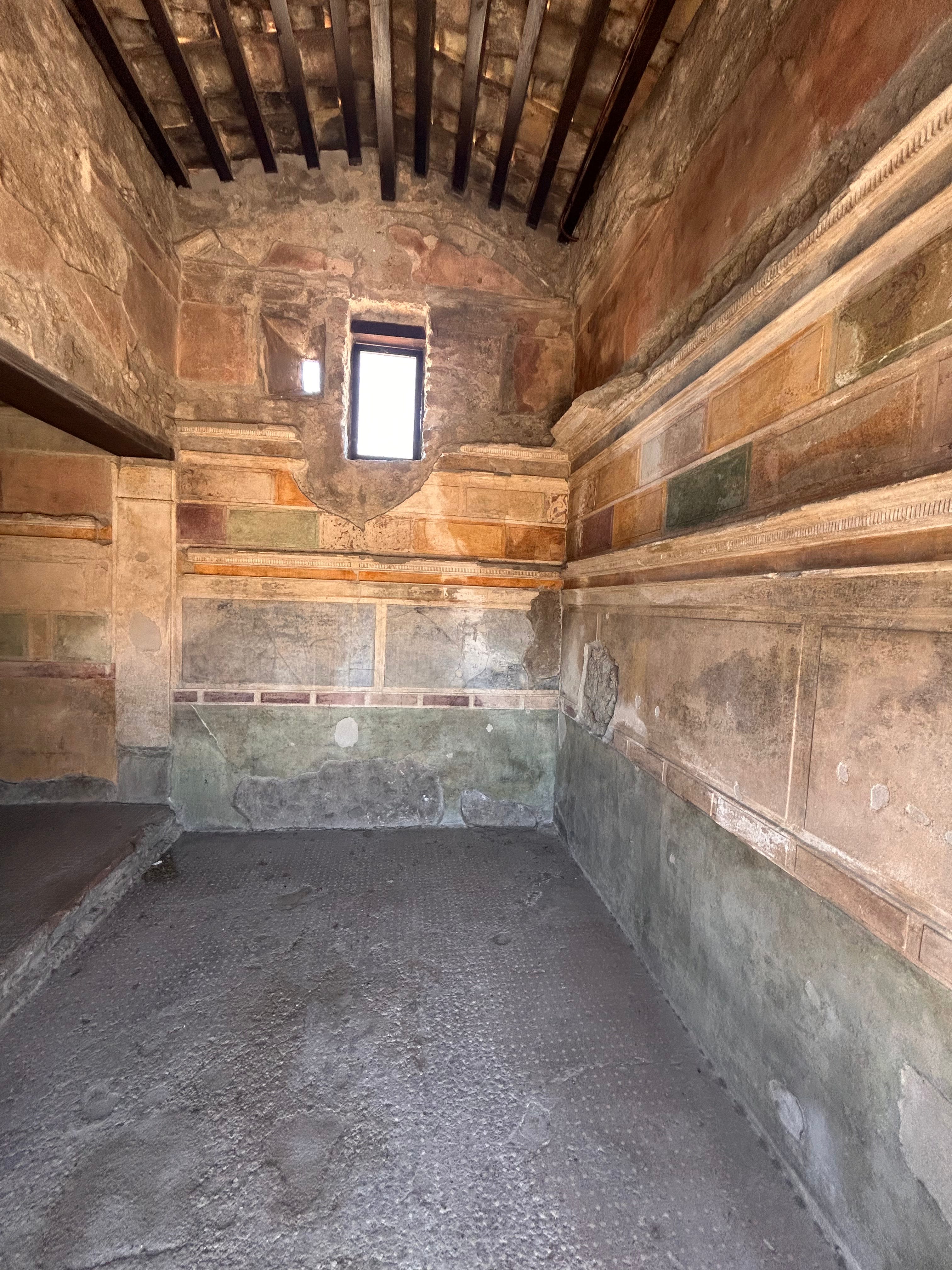
This is the first and oldest of the four styles. This style seems to survive across the Mediterranean world. Comparable masonry-slab paintings survive on the Greek island of Delos and the Palace of Herod in Jerusalem.
While the First Style reifies the wall, the ‘Second Style’ does away with it. Walls in this style are decorated with increasingly grandiose vistas. While the First Style is dated to the Hellenistic period, the Second Style becomes popular in the 1st century BCE, in the wake of Rome establishing hegemony across the Mediterranean world.
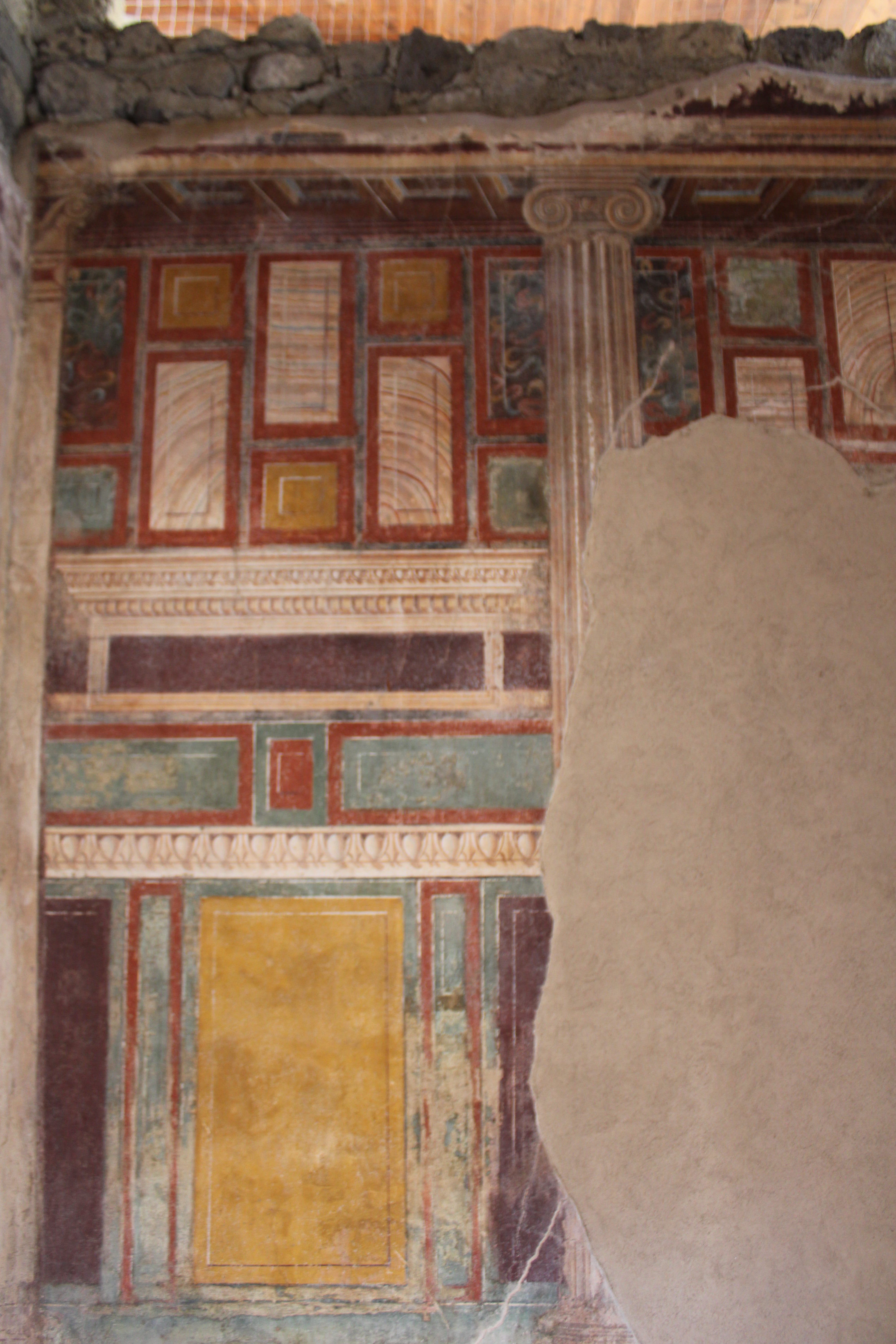
Early second style paintings, like those in the Villa Arianna in Stabia and in the House of the Griffins on the Palatine Hill in Rome offer modest architectural schemes that extend the room outwards. Similarly, the scheme in this cubicula from the Villa of the Mysteries in Pompeii is relatively flat; it creates a simple portico before large false-revetment panels (see the link to the first style here?).
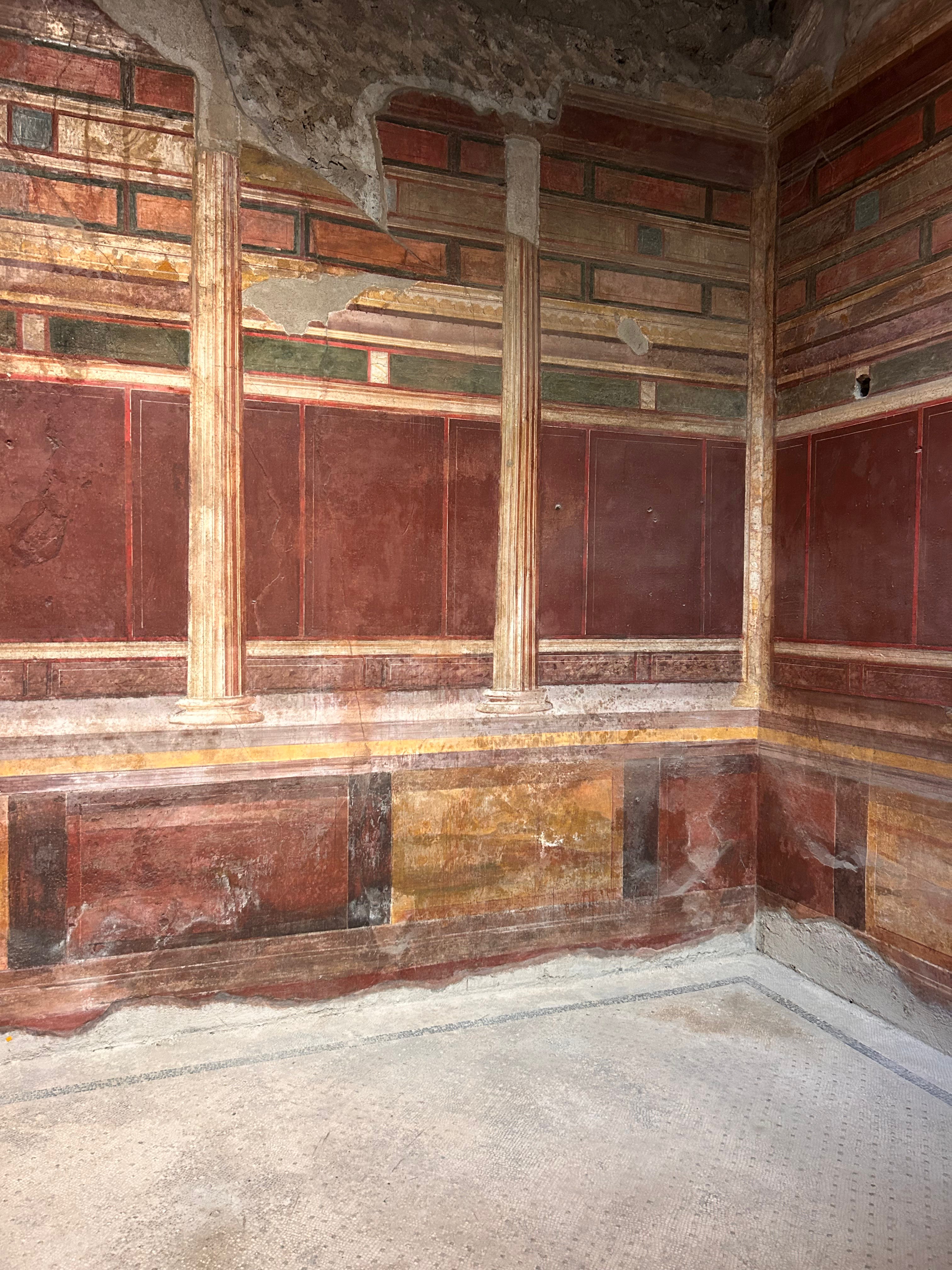
However, later second style paintings swap out a single portico for enlarged space, like monumental doorways or the scaenae frons, or stage front. Eventually, architecture is substituted with grand views of sprawling hills and idyllic pastures, like we see in ‘Triclinia 6’ (a dining room) from Villa A at Oplontis. Elaborately adorned columns sit atop a podium defined by marble revetment. Behind the columns, porticos extend backwards, framing a round structure or tholos. Arched cornices and friezes with running tendrils add visual interest and splendor to the fictitious construction. A comparison with the early image above is striking.
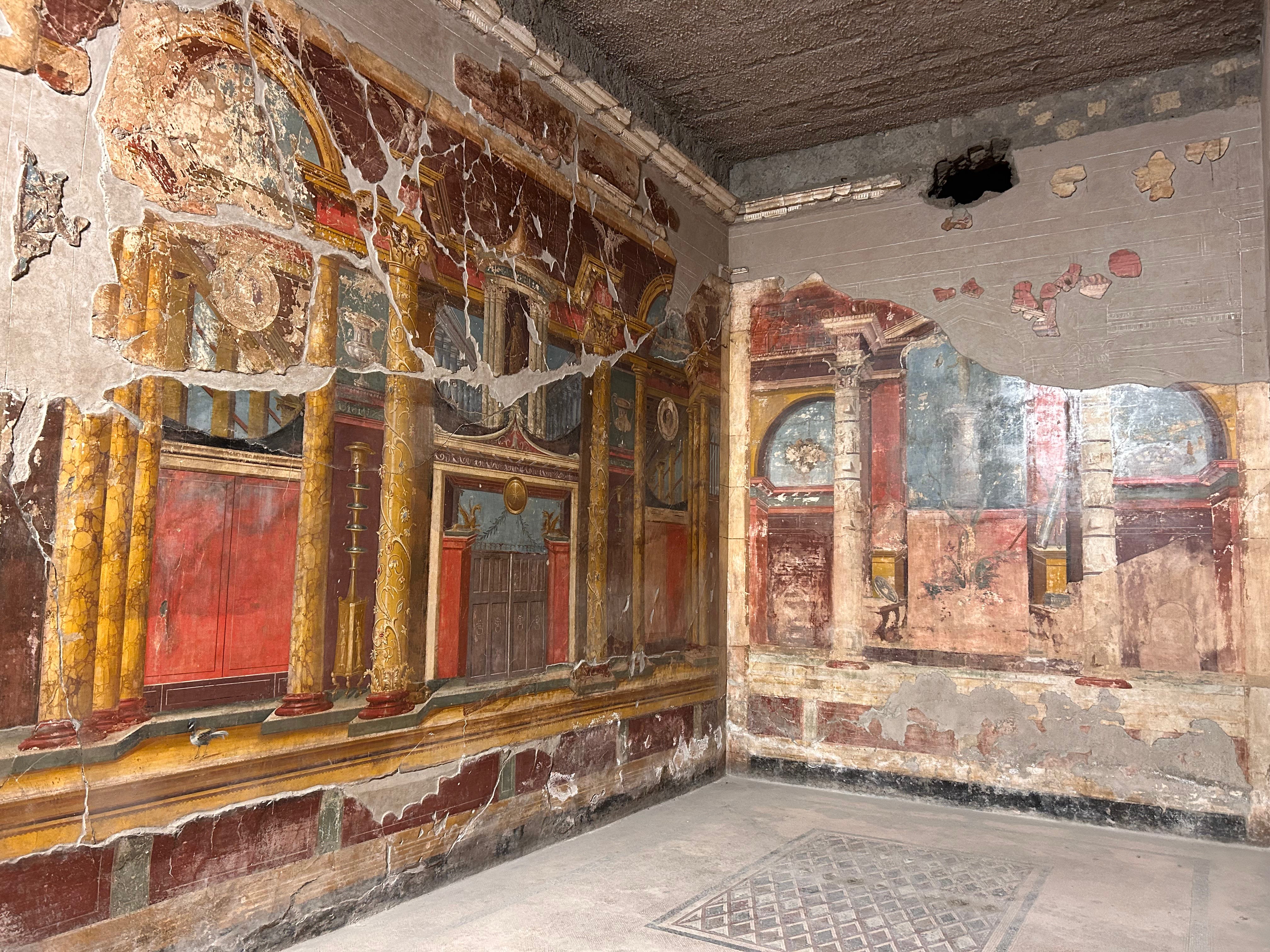
It is within this group of ‘vanishing walls’ that we might include garden paintings, like those that survive from the Villa of Livia at Prima Porta. Despite their bucolic nature, these paintings indeed visualize the expanding reaching of Rome by gathering species of plants and animals not indigenous to the Italian peninsula.
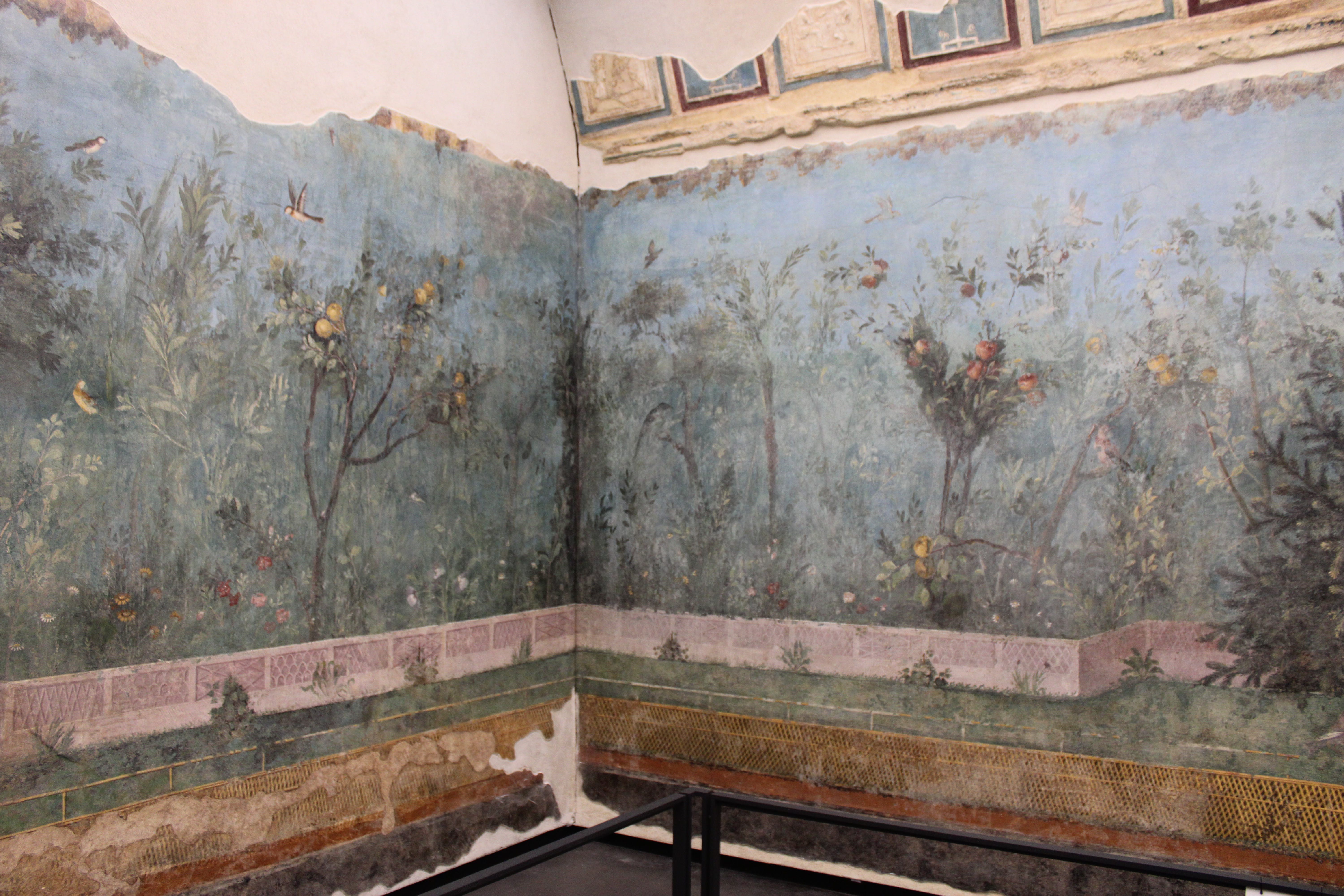
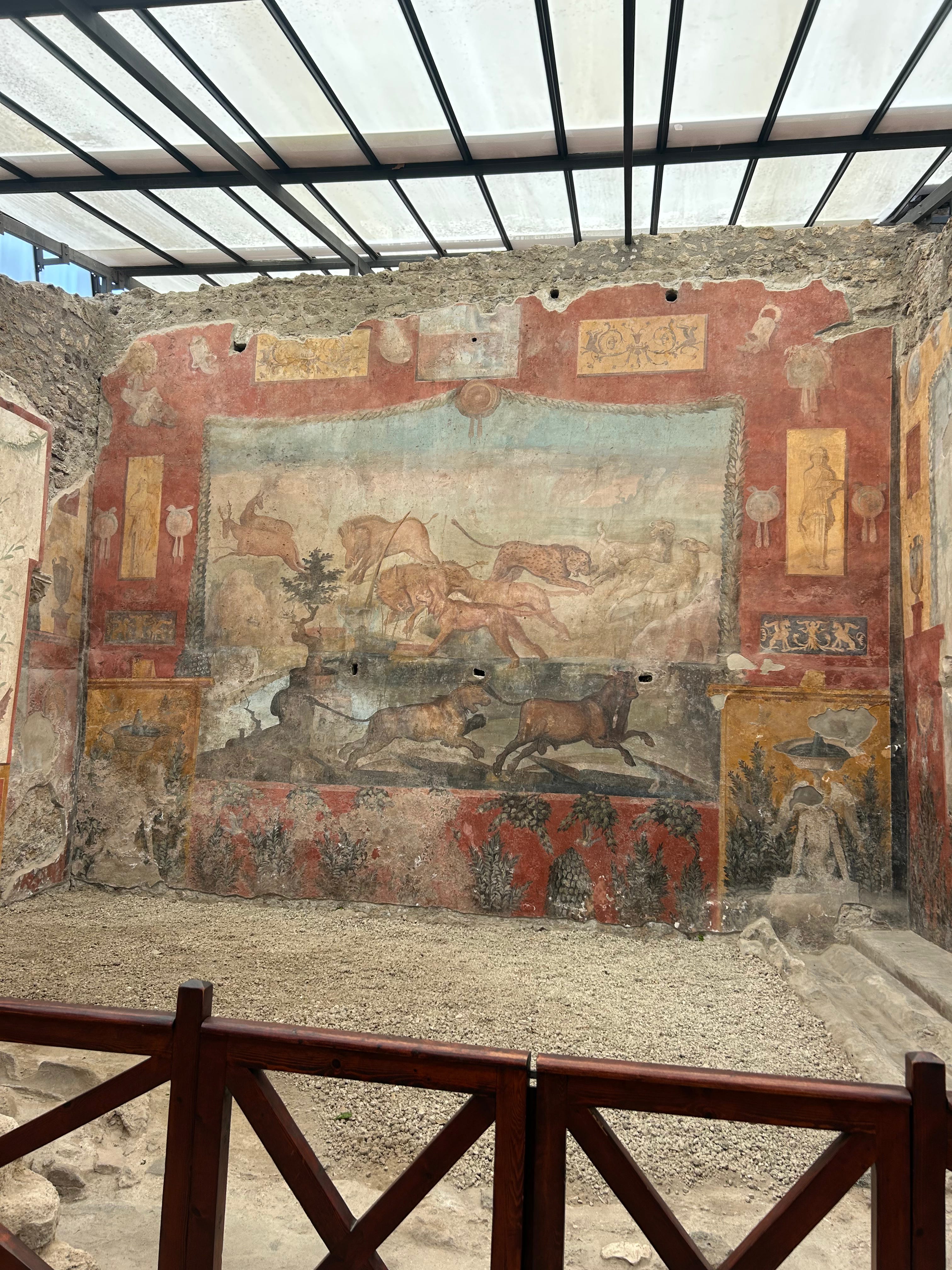
Likewise, megalographic frescos, or large scale figural scenes are often associated with the same period. Frescos from the Villa of the Mysteries and the recently discovered House of the Thiasos exemplify this mode of wall decoration, featuring allusions to cultic themes. Hunts are also popular megalographic schemes, one astounding example survives from the House of the Ceii, Pompeii They are dated to the later-Republican period.
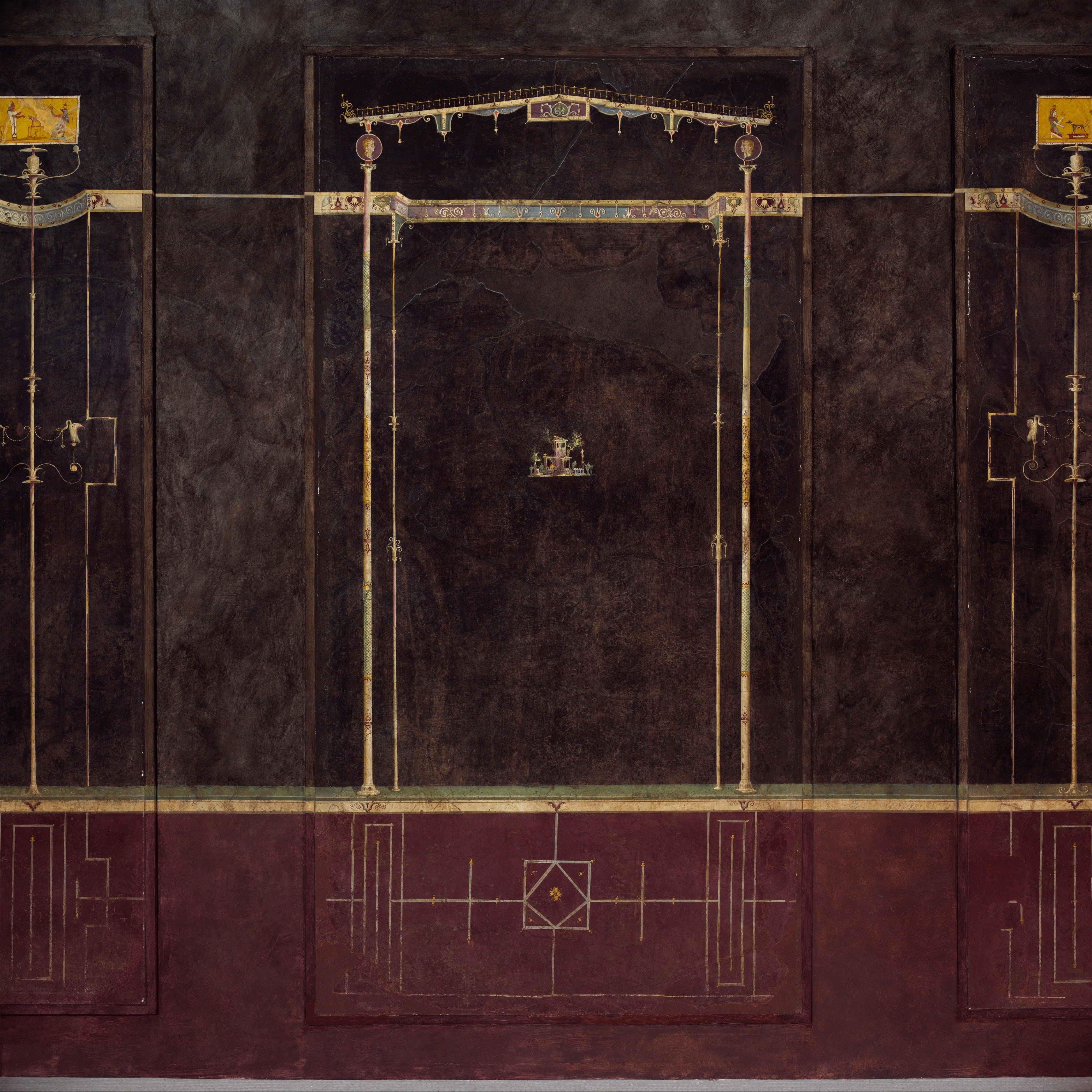
After the turn of the first century CE, the Third Style walks back the destructive illusionism of the preceding Second Style. Walls are reinforced with monochrome planar blocks, only interrupted with delicate, fantastical details like those in the ‘black room’ from the Villa of Agrippa from Boscotrecase, today in the Metropolitan Museum of Art. Miniature egyptianizing details and small portraits adorn a petite golden architectural outline. The forms are so tiny, they demand that viewers stand close to fully appreciate their detail.
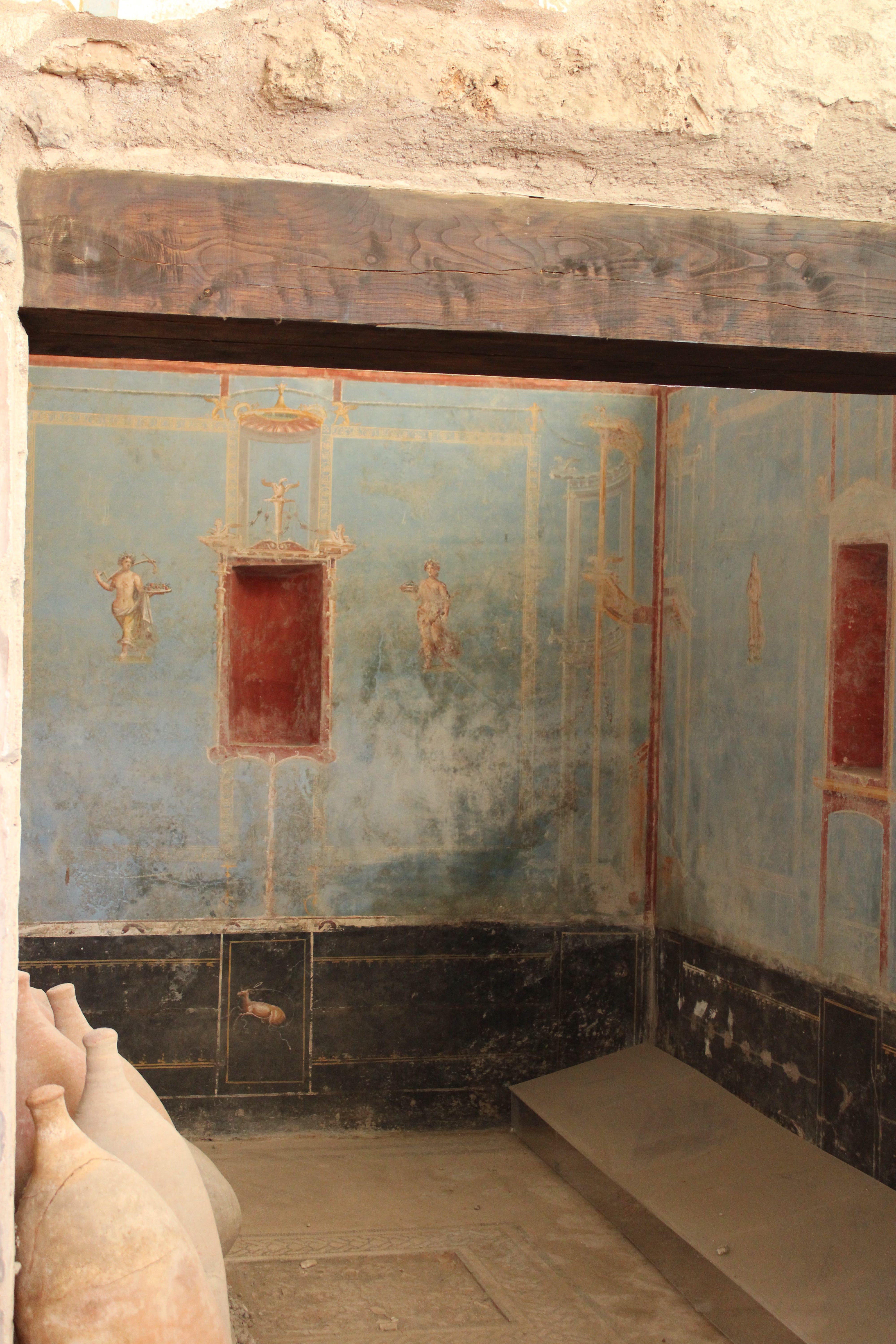
Third Style schemes also incorporated mythological figures and even narrative vignettes. In the recently excavated ‘Blue Room’, nude female figures bearing instruments and foodstuffs float in the center of the framed panels. Likewise, frames of narrative vignettes also could have sat within the larger panels.
Then in the later half of the 1st century CE, the third style is replaced the Fourth Style. In simple terms, this group is defined by a puzzling eclecticism. Aspects of each of the previous styles are assembled and arranged in discrete compositions. A single room might include a large mythological painting, a faux architectural vista, painted masonry, tiny floating figures, and more. They are visually overwhelming.
This style is typically understood to suggest that a particular room was decorated after the massive earthquake in 62 CE.
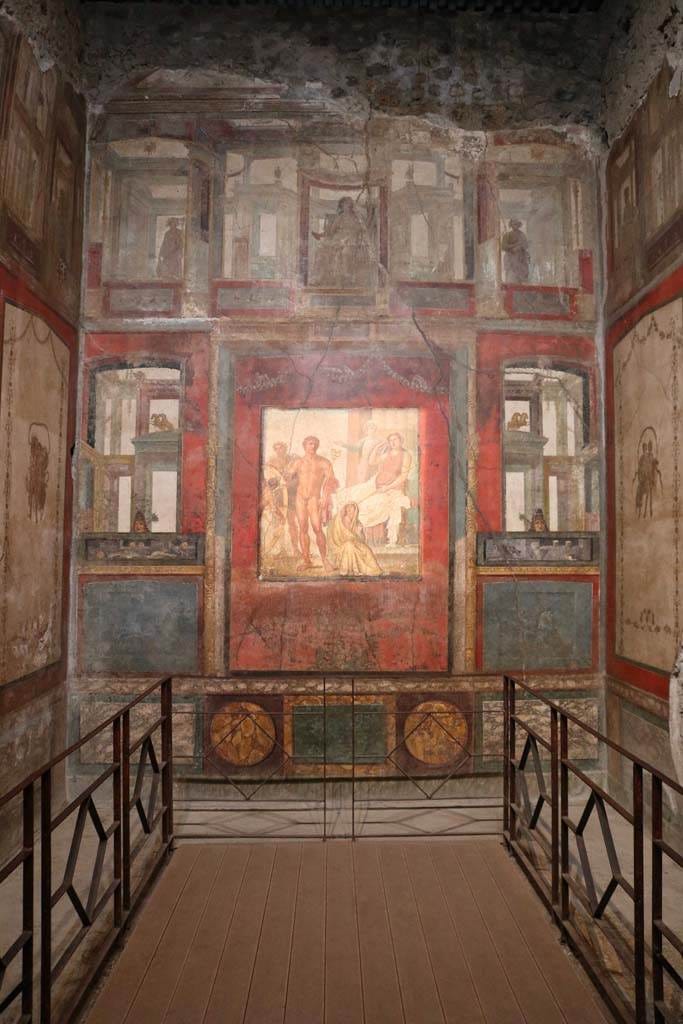
Particularly well preserved — and recently restored — Fourth Style compositions survive in The House of the Vetii in Pompeii. If you take a look at the wall above, you can identify various elements of each of the aforementioned styles reassembled into a single, cohesive scheme.
Although Mau’s framework serves as the basic outline of Roman painting it fails to account for centuries of later fresco types. Painting did not end with Pompeii. Sites across the Roman world that continue to produce magnificent frescos after 79 CE. A set of villas that survive on Rome’s Caelian Hill, for example, preserve breathtaking paintings from the 2nd - 4th centuries.
Indeed, it is likely that we are missing a great body of Roman painting. Mau’s framework is ultimately an outline of local chronology and style, which of course is in conversation with broader Mediterranean-wide trends.There is also a problem in thinking about chronology and painting outside of Pompeii. It is unclear when certain styles reached certain corners of the empire; they could pre- or post- date their Pompeian counterparts.
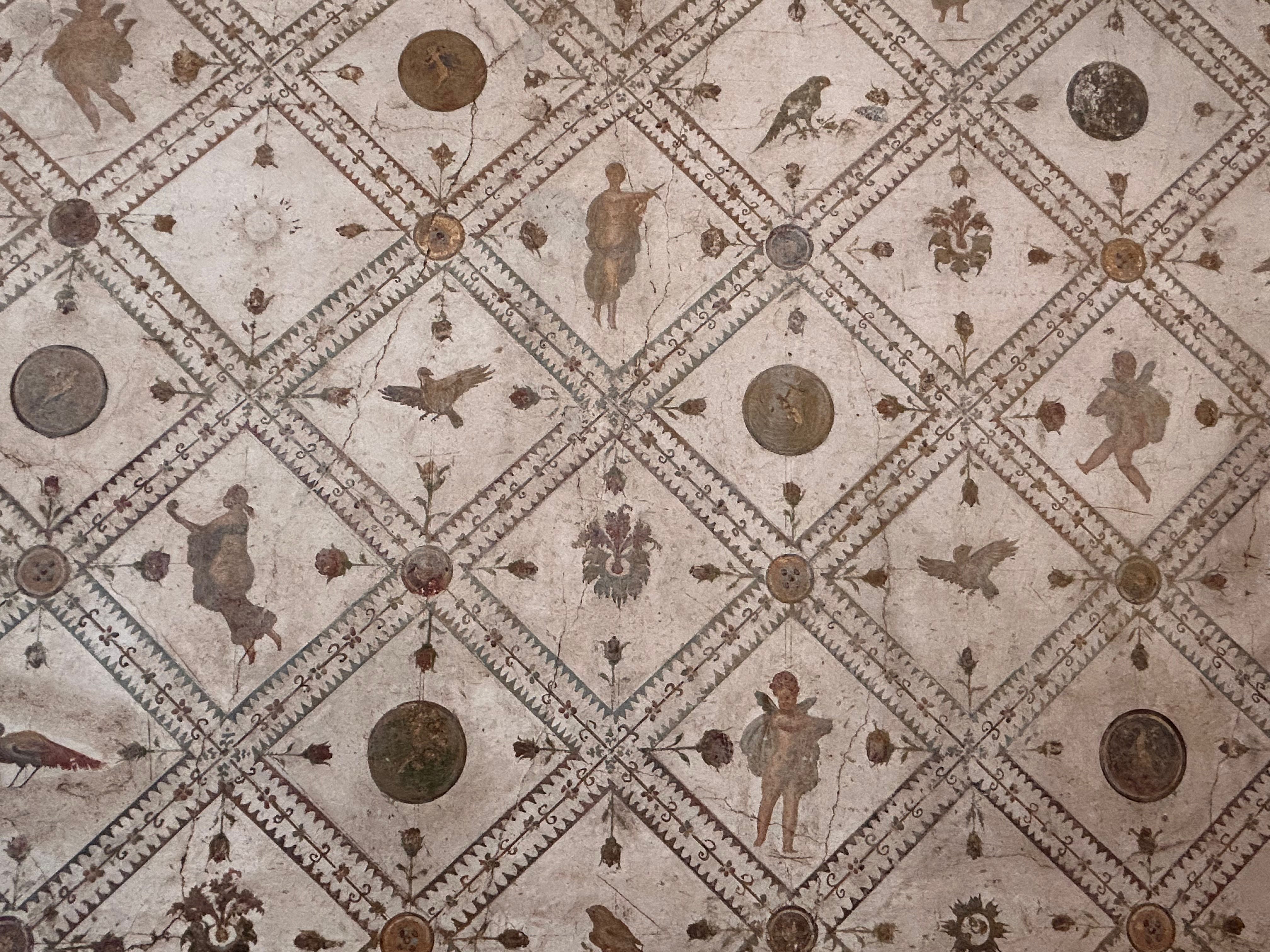
Perhaps most crucially, fixation on style fails to reveal anything interesting (in my opinion) about Roman society or visual culture. While dating is extraordinarily important, I am more interested in understanding how images conveyed meaning in the particular social contexts of the ancient world. Typologizing schemes, like Mau’s, fail to provide such insights. Indeed, this scheme (like many others) arose out of an earlier mode of art historical inquiry that was not interested in lived experience and social history.
Unsurprisingly, a number of paintings survive that fall outside of this four-part chronological scheme. It would be bizarre if painting simply stopped existing after 79 CE. Some of my favorite Roman wall paintings survive from the later empire in the Case Romane on the Caelian.
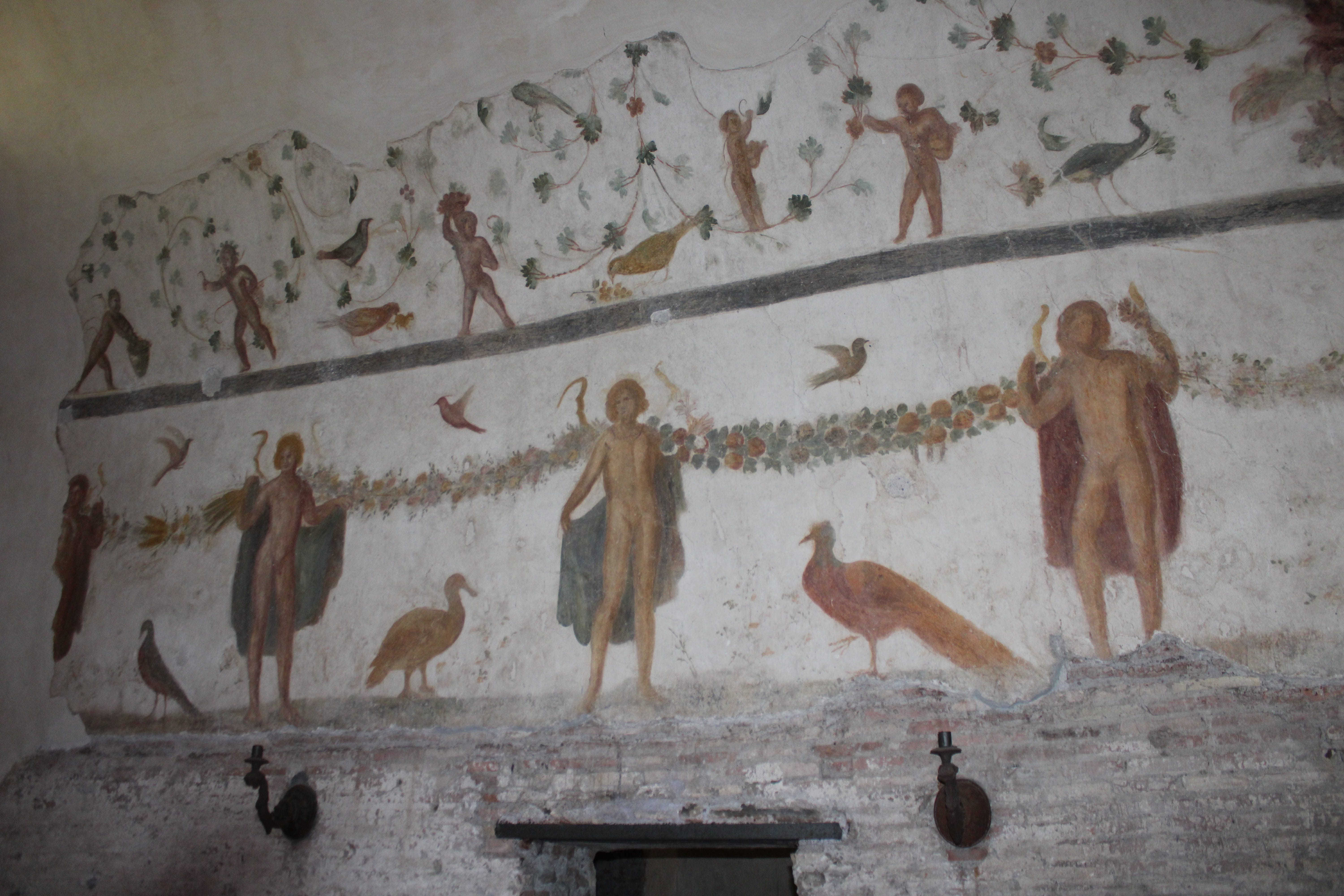
In a large, vaulted room megalographic figures — similar in scale to the Republican-period Villa of the Mysteries paintings, dance amidst garlands against a white ground. Devoid of spatial definition, the composition adds emotive vibrance to the room, while affirming the flatness of the four walls. These figures date between late 2nd and early 3rd centuries.
Meanwhile, a nearby stairwell is strikingly defined by a large-scale garden scheme. A trellis defines the border between the domestic environment and the fictive garden. In some respects this scheme is striking similar to earlier garden schemes, yet carefully defined assemblages of flora seem to be replaced with a generalizing, nearly impressionistic greenscape (to my eye there are not well defined and differentiated species, but I’m not an expert in plants).
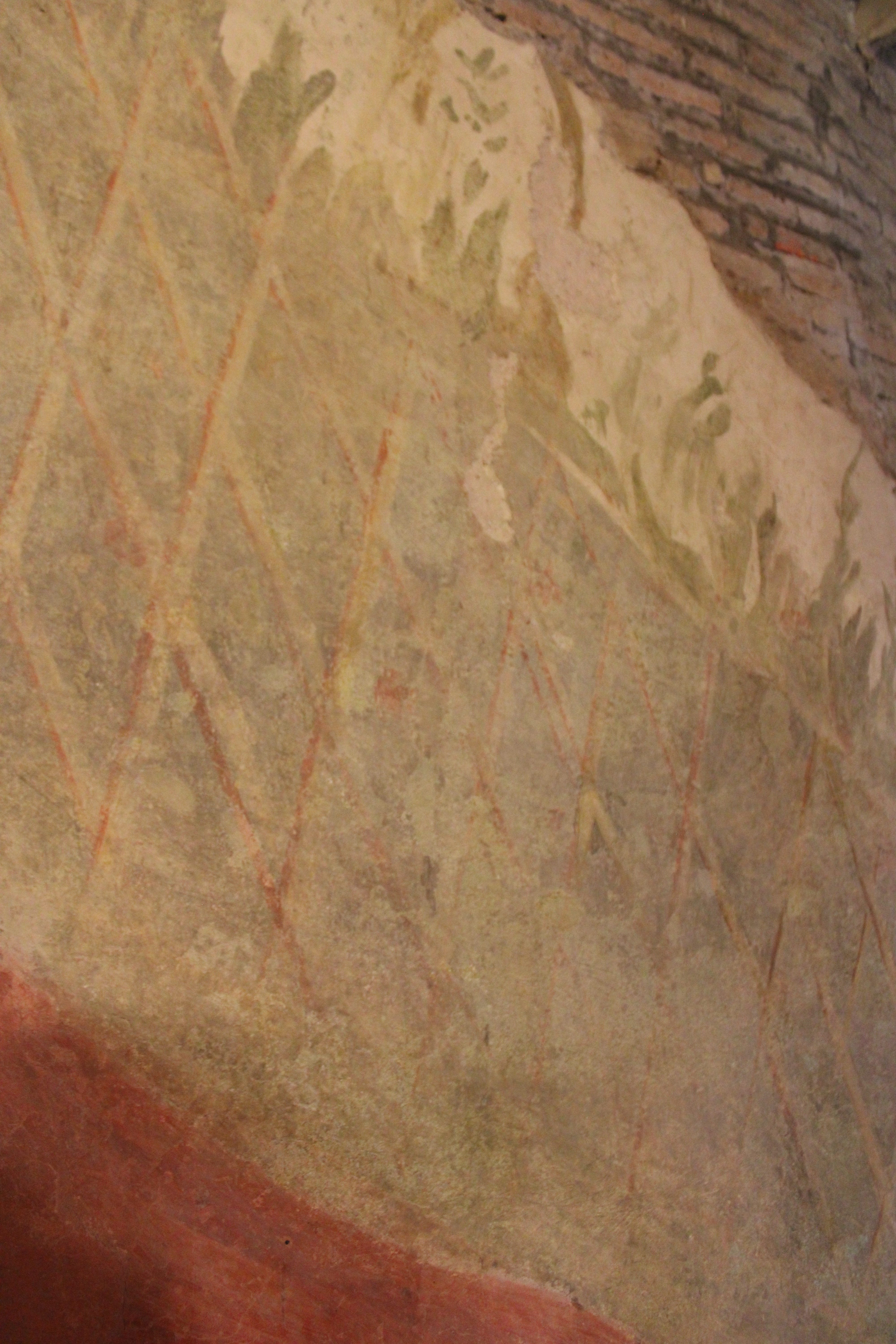
These two examples remind us that some of the “defining” features of earlier styles never quite disappear fully. Yet, to use those features alone as chronological markers would lead us astray.
Wall paintings survive across the empire. I’ve recently seen fragments of domestic decor in local museum in Germany and Austria. Likewise, I’ve studied curious miniature “second style” schemes from Petra, Jordan. Roman visual culture had a wide reach, and this extends well beyond the public architecture and funerary art we see most often outside of the Italian peninsula.
I’ve also omitted any painting from non-domestic contexts, most plentiful perhaps are paintings tied to funerary monuments which survive from archaic Magna Graecia into the catacomb paintings of late antiquity.
Although this newsletter was by no means comprehensive, I hope you’ve enjoyed this introduction of the wonderful world of “Roman” wall painting. There is so much more that can be said about frescos and cultural exchange, embodied experiences of wall-bound images, their relationship to other painting traditions (like painted panels), intermediality, and much more.
Further Reading
Leach, Eleanor Winsor. The Social Life of Painting in Ancient Rome and on the Bay of Naples. Cambridge University Press, 2004.
Dr. Jessica Leay Ambler, "Roman wall painting styles," in Smarthistory, June 8, 2018
Until Next Time,
Jackie
No posts
Comments
Nothing yet. Say the first thing.
Sign in to join the conversation.