
As a child, I lay in bed wondering, “What’s outside our world? And what’s outside of that? Where exactly are we?” The vast gap between our tedious, goofball lives and the majestic reaches of space made no sense. Even at that young age, I sensed a dramatic story at play: humanity performing in a frenzied “theater of the absurd” on a tiny plot of earth, and without a playbill to explain the plot.
At age 22, a mescaline trip lifted the veils. I was given a glimpse of the world as a projection of consciousness. Naturally, I was drawn to understand this, and soon met author/teacher Reshad Feild. We brought the work of Rumi to America and I became a whirling dervish. I practiced conscious breathing and aspired to live in the present moment.
Twenty years later, I met Dr. Bhagwan Awatramani, a teacher in the direct line of Ramana Maharshi. His teaching sent me toward “Self Inquiry” — turning the attention inward to contemplate "Who am I?"
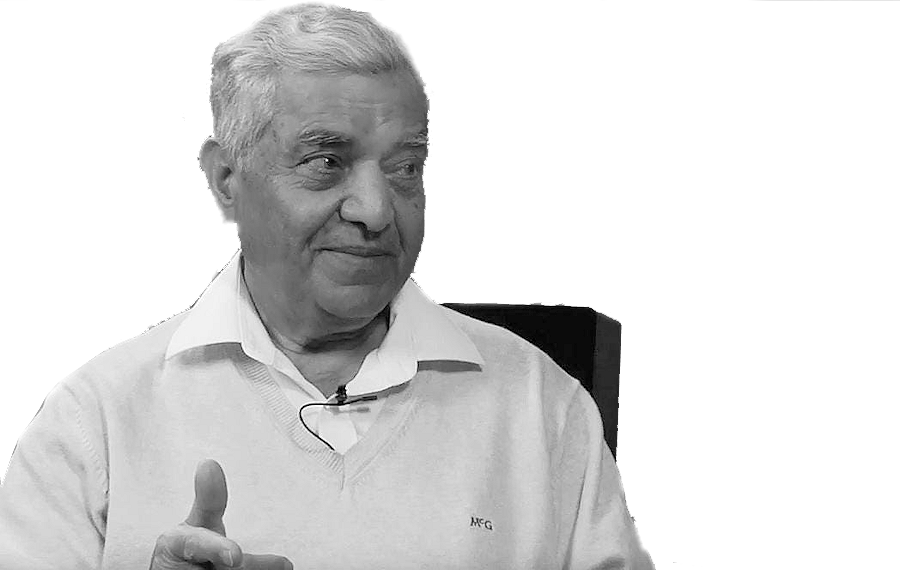
Neither Reshad nor Bhagwan had much use for psychology. Reshad disparaged psychologists as an illusion treating an illusion — or something similar. But over the last year (seeing how spirituality bypasses one’s psychology), I have been drawn to Jung — specifically his understanding of the Shadow and Integration.
I offered two “salons” to my friends — one to explore the shadow and one focused on integration.
The goal was to experience the shadow as an ever-present ballast and to inquire, in healing, where does it go?
According to the Law of Conservation of Energy, energy cannot be created or destroyed, only transformed from one form to another.
I created several videos, which I include here with brief introductions.
The shadow has been given a bad rap, conjuring something dark and underworldly. For 22 years, from 1932 to 1954, in the infamous radio show, The Shadow, the lead character, Detective Lamont Cranston, used a “hypnotic power to cloud men’s minds so that they cannot see him.”
This was the first clue: the shadow is invisible to our conscious minds.
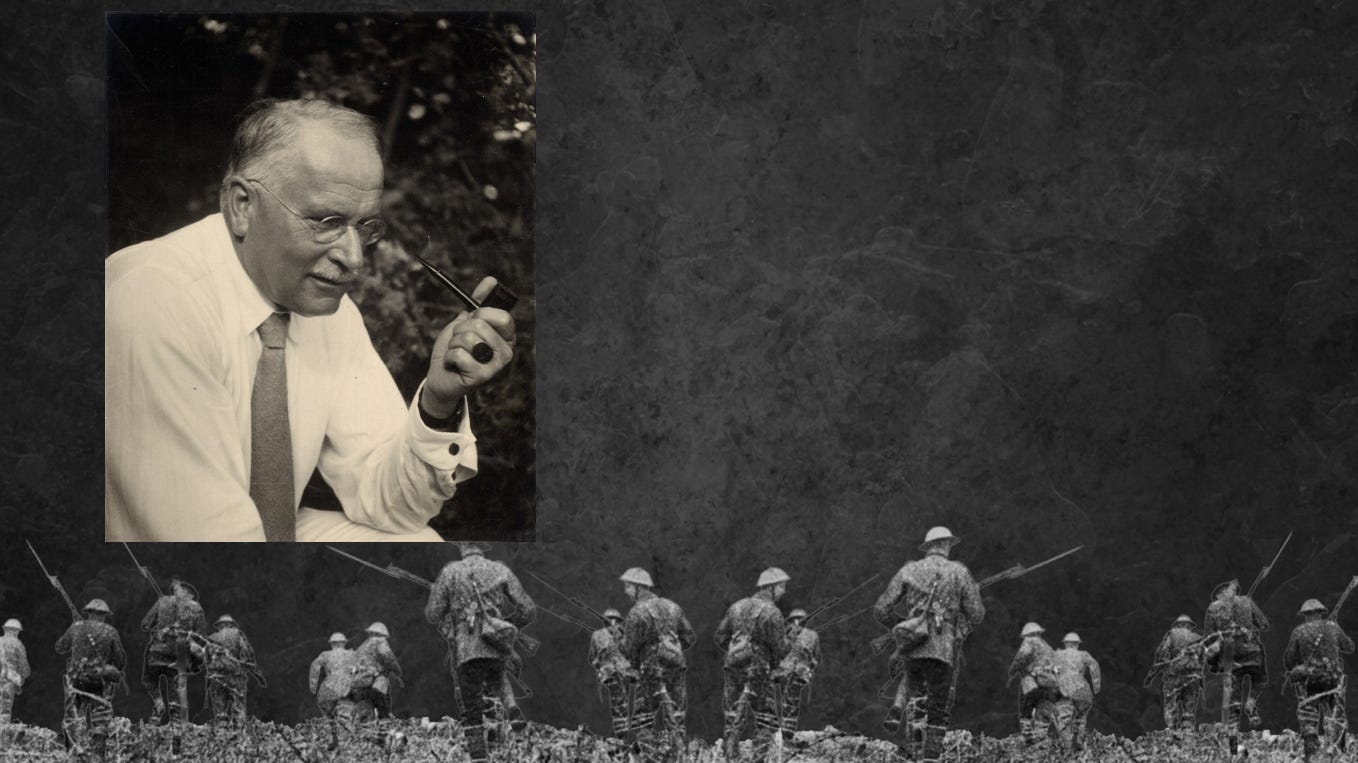
After his work with Freud, Carl Jung discovered this unconscious repository in the psyche. He was propelled to explore his depths in reaction to the imminent global slaughter to come — a moment not unlike today.
As the world hangs again on the precipice of madness, I draw this parallel to the start of World War I. Jung felt a need to plumb the depths of his own psychology. He wrote:
On August 1, World War I broke out. Now my task was clear: I had to try to understand what had happened and to what extent my own experience coincided with that of mankind in general. Therefore, my first obligation was to probe the depths of my own psyche.”
“I was frequently so wrought up that I had to do certain yoga exercises in order to hold my emotions in check.”
“I was sitting at my desk once more, thinking over my fears. Then I let myself drop. Suddenly it was as though the ground literally gave way at my feet, and I plunged down into dark depths…
Before me was the entrance to a dark cave, in which stood a dwarf with a leathery skin, as if he were mummified. I squeezed past him through the narrow entrance and waded knee deep through icy water to the other end in the cave where, on a projecting rock, I saw a glowing red crystal. I grasped the stone, lifted it, and discovered a hollow underneath. At first I could make out nothing, but then I saw that there was running water.
In it a corpse floated by, a youth with blond hair and a wound in the head.
For newcomers to Jung, here is a quick background. This excerpt is not my work, but from a documentary produced by George Lucas and Rick McCallum:
Jung’s exploration of his psyche revealed a simple truth:
“One does not become enlightened by imagining figures of light, but by making the darkness conscious.
The latter procedure, however, is disagreeable and therefore not popular.”
– C.G. Jung, ‘Alchemical Studies,’ para. 335
Jung called this darkness the shadow” — disagreeable. but not negative. The shadow represented the unconscious aspect of the personality that conflicted with our idealized self-image.
Bly saw this bag stuffed with discarded aspects of self, such as anger, creativity, or power, to explain how the shadow is formed (read by Jungian author, Connie Zweig. Video by me):
Current pop psychology exhorts us to love ourselves, but for Jung, this is as enjoyable as “embracing a glowing red hot iron.” Yikes.
Now that I’ve entered the dating world, I feel the powerful and universal urge “to love somebody else.” But Jung warns, in the absence of “loving what you are,” this can become an escape that comes back to haunt us.
Integration is the process of “bringing unconscious, disowned, or repressed aspects of the self—both negative and positive—into conscious awareness to achieve wholeness and individuation.”
Humans are metabolism machines. Reshad used to quote Gurdjieff (maybe partly invented), A human is ‘a cosmic apparatus for the transformation of subtle energies.”
Integration is that apparatus at work. Think of Integration as metabolizing or digesting our buried bits. When we digest food, we know where it goes — into energy production and into compost. When we digest a wound, where does it go?
Most people don’t integrate the pain buried in their psyches.
Food for the moon is a powerful metaphor for how our unconscious, unexamined suffering and mechanical behaviors (our “shadow” material) can drain our life force and feed into negative, external “systems” or internal “parasitic” patterns. In this metaphorical sense, integrating the shadow (becoming conscious) would be the way to stop “feeding the moon.”
“The more you are obliged to repair the past, the more you will have remorse of conscience…
“You are a link in the chain of your blood… Your whole family, past and future, depends on you. Your whole family depends on how you repair the past. ~ Gurdjieff
I created this video to pose that integration question: Where does it go? To the moon?
Suppose a very young child was deeply frightened by the TV series Lost and developed a fear of flying as an adult:
Jung explained that the first half of life is for forming a healthy ego, and the second half is going inward and letting go of it.
This is integration. Like distant thunder, the first rumblings of un-integrated life surface at age 42 (midlife crisis).
By 63, the absurdity of worldly ambition begins to sputter, and a reflective stage begins.
We all have unlived potential. My young life was wholly focused on becoming a filmmaker — until the veils were lifted and I became a Sufi. Now in my seventies, the “great director” in me languishes as an unlived creative life.
At age 50, my late wife Karen quit nursing and went to seminary, ultimately becoming a chaplain educator. Her unlived life was about finding her voice and professional authority after being squelched as a child.
Two weeks before starting her new career, she collapsed in my arms from a brain tumor — but she managed to triumph anyway, spending the next eight years as a highly respected professional in her field.
We all have dreams unfinished. For Karen, it was to have grandchildren. As she passed, she released the entirety of her unlived life. She was free.
For those of us of a certain age, we must make peace with our unlived lives. This is integration.
When something is repressed, it must go somewhere. Jung called this place the Shadow. Everything about yourself that you neglect and refuse to acknowledge goes here. That’s why something can trigger you without you knowing why. The Shadow has been touched.
It can’t be destroyed, and by hiding it, you feed it, until it takes on a life of its own.
Maybe they were not your own — foisted on you by your parents or society. Or maybe, for whatever reason, if you inquire into your shadow, you find that you missed the mark — in your love life, career potential, relationships, creative life, finance, or health.
There’s no consolation prize — the shadow is a hidden weight, dragged behind like Robert Bly’s metaphorical bag.
Integration can also be described as transformation or healing. I’m convinced that it requires another nervous system as the catalyst. A guru is another word for an outsourced nervous system. Same with friends and lovers. A moment of safety, stillness, or empathy creates space for integration.
This video describes the role of empathy as fundamental to the process of integration. I found this couple in a movie scene. Despite their emotional intensity, something chemical is happening beneath the surface.
I will finish with a final video based on a poem by James McCrae, “Instructions Before Visiting Earth: A poem for the soul’s journey.” It is read by Tetyana Denford.
I include it to help you embrace your circumstances with compassion — for yourself and for each other. Thanks for reading.
No posts
Comments
Nothing yet. Say the first thing.
Sign in to join the conversation.