
A few months ago, Lee Clare, the field director at Göbekli Tepe, criticized a tweet of mine on X. In that tweet, I wrote: “So who built it… before ‘builders’ existed?”
Actually, I don’t know what upset him so much, since it’s basically more or less true.
All right, there were builders back then and they were building their modest temporary dwellings, I agree with that. But did they build temples on this scale?
I’ve decided to write an article about Göbekli Tepe in which I’ll take a closer look at this issue.
So… Göbekli Tepe. Maybe you’ve heard of it, maybe not, but it’s rewritten the entire timeline of human development, and almost no one is talking about the central problem it creates. The problem is this: we found a massive temple complex built by people who, according to everything we know about human progress, shouldn’t have been capable of building anything at all.
Let me explain what I mean.
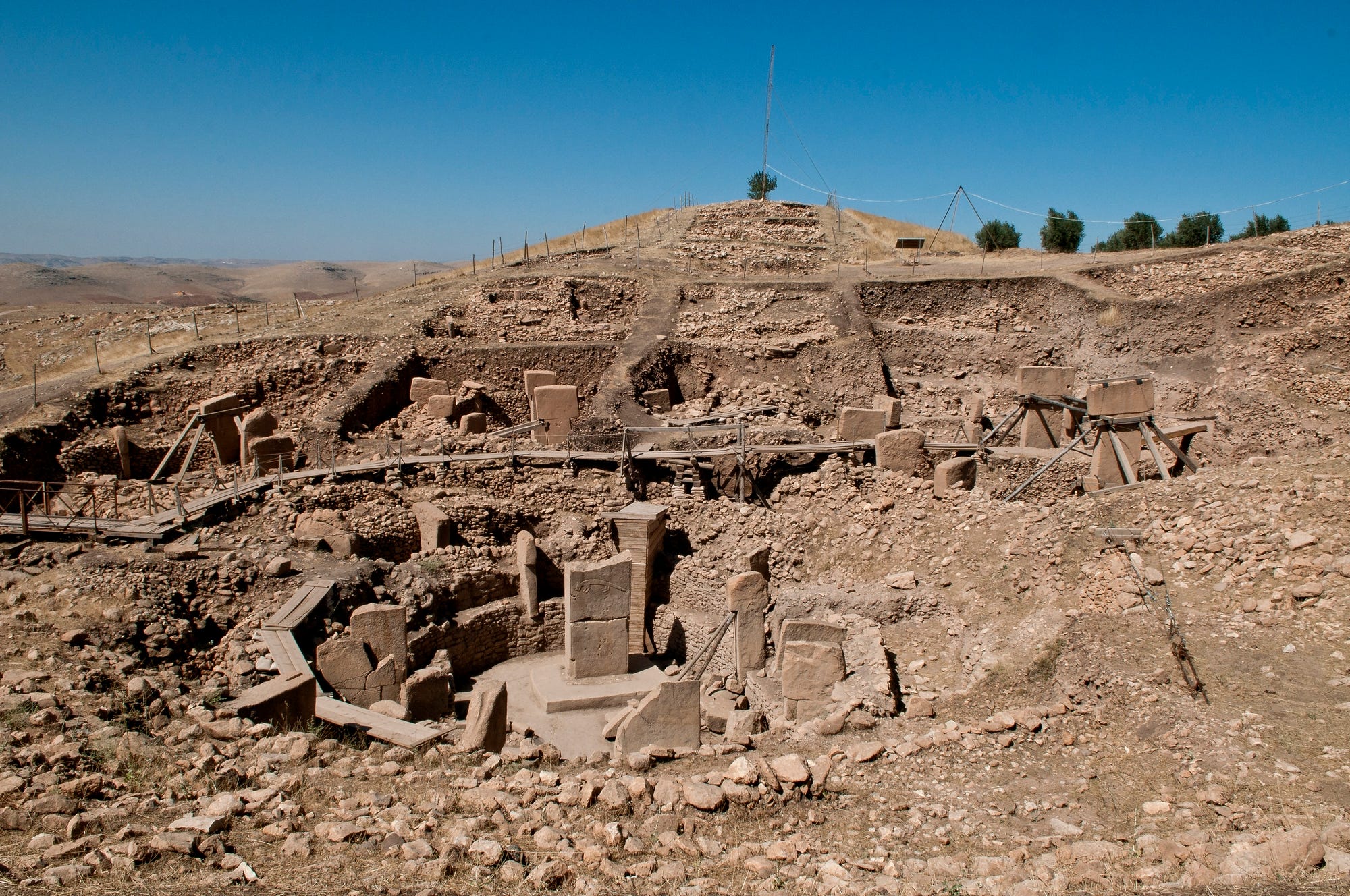
In 1963, a team doing a survey in southeastern Turkey noticed a strange hill. It looked artificial. They catalogued it and moved on. It wasn’t until 1994 that German archaeologist Klaus Schmidt actually started digging.
What he found was impossible.
Göbekli Tepe is a temple. Not a small shrine, but a massive complex of stone circles with carved pillars, some weighing up to 20 tons. The pillars are decorated with detailed reliefs of animals: foxes, lions, scorpions, vultures, snakes. The craftsmanship is sophisticated. These weren’t crude scratches. Someone spent months, maybe years, carving each pillar.
The site dates to around 9600 BCE. That’s roughly 11,600 years ago. The people who built it were hunter-gatherers. They had no agriculture, no domesticated animals, no pottery, no metal tools. They lived in a world before farming existed.
Every model we have of human civilization says this: first you develop agriculture, then you get surplus food, then you get specialization of labor, then you get monumental architecture. Göbekli Tepe reverses that entire sequence. The temple came first. Agriculture came after.
Each of those 20-ton pillars had to be quarried, shaped, transported, and erected. The quarry is nearby, but moving stones that size without wheels, without beasts of burden, without any of the technology we associate with monument-building is a massive undertaking. We’re not talking about a few people. We’re talking about coordinated labor on a scale that requires organization, planning, and a sustained food supply for workers.
But these were hunter-gatherers. Their entire social structure, as we understand it, was small, mobile bands. Maybe 20 to 50 people per group. They moved with the seasons, following game and wild plants. They didn’t stay in one place long enough to build something like this.
Except they did.
The site shows signs of repeated use over many centuries. It wasn’t built in one generation. It was built, expanded, and maintained across what might have been a thousand years. Then, around 8000 BCE, someone deliberately buried the entire complex under tons of dirt. Not destroyed. Buried. Carefully.
We have no idea why.
I spent an afternoon reading through academic papers about Göbekli Tepe, and there’s a strange gap in the discourse. Researchers describe the site in meticulous detail. They catalog every carving, every stone, every layer of sediment. But when it comes to the central question, most of them dance around it.
The question is: what made hunter-gatherers do this?
One theory, proposed by Schmidt himself, is that the desire to build the temple actually led to agriculture. That groups of people started gathering regularly at Göbekli Tepe for some kind of ritual or social function, and the need to feed large numbers of people in one place pressured them into figuring out how to cultivate wild grains. In this model, religion came before farming. Belief drove civilization, not the other way around.
It’s an elegant idea. It also requires us to believe that people organized massive construction projects for purely symbolic reasons, with no material benefit, while still living hand-to-mouth.
Maybe that’s true. Humans do irrational things for belief all the time. But there’s a second problem: we don’t actually know what Göbekli Tepe was for.
Everyone calls it a temple because we don’t have a better word. There’s no evidence of habitation. No trash heaps, no hearths, no signs that people lived there. It was a place people came to, not a place they stayed. But we don’t know what they did when they arrived. There are no burials, no obvious altars, no clear ritual objects.
The carvings might be symbolic. Or they might be something else entirely. Some researchers have suggested they’re a kind of narrative, maybe even an early star map. Others think the animal imagery represents clans or social groups. We’re guessing.
Here’s something I’ve noticed in my research, not just about Göbekli Tepe but about a lot of ancient sites: we assume that if we can’t explain something, it must be religious.
There’s a term in archaeology called the “ritual explanation.” When researchers find an object or structure they don’t understand, they label it as ceremonial or religious and move on. It’s a placeholder. It doesn’t actually explain anything. It just names our ignorance.
I’m not saying Göbekli Tepe wasn’t religious. It very well might have been. But I think we’re too quick to stop asking questions once we file something under that category.
What if the site had a function we don’t recognize because it doesn’t exist in our modern experience? What if the people who built it had a social structure we can’t model because it’s not like anything that survived into the historical record?
We know almost nothing about the belief systems of pre-agricultural people. We have cave paintings, burial sites, carved figurines. We interpret them through the lens of modern anthropology, but we’re making assumptions based on contemporary hunter-gatherer cultures, which have all been shaped by thousands of years of contact with agricultural societies. We don’t actually know what purely prehistoric social organization looked like.
Göbekli Tepe suggests it was more complex than we thought.
I think the reason Göbekli Tepe unsettles me is that it implies we’ve been telling the story of human progress wrong.
We like narratives that move in straight lines. Primitive to advanced. Simple to complex. Ignorant to enlightened. Göbekli Tepe doesn’t fit that story. It shows people doing something sophisticated, then stopping. Agriculture didn’t emerge smoothly from hunter-gatherer life. It happened in fits and starts, in specific places, for reasons we still don’t fully understand.
And then there’s the burial. Someone, for some reason, decided to end Göbekli Tepe. Not by destroying it, but by preserving it under earth. That takes effort. It’s deliberate. It’s the opposite of what you’d do if you were just abandoning a site.
It suggests intentionality. A decision. Maybe even a taboo.
I keep thinking about what it must have taken to organize that effort. To convince a community, or multiple communities, to spend weeks or months hauling dirt to cover something their ancestors had spent generations building. That’s not a casual choice. That’s a statement.
But we don’t know what the statement was.
I don’t have an answer. I’m not sure anyone does.
But I think Göbekli Tepe is evidence that human beings 12,000 years ago were capable of abstract thought, long-term planning, and collective action on a scale we didn’t think was possible without agriculture. And if that’s true, then we need to rethink a lot of assumptions about early human history.
Maybe the development of civilization wasn’t a slow, linear process. Maybe it happened in bursts. Maybe there were other experiments, other attempts at complex society, that didn’t leave behind enough evidence for us to find. Göbekli Tepe only survived because it was buried. How many other sites eroded away, were built over, or were dismantled for stone?
We might be looking at the exception, not the rule.
Or maybe I’m overthinking it. Maybe Göbekli Tepe was just what happens when you give a bunch of hunter-gatherers a few centuries of good weather and abundant wild resources. Maybe it’s not that mysterious. Maybe the mystery is just our own ignorance of how much humans can do when they want to.
I don’t know. But I think the question is worth sitting with.
If you’ve been following along with my research, you know I tend to focus on cases where the official explanation feels incomplete. Göbekli Tepe is one of those. It’s not that the archaeologists are wrong. It’s that they’re working with a framework that doesn’t quite fit the evidence.
I’ll keep digging. If you want to follow along, you know where to find me.
No posts
Comments
Nothing yet. Say the first thing.
Sign in to join the conversation.