
I don’t believe in Bigfoot.
I want to make that clear upfront, because what I’m about to tell you sounds exactly like a Bigfoot story. Except it’s not. It’s smaller, stranger, and backed by enough credible witnesses that I’ve spent the last two weeks trying to understand why this particular case feels different from every other “mystery ape” report I’ve ever read.
The creature is called Orang Pendek. It means “short person” in Indonesian. And the reason I’m writing about it is simple: the people who’ve seen it aren’t who you’d expect.
In September 2009, a British conservation worker named Sahar Didmus was doing a routine forest survey in Sumatra’s Kerinci Seblat National Park when something walked across the path ahead of her. She later described it as bipedal, covered in dark gray hair, about four feet tall, with a distinctly non-human gait. Didmus had spent years in that forest. She knew every primate species in the region. This wasn’t one of them.
Here’s what makes her account interesting: she didn’t want to report it. She knew how it would sound. But she wasn’t the only member of her team who saw it, and the encounter was so matter-of-fact, so undramatic, that it ended up in her field notes almost as an afterthought.
That’s the pattern with Orang Pendek. The witnesses are often scientists, park rangers, conservation workers. People who have every professional reason not to report seeing an unidentified primate. And yet the reports keep coming, spanning decades, with a consistency that’s hard to dismiss.
So either there’s something actually living in those forests, or we’re looking at one of the most geographically and temporally stable mass delusions on record.
Let me walk you through why this case is different.
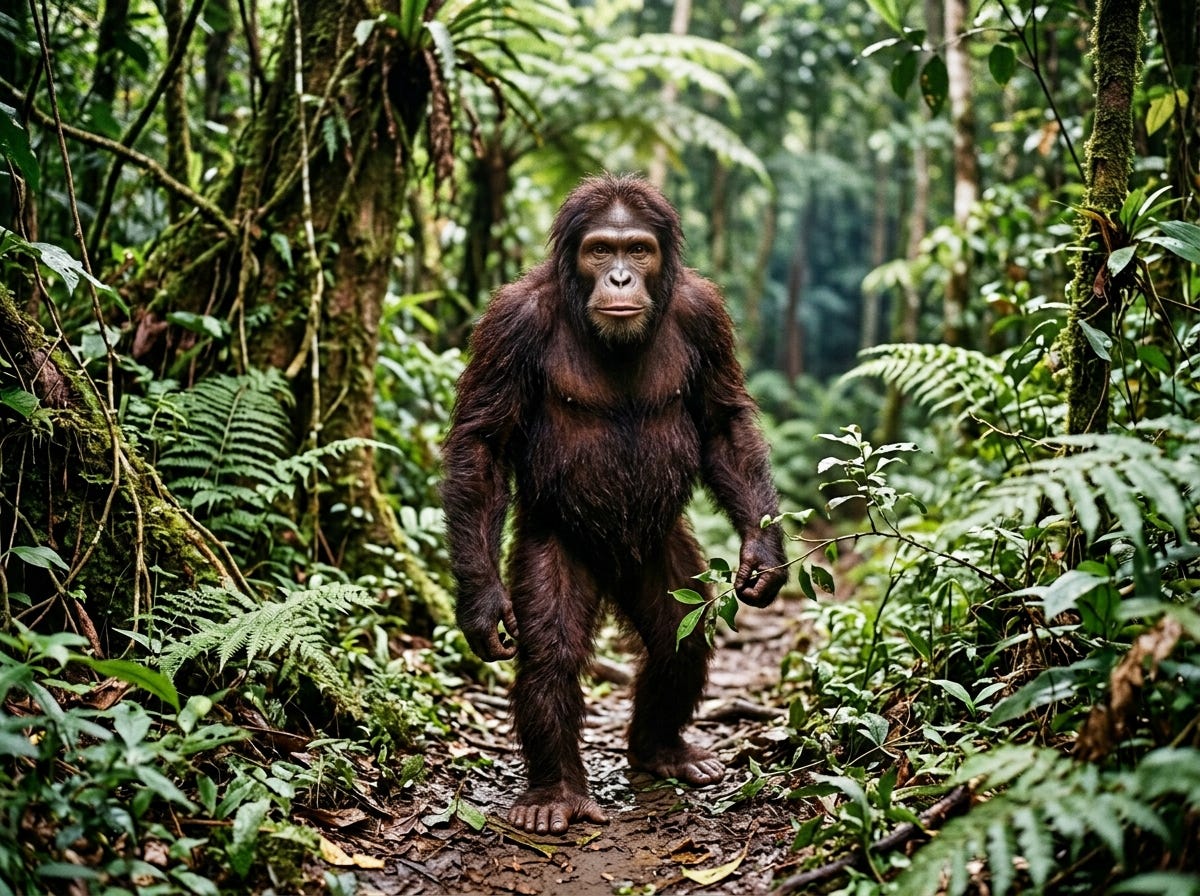
Orang Pendek sightings cluster almost entirely in the mountainous forests of Sumatra, particularly around Kerinci Seblat National Park. The park covers nearly 5,400 square miles of some of the most remote, dense jungle terrain in Southeast Asia. Parts of it have never been fully surveyed.
Descriptions of the creature are remarkably consistent:
Height: 80 to 150 centimeters (roughly 2.5 to 5 feet)
Build: muscular, barrel-chested, with powerful shoulders
Hair: short, dark brown to reddish, covering most of the body except the face
Face: described as more human-like than ape-like, though clearly not human
Gait: fully bipedal, walks upright without the hunched posture of known apes
Behavior: shy, non-aggressive, typically flees when encountered
Local Sumatran communities have stories about Orang Pendek going back generations. But the modern documented history starts in 1915, when a Dutch colonist named Van Heerwarden reported a prolonged sighting. He described watching the creature for several minutes and specifically noted that it was not an orangutan or any known primate.
Then, in 1923, another Dutch explorer reported tracks that didn’t match any cataloged species.
Fast forward to the 1990s. British journalist Debbie Martyr moved to Sumatra to work on tiger conservation. She was deeply skeptical of local Orang Pendek stories until she saw one herself in 1990. She described the encounter as lasting only seconds but being completely unambiguous. It changed the direction of her career. She spent the next 15 years documenting sightings, collecting hair samples, and recording footprint casts.
What’s unusual here is that Martyr had no incentive to fabricate this. She was already doing meaningful conservation work. Attaching herself to a cryptid hunt could have easily damaged her credibility. And yet she committed years to investigating it, producing some of the most methodical field research on the subject.
Here’s where it gets strange.
In 2001, a group of Indonesian park rangers reported finding tracks near the Tapan River. The prints were humanoid but small, with a divergent big toe like an ape. They made plaster casts. When analyzed, the foot structure didn’t match any known primate in the region. It also didn’t match human prints, even accounting for deformities or barefoot populations.
The gait implied by the stride length suggested bipedalism, but the foot morphology was wrong for a human. It looked more like what you’d expect from an evolutionary experiment: a primate foot adapted for upright walking but not fully specialized for it yet.
Then there’s the hair. Multiple samples collected over the years have been sent for analysis. In 2009, hair samples were analyzed using mitochondrial DNA testing. The results came back as unknown primate. Not human. Not orangutan. Not gibbon. Not any cataloged species in the database.
That should have been major news. It wasn’t, largely because a single DNA result from hair isn’t definitive. Contamination is possible. Misidentification of the sample source is possible. But it adds to a pattern that’s hard to ignore.
There’s also the behavior. Witnesses consistently describe Orang Pendek as shy and evasive. It doesn’t approach humans. It doesn’t raid crops or campsites. It just exists in the forest, occasionally crossing paths with people, then disappearing. That’s not the behavior profile of a hoax or a misidentified known animal. Hoaxers want attention. Misidentified animals don’t consistently evade documentation.
Let’s be rational. There are a few possibilities.
The most common explanation: people are seeing known animals and misinterpreting them. The problem is that most witnesses are familiar with local wildlife. Sumatran orangutans exist in the region, but they’re arboreal, orange, and move differently. Siamangs and gibbons are there too, but they’re smaller, also arboreal, and their locomotion is distinct.
Sun bears sometimes stand upright, and there’s a theory that Orang Pendek sightings are actually sun bears. But sun bears have a distinctive gait when bipedal, nothing like the smooth walking described in reports. And witnesses who’ve seen both say they’re completely different.
Could every single witness over a hundred-year span be misidentifying the same common animal? Possibly. But it requires assuming a level of perceptual error that doesn’t match the consistency of the descriptions.
Maybe it’s a shared cultural story that people unconsciously project onto ambiguous sightings. Except the descriptions predate significant Western contact in some regions, and they come from multiple ethnic groups with different languages and traditions.
The hoax explanation falls apart when you consider the lack of motive. Most witnesses don’t seek publicity. Many are locals who mention it casually, without drama. The conservation workers who reported sightings often did so reluctantly, knowing the professional risk.
This is the explanation that sounds insane but actually has some scientific precedent.
New large mammal species are rare, but they’re not impossible. The saola, a large forest-dwelling bovine, wasn’t scientifically documented until 1992 in Vietnam. It’s not a small animal. It just lived in remote enough terrain that it evaded discovery.
Sumatra’s forests are vast and difficult to survey. If a small population of an unknown primate existed in the most remote highland areas, it’s not inconceivable that it could remain undocumented, especially if its population is small and its behavior is evasive.
The bipedalism is the sticking point. No known ape smaller than a human walks upright as a primary mode of locomotion. But evolutionary biology doesn’t have hard rules about what’s possible, only what we’ve observed so far. If environmental pressures in Sumatra favored bipedalism in a smaller ape lineage, we’d only know about it if we found one.
There’s also the question of what it could be, evolutionarily. Some researchers have speculated it might be a remnant population of a previously unknown hominin species, something that diverged from the human lineage but survived in isolation. Others think it’s more likely a new species of bipedal ape.
Both sound absurd until you remember that we’ve only been doing scientific zoology for a few hundred years, and large portions of the planet remain poorly studied.
I’m not convinced Orang Pendek exists. But I’m not convinced it doesn’t.
What I find compelling is the absence of the usual red flags. There’s no industry built around it. No tourist traps. No grainy, suspiciously blurry photos that look like someone in a suit. Just a steady trickle of reports from people who often wish they hadn’t seen anything at all.
If this were happening in North America, I’d be more skeptical. We’ve surveyed those forests extensively. But Sumatra is different. The terrain is brutal. The biodiversity is staggering. And the historical record of late species discoveries in Southeast Asia suggests we’re not done cataloging what lives there.
The other thing that sticks with me is the DNA result. It’s easy to dismiss one anomalous genetic sample, but it’s harder to dismiss it when it aligns with decades of consistent eyewitness testimony and physical evidence like tracks.
I might be wrong. This could all be a case of pattern-seeking and confirmation bias, where ambiguous sightings get filtered through cultural expectations and produce a false consensus. Human perception is deeply unreliable, and our brains are wired to see agency and intention even where none exists.
But if I had to bet, I’d say there’s something in those forests that we haven’t properly identified yet. Whether it’s a new species of primate or just a behavioral variant of a known one, I don’t know. But the possibility is there, and it’s more credible than most cryptid cases I’ve looked into.
The fact that we can’t be sure, even with modern technology and decades of reports, says more about the limits of our knowledge than it does about the existence of the creature itself.
If you want to dig into this more, the field research archives from Debbie Martyr’s work in the 1990s and early 2000s are surprisingly detailed. Most cryptid cases fall apart under scrutiny. This one just gets more interesting.
I’ll keep looking. If I end up in Sumatra, you’ll be the first to know.
If you found this interesting, I write about cases like this every week. Real mysteries, analyzed without the sensationalism. Subscribe to get them in your inbox.
No posts
Comments
Nothing yet. Say the first thing.
Sign in to join the conversation.