
I’ve been thinking about what it means for a city to share a hallucination.
Not a small group. Not a handful of people primed to see something strange. But thousands of witnesses across a hundred miles, over the course of several hours, on a clear March evening in 1997. This case breaks every pattern I’ve learned to recognize in mass sighting events.
The Phoenix Lights should be easy to dismiss. It has all the markings of collective misidentification. Except for one detail that doesn’t fit.
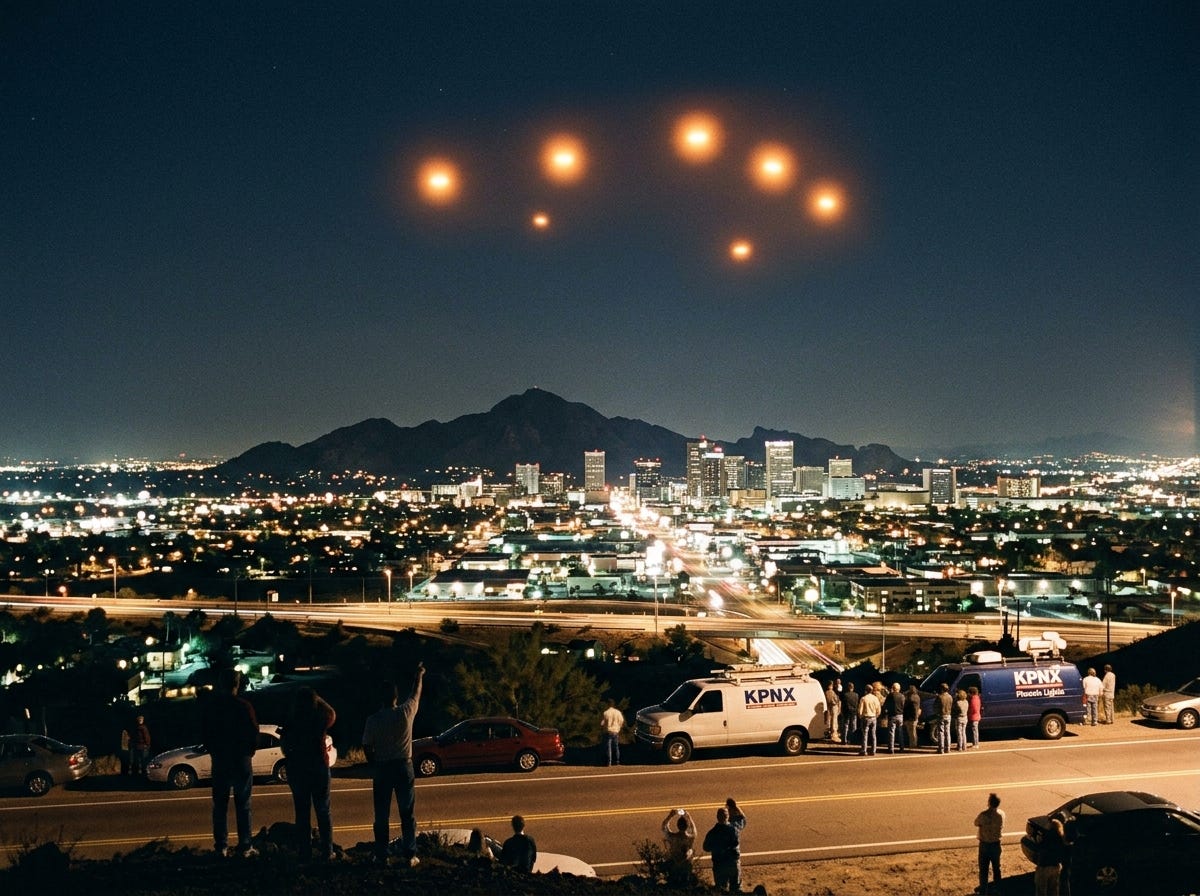
On March 13, 1997, starting around 7:30 PM, reports began flooding in across Arizona. The sequence of events is unusually clear because of the sheer number of witnesses and the timeline investigators were able to construct afterward.
A series of lights appeared in the sky, moving southeast from the Nevada border, over Prescott, Phoenix, and eventually toward Tucson. Witnesses described a massive V-shaped or triangular formation. Some said the lights were attached to a solid object. Others said they only saw the lights themselves.
The craft, or formation, or whatever it was, moved slowly and silently. Multiple witnesses reported that it blocked out stars as it passed overhead. One man said it was “bigger than a football field.” A woman in Phoenix said it passed so low over her home that she could see individual panels on its underside.
Around 10:00 PM, a second event occurred. A series of flares appeared over the Estrella Mountains, southwest of Phoenix. These were captured on video by multiple people and became the most widely circulated footage of the incident.
Here’s where it gets complicated.
The U.S. Air Force later explained the 10:00 PM lights as flares dropped during a training exercise by the Maryland Air National Guard. LUU-2B/B illumination flares, specifically. The flight logs matched. The location matched.
For the second event, this explanation works perfectly. The flares descended slowly, suspended by parachutes. They were bright, reddish-orange, and appeared in a line. Everything about the 10:00 PM sighting fits.
But the 7:30 PM event doesn’t.
The earlier sighting involved lights moving in formation across hundreds of miles, reported by witnesses in different cities over the course of more than an hour. The Air Force explanation doesn’t account for this. In fact, official statements have been inconsistent about whether the earlier reports were even real or just misidentified commercial aircraft.
This inconsistency is what made me dig deeper.
Most articles about the Phoenix Lights focus on the spectacle. The massive craft, the government denial, the conspiracy theories. But there’s a smaller detail that interests me more.
Several witnesses reported that the object made no sound.
Not “a quiet hum” or “a distant rumble.” Literally no sound at all.
One witness, a truck driver named Bill Greiner, was outside his home in Paulden, a small town north of Phoenix, when the lights passed directly overhead. He estimated the object was less than 100 feet above him. He said it was enormous, V-shaped, and completely silent.
Silence is a problem.
Any aircraft large enough to block out stars and fly at low altitude should generate noise. Helicopters are loud. Jets are loud. Even experimental military craft using advanced propulsion would produce some detectable sound signature. The absence of sound doesn’t just fail to fit known technology in 1997. It challenges basic physics of how we understand large objects moving through air.
I’m not saying this makes it extraterrestrial. I’m saying it makes the existing explanations incomplete.
I’ve studied enough of these cases to recognize the usual patterns. When large groups of people report seeing something strange, there are common psychological and social dynamics at play.
Expectation bias is the big one. If someone tells you there’s a UFO in the sky, you’re more likely to interpret ambiguous lights as something unusual. Cascade reporting happens next. One person’s interpretation influences others. Memory becomes unreliable. Details shift.
But the Phoenix Lights don’t quite fit this model.
The reports began independently across multiple locations before any media coverage. Witnesses weren’t gathered in one place, primed to see something. They were in their backyards, on highways, separated by miles. Their descriptions were remarkably consistent: V-shaped formation, silent, slow-moving, massive.
Consistency across independent witnesses is rare. It doesn’t prove anything extraordinary, but it does suggest people were reacting to a real external stimulus, not a shared delusion or expectation.
I’ve narrowed it down to a few scenarios that actually make sense.
One: It was a classified military test. The U.S. has a long history of testing experimental aircraft over Arizona and Nevada. Stealth technology, unconventional propulsion, large surveillance platforms. The silence could be explained by altitude miscalculation. Witnesses might have thought the object was closer than it actually was, which would explain the perceived size and lack of sound.
Two: It was a formation of conventional aircraft misidentified due to atmospheric conditions. Temperature inversions can bend light and create optical illusions. Multiple planes flying in formation, seen through distorted air, could appear as a single massive object. This has happened before.
Three: It was something we don’t have a framework for yet. Not necessarily alien, but a natural atmospheric phenomenon we haven’t categorized. Ball lightning was considered pseudoscience until fairly recently. I try to stay open to the possibility that we don’t know everything about how light and air interact under specific conditions.
None of these feel complete.
The military test theory doesn’t explain why the object would fly directly over populated areas at low altitude. The misidentification theory struggles with the consistency of witness descriptions and the timeline. The unknown phenomenon theory is functionally unfalsifiable, which makes it unsatisfying.
It’s not the lights themselves. It’s the response.
The governor of Arizona at the time, Fife Symington, held a press conference a few months after the incident. He brought out a staff member dressed in an alien costume, mocking the reports. Years later, in 2007, he admitted he had also witnessed the lights and didn’t know what they were. He said he made a joke of it to avoid public panic.
That shift bothers me. Not because I think it’s a coverup in the conspiratorial sense, but because it reveals how institutions handle uncertainty. When something doesn’t fit into existing categories, the instinct isn’t to investigate openly. It’s to minimize, deflect, or ridicule.
I think that impulse, more than any specific explanation, is what keeps cases like this unresolved. We’d rather have a flawed answer than admit we don’t know.
I don’t know what people saw over Phoenix in 1997. I don’t think anyone does, completely.
What I do know is that something happened. Something visible, consistent across independent witnesses, and unexplained by the official accounts we’ve been given. Whether it was experimental military technology, an optical phenomenon, or something else entirely, the case deserves better than dismissal or sensationalism.
I’ve learned to sit with uncertainty. Not every mystery has a satisfying resolution. But the process of thinking through the inconsistencies, testing the explanations, noticing what doesn’t fit, that’s where the real work is.
If you’re reading this and you’ve been following along with the cases I’ve been writing about, you know I’m not here to sell you answers. I’m here to ask better questions. The Phoenix Lights are a good test case for that approach. They force you to hold multiple possibilities at once without collapsing into easy certainty.
I’ll keep digging into cases like this. If that’s the kind of thing you want to read more of, you know where to find me.
No posts
Comments
Nothing yet. Say the first thing.
Sign in to join the conversation.