
I was inspired by a line from one of my favorite movies, Indiana Jones and the Kingdom of the Crystal Skull, when I came up with the title for this article. I sincerely hope Mr. Spielberg won’t sue me for borrowing the idea.
In this post, you’ll learn that the idea behind the title might not be all that far from reality. Although...
I have a habit of zooming out on Google Maps until geography stops making sense. Mountain ranges look like wrinkles. Cities look like mold. And sometimes, if you zoom into the right stretch of desert in southern Peru, you start seeing shapes that have no business being there.
A spider the size of a football stadium. A hummingbird with a wingspan longer than most American city blocks. A monkey with a curling tail drawn in a single, unbroken line. All of it etched into the surface of a plateau that receives about twenty minutes of rain per year, sitting at an elevation where the wind behaves strangely and the ground has turned a color that NASA once described as “unusual even by desert standards.”
I want to be careful here. The Nazca Lines are one of those subjects that attract a particular kind of enthusiasm, and most of that enthusiasm moves in exactly the wrong direction. People see the aerial photographs and immediately jump to conclusions that feel satisfying but stop the actual thinking cold. So I am going to try something different. I am going to sit with what we actually know, which is genuinely strange enough without any help from ancient astronauts.
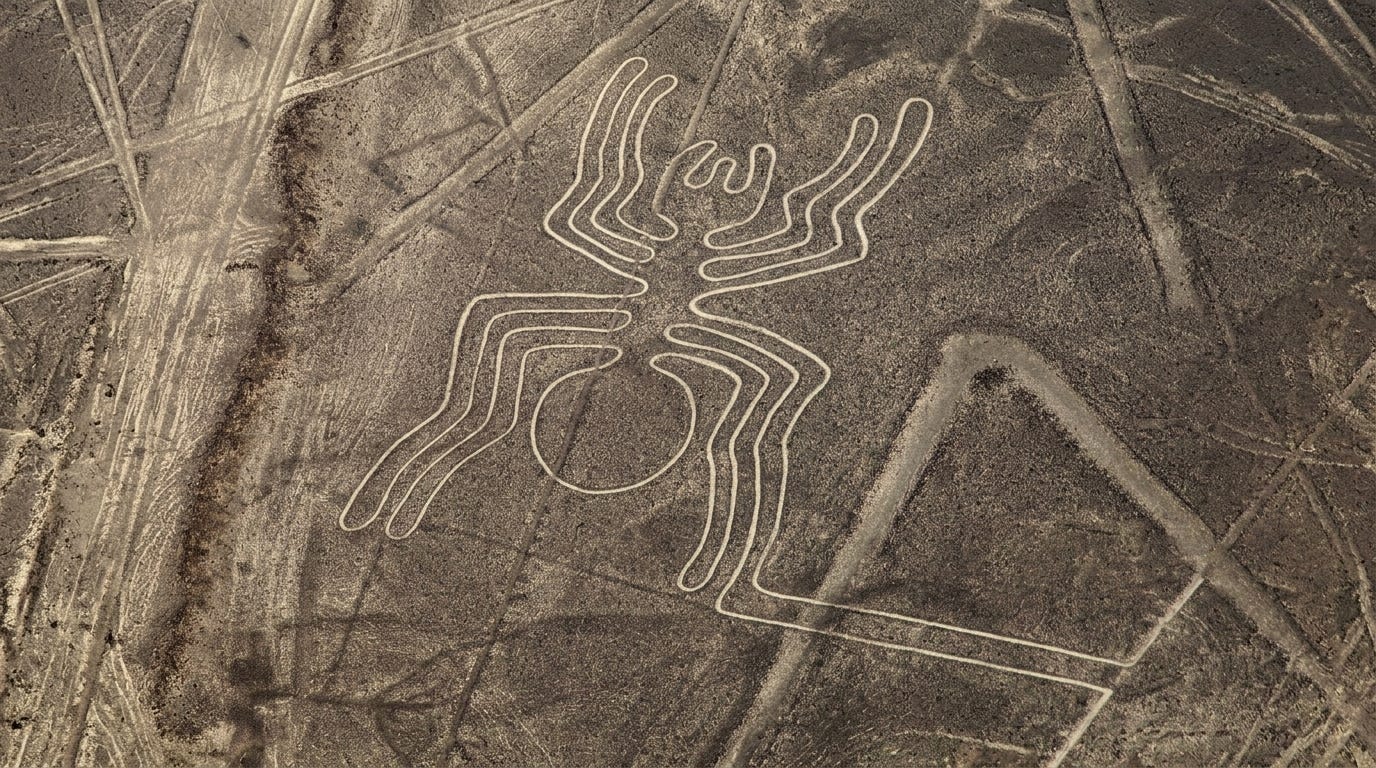
The Nazca Lines are geoglyphs, which is just a technical word for large designs made on the ground. They are located in the arid coastal plain of southern Peru, particularly around the Nazca and Pampas de Jumana region. UNESCO dates the main body of the famous geoglyphs to roughly 500 BCE to 500 CE, while the broader archaeological landscape reflects activity over a longer period.
The method of creation is understood and not particularly mysterious. The surface of the plateau is covered in reddish-brown iron oxide-coated pebbles. The Nazca people removed those pebbles and piled them to the sides of their designs, exposing the lighter yellowish-grey ground beneath. That’s it. No lost technology. No alien assistance. Just patient, organized human labor.
There are hundreds of individual figures and many more geometric formations. Some are zoomorphic, meaning they represent animals. The spider, the hummingbird, the monkey, the condor. Some are humanoid. Some are geometric, including long straight lines and trapezoids that extend for kilometers across the desert. Others radiate from particular points or form enormous geometric patterns.
The lines have survived for roughly two thousand years primarily because of the extraordinary aridity of the environment. The region receives extremely little rainfall, and the low level of erosion has helped preserve the designs. UNESCO describes the area’s extreme aridity as one of the key reasons the geoglyphs have survived for nearly two millennia. Researcher Maria Reiche, a German mathematician who dedicated most of her adult life to studying and protecting the lines, called the plateau a natural drafting table. That description has always stuck with me.
So the creation is understood. The preservation is understood. What is not understood, and what has generated more competing hypotheses than almost any other archaeological site on Earth, is the purpose.
Most people who talk about the Nazca Lines focus on the animal figures. The spider. The hummingbird. The monkey. Those are the images that appear in documentaries, on travel posters, in every thumbnail of every YouTube video that is going to recommend you buy into something uncritical and exciting.
But the animal geoglyphs represent a small fraction of the total designs.
The majority of the Nazca Lines are not animals at all. They are straight lines. Kilometers-long, perfectly straight lines that run across the plateau, up and over small hills, through slight depressions, without deviation. And enormous trapezoidal areas, cleared of stones, that look from above like runways.
This is where the “alien airport” hypothesis comes from, and I understand the visual logic of it. If you took a photograph of a modern airport and removed all context, the geometry would look almost identical. Long straight lines. Cleared rectangular areas. Converging paths.
But here is what that hypothesis gets completely wrong, and it bothers me that this point is not made more clearly in popular coverage: the trapezoids are not flat. They are not level. They follow the natural contour of the terrain underneath them. The Nazca cleared the surface stones but did not grade or flatten the underlying ground. If you tried to land any aircraft on one of these cleared areas, you would have a very bad time.
So what are they?
I want to work through the main explanations here, not to dismiss any of them quickly, but to look at what each one actually accounts for.
The astronomical calendar theory is probably the most academically respectable. Maria Reiche promoted it for decades and devoted her life to measuring alignments between the lines and solstice and equinox positions. Some lines do point toward sunrise or sunset on significant calendar dates. The problem is that with hundreds of lines running in essentially every direction across the plateau, you would expect some of them to align with astronomically significant positions by pure probability. When researchers ran statistical analyses on the alignments Reiche identified, they found the correlation was not significantly stronger than random chance. That doesn’t mean the astronomical explanation is wrong. It means it’s incomplete.
The water hypothesis, developed primarily by archaeologist David Johnson and later refined by other researchers, is genuinely interesting and underappreciated. Johnson noticed that some of the straight lines appear to follow underground aquifers. The Nazca culture survived in an extremely dry environment and water management would have been existentially important. If the lines were used as markers for water sources, ritual paths to springs, or territorial boundaries related to water rights, that would explain their practical function without requiring anything supernatural.
The ritual procession theory has gained considerable traction in the last two decades. Archaeologist Clive Ruggles and anthropologist Nicholas Saunders have both argued that the lines were designed to be walked rather than viewed. Ceramic evidence and food remains have been found along some lines, suggesting that groups of people moved along them, possibly during festivals or religious ceremonies. This theory has the advantage of not requiring you to explain how the Nazca could see their own designs from above.
That last point is the one I keep returning to.
Here is the question that should be at the center of every discussion of the Nazca Lines and somehow almost never is: if the designs were meant to be seen, and they were created by a culture without flight, who were they made for?
The standard answers are: the gods. Or: they didn’t need to see the finished image because they knew what they were making. Or: hot air balloons, which is a fringe theory that proposes the Nazca could achieve basic flight using materials available to them.
I find the second answer more interesting than it usually gets credit for. There is no reason to assume that every large-scale design had to function like a picture intended for human viewers standing in one particular place. A ritual landscape can have meaning through the act of creating, walking, gathering, offering and performing, even when the complete design is difficult to appreciate from ground level.
That possibility becomes even more interesting in light of recent research.
In 2024, researchers from Yamagata University and IBM used AI-assisted analysis of aerial imagery to identify candidates for previously unknown geoglyphs. Field surveys confirmed 303 new figurative geoglyphs in just six months. The researchers found an important distinction between two broad types: enormous line-type figures, predominantly depicting wild animals and associated with networks of straight and trapezoidal lines, and much smaller relief-type figures, often depicting human-related subjects and located within viewing distance of winding trails. The researchers interpreted the larger figures as likely connected to community-level ritual activity, while the smaller figures appear to have been intended to be seen by people walking along the trails.
That distinction matters.
It suggests we may have been asking the wrong question.
Maybe the Nazca didn’t create all of these things for one audience.
There is a famous claim about the Nazca spider that I find much more interesting than the claim itself.
Some popular accounts have argued that one of the spider’s legs contains a tiny anatomical detail resembling the reproductive organ of a particular spider found in the Amazon rainforest, hundreds of kilometers away. The story has often been presented as evidence that the Nazca must somehow have had knowledge of a species they could not have encountered locally.
It is a fascinating idea. It is also much less certain than the internet usually makes it sound.
The identification of that anatomical feature with a particular Amazonian species is not secure enough to treat as an established archaeological fact. A resemblance in a stylized geoglyph is not, by itself, evidence that the Nazca deliberately reproduced the anatomy of a distant species.
And once you remove that certainty, the argument changes completely.
We no longer have proof that the Nazca knew about a specific Amazonian spider. We have a hypothesis based on an anatomical resemblance.
That doesn’t make the spider uninteresting. Actually, I think it makes the question better.
If the resemblance is intentional, what source did the artist use? If it isn’t, why did the resemblance become such a persistent part of the modern story of the Nazca Lines?
And how many other details in these enormous drawings have we simply failed to notice because we didn’t know what to look for?
That last question is the one I find hardest to let go of.
One thing that popular coverage almost always omits is that the Nazca Lines did not appear in isolation. The Nazca culture produced extraordinary polychrome pottery with detailed iconography. They built underground aqueducts called puquios, some of which are still in use today, that are remarkable feats of hydraulic engineering. They created elaborate textile work. They had a complex religious system centered on ancestors, water, fertility, and the relationship between living and dead.
When you put the Lines into that context, the “aliens did it” hypothesis doesn’t just become unnecessary. It becomes almost condescending. It says: this evidence of organized labor, sophisticated planning, and coherent symbolic logic cannot be the product of these people, so it must be something else.
Maria Reiche reportedly became furious when she encountered ancient astronaut theorists at the site. She had spent decades in the desert, measuring, documenting, sleeping on the plateau in a sleeping bag to prevent tourists from damaging the lines with their footprints. She knew what the evidence looked like up close. She had no patience for explanations that bypassed the evidence entirely.
I find that reaction understandable. Not because Reiche was necessarily right about her own astronomical theory, but because she had done the work. There is something that tends to happen in our culture when we encounter unexplained things: we skip the uncomfortable middle stage, the one where you sit with genuine uncertainty and keep asking questions, and we jump straight to an answer that makes the mystery feel resolved even if it explains nothing.
The ancient astronaut theory is extremely good at doing this. It takes something genuinely puzzling and replaces the puzzle with a story. The story feels like an answer. But it has the structure of giving up.
I want to be transparent about the limits of my own analysis here. I have not been to Nazca. I have spent an embarrassing number of hours reading published research, looking at aerial imagery and trying to separate what archaeologists actually know from what the internet has decided they know. But I have not stood on that plateau and looked at the horizon.
What I think, provisionally and with genuine uncertainty: the lines probably served multiple functions, and those functions probably shifted over the long period during which the geoglyphs were created.
The animal geoglyphs feel to me like they belong to a different conceptual category than at least some of the straight lines. The giant line-type figures predominantly depict wild animals and are associated with networks of straight and trapezoidal geoglyphs. Recent research suggests that these large designs were connected to community-level ritual activity.
The smaller relief-type figures seem to tell a different story. Many are positioned near ancient paths and appear to have been placed where people walking through the landscape could actually see them. Researchers have suggested that their themes including humans, domesticated camelids and decapitated heads, may have conveyed information or narratives to people moving along those paths. The straight lines themselves may have been paths, ritual routes, connections between significant places, or elements of a larger system involving water and sacred geography. A single explanation may simply be too small for the landscape.
Paul Kosok, one of the early researchers of the lines, famously described the Nazca plateau as a kind of enormous astronomical book. I don’t think we need to accept that interpretation to recognize what he was reaching for. The plateau really does function like a kind of writing.
It just might not be written in the language we assumed.
I keep thinking about the spider.
Not because I am convinced that it contains a hidden anatomical reference to an Amazonian species. I’m not.
I keep thinking about it because the story demonstrates how difficult it is to interpret something when we no longer have the people who made it around to explain what they meant.
We see a strange detail. Someone proposes an explanation. The explanation gets repeated. Eventually the explanation becomes a “fact.” Then someone else comes along and asks whether the original identification was ever secure in the first place.
That’s archaeology in miniature.
And the Nazca Lines are full of these little moments.
Maybe the spider was based on an observation we don’t understand. Maybe it wasn’t. Maybe some of the animal figures had religious meanings we can partially reconstruct from pottery and other archaeological evidence. Maybe some meanings are simply lost. Maybe the straight lines were sacred paths. Maybe some were connected to water. Maybe astronomy mattered in some places and not in others. Maybe the meaning changed as generations added new lines to an already ancient landscape.
What I find most compelling is that we are still discovering the evidence itself.
The 303 new figurative geoglyphs identified in the 2024 Yamagata University and IBM project were not the end of the story. In 2025, the researchers announced another 248 geoglyphs discovered through AI-supported field surveys carried out in 2023 and 2024, bringing the total number of known figurative geoglyphs to 893.
So perhaps the strangest thing about the Nazca Lines isn’t that we haven’t solved them.
It’s that, after nearly a century of serious study, the desert is still giving us new pieces of the puzzle.
Two thousand years later, we’re still finding things they left behind.
And we’re still trying to learn how to read them.
I think I’d rather have that mystery than an answer.
If this kind of slow, careful unpacking of a case is what you are looking for, you are in the right place. I write about unexplained events and lost histories from a research perspective, trying to stay in that uncomfortable middle stage as long as the evidence requires. No sensationalism. No easy answers. Just the actual thinking.
If you want to follow that process in real time, subscribing means you get each piece as it goes up.
No posts
Comments
Nothing yet. Say the first thing.
Sign in to join the conversation.