
Some stories become so familiar that we stop noticing the parts that don’t make sense.
The Anneliese Michel case is usually presented as either proof of demonic possession or a clear-cut example of religious fanaticism killing a mentally ill girl. But the record surrounding the case tells a different story. Not a simpler one. A stranger one.
Anneliese was already in psychiatric treatment when the exorcisms began. Her parents knew she had epilepsy. The priests knew. The doctors knew. And they all kept going anyway.
That’s the part I can’t figure out.

Anneliese Michel
Anneliese Michel was a 23-year-old university student in Bavaria when she died in July 1976. The cause of death was malnutrition and dehydration. In the year leading up to her death, two Catholic priests performed 67 exorcism sessions on her, with her parents’ full consent and participation.
The basic timeline goes like this:
She began having seizures as a teenager and was eventually diagnosed with epilepsy. She was treated with anticonvulsant medication and, for a time, continued with school and an apparently ordinary life.
But in 1973, she started reporting other symptoms. Seeing disturbing faces during prayer. Hearing voices telling her she was damned. Feeling unable to walk past religious images. Her medication wasn’t working as well anymore.
She saw multiple doctors. They adjusted her epilepsy medication, suggested psychiatric care. She tried both. The seizures continued. The psychological symptoms got worse.
In 1975, her family contacted a priest about performing an exorcism. The local bishop eventually approved it. The sessions began in September 1975 and continued until a week before her death.
During those sessions, which were audio recorded, Anneliese spoke in different voices, refused food, performed hundreds of genuflections per day, and described detailed theological visions. She broke furniture, hurt herself, ate insects and coal.
By June 1976, she weighed 68 pounds. She couldn’t walk. Her knees were destroyed from genuflecting on stone floors.
She died at home, in bed, on July 1st.
The priests and her parents were charged with negligent homicide. They were convicted but given suspended sentences.
That’s the version you’ll find anywhere. What’s missing is everything that makes the case actually strange.
First: Anneliese’s medication history.
According to the medical records entered as evidence, she had been prescribed multiple anticonvulsants over the years. Phenytoin, Phenobarbital, others. Standard treatment for temporal lobe epilepsy in the 1970s.
But here’s the thing. At some point in early 1976, she stopped taking them. The question is why.
Some sources say the priests told her to stop. The priests denied this at trial. They said she stopped on her own because she believed the demons were interfering with the medication’s effectiveness.
Her medical doctor, Dr. Richard Roth, testified that he had continued prescribing her medication through early 1976, but that she had stopped filling the prescriptions. He said he’d tried to convince her to continue treatment. He also said he’d been told about the exorcisms and hadn’t reported them to any authority.
That’s the first weird detail. A doctor who knew his patient was undergoing exorcism instead of treatment, and just... documented it.
Second: what’s actually on those audio recordings.
I haven’t heard them myself. They’re not publicly available in full, though short excerpts have been released over the years. But the trial transcripts include descriptions from multiple psychiatrists who reviewed them as expert witnesses.
Their observations are specific. Anneliese’s “demon voices” were consistent across sessions. Same vocal patterns, same theological references, same personalities. Six distinct voices, claiming to be historical figures: Judas, Nero, Hitler, Cain, Lucifer, and a disgraced priest named Fleischmann who’d been defrocked in the 16th century.
The psychiatrists noted that the voices demonstrated knowledge of Latin and theological history that Anneliese shouldn’t have had as a regular university student. But they also noted that all the historical references were things that could have been learned from popular religious education in Catholic Bavaria.
Their conclusion: the voices were most likely a complex dissociative phenomenon, possibly related to temporal lobe epilepsy and reinforced by religious expectation and group dynamics.
Not possession. But also not simple fraud.
Third: the timeline of her deterioration.
Anneliese’s physical decline accelerated dramatically once the exorcisms became more frequent. In September 1975, when they started, she was thin but functional. By November, she’d stopped attending university. By January 1976, she was mostly bedridden. By April, she couldn’t eat solid food.
The exorcism sessions were becoming longer and more physically demanding. Multiple witnesses described her performing 400 to 600 genuflections in a single session, basically deep knee bends on stone floors for hours at a time.
Her parents testified that they believed this physical suffering was necessary. That the demons had to be “worn down” through physical endurance and prayer. The priests encouraged this interpretation.
But none of them called a hospital, even as she stopped eating entirely.
The prosecutor asked why. The answer, from both parents and priests, was that Anneliese herself had refused medical intervention. She believed she was suffering for the salvation of wayward youth and apostate priests. She’d told them she needed to endure it.
She was 23. Legally an adult. Mentally competent enough, apparently, that no one felt obligated to intervene against her will.
Except she was also starving to death and performing physically destructive rituals at the instruction of religious authorities her family trusted completely.
That’s not competence. That’s coercion, even if everyone involved believed they were helping.
I’m not a neurologist, but I’ve read enough case studies by now to recognize patterns.
Temporal lobe epilepsy, the type Anneliese was diagnosed with, is associated with something called hyperreligiosity. It’s a documented phenomenon where seizure activity in specific brain regions increases religious ideation, feelings of spiritual presence, and moral intensity.
People with TLE sometimes report hearing divine voices, seeing religious figures, feeling overwhelming spiritual significance in ordinary moments. It’s not every case, but it’s common enough to be clinically recognized.
Add that to a devout Catholic upbringing in rural Bavaria in the 1960s and 70s, where religious framework was the primary lens for interpreting unusual experiences.
Add that to anticonvulsant medications that can cause depression and dissociative symptoms as side effects.
Add that to the stress of university, normal young adult identity formation, and a family culture that took religious transgression very seriously.
You get a perfect environment for a psychological crisis to be interpreted as spiritual warfare.
But here’s where it gets complicated.
Anneliese wasn’t just passively experiencing symptoms. According to multiple witnesses, including her sisters and her boyfriend, she was articulate and specific about what she was experiencing. She described theological visions in detail. She made predictions about church politics that, in a few cases, apparently came true. She discussed historical religious events with accuracy that surprised the priests.
The question isn’t whether she was mentally ill. She clearly was. The question is whether the mental illness fully explains everything she said and did, or whether there were elements of genuine religious experience mixed in.
And I realize that sounds like I’m hedging. I am.
Because one thing I’ve learned from researching cases like this is that “mental illness” and “religious experience” aren’t always opposites. Sometimes extreme psychological states open people up to experiences that don’t fit neatly into either category.
That doesn’t mean demons are real. It means human consciousness is weirder than we usually admit.
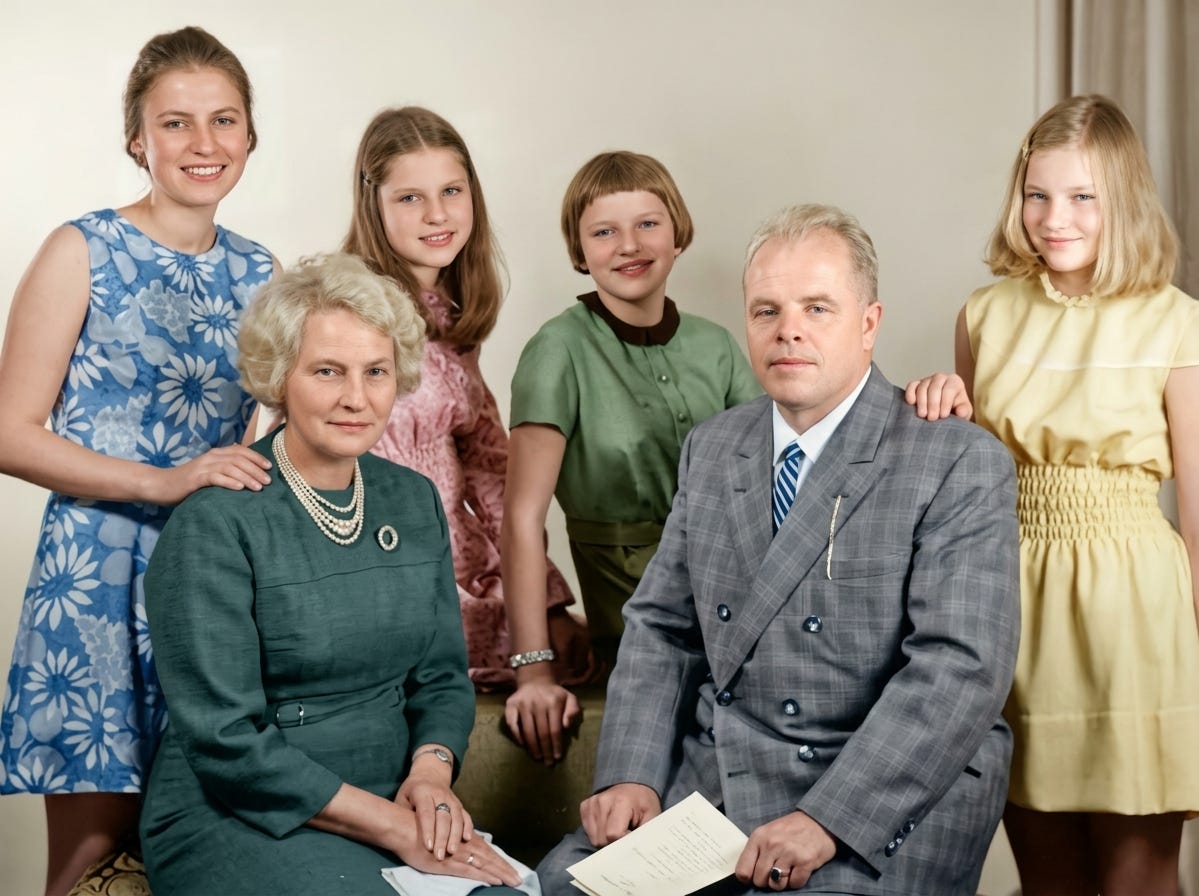
Anneliese Michel (far left) with her family
I think Anneliese Michel had temporal lobe epilepsy that was inadequately treated.
I think the seizures, combined with medication side effects and religious guilt, triggered dissociative episodes that her community interpreted as possession.
I think once that interpretation took hold, it became a self-reinforcing cycle. The more she was treated as possessed, the more her symptoms conformed to possession narratives. The more her behavior fit the expected pattern, the more convinced everyone became.
I think her family and the priests genuinely believed they were saving her soul. I think she believed it too.
I think the physical rituals, the fasting, the genuflections, created a state of extreme physical depletion that made her even more vulnerable to dissociation and delusion.
And I think at some point, probably in the last few months, she became too weak and too psychologically isolated to ask for help, even if part of her wanted to.
But there are still pieces that don’t fit cleanly.
The historical knowledge she demonstrated. The consistency of the voice personalities. The few predictions that did come true.
I don’t think those prove anything supernatural. I think they show how much we still don’t understand about what the human brain can do under extreme stress, especially when seizure activity is involved.
I also think this: the people responsible for her death weren’t monsters. They were true believers who thought suffering was redemptive and that spiritual reality mattered more than physical survival.
That doesn’t make them less guilty. It makes them more tragic.
The trial happened in 1978. The priests were convicted. The Catholic Church became more restrictive about approving exorcisms in Germany.
During the trial, one of the prosecutors asked Anneliese’s mother: “At what point did you realize your daughter was dying?”
Her answer: “I never thought she would die. I thought God would save her.”
That’s not insanity. That’s faith taken to its logical extreme.
And the thing is, in a different context, if Anneliese had survived, if she’d recovered and claimed to be freed from demons, the same people who prosecuted her parents would probably call it a miracle. The narrative would be completely different.
The only difference between a miracle and a tragedy is whether the person lives.
I’ve been thinking about writing more about cases where psychology and religious experience overlap, because I think we’re still terrible at talking about them honestly. We either dismiss everything as delusion or accept everything as supernatural, and neither approach actually explains what happens to people in extreme states.
Let me know what you think. Seriously. I’m still figuring out how to make sense of this one.
No posts
Comments
Nothing yet. Say the first thing.
Sign in to join the conversation.