
Imagine finding a message that is nearly 4,000 years old and realizing that no one on Earth can tell you what it says.
That’s the problem with the Phaistos Disc.
It’s a clay disc, about six inches across. Stamped into both sides are 241 symbols arranged in a spiral. Forty-five different characters, some repeating, some appearing only once. It was fired in a kiln sometime around 1700 BCE, which means someone thought it was important enough to make permanent.
No one can read it. Not a single word.
We can’t read it because we’ve never found anything else like it. Not in Crete. Not in Greece. Not anywhere in the Mediterranean. This disc uses a writing system that appears exactly once in the entire archaeological record, then vanishes.
That’s not how writing systems work.
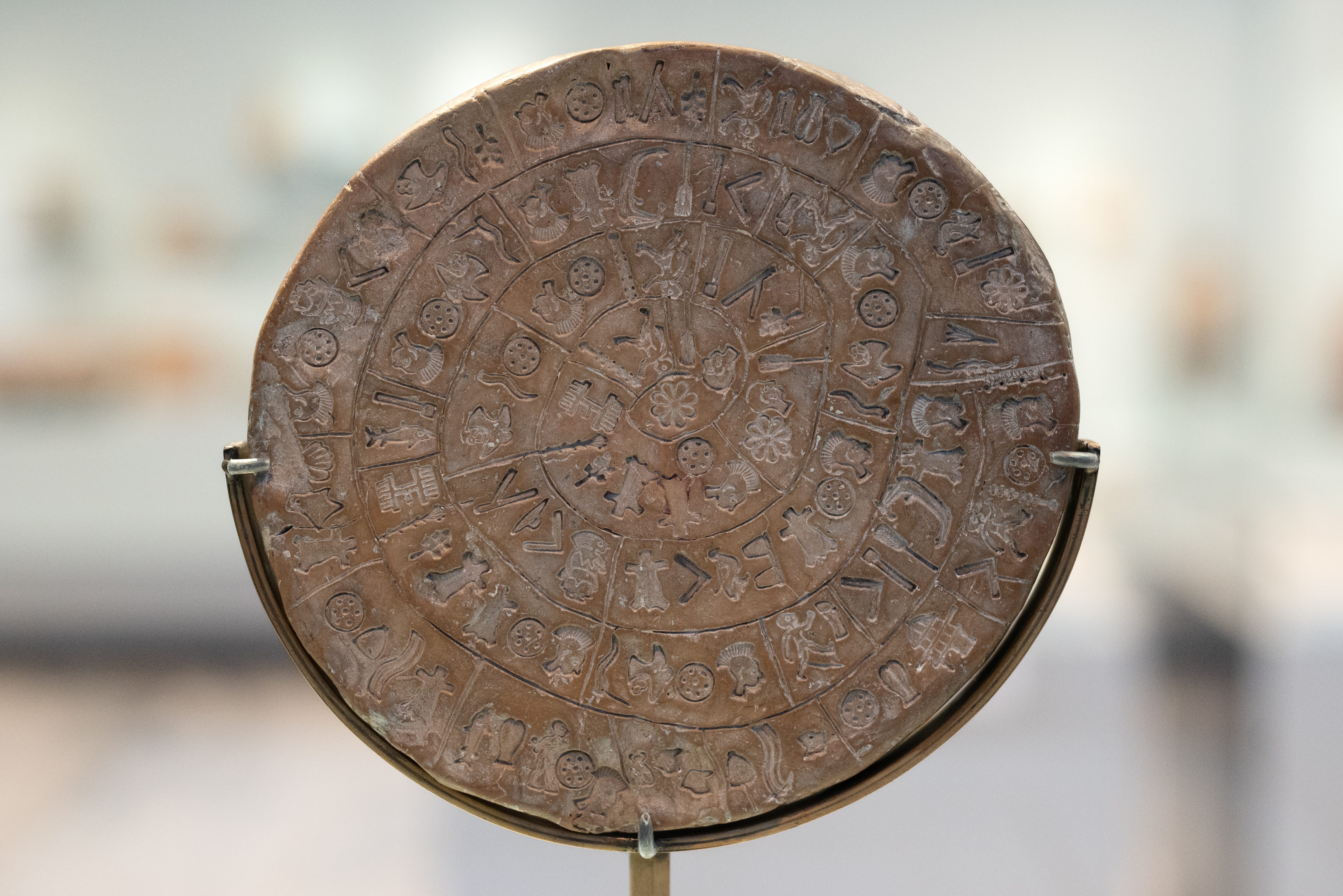
Phaistos disc - Side A
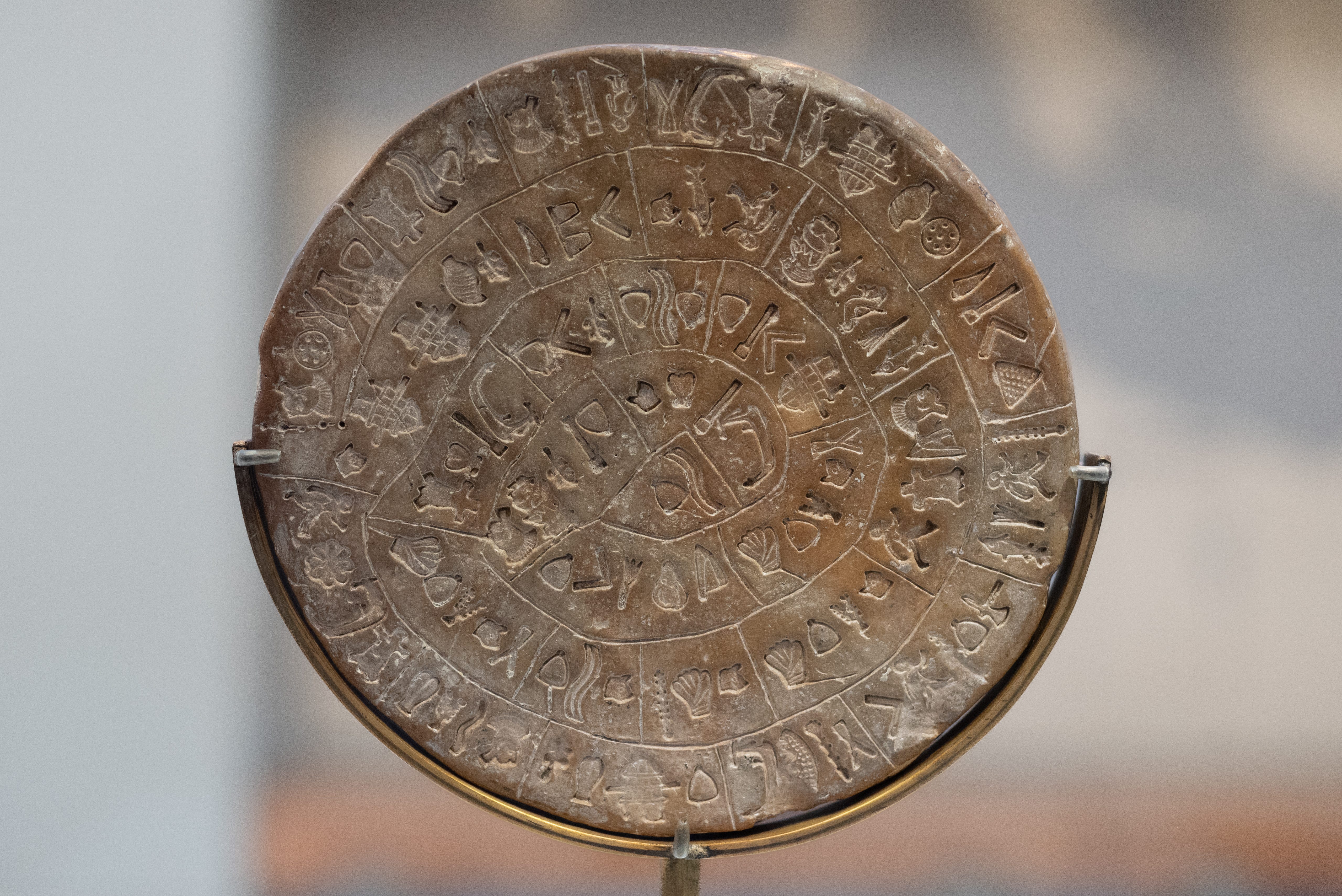
Phaistos disc - Side B
The Phaistos Disc was discovered in 1908 by Italian archaeologist Luigi Pernier. He found it in a basement room of the Minoan palace complex at Phaistos, in southern Crete, buried in a layer of fire-baked earth that dated to around 1700 BCE.
The symbols weren’t carved. They were stamped using individual punches, like movable type. This makes the disc the earliest known example of printing technology, predating Gutenberg by three thousand years.
Let me repeat that because it matters: someone created forty-five different stamps, each with a unique symbol, then used them to compose a text. This implies planning. Infrastructure. Probably other documents that used the same system.
We’ve found none of them.
The symbols themselves are strange. Some look like people in various poses. Others depict animals, plants, tools, geometric shapes. They’re weirdly detailed for something this old. One figure appears to be wearing a feathered headdress. Another looks like a ship. There’s a cat, a bee, a pair of manacles, a hide, a striding man with elaborate hair.
The spiral arrangement is divided into sections by lines, creating what look like word groups. Sixty-one groups total, thirty-one on one side, thirty on the other. Some symbols appear frequently. Others show up once and never again.
It’s been sitting in the Archaeological Museum of Heraklion for over a century. No one has successfully translated it.
When archaeologists find a new script, they usually can’t read it immediately. But they can typically identify the language family by comparing it to other writing systems from the same region and time period. Linear A and Linear B, both found in Crete, took decades to decipher, but scholars could at least see they were related to known writing traditions.
The Phaistos Disc doesn’t connect to anything.
It doesn’t resemble Linear A, the script the Minoans were using at the time. It doesn’t look like Egyptian hieroglyphics, though there was active trade between Crete and Egypt. It shares no obvious features with any Mesopotamian cuneiform, despite the cultural exchange across the Mediterranean.
It’s stylistically isolated.
The technical skill required to create forty-five individual character stamps in Bronze Age Crete suggests this wasn’t a one-off experiment. You don’t develop stamp-printing technology for a single document. The learning curve alone would require trial and error, multiple attempts, refinement.
So where are the practice pieces? Where are the other documents that used this system?
The most common explanation is that they haven’t been found yet. But Phaistos was excavated thoroughly. So were the other major Minoan sites. We’ve found thousands of clay tablets with Linear A. We’ve found Egyptian trade goods, Mesopotamian cylinder seals, pottery from Cyprus and Anatolia.
But only one Phaistos Disc.
I need to mention this because it comes up in every serious discussion of the disc.
Some researchers think it’s a fake. Not an ancient forgery, but a modern one, created by Luigi Pernier or someone on his team in 1908.
The arguments for forgery are interesting:
The disk was found in a context that included Middle Minoan pottery, but the room had been disturbed. Pernier’s excavation records are incomplete. He had access to knowledge of other ancient scripts and could have created something deliberately unreadable to generate mystery and prestige.
The symbols are oddly well-preserved compared to other clay objects from the same period. The stamping technique is suspiciously advanced for Bronze Age Crete. And most damning: nothing else like it has ever been found, despite a century of intensive Mediterranean archaeology.
But here’s the problem with the forgery theory: why would Pernier create something so strange?
If you’re going to forge an artifact for fame, you make it decipherable enough to seem important, but not so alien that it raises suspicion. You’d connect it to known scripts, include familiar elements, give scholars something to work with. The Phaistos Disc does the opposite. It’s too weird to be a successful forgery.
And the stamping technique, while advanced, is physically consistent. The same punches were used multiple times in different positions. Whoever made this, ancient or modern, actually created a functioning stamp-printing system.
Most mainstream archaeologists accept it as genuine. The clay composition matches other Bronze Age Cretan pottery. The firing technique is consistent with the period. And the context, while not perfect, isn’t impossible.
But the doubt lingers because the disc itself is so anomalous.
Dozens of claimed translations exist. I’ve read maybe fifteen of them.
Some propose it’s Minoan, others suggest Luwian, Proto-Greek, or even a language isolate with no modern descendants. One theory claims it’s a prayer to a mother goddess. Another says it’s a geometric theorem. Someone argued it’s a board game.
The problem is that without a bilingual inscription or a large corpus of similar texts, translation is just educated guessing. You can impose almost any pattern you want on 241 symbols if you’re creative enough.
The most linguistically rigorous attempts focus on statistical analysis. The frequency distribution of symbols, the position of repeated patterns, the structure of the groups. This can sometimes reveal grammatical patterns even without knowing what the words mean.
These analyses suggest the disc might be syllabic rather than alphabetic. Certain symbols appear consistently at the beginning or end of groups, implying they might be grammatical markers. Some combinations repeat in ways that look like suffixes or prefixes.
But that’s about as far as statistical analysis can take us without more data.
I found one detail in my research that I haven’t seen emphasized elsewhere: several of the symbols appear to be moving.
The running man isn’t just standing, he’s mid-stride. The ship has oars positioned as if rowing. The woman (if that’s what it is) seems to be walking. This suggests action, narrative, maybe even verb forms embedded in the characters themselves.
If that’s true, it would make the script more semantically complex than most Bronze Age writing systems, which tended toward simple inventories and administrative records.
That would be strange for a period when most writing was economic. But not impossible.
I don’t think it’s a forgery. The technical execution is too consistent, and the archaeological context, while imperfect, is plausible.
I think it’s a real artifact from Bronze Age Crete, but I don’t think it’s Minoan.
My hypothesis: it was brought to Phaistos from somewhere else.
The Minoans were traders. Their ships reached Egypt, the Levant, possibly even the Black Sea. What if the disc originated in a coastal settlement that was later destroyed or abandoned? A small port city, maybe, with its own writing tradition that never spread because the city itself was isolated or short-lived?
A volcanic eruption. An earthquake. A tsunami. The Bronze Age Mediterranean was violent. Entire cultures vanished in a generation.
If the disc came from a place that no longer existed by the time of its deposition in Phaistos, that would explain why we’ve never found another example. The civilization that created it simply didn’t survive long enough to leave a larger archaeological footprint.
Or maybe I’m wrong. Maybe it was a single experiment by a Minoan scribe who wanted to invent a new writing system and abandoned it after one attempt. Maybe it’s a religious text in a secret script, intentionally obscure.
Or maybe it’s something else entirely, and I’m missing the pattern because I’m looking at it from the wrong angle.
There’s a specific kind of frustration that comes from encountering something human-made that you can’t understand.
The disk isn’t a natural mystery. It’s not a geological formation or an unexplained phenomenon. Someone sat down, designed those stamps, arranged those symbols, and fired that clay because they had something to communicate.
The message still exists. It’s sitting in a museum in Crete right now, perfectly preserved.
We just can’t hear it.
I keep thinking about the person who made it. What did they want to say? Was it important? Mundane? Sacred? Were they the only one who could read it, or was this script common in their world?
Did they ever imagine that three thousand years later, someone would sit and stare at photographs of their work, trying desperately to understand?
If you’ve ever looked at something and felt that pull, that need to understand even when understanding seems impossible, you know what I mean.
And if you’re curious about this kind of thing, about real mysteries that don’t have easy explanations, I’ll keep writing about them. Subscribe if you want to follow along.
No posts
Comments
Nothing yet. Say the first thing.
Sign in to join the conversation.