
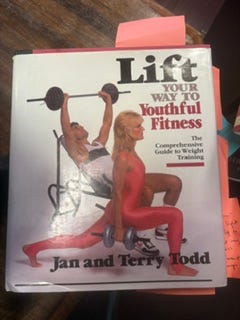
It’s summertime, and I’m back hard at work on my next book project, Strong, about the history of strong-bodied women in America. This week, as I was reading Lift Your Way to Youthful Fitness by Jan and Terry Todd (1985), I stumbled onto a name I hadn’t seen before: Dorris Barrilleaux, in a chapter that called her a bodybuilding pioneer. Of course, that title got my attention, and I quickly dove into researching her, and what I found was extraordinary. In fact, most called Barrilleaux “the First Lady of Body Building” for what she did for the sport.
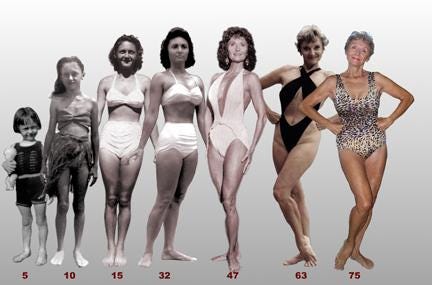
In 1978, Dorris Barrilleaux (1931-2018) was 47 when she left her Florida home to compete in her first women’s bodybuilding competition, called the First National Physique Championship, at the YMCA in Canton, Ohio. She’d been encouraged to compete by the editor of Strength & Health magazine, John Grimek, and only had about three weeks to train for it.
What she found at the contest shocked her. Barrilleaux recalled how the contest was “total chaos.” The meet promoters insisted that the female contestants wear high heels to offset the shock or disgust the audience might feel at seeing muscular women posing on the stage, and she and the other contestants had to wear shirts while their lower bodies were judged, then put on pants for their upper bodies to be judged. As she later reflected:
“I was so upset at the way the men thought women should look that I decided someone had to head the sport in a different direction. … If there was a future for women’s bodybuilding, it should not be a future in which men determined how the ideal feminine physique was supposed to look.”
How did a mother of five find herself posing on a stage in Ohio and then questioning the way that women were being judged? It all started in 1956 when Barrilleaux started lifting weights to improve her physique. She’d just had her fourth child and was troubled by her lack of strength. All her life, she’d been fascinated with strong bodies, and she had always prided herself on having one. So she started reading Strength & Health magazine (the same magazine that early strength pioneer and Muscle Beach icon Pudgy Stockton turned to in the 1940s) and following the routines found within its pages. As she remembers:
“This improved my health and looks to such a great extent, that I wanted to get this message out to all women. But I was just a grandmother and homemaker and had no way to spread this news. I corresponded with Vera Christensen who had a Women’s Column in Strength & Health and my first picture was published in 1963 (after they denied her first submission for it being too masculine!).”
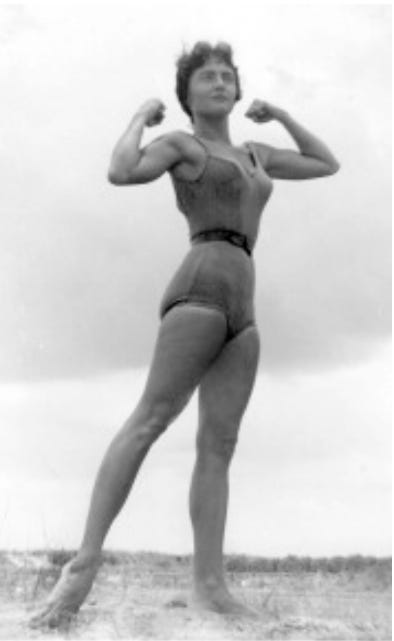
Vera Christenson had taken over writing the “Barbelles” column in Strength & Health when Pudgy Stockton stopped writing in and transformed it a column called “To the Ladies,” which ran from 1956 to 1986.
In 1977, Barrilleaux became interested in competitive bodybuilding. She was also an amateur photographer, so she began traveling to bodybuilding competitions to photograph the competing men (her work would eventually grace the covers of over 200 magazines, including the last issue of Strength & Health). Because of her toned physique, she was often asked to give out the trophies at these competitions. She did so, but was confused why similar competitions didn’t exist for women.
“I could not understand why only men were recognized for being in good shape.”
The only chance women had to compete in anything similar to a bodybuilding show was in a traditional beauty contest, but Barrilleaux had no desire to enter one. Bodybuilding was considered a “masculine” sport, and no one had ever challenged that. That is, no one had ever challenged it until Barrilleaux entered the scene.
After her first competition, Barrilleaux continued her involvement in competitive bodybuilding, including an invitation to guest-pose at a men’s competition in Tampa, Florida, in 1978. It was in Tampa that she met Suzanne Kosak, a fellow woman bodybuilder, and the two came up with the idea of creating a competition for women judged more like men’s competitions. This was how the Superior Physique Association (SPA) was created: a pioneering, non-profit federation that supported and legitimized women's bodybuilding and even organized many of the first women's bodybuilding events.
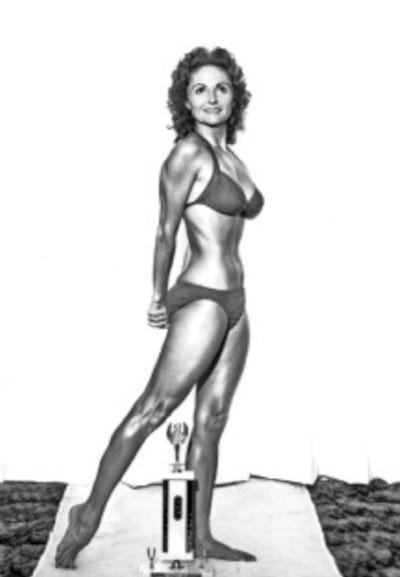
Then, female bodybuilding got a huge boost when Barrilleaux was featured on the 1979 TV show, Real People, one of the first reality television shows. On each show, a variety of everyday people were featured for their unique hobbies or unusual talents. The show's crew traveled to Tampa, Florida, where they filmed Barrilleaux and fellow bodybuilder Laura Combes as they worked out and talked about the sport of bodybuilding. In that short five-minute broadcast, they were about to educate non-bodybuilders about the benefits of weight training and introduce the world to the idea that women with muscle were strong and beautiful. And just like that, the female sport of bodybuilding was born.
Barrilleaux would go on to be an important figure in bodybuilding even as the sport grew and changed. In 1980, Doris was elected Chairwoman of the International Federation of Bodybuilders (IFBB), and within the IFBB, she formed the American Federation of Women’s Bodybuilding (AFWB), which absorbed the SPA organization. She judged many competitions for the IFBB and the AFWB, including being the head judge for the Ms. Olympia competition in 1981.
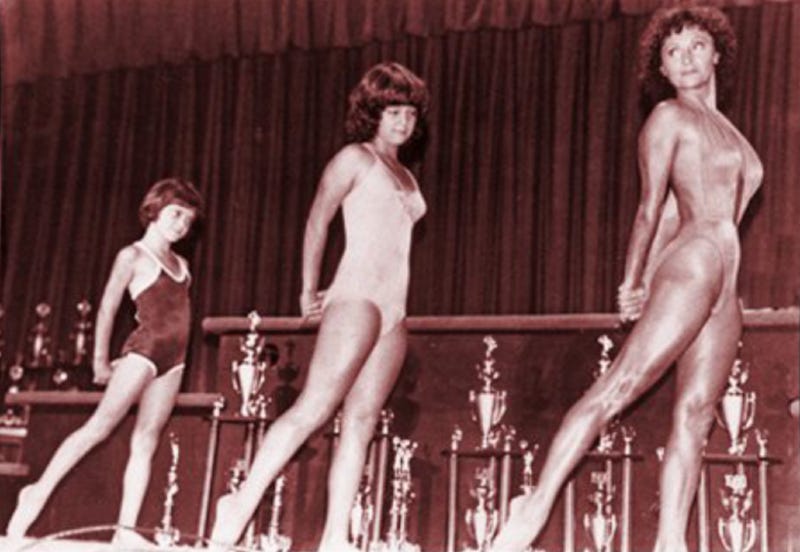
In the 1980s, when anabolic steroids became a point of controversy within the sport of women’s bodybuilding, she took a strong stand against them. In 2011, she was inducted into the National Fitness Hall of Fame.
Learning about the early days of bodybuilding and how it transformed after being featured on a TV program made me so curious about this period. What was happening in American culture at that time to make space for this? To go from competitions where women had to hide half their bodies in order to be judged, to a televised segment that featured muscular women pumping iron, “going viral”?
There is so much to still figure out in this book, but I’m so happy to have this space to think through it with you!
Todd, Jan, and Terry. Lift Your Way to Youthful Fitness. Little Brown and Company, 1985
“The Double Gift of Doris Barrilleaux” https://starkcenter.org/2009/12/the-double-gift-of-doris-barrilleaux/
Doris Barrilleaux Collection - https://starkcenter.org/research/collections/doris-barrilleaux-collection/
March 2014 Interview with John Hansen at the 2013 NPC Sunset Classic
Pumping Iron II - The Women (1985)
Comments
Nothing yet. Say the first thing.
Sign in to join the conversation.