
One of the things that happens as you work on a book project is that the topic expands and contracts based on the research you find. When I’m writing straight-up biographies, this means the storyline, the path of a person's life that I follow, alters based on the research that I find. But when it comes to this new book, Strong, which has a myriad of characters and is trying to understand a cultural definition of female strength, that shifting is more jarring.
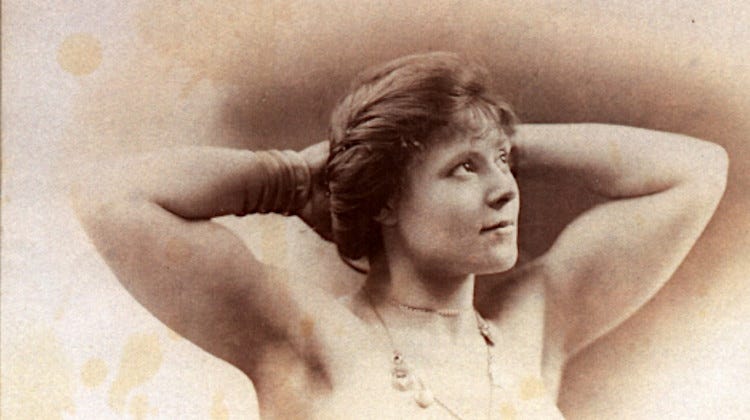
Today, I decided to dive into researching early strongwomen. I’ve already researched The Great Sandwina (see my earlier post), and I do have more work to do on her life; however, another strongwoman’s name keeps coming up. During her lifetime, 1874–1946, the Strongwoman performer, Vulcana, was considered the “most perfectly developed woman in the world.”
Previously, I’d veered away from writing about her because she wasn’t a part of my original thesis: why does America want its women not to appear strong-bodied? But the more I research, the more interesting it is to look at this topic from a broader perspective, and shifting this perspective has enabled me to broaden my research to include the life of Vulcana.
Her name came up again during my last visit to the Stark Center at the University of Texas at Austin as part of the NORTH AMERICAN SOCIETY FOR SPORT HISTORY (NASSH) pre-conference. For two days, about a dozen of us sat around a table to deliver our papers on the topic of “The Meaning of Muscle”. A topic that is so close to my heart these days as I write this book. As Charles Stocking, the Assistant Director of the Stark Center, pointed out,
“The meaning we attach to muscle is arbitrary. It is a signifier influenced by culture.”
The first paper of the day was titled “Strongmen of the Valleys” and was written by Alec Hurley. In it, Hurley focused on post-WWI Wales and how weightlifting was encouraged for men as a fountain of youth and a form of geopolitical resistance (being able to lift weights meant you could push back against the British). But during his talk, he pointed out that all the successful strongman performers in Wales during that era were women, and the most successful was Vulcana. During his talk, Hurley just touched on Vulcana’s name and then moved on. So later, during the Q&A period, I threw a volley of questions at him about Vulcana’s influence on the women of her era. He suggested that Vulcana was adored and accepted because of the tradition of strong, powerful Welsh women, portrayed as warriors and physically intimidating. Which, of course, fascinated me and made me realize it was time to dive into Vulcana's life to better understand the culture she came from.
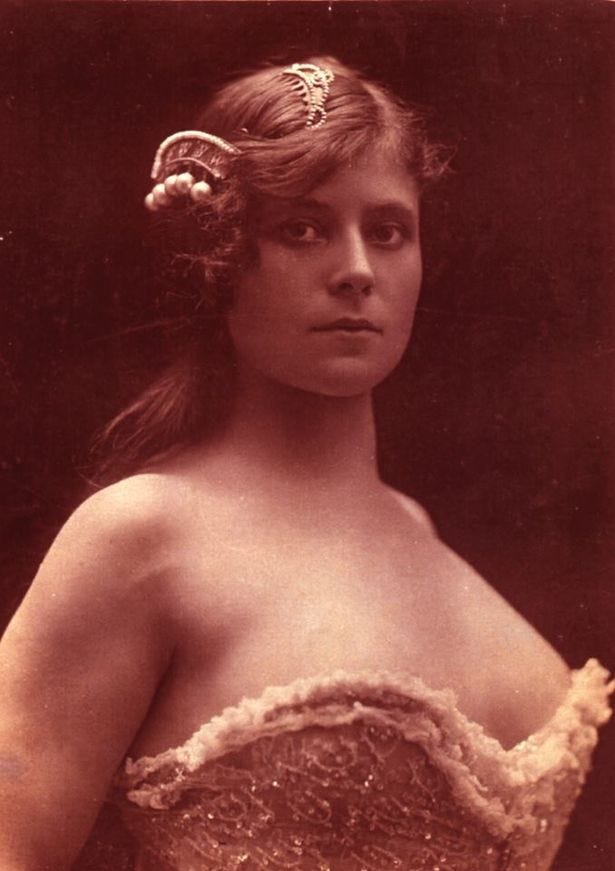
Vulcana was born Miriam Kate Williams, 1874–1946, in Abergavenny, in the South of Wales. According to “The Strongman Project,” her father was a local clergyman who noticed her early interest in physical activities, such as swinging from trees or showing off her strength at school by lifting heavy objects, including the school piano. So, he encouraged her to train at a local women’s fitness club. Some sources note that this fitness club was run by William Hedley Roberts (who went by the stage name of “Atlas” - who would later become William’s training partner. (Note: I’m looking to learn more about these women’s fitness clubs in Wales during this era; if anyone reading this has information about these clubs, please respond to this post!)
By age 13, Williams was reported to have “single-handedly” reined in a runaway horse in Bristol, England. And in July 1901 at Abergavenny, she reportedly dove into the Usk River to save a boy from drowning. But it's hard to tell whether this is a sensationalized story that was later added to her biography to sell tickets to her shows. So many of the early strongwomen’s stories are wrapped in self-made myths that it is at times difficult to discern the kernel of truth in their lives.
At age fifteen, the married William Hedley Robert (Atlas), enlisted Williams to fill a last-minute vacancy in a variety show he was putting on in the nearby town of Pontypoll. In later articles, Atlas said she was "so delighted with the audience that she then, and there decided to turn professional". Atlas was a slight man (he weighed about 125 lbs), but his small frame didn’t hinder his boasts; as David Webster wrote, “Atlas was a small strongman with a very big ego.”
Shortly after this show Atlas invited her to join his traveling strength act and by 1894 they were top billed in the show as, ”Atlas and Vulcana” and billed themselves as a brother and sister act to cover up the fact that they were lovers even though Atlas was married. Over the years they would have six children together.
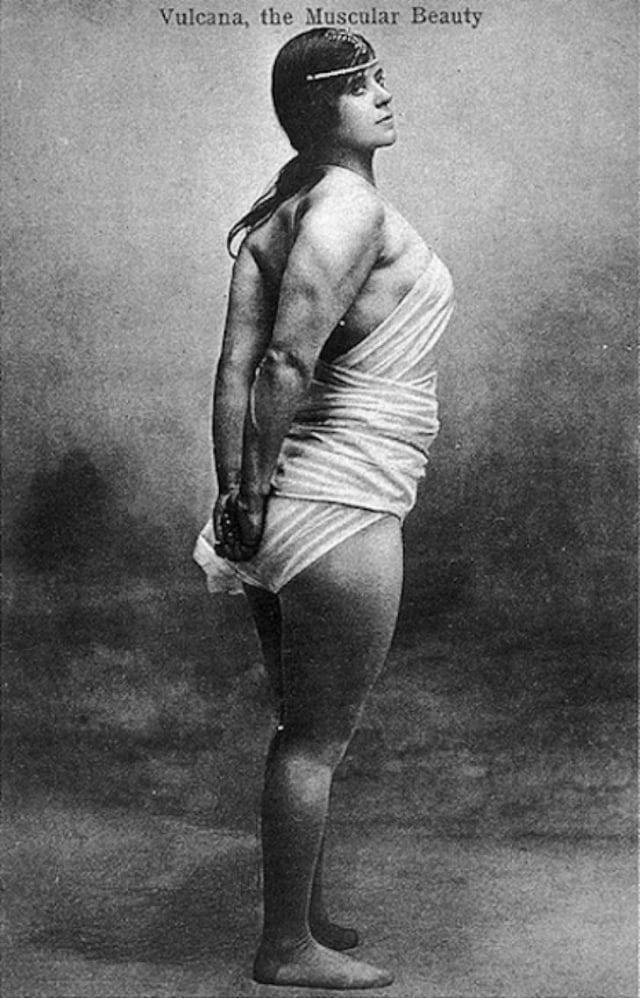
Vulcana was just 5’ 4” but she had “undoubted beauty and grace, combined with phenomenal muscular strength” thaat made her a star on the stage. Vulcana bent pressed at least 124 ½ pounds (an exercise where you lift the weight overhead by keeping your arm locked straight while bending and rotating your torso underneath the weight) with only her right hand and she could overhead press with a 56-pound weight in each hand. But just like the hyperbolic stories about her feats of strength during her childhood, many of Vulcana’s records are questioned because Atlas (who was known for his exagerations) claimed them. Whatever her exact numbers were, it was clear she was incredibly strong.
An activist at heart, Vulcana advocated for women’s rights. She fought to alow women to be able to wear sensible clothing(wihtout the constriction of corsets) and to exercise, and she routinely asked mothers to allow their daughters the freedom to be tomboys.
She would perform all over the world (including Austraila) until 1921 when on June 4 a fire broke out during her performance with Atlas at the Garrick Theatre in Edinburgh. The blaze spread quickly and everyone ran from the building toward safety. Instead, however, Vulcana courageously ran back into the burning theater to save a pair of horses who were trapped in the fire. She managed to save the horses, but while she was escaping, the flames surged and her hair caught fire leaving her badly burned. After the fire she continued to perform until she was involved in a car accicent in 1939 that left her with brain damage which eneded her career as a strongwoman. Atlast took care of her in her final seven years util he died in 1946. She died just a few months after.
So many research questions have arisen from just this cursory insight into Vulcana’s life. I am wondering about the impact Vulcana had on young girls, espeically those who trained at women’s fitness clubs in Wales. Similar clubs exsisted in the United States at the same time (including one that Louisa May Alcott attended in the Boston area). I wonder what influence (if any) these European women’s fitness clubs and Strongwoman acts had on the U.S. Also, its seems as though many of the Strongwomen were also activists working for women’s rights (see also my post on the trapeze/striptease artist Charmion) and advocating for healthy lifestyles.
These are the types of questions I’m trying to untangle at this time in my reseach as I widen my scope. Thanks for joining me on this journey of discovery!
“Vulcana” https://strongmanproject.com/features/15
“The Victorian wonder woman who could lift a man with one hand” https://www.walesonline.co.uk/news/wales-news/victorian-wonder-woman-who-could-15339655
Comments
Nothing yet. Say the first thing.
Sign in to join the conversation.