
It’s strange how life can feel like a guided path, where if you only recognize the signs, you see what feels like an entirely choreographed or premeditated way. Last Thursday, felt much like that. My dear friend invited me to visit a sauna on the edge of the San Francisco Bay in Sausalito. On the drive down, a blue heron flew overhead. Then, hours later, when we emerged from the sauna about to jump into the cold bay water, we noticed another sitting on the dock next to us. Then, in the changing rooms, there on the wall was a print of a blue heron. These repeated sightings feel, at the time, like out-of-the-blue coincidences. Or, when read another way, feel like the universe is trying to tell you something. As a writer who spends her days trying to understand the world around me (which is no small feat these days), those sightings added weight to the beauty of the entire experience. It was as if the universe was telling me to write a poem about what I had seen, and so I did.

This sort of writer’s intuition and permission to write from it, this close looking at the world around us, this noticing is something most writers turn on and off so they can appear “normal” in front of other people who are not writers. But that turning on and off did not seem to be the case with Dorothy Richardson (1873 - 1957), who used that act of noticing “a fresh pathway” to write a thirteen-volume novel, Pilgrimage, largely based on her own life experiences. A novel that spans over two thousand pages and that was deemed the first occurrence of stream-of-consciousness writing in a novel. But according to scholars like Brad Bigelow of Neglected Books, Richardson’s method is so much more than just stream of consciousness. Her writing presents us with the “fabric of a mind” that, as Derek Standford points out, is unique to a woman’s experience: “In all the two thousand pages of Pilgrimage, there is not one effort to see the world from a man’s point of view.”
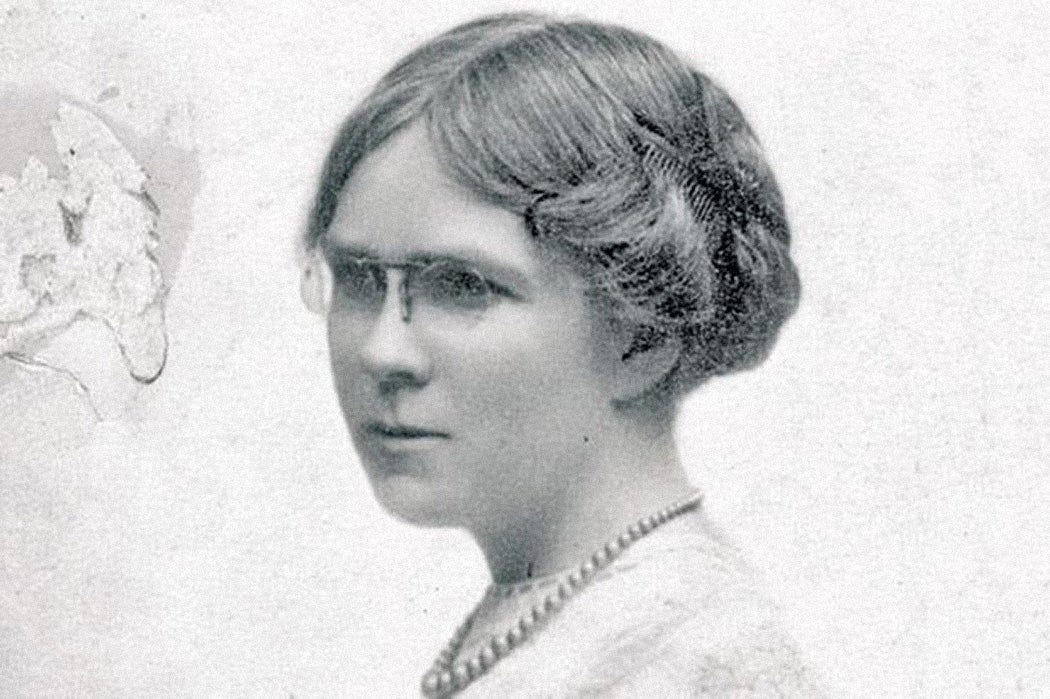
So, given the important innovation she is responsible for, who was Dorothy Richardson, and why have you likely never heard of her book?
Dorothy Richardson (1873 - 1957) was born in Abingdon, Berkshire. She was the third of four daughters. Her father was disappointed that she wasn’t a boy, so he called her his “son.” According to Doris B. Wallace & Howard E. Gruber, this reflected that her “boylike willfulness” didn’t align with the gender norms of her day. She grew up in a large house her father built, called “Whitefield,” before moving to London to attend a progressive school where she was taught modern psychology, literature, and music, and taken seriously as a student. Richardson was fiercely independent. In 1890, when she was only 17, she secretly answered an ad in the London Times for a teaching position at Fräulein Lily Pabst’s school in Hanover, Germany. By the time she returned a year later, two of her sisters were engaged, and the third had taken a traditional job as a governess. Richardson had no desire to follow the expected path for her gender; a new world had opened to her in Germany, one infused with poetry and music. At first, she tried to continue teaching, taking a job teaching at a school in North London, but she found the grayness dimmed her spirit. The grayness of the sky and the gray future of her middle to lower-class pupils, whose futures seemed set to them regardless of what they learned.
While Richardson was finding her vocation, her father had slowly become bankrupt. In the spring of 1895, their family possessions were sold at a public auction. Perhaps triggered by these events, her mother became ill and was persuaded by a doctor to rest by the sea. So Richardson went to live with her mother in Hastings on the south coast of England. One day, while Richardson was out walking the beach, she returned to find her mother bleeding out on the floor of their boarding house. Her mother, who was only fifty-two years old, had slit her throat with a kitchen knife.
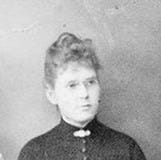
After this trauma, Richardson’s mind began to look inward. She moved back to London in search of freedom. She took a job as a secretary at a dental office and lived in the attic of a boardinghouse in Bloomsbury. It’s there in that intellectual hive that she met H.G. Wells (he had married an old schoolmate). He was the first writer she’d ever met, and so her true vocation could finally materialize in her mind. When she began to show her work to Wells, he praised her “sharp eye” and her unique ability to record the self. His praise gave her confidence, and in 1906, she began publishing her essays on topics ranging from Walt Whitman to the House of Lords. By 1908, she was able to quit her secretarial job and began to rely solely on her writing for her income.
Within a few years, she discovered Cornwall, a small, remote town on the southwest coast of England, where her friend J.D. Beresford was able to live modestly enough that he could support his family off of his writing. She first stayed in St. Ives in a small bungalow “with its knees on the rocks” on the edge of the sea. Later that summer, she and Beresford and his family went to Padstow, where they rented a stone cottage that had once been a chapel. After the Beresford family left, she stayed on through the winter, and it's here, in this stone room that she claimed was haunted, that she began to walk the fresh pathway toward writing Pilgrimage.
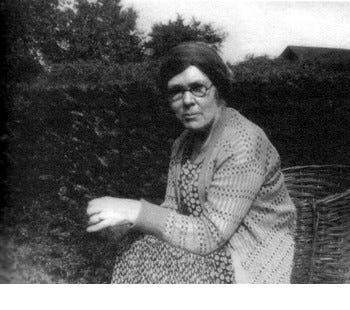
It was one of the first times she had been able to experience complete solitude where the world “dropped away,” and everything interior took on “terrific intensity”. She was able to conjure almost total recall of her past, and so, the protagonist, Miriam (largely based on herself), took shape and began to speak directly onto the page in close proximity to stream-of-consciousness. When Richardson read The Ambassadors by Henry James (1903), she’d been deeply influenced by the internal transformation of the wealthy American protagonist, Lewis Lambert Strether, calling it “the first completely satisfying way of writing a novel.” She suddenly realized the intrinsic value of writing about her own transformation. Her novel would be her statement about herself as a woman in real time as it unfolded. So, she sat in that stone room and found a fresh pathway back to the past, traveling back to the year she spent in Germany, and noticing everything again with the careful, more experienced eye of her older, nearly forty-year-old self. She found herself back in their anxious household, where her father was on the brink of bankruptcy, and from which she only wanted to escape. Then she followed the path to Hanover, where she was both repulsed and entranced by the culture.
The first volume of Pilgrimage, titled Pointed Roofs, was finished in 1913 and published in 1915, on the eve of the First World War. Although the war impeded its reception, reviewers were still fascinated by its unique narrative. As one reviewer stated in the Observer, it “somehow read…as if the reader did not exist.” Other reviewers claimed Richardson must be of “unsound mind” or called the book “fevered fantasies”. Pointed Roofs seemed deceptively simple. Yet, it did not adhere to traditional narrative structure. The book presented a female protagonist in a masculine environment hostile toward women, and openly shared the humiliating encounters she experienced with these men.
By 1916, when she’d publish the second volume, Backwater, her reputation as a writer who was trying to conjure consciousness was beginning to be known amongst the writers who frequented Cafe Royal.
May Sinclair was the first to apply the term “stream of consciousness” to Richardson’s writing in a review on Pointed Roofs, which she wrote for the Egoist in April 1918: "In this series, there is no drama, no situation, no set scene. Nothing happens. It is just life going on and on. It is Miriam Henderson's stream of consciousness going on and on.” Richardson never agreed with Sinclair’s assessment of her work, as she did not think the term “stream of consciousness” defined the type of writing she created in Pilgrimage. In fact, she didn’t even agree that Pilgrimage was a novel, as she found the novels written during her era to be “conducted tours.” What Richardson sought to create in Pilgrimage was a book that gradually developed its own aesthetic.
As Richardson’s reputation grew, other writers began to be compared to her work. Virginia Woolf’s Mrs Dalloway was thought to be extending “the method of Miss Dorothy Richardson” by a reviewer. By the late 1920s, James Joyce, Woolf, Marcel Proust, and Richardson were invariably linked as “explorers of a province of consciousness”.Proust.
Richardson married the artist Alan Odle in 1917. Odle was dedicated to his practice as an artist, and he had an important influence on Richardson’s work. From 1917 until 1939, they spent their winters in Cornwall and their summers in London. They stayed permanently in Cornwall from 1939 until Odle’s death in 1948. Ricahrdson did not leave Cornwall until she was moved unwillingly to a nursing home in Kent in 1954, where she died in 1957.
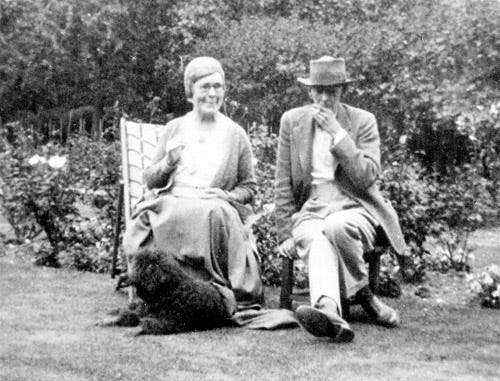
It would take Richardson over four decades to finish writing Pilgrimage. In it we follow the life of Miriam from age seventeen to forty, the age that Richardson was when she entered the stone room to begin the novel. The first ten volumes of Pilgrimage (Richardson called these volumes “chapters”) were published by Duckworth between 1915 and 1931:
Pointed Roofs (1915);
Backwater (1916);
Honeycomb (1917);
The Tunnel (1919);
Interim (1919);
Deadlock (1921);
Revolving Lights (1923);
The Trap (1925);
Oberland (1927);
Dawn’s Left Hand (1931)
Then the eleventh chapter, Clear Horizon, was published by Dent in 1935. Three years later, Dent published a four-volume edition that included a new ‘chapter’, Dimple Hill.
Richardson never finished Pilgrimage. The last volume, titled March Moonlight, was left unfinished at the time of her death and didn’t appear in print until the first full edition of Pilgrimage was published by J. W. Dent in 1967. In 1979, Pilgrimage was finally recognized as a feminist classic with the publication of a Virago paperback edition.
So why should we read Pilgrimage today? Because Richardson walked a fresh path in her work, depicting a woman’s point of view in what would predate Hélène Cixous’s Écriture féminine. Her work is written entirely from the female body and the female experience, and throughout the novel, she experiments with dropping or altering punctuation to better suit her protagonist's thought patterns.
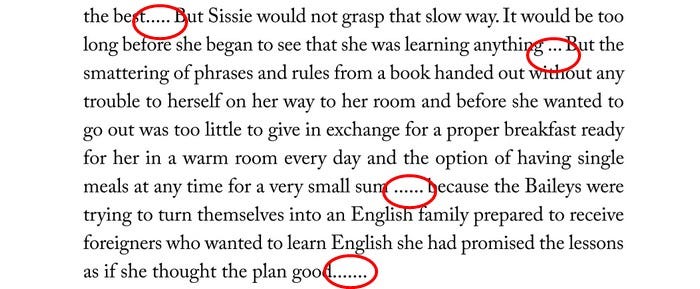
Now that I have read Richardson, and am beginning to understand her method, the next time I “notice” a series of visitations as I did with the Blue Heron last Thursday, I will hold it closer, I will let it align, not in a linear fashion, with my past to see what I can feel and understand by looking through my own experience. I offer this fresh path to you as well. Will you join me?
Get started by reading Pointed Roofs by Dorothy Richardson on Project Gutenberg
Join the year-long Pilgrimage reading group at The Sitting Room beginning in September by sending an email to sittingroom library@gmail.com (we will be offering a discount on the four-volume set of Richardson’s full text of Pilgrimage published by Asterism Books for those who join the September 2026-September 2027 reading group with The Sitting Room).
Read my interview with Brad Bigelow from Neglected Books on the Sitting Room Substack.
Fromm, Gloria G., “Dorothy Richardson” Dictionary of Literary Biography v. 36: British Novelists, 1890-1929: Modernists, 1985.
Reading Pigrimage - https://readingpilgrimage.com/
“Dorothy Richardson” - https://en.wikipedia.org/wiki/Dorothy_Richardson
Interview with Brad Bigelow from Neglected Books, June 2026
Lost Ladies of Lit Episode on Dorothy Richardson (where I first heard of Richardson!)
Comments
Nothing yet. Say the first thing.
Sign in to join the conversation.