
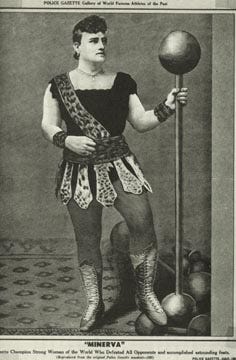
This week, I dove into the life of another early strong woman, Minerva, for my chapter on early strongwomen and their influence on future women in strength in my forthcoming book, Strong. Like most of the early American strongwomen, Minerva’s story is hard to come by. What you find out about her must be sifted through a sieve to separate her real life from her “stage biography” – the inflated biography that was created about her to sell tickets to her shows. But thanks to the scholarly work of Jan Todd and others, the work of discovering Minerva’s life has already begun.
![throwbackthursday Josephine Schauer Blatt[1] (1869 – September 1, 1923), best known by her stage name Minerva, was an American strongwoman. Height 6 ft 0 in (183 cm) Weight 230 lb (104 kg)](https://substackcdn.com/image/fetch/$s_!QEoZ!,f_auto,q_auto:good,fl_progressive:steep/https%3A%2F%2Fsubstack-post-media.s3.amazonaws.com%2Fpublic%2Fimages%2F0aad8c81-93aa-48e2-95ac-7d10dcbdf02b_403x496.jpeg "throwbackthursday Josephine Schauer Blatt[1] (1869 – September 1, 1923), best known by her stage name Minerva, was an American strongwoman. Height 6 ft 0 in (183 cm) Weight 230 lb (104 kg)")
She is remembered mainly due to her place in the Guinness Book of World Records, where her greatest feat of strength was documented as the best ever done by a woman:
The greatest by a woman is 3,564 lb. with a hip and harness lift by Mrs. Josephine Blatt (nee Schauer) (US) (1869-1923) at the Bijou Theatre, Hoboken, N.J., on April 15, 1885.
What actually happened at the packed Bijou Theater on April 15, 1885, was not quite as impressive as what was recorded, but it was still incredible.
That night, six-foot-tall Minerva stood center stage, illuminated by the gas light, wearing a custom-made leather harness around her hips and shoulders, attached via heavy chains to a suspended platform, as she invited eighteen men from the audience below to volunteer to stand on it. Eager men raised their hands, and she chose them one by one. When they got to the stage, each was escorted onto the elevated platform. Once the eighteen were in place, Minerva secured the belt around her hips and the harness across her shoulders, then threw her body into the lift. By simultaneously straightening her hips, knees, and torso, she utilized the strength of her entire body to hoist the heavy load completely off the floor. The crowd erupted in applause and likely sprang to their feet. In the end, Minerva had lifted over 3000 lbs.
But before she became Minerva, Josephine Blatt was just a young girl who had incredible natural strength. According to her death certificate, Blatt was born in Hoboken, New Jersey, on January 2, 1863, to two German-born parents: Joseph Schauer and Louisa Hetener. Growing up in her Hoboken neighborhood, she liked to impress her friends and neighbors by lifting heavy things. According to the National Police Gazette article, “Recalling the Great Minerva,” she once carried a barrel of potatoes weighing 165 lbs up several flights of stairs.
In 1881, Blatt married the older Christian Wohlfarth, a Brooklyn-born “pork packer” (an industrial wholesaler who processed, preserved, and packaged pork products), and they had three children together. But it’s her love for acts of strength that saved her from the fate of solely becoming just Mrs. Wohlfarth. We aren’t sure when, but sometime in the late 1880s, she began performing acts of strength at Dime Museums. Dime museums began in the 1840s when P.T. Barnum opened the American Museum in New York City. The name is derived from the ten-cent admission cost. For almost the next hundred years, dime museums became one of the most popular middle-class forms of entertainment. In these venues, visitors would see “dioramas, panoramas, georamas, cosmoramas, paintings, relics, freaks, stuffed animals, menageries, waxworks, and theatrical performance.” (Weird and Wonderful: The Dime Museum in America) Dime Museums served as escapes for Victorian Americans who suddenly had leisure time thanks to the Industrial Revolution, and it is where many strongwomen, like Minerva, found their foothold on the stage.
It’s at one of these Dime Museum performances that she first met Charles P. Blatt. Blatt was shorter than Minerva, standing 5’9,” and weighing well over 200 lbs. He had huge biceps and was already a veteran strongman known for his shows around the United States, where he would catch cannonballs shot at him with his stomach and bend horseshoes with his bare hands. He went by the name “Hoboken Hercules” and was called the “Hercules of our day” in an 1891 article in the Washington Post. He first saw Minerva perform at one of those New York-area Dime Museums and later told newspapers that when he watched her feats of strength, he immediately fell in love with her and knew she would be a star.
Minerva divorced her husband, left her children, and went on the road with Blatt. For the next 20 years, Minerva and Blatt traveled throughout North and South America and Europe giving strength shows. During 1891 and early 1892, they traveled with the popular Orrin Brothers Circus in Mexico before settling in San Antonio, Texas, where Blatt began operating Central Park, that accoring to Todd was “a popular open-air family entertainment venue and beer garden located on Garden Street” on a small, lushly wooded island in the middle of the San Antonio River downtown, originally known as Galveston Island and later Bowen's Island (The island no longer exists). There, Blatt claimed there would be nightly entertainment fit for families, including “the great Minerva, the strongest woman in the world.”
But, by early 1893, the couple had returned to the Mideast to perform. Minerva reportedly created a “furor by her wonderful feats of strength” at a show in Philadelphia that January. Other feats of strength shown in her act included lifting a cannon with her teeth, a horse with a single finger, and a 400-lb rock.
One way Strongwomen gained fame and legitimized their lifts (which of course weren’t standardized) was by challenging other strongwomen. Fannie Gorman, AKA “Yucca” (or Madame Yucca), was one of the other prominent American strongwomen of Minerva’s era. So, it makes sense that Minerva challenged her in a letter that was posted in the Police Gazette in 1891:
I hereby challenge her to arrange a match to lift heavyweights and catch cannonballs from 10 pounds to 20 pounds for $500 to $1000 a side and the female heavy weightlifting championship of the world. The $100 my backer, Mr. C.P. Blatt, has posted with Richard K. Fox, shows that I mean business.
Over their long careers, Minerva and Blatt spent four seasons with the Rentz Circus in Europe, and also worked in Germany with both Circus Schumann and the Merkel Circus. They continued to perform until 1910, when they retired to Perth Amboy, New Jersey, and Tottenville, New York, where Minerva invested in real estate. She died on August 1, 1923, from a “carcinoma of [the] stomach.” But thanks to her name being printed in the Guinness Book of World Records, she has been remembered.
“Sex! Murder! Suicide! New Revelations about the "Mystery of Minerva" by Jan Todd
“The Mystery of Minerva” by Jan Todd
“Minerva, World’s Strongest Woman (Strength History)”
by Nick Soleyn
Comments
Nothing yet. Say the first thing.
Sign in to join the conversation.