
Over the past few days, I’ve been in Austin, Texas, and during the trip I finally dove into a book I’d been wanting to read since my last visit to Texas a month ago: The Wind (1928) by Dorothy Scarborough.
The Wind’s protagonist is an 18-year-old girl named Letty who moves to West Texas from Virginia after her mother dies and she has nowhere else to go except to live with her cousin Bev on his isolated ranch near the ironically named town of Sweetwater. Over the course of the book, Letty is slowly worn down by the ever-present wind that blows sand over everything: the tables, the beds, and the dishes. It thickens the air and turns it brown, clogs her ears and nose, and constantly messes up her hair. At first she is terrified of the wind, and as it rises and becomes more threatening, her agency as a woman diminishes.
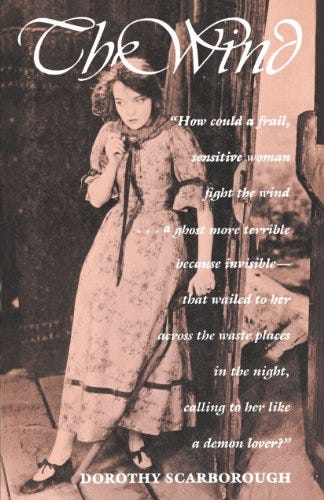
The Wind was originally published anonymously, and this, paired with the way Scarborough depicted the plains, infuriated Texas readers. One reviewer claimed The Wind was “a deliberate effort, by disregard and exaggeration and distortion of facts, to deliver a slam on West Texas in the making.”
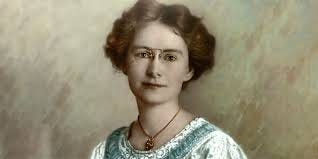
But Scarborough, who spent her childhood in the area where she sets the book, was writing from her own experiences and from West Texas history when drought brought the booming cattle industry to its knees. Scarborough set the text during this era because she knew, “only the savage isolation of the past would provide a situation where she would have no defenses.”
As Scarborough explains, the story’s origins are also drawn from “the impressions I got from hearing my mother’s vivid struggle with the climate of the West. She loved the people out there but she did not care for the weather…. So in the back of my mind has been for a long time the purpose to write a story which would show the effects of the wind and sand on a nervous, sensitive woman…that seemed like good drama to me.”
Her protagonist is drawn into madness through the “tyranny of fear,” set in motion by a brash man named Wirt Roddy, whom Letty meets on the train to Sweetwater when he “carelessly put the terror of the wind into her mind.” Over the course of the next year, the fear grows “and mastered her till it brought destruction.”
When it came out, the book experienced immediate success. Reviewers compared it to “Hardy’s Tess and Jude” and called it “a piece of masterly realism” reminiscent of “the Russian school.”
The same year the book was released, it was adapted into a film starring Lillian Gish. The movie did a remarkable job recreating the treacherous sandstorms, so much so that filming in the Mojave Desert was itself dangerous. As Gish later recalled:
“Working on The Wind was one of my worst expereinces in film making. Sand was blown at me by eight airplane propellers and sulphur pots were also used to give the effect of a sandstorm. I was burned and in danger of having my eyes put out. My hair was by the hot sun and nearly ruined by the sulphur smoke and sand.”
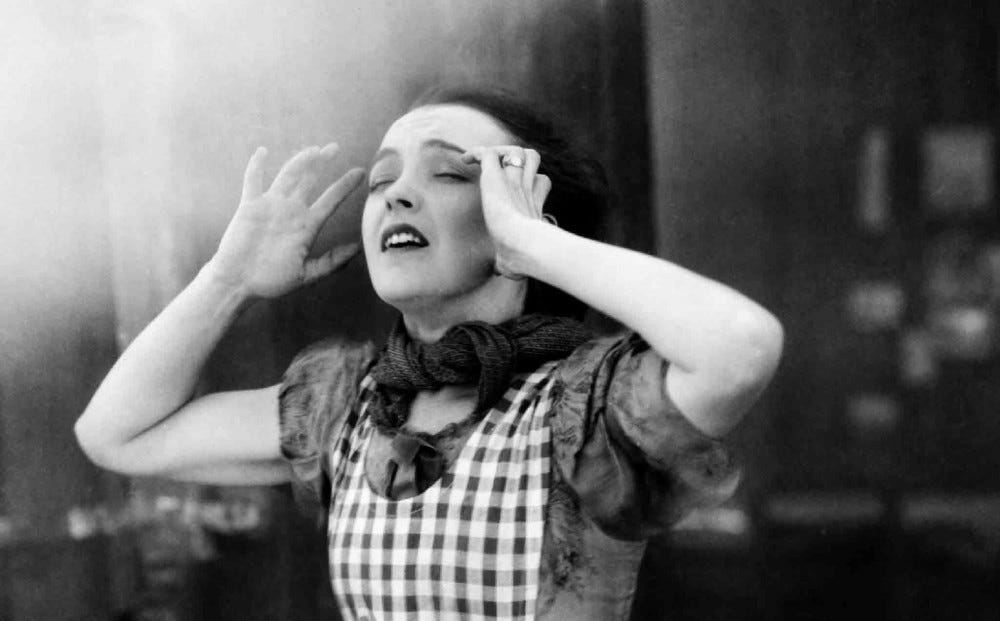
But even though the setting was almost perfectly recreated, the ending was changed to a traditional happy ending. After the film’s release, the book sold even more copies and most though it would never be forgoteen. But by 1929, the Great Depression had begun to batter the financial stabilty of the United States, and instability that was soon followed by the Dust Bowl of the 1930s, and The Wind largely stopped selling and evetually all but disapeared.
I can still remember October 2017, when my book club was reading Parable of the Sower on my enthusiastic recommendation. Then the wildfires that devastated Sonoma County hit, and no one could finish the book because when you are experiencing disaster, it is difficult to read about it.
But The Wind (and Parable of the Sower, for that matter!) is not just about disaster. What happens to Letty over the course of the novel is not only due to the extreme weather conditions she experiences; it is also the result of the oppressive conditions she must endure as a woman living in the West. Scarborough’s work remains important because there are not many books that challenge the trope of the selfless pioneer heroine. Letty had no choice in the decisions that are made for her. When her mother dies, a pastor in Virginia arranges for her to travel to live with her cousin not knowing the conditions she would be place under.
In her new home, where she lives with her cousin and his wife, Cora and their children, Cora scrutinzes her. Cora is jealous of Letty’s closeness with her husband Bev. So when two local cowboys fall in love with Letty, Cora eagerly waits for Letty to accept one of their proposals. At this point, however, Letty still has agency. She doesn’t love the rough men and wants to wait for love to find her. Cora who devised this plan to get Letty out of the house, is furious with her decision and she and Bev get in a terrible fight. Letty realizes that Cora never wanted her to be a visitor in her home and it nearly destroys her.
The next day, Bev and his wife, Cora, leave on an errand and Letty is left alone with the children. That night, a huge sand storm blows in. Letty becomes terrified and when one of the cowboy’s comes to check on her and the children, she succombs to marriage. The next morning she moves out to his isolated shack on the desolate, drought ridden prarie witht he cowboy. What follows is her slow descent into madness as the landscape, and the unachiavable expectations on pioneer women overtake her.
The Wind feels like a gothic sister novel to Shirley Jackson’s The Haunting of Hill House in the way the slow descent into madness is depicted through the environment surrounding the character. The characterization of the weather is also reminiscent of Kate Chopin’s short story “The Storm.”
At the heart of Scarborough’s work was her study of Texas folklore. She was an early member of the Texas Folklore Society, which was founded in 1910, and served as its president from 1914 to 1915. The folk stories of West Texas and the greater Panhandle are threaded throughout The Wind. Cowboy ballads appear throughout the text, as does the figure of a ghost horse—a wild horse that cannot be caught and cannot die. Sanora Babb also writes about a similar ghost horse in her memoir about growing up in a dugout in eastern Colorado, An Owl on Every Post.
Scarborough graduated from Baylor University with her B.A. in 1896 and her M.A. in 1899. She taught English at Baylor before pursuing postgraduate work at the University of Chicago. In 1910, she attended Oxford University. She later earned her Ph.D. from Columbia University, where she was hired to teach creative writing (Carson McCullers took her first college writing course from Scarborough).
Scarborough died unexpectedly from flu-like complications in 1935.
Comments
Nothing yet. Say the first thing.
Sign in to join the conversation.