
ALSO KNOWN AS: Kurlipi, bush banana, green vine, Leichhardtia australis, Marsdenia australis, Myakka, Magabala by Walmajarri, galgurli, the list goes on…
0:00
-13:10
There is a traditional South Australian myth represented through ceremonial Indigenous art of the Dreaming when two women traversed the desert. As they walked an eagle flew behind them, a being who was both man and bird. In the desert, companionship might be just what one needs.
The flowers pocket a sweet nectar. The travelers paused there.
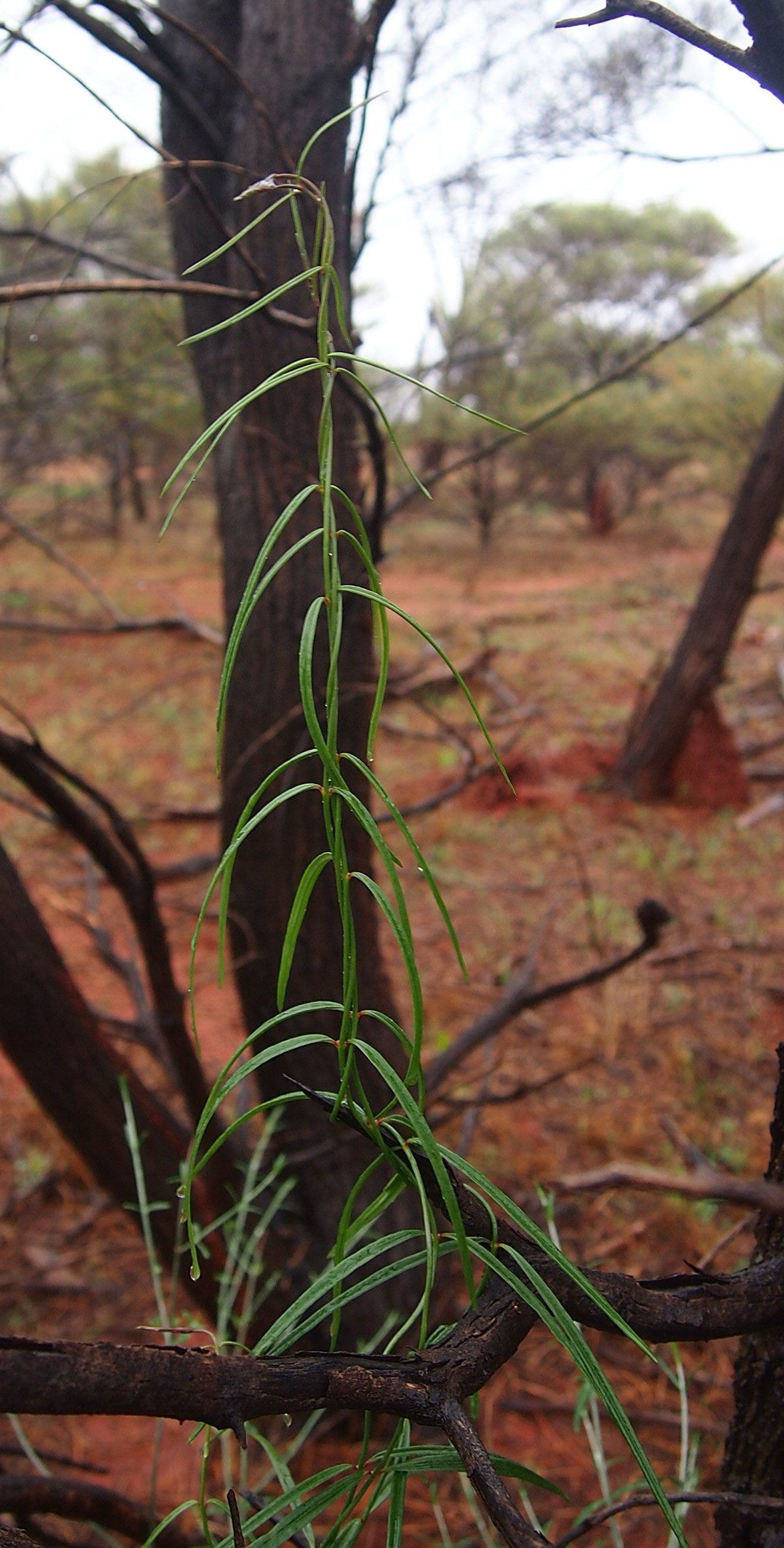
There is no ocean close, sun, the sound of insects and animals carried on the breeze, and it’s all open. Shrub pocked land creates trellises for strands of vines that harden to wood as they age. Vines twine to anything, but it has learned to love the acacia, known by many indigenous cultures as wattle, and forms a cool shroud for passing animals.
The Country, or land, of South Australia is dry though it has a range of soils from clay to red rock that peak out from shrubs or hillocks of grasses. As far as soil goes, Australia is one of the least habitable places for plants on earth, so the seeds germinate quickly in the rainy season.
Yet woody vines with wraithlike leaves, so spare they could be darning needles blooms and fruits between November and April. According to Aboriginal ideology, South Australia has seven seasons. From the thin blooms of the early grasses to the kangaroo-apple season, and breaking in the dry season, this, too, is when silky pear develops.
William Marsden was born in 1754 in Ireland. Like so many before him he found himself in Polynesia looking at plants, taking specimens. Silky pear was drawn into this family as Marsdenia australis. A name tells the world one’s place, and defines relationship to it. Luckily folk names for it tell its use: silk, banana, pear, green vine. The shape, habit and use all there held unofficially together in pet names for the plant. There are about 300 Marsdenia species around the world. Including all of the Indigenous names that are still in use.
Many of the stories that have to do with this plant are related to two women traveling across the desert together, a testament to the tight knit community of all ecosystems, but the essential connection in places with so few resources. It is an old desert designed by the polar region whose cold sea currents allow for very little evaporation and as a result very little rainfall throughout the middle of the continent.
The large teardrop fruits adorn it. Beside the precious few water bodies of the region acaia with its silky pear makes do with very little. Though they rely upon one another. The acacia fixes nitrogen in the soil making a small oasis for the silky pear and in turn the silky pear will draw pollinators and animals to the tree’s branches.
The arid zones of Central Australia are some of the most stable deserts in the world. Their spare and ephemeral bodies of water sustain high endemism and they are almost always groundwater fed. A person might not see the teeming life, and so the colonized region was deemed fit to bomb.
In 1950 the deserts in South Australia were dedicated to atomic bomb detonation. Indigenous people were evicted and brought to Western schools, a genocidal tool of stripping culture, while those who refused to leave lived in the “black mist.” Many suffered and died there as the foodways became poisoned and bombs exploded. Some elders returned soon to the land an act of resistance and named themselves the Spinifex People - those who maintain their lifestyle despite continued degradation of land through grazing and climatic warming. In spite of the violent past, to find Country again.
Plants of the drylands think about the rocks, lined, slightly red and covered in dry brush. Silky pear has a home tucked into the cooler crevices on the Flinders Range area where the Adnyamathanha, or ‘Rock People’ live. Which is saying something because here are some of the oldest rocks on earth and the reason for the wealth of the region. In 1893 the region was a center for a gold rush that persisted in various forms through the 1990’s.
This place, named for the silky pear, are also called the Goldfields. Here, in South Australia the plant skirts the Eastern border of the country there is a city named Kalgoorlie, a take on the Indigenous name for the plant itself, galgurli. Silky pear also grows smack in the middle of Australia, in Alice Springs, and feeds the land all the way through massive expanses of sand plateau overlooked by sandstone ridges and some cracking granite cliffs which are tall even though this land is no more than 600 meters above sea level.
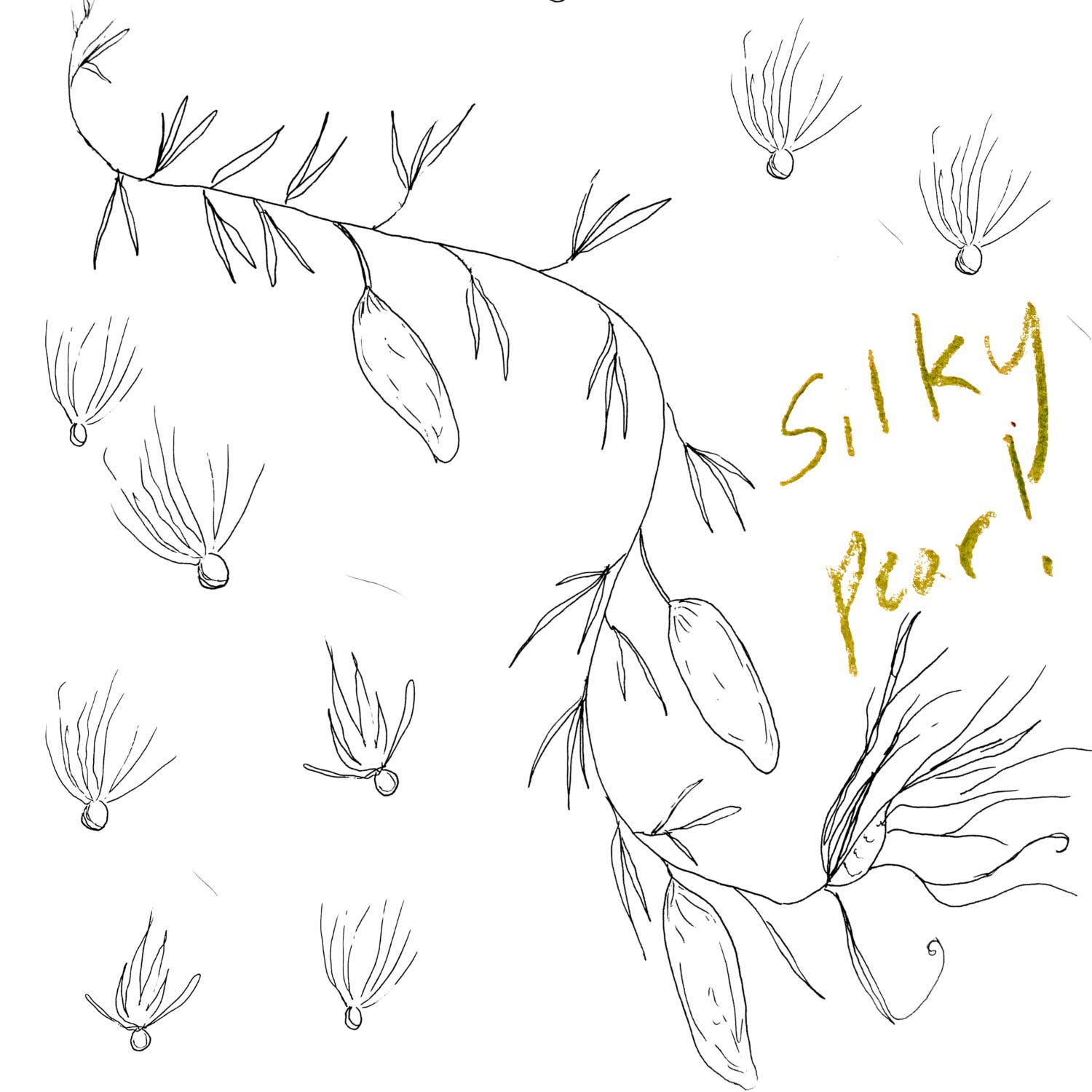
Silky pear flowers start out in umbels of ten or twelve, whitish and green and rounded petals. The first bloom is called the big sister and the second the follow, or the little sister. Their fruit looks a lot like a small mango or an avocado with thin hairs all along the skin, thus the name, silky pear.
The plant has wide range of relatives, from milkweed, fragipani, and oleander. Dogbane: of the Apocynaceae family. You can tell because it has a milky sap - just like milkweed. Only this sap is sweet. Of their entire family, silky pear is one of the only plants that is not poisonous to humans. They carry the sea foam green of milkweed species. In an umbel mound the flowers bloom, but barely. The greenish sepals and plump cream bases where the reproductive parts of the plant are are spherical to protect those areas.
Marsdenia species are likely to be an obligate outbreeder, which means they can be pollinated by a wide range of floral species both related and unrelated to them. Once pollinated by the roving bee or wasp, the ovaries will swell with a thick flesh that tastes fresh like snap peas. The flesh covers a body of oval seeds connected to a long feather pappi that once the fruit withers, will, in April fluff, dehisce, or shatter, and fly.
Thiamine, Vitamin B1, courses through silky pear. This is a valuable vitamin also in beans, nuts, and whole grains that human bodies cannot make on their own - breaking down carbohydrates. It was the first vitamin found and isolated in an organic substance in 1930. While the plant can be eaten raw it is also traditionally cooked in hot ashes. Sometimes the entire fruit is eaten whole.
The tuber underground sustains them through bushfire, even when their vines burn. Though these lands are very dry and have difficult clay soil, this part of south western Australia is very water efficient. Not a wasteland. Yet silky pear is threatened from overgrazing.
From a map, Australia kind of looks like a boomerang, and the native range of the silky pear lines the inverted half. A foundational food in South Australia, silky pear is part of the pantheon of “bush tucker” a term for the plants that are valuable to the food systems of the Indigenous peoples in Australia, groups who have lived with the land for at least 65,000 years. According to the website, Country Needs People “Bush tucker is more than food; it is considered an example of Country’s generosity and traditional law instills the responsibility to harvest and manage with care.” Much has been lost through the dispossession of Indigenous land and genocidal practices of stripping ancestral knowledge. But there was a time when people spent much of their lives on this land in South Australia walking to sacred places and building small fires as they went to nourish the land.
I met a man the other day on a mountain. He has been running on these trails in Oregon for decades, and once, he believed he saw a shaggy, loping being - this is many years ago now. Exhausted, the young man watched as the being walked up the hill and into the trees. One moment, and to this day he is certain he saw Sasquatch - Sasquits, as the Salish peoples call him. I know Sasquatch and all the cryptids live somewhere beyond reality. But I have a small theory that I think has to do with lost wisdom as it pertains to the land. With the right kind of preparation and attention knowledge can be gained. While knowledge can be stripped, taken, torn from peoples there is a small element that remains. What I mean is that, I’m not sure knowledge is owned. Maybe it takes a long run, or a long time away, or it takes therapy, or the setting of a boundary, maybe it takes the formulating of a question, or listening to a grandparent; looking at an insect for a long time. But you gain something there - some knowledge.
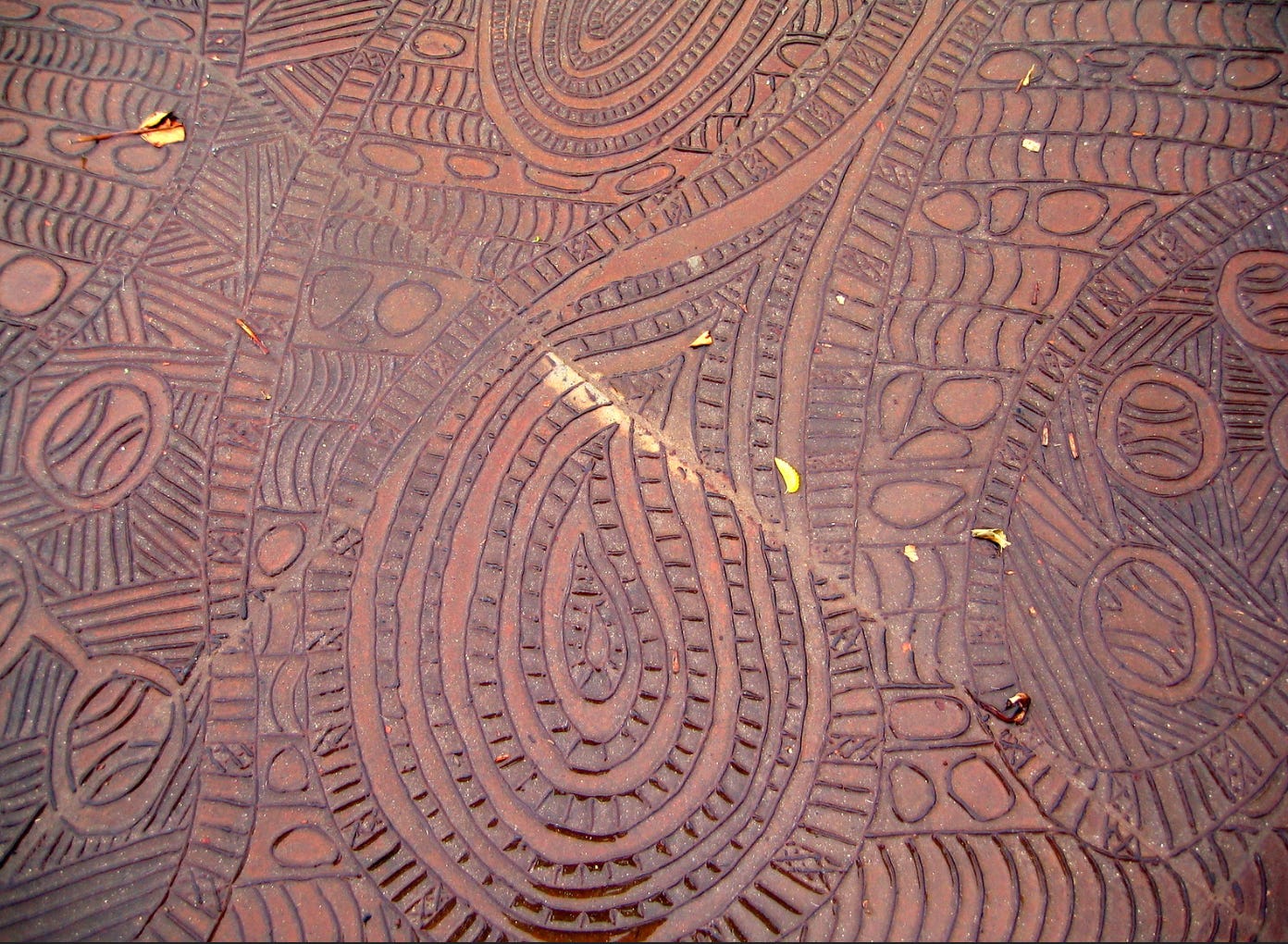
Here is the tradition of storytelling through dot painting: Dreamtime is a concept that is specific to Indigenous Australia and I can’t presume to know it. But I can try. A painter, Dorothy Napangardi engaged in a practice that necessarily required the whole body, a practice that, even now, when the paintings have moved from rock to canvas, the artist embraces it. Dreamtime painters paint sitting on the canvas, part of it. The painting germinates from the ground - horizontal, as the canvas tells a story. Certainly a canvas may seem dry, but if you don’t know the story, you won’t know how to see its value.
myth for silky pear
0:00
-4:17
Music for myth:Debussy - Cello Sonata - L. 135, Performed by: Paul Pitman, Bang-Eun Lee Source: https://musopen.org/music/performer/paul-pitman-bang-eun-lee/ License Terms: CC PDM 1.0
sources
https://www.inaturalist.org/taxa/1448508-Leichhardtia-australis
https://rightnow.org.au/opinion/spinifex-people-then-now/
https://en.wikipedia.org/wiki/Leichhardtia_australis
https://anpsa.org.au/plant_profiles/marsdenia-australis/
https://syzygium.xyz/saplants/Apocynaceae/Leichhardtia/Leichhardtia_australis.html
https://atla.com.au/about/adnyamathanha-people/
https://sanativefoods.org.au/bush-banana/
https://atla.com.au/about/adnyamathanha-people/
https://www.sciencedirect.com/science/article/abs/pii/S0140196308000426
https://www.alec.org.au/biodiversity
https://albertis-window.com/2024/04/dorothy-napangardi-floor-and-family/
https://tasteaustralia.biz/bushfood/native-fruit/marsdenia/
https://www.britannica.com/place/Kalgoorlie
https://www.alec.org.au/biodiversity
https://spapps.environment.sa.gov.au/seedsofsa/speciesinformation.html?rid=2840
https://easyscape.com/species/Leichhardtia-australis%28Bush-Banana%29
https://www.newsteadart.com.au/auctions/sale-2-lot-14
https://lpi.oregonstate.edu/mic/vitamins/thiamin
https://tours.eventspace3d.com/view/wa-museum/spinifex-people
https://ui.adsabs.harvard.edu/abs/2016AGUFM.H51J..04T/abstract
https://worldwidewattle.com/infogallery/utilisation/aboriginal.php
Comments
Nothing yet. Say the first thing.
Sign in to join the conversation.