
We’re closing in on 150 unique plants in the What’s That Plant?! ecosystem! To celebrate, throughout the summer (and possibly moving forward when I feel the time is right) I will REPOT some plants you might have missed.
As it is when we repot plants, these pieces will have changed slightly. There is always something new to learn about every plant. Even the smallest ones.
0:00
-14:32
Walk the border long enough and you’ll find sweetness. This is where the animals wait and watch, where fairies and witches linger, where poison ivy glares; where deer are, all at once, seen; where I saw a shadow between the trees. It takes courage to enter the forest. Many times it takes a trip through a bramble to get to the heart of the wood. As love lorn princes know, sometimes you must. The painful threshold is also home to the forest’s most delectable gift.
When foraging isn’t downright dangerous, it can be dirty and bitter. Plants may be better when they’re cooked or washed - like roots. Sometimes you only need a taste before your tongue curls. Sometimes a foraged berry is only a drop - like a small strawberry. Find raspberries and find a feast. The berries are so abundant you can fill your hands again and again, always finding more under a canopy of leaves. Our own two hands won’t get them all, so we can’t help but share with the deer and the groundhogs and the orioles, blue jays, catbirds, and robins.
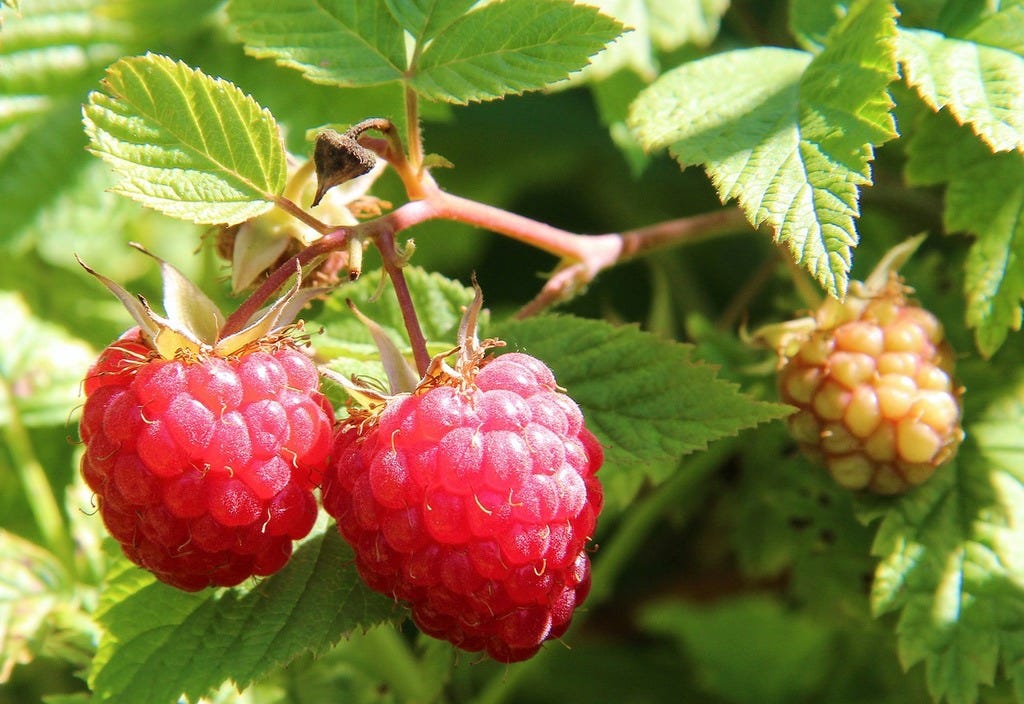
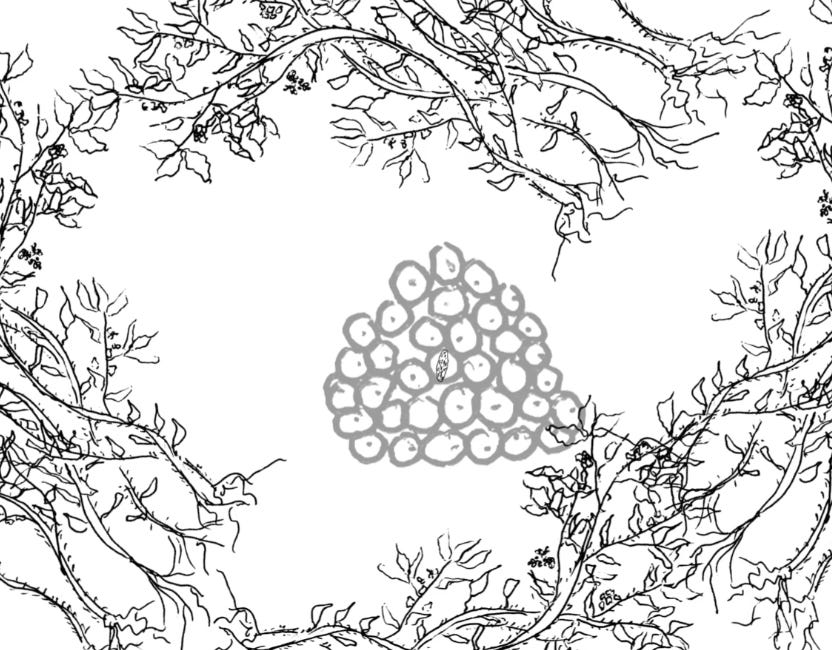
Unlike blackberries, the raspberry has hairs so fine they create the effect of a velvet cushion. But the cushiony conglomerate is not a berry at all. The raspberry itself is a multiple. Each bead is a fruit, all stuck together in a term called aggregate. Each berry has a single seed, which is spritely known as a drupelet. Pick it and see the pale etaerio that held it - an inner stem.
There are native raspberries that span the entire northern hemisphere. But there may be an origin for the entire 200 global species, however, in Asia. But that’s old, and it’s really speculation. They grow abundantly in secret places in forests and openings where the sun comes in and the shadows visit too. They don’t often congregate in meadows because they usually take in that shade. South of the Great Lakes in the United States, it will only be found in mountainous regions where it doesn’t get too warm. The raspberry is adapted to winters between the lush warm summers when it shows out.
Raspberries are part of the popular family of roses. The petals of a rose are rounded as opposed to the radial and pointed asters. The roses that we see with layered petals are cultivated to be that way. The roses in the wild usually have a single layer of petals revealing a center with anthers springing out like broken clockwork. The cherry, apple, pear, and strawberry are all rose relatives, like them, raspberry flowers are shaped the same, bursting from the sidelong stems and ends of canes. The flowers are almost always white - and sometimes pink. Those floral sprung landing pads are made for the belly flop of bees.
In fact the genera Rubus, of which the raspberry and blackberry are a part, is the most diverse of all the Rosaceae plants. In other words, there are more kinds of raspberries (and similarly, blackberries), than there are roses, which is to say over 1,000 Rubus berries in all.
I have a worn down Emily Dickinson book of poems that my grandmother marked with checks. Whatever she was looking for, she used a slightly dried black marker to mark them. In her house with the bright red carpets and a revelation of light through the living room windows illuminating the books. I imagine this sun ate away at the blue cover of this small book, so the paper broke the fifth time I opened it. She hardly needed the stacks she collected. She had libraries of poems in her head, like a dreamy Borges story, she gave poems to so many banal moments. She didn’t put a check mark next to this poem, but I imagine she knew it. One who becomes blind feels fortunate because they can always see.
This plant has no other name, but that doesn’t mean it isn’t well loved. Say the word and I taste the fruit in my mouth. Everyone who has eaten raspberry knows that what makes it so good is not only the sweetness, but the exciting tang.
“But were it told me, today,
That I might have the sky
For mine, I tell you that my heart
Would split, for size of me.
The meadows mine, the mountains
mine, —
All forests, stintless stars,
As much of noon as I could take
Between my finite eyes.”
The leaves emerge with miniature mountains and valleys lined on each, on stems that are set alternately down the cane. When the breezes of a summer rain come you can see their compound leaves - three or five collected on a stem - flip over to reveal a willowy white under the green surfaces.
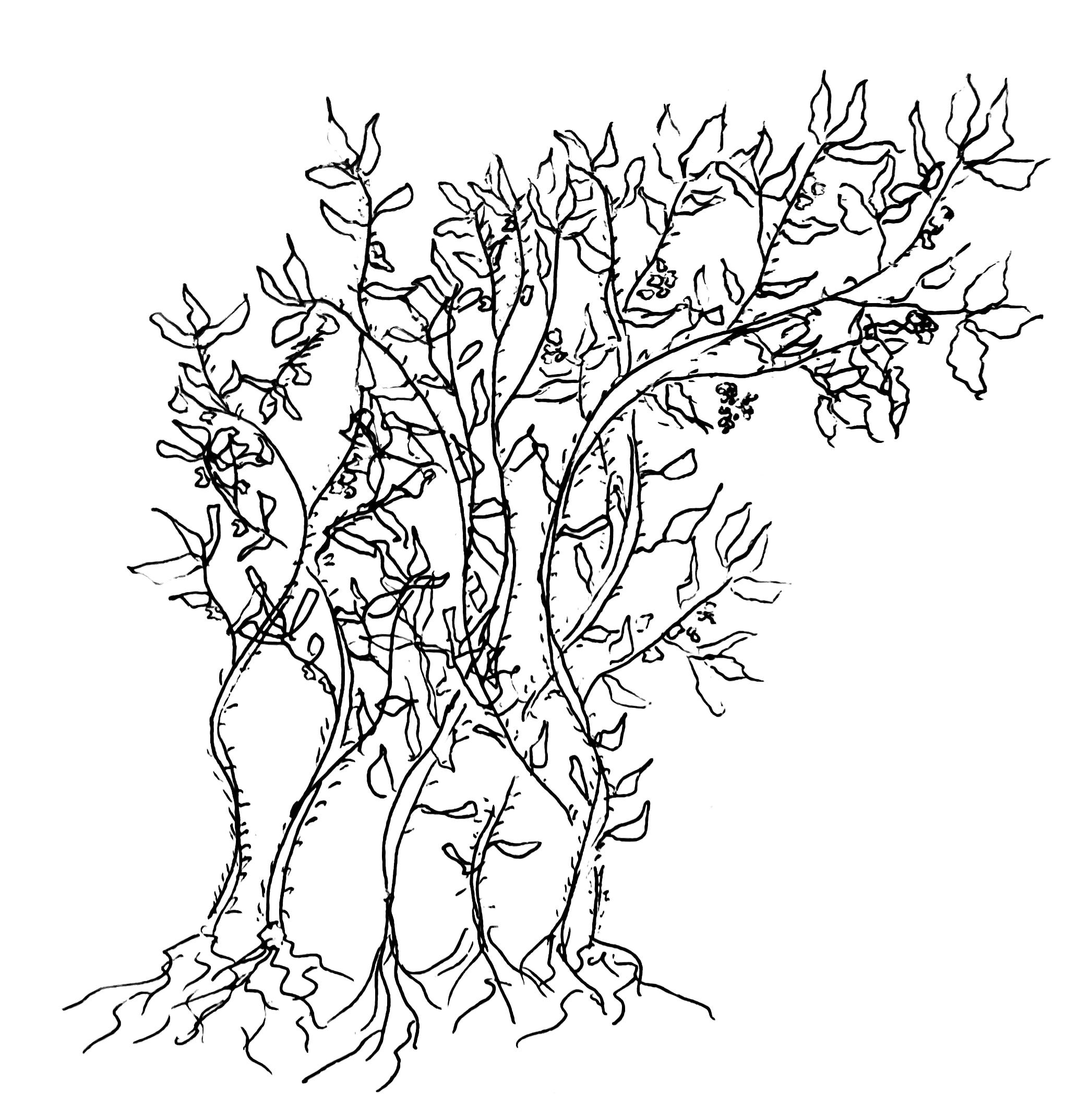
Beneath the layers of toothed leaves, these brambles grow thick like a gang: territorial, protective, and tight knit. Nearly woody canes are bristled with painful prickles. Their intermingling canes stand at a stout 2-5 feet. Their canes will only live for two years. There are two stages of the raspberry cane. The primocane can have no flowers, or very little. The floricane always has more fruit. Then they senesce, hollow out, and become home for nesting bees before they return to the earth again. Their canes can also be replanted and they can grow from underground suckers to start the two year cycle over again. A bramble of raspberries can live and grow new canes for many years. Some raspberry canes will grow tall, but some will dive towards earth where, despite their general adaptability they are susceptible to diseases, but not before feeding the animals there and providing a sheltered home for them to live - the floral dragon knotted around them. Come winter, foraging rabbits will eat the bare rust tinged canes.
They want rich, slightly moist, well draining soil with lots of organic matter and full sun to make the best berries. In shade their berries will be few and far between. So they naturally congregate at the edges of forests and will slither like snakes if let loose in gardens or disturbed areas.
The commercial raspberries we eat are a hybrid between Rubus idaeus, the Eurasian and Rubus strigosus, the North American. And because many Rubus plants can be interbred, other species have been hybridized with raspberries to fortify plants against pests or diseases, or slightly change the shape or flavor of the fruit. Right now, Russia is the largest producer of raspberries. There is a long ethnobotanical history with the raspberry through Eastern Europe and Russia. Their uses are well known in folk traditions all over the world.
In the primeval time of many gods, the raspberry played a role in myth as the Rubus idaeus or “bramble bush of Ida”. Ida is a mountain range in Turkey and the name of a nymph who lived there. In general, the mountain range was associated with Sybille, and the great mother, which connects to the medicinal qualities of the plant. Ida was Zeus’ caretaker in his infancy. It was her blood that stained them red. In Germany the bramble was used to tame bewitched horses, but this seems like the cruelest form of raspberry use. In the Philippines, the sharp cane will keep out wandering spirits from houses. The pricks are a wake up call for anyone lost on the edges.
Raspberry seeds were found in Roman forts in Britain where they may have been introduced from the Eastern European and Asiatic mountains but they were so loved in the 13th century by King Edward I, he made it a mission to make the fruit popular, and he remains a forefather of its lasting popularity. The medieval wine that the raspice, a sweet rose wine made with raspberries. Like wine, the raspberry stains. It’s been used as a dye for light blue and a faded red. The native North American raspberries were used throughout Turtle Island for food, particularly dried and persevered in pemmican to be sustenance over long travels or deep winters.
Not only is the raspberry sweet, the leaves also have medicinal qualities that calm the system. Overall, the medicine is cooling. Maybe this is why it’s so refreshing in the summer - but it cools the body too. If it’s brewed for very long it has tart astringency.
Folk remedy says that it calms and stimulates the uterus, and beyond, so legend goes, it can be a salve for really any pelvic occasion. It regulates menstruation, cramping and PMS. The leaf tea encourages fertilization for the reproductive system. The astringency reduces moisture. Post breastfeeding it has been prepared as a tea. It works with the pelvis and as a uterine tonic whether someone is looking to get pregnant or not.
The entire plant has similar medicinal uses. The antimicrobial properties make it effective against yeast infections. It can also be used to lower inflammations - particularly in the tonsils. It has been proven to prevent kidney stones, which was a main purpose for the many Native American traditions that use the plant. As a makeup, it has the ability to clear dark spots because it is a tyrosinase inhibitor. For this reason, and the vitamins C and E coursing through it, it is a popular ingredient in anti-aging skin creams.
Because the raspberry bands the northern hemisphere, it is used in traditional Chinese medicine. Here it’s used in many of the ways it’s used throughout the world, in addition to being a medicine for the liver. But it is implemented to brighten the eyes. It is also an important component in Ayurvedic medicine. It is rich in fiber, manganese, iron, vitamin C, K, E, A and B complex. You can tell by the deep color that it has antioxidants. That red: this color usually also indicates polyphenols, which can be used to prevent cancer.
The ripe raspberry will age quickly, so if you see them, eat them at once.
And aside from the border of woods, a study has shown raspberries are hemmed into our galaxy. Using spectral light technology scientists have found that the sugar erythrulose exists in abundance in a system near the center of the Milky Way. Long ago, four billion years ago, before the world as we know it there were tremendous meteor showers that delivered much to this planet. Including this sugar, which may have been involved in creating life - and remained potent in raspberries. This is a berry that has had the infinite, and yet remains ever so small, a red dot on our hands. Stuff of stars, staring in wonder, for it is ours.
Sources
https://doiserbia.nb.rs/img/doi/1821-2158/2021/1821-21582101107V.pdf
https://thepracticalherbalist.com/advanced-herbalism/raspberry-myth-and-magic/
Peterson Field Guide: Eastern Central Medicinal Plants
Herb School Podcast
Stalking the Wild Asparagus, Euell Gibbons
Foraging New York: Finding, Identifying, and Preparing Wild Foods, “Wildman” Steve Brill
https://www.britannica.com/plant/raspberry
https://www.sciencedirect.com/topics/food-science/raspberry
https://plantura.garden/uk/fruits/raspberries/raspberry-overview
Emily Dickinson “Love Poems” The Peter Pauper Press
https://plants.usda.gov/DocumentLibrary/plantguide/pdf/pg_ruid.pdf
https://www.minnesotawildflowers.info/shrub/wild-red-raspberry
https://en.wikipedia.org/wiki/Rubus_idaeus
https://www.ediblemontereybay.com/online-magazine/summer-2022/raspberries/
https://pmc.ncbi.nlm.nih.gov/articles/PMC11283228/
https://pubmed.ncbi.nlm.nih.gov/36341819/
https://plants.usda.gov/DocumentLibrary/plantguide/pdf/pg_ruid.pdf
https://ethnobotanyjournal.org/index.php/era/article/view/2379
https://pubmed.ncbi.nlm.nih.gov/36341819/
https://en.wikipedia.org/wiki/Mount_Ida_(Turkey)
https://doiserbia.nb.rs/img/doi/1821-2158/2021/1821-21582101107V.pdf
Look back in time to see the original, the video, and the myth
·
July 18, 2025
ALSO KNOWN AS: Rubus idaeus, red raspberry, greyleaves, wild red raspberry, malina (Serbian), Fu-pen-zi(as Chinese herb)
I hold a botanical writing walk in Prospect Park every last weekend of the month please join me! The next one is…
Saturday August 29th from 11am-1:00pm at the Grand Army Plaza Entrance of Prospect Park.
We are going to walk through Prospect Park to learn about grasses and grassland environments and participate in three prompted generative writing exercises. To honor the season we will also work with grasses to build small ropes out of the grasses - because they’re all golden now.
To Register, email bending.tree.education@gmail.com.
$20 suggested donation, or just come as you are.
No posts
Comments
Nothing yet. Say the first thing.
Sign in to join the conversation.