

ALSO KNOWN AS: Heavenly blue, Ipomoea tricolor, Ipomoea violacea, Flying Saucers, Grannyvine, Pearly Gates Morning Glory
0:00
-9:17
Frazzled. A list of everything I could not possibly finish pulls at my thoughts and the sun is long down. I don’t want to sleep as I keep pushing ahead on an email I will need to rewrite when my head is clear. Night has never been a friend of mine. It has been a mother and a teacher; an enemy and an ally. But never a friend.
Its sister, dawn, on the other hand, comes every morning as a gift. I could never despise mornings because they are so sure of themselves, so pure in their intentions.
A mother told me once that she took her colicky baby into the sun every morning before 11am and it healed her. She was convinced there was more Vitamin D in that light.
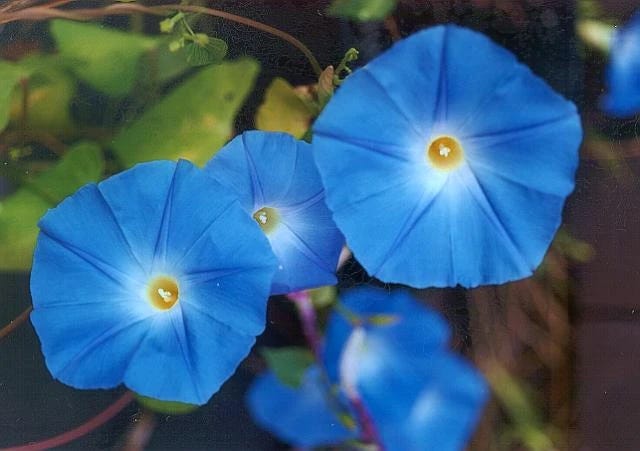
Morning glory knows that special morning glow because it only blooms for a few hours before afternoon. Face to face with one and they are luminescent. The colloquially named “heavenly blue” is indeed blue. Blue is a precarious color for a flower. Botanists say this is one of the few flowers that is “true blue.” Many plants play with shades of red to make illusions of blue. Because of their anthocyanins, they can also be bred to form different shades of pink or white. In the wild the plant will usually find a shade of purple to settle into, hence its first name: Ipomoea violecea.
While morning glory discs look like a funnel spiraling in on a luminescent center the structure is a conglomeration. Five delicate petals fuse together to form the flower. Five sepals crown its base.
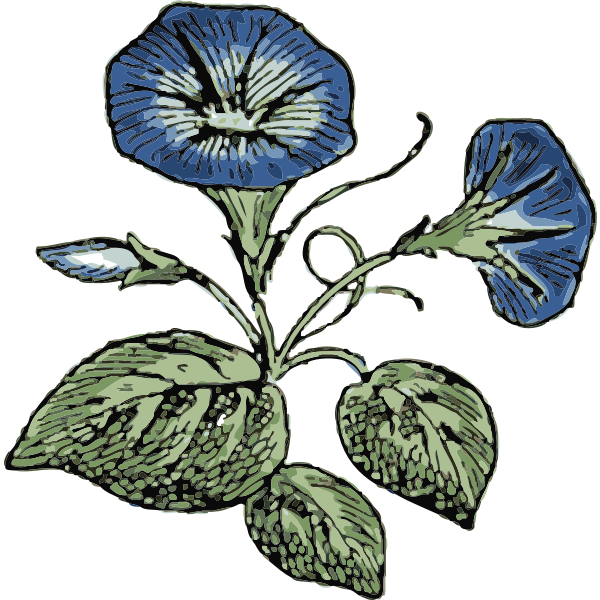
Heartshaped, or cordate, leaves with smooth edges form quickly in July and bloom finally in August. Many Convolvulaceae plants look the same, you know the family of morning glories by these same funneling flowers and similar leaves that lope up at the bottom. Very early in the season these leaves may be blanched and eaten. But careful.
Morning glories are part of a family of Ipomoea - or sweet potatoes and all sorts of binding weed, morning glory must cling on thin vines with fuzzy trichomes all over. Their tendrils make chartreuse curlie-cues.
Ipomoea tricolor is a classic. The well draining soil and full sun of its range reflect its ancestral home around Veracruz, and that narrow place that lines the inner curl of Mexico. Here morning glory has for thousands of years been recognized as an extremely sacred plant.
There are several medicinal properties that can be derived from morning glory that purge the body of toxins. Remedy from the seed can be laxative, diuretic, and antibacterial.
This is to say it is absolutely not food, and the healing effects draw the poison out. Ipomoea tricolor is the plant that has changed so many thought patterns.
The Mexica used the plant to draw images out in the mind and rest the body. Likely those who moved between states had the responsibility of using the plant. Not everyone was allowed. All morning glory species have collaborated with varying amounts of a bacteria that grows in this seed that the plant used to deter against herbivory. This bacteria can develop in wheat and corn species. It contains ergot alkaloids: LSA, which is the precursor to LSD. Some have speculated that it is this very alkaloid that brought forth visions of demons in the old deciduous woods of Salem. It is a chemical compound that works in our minds the way LSD does. Many believe it has the potential to heal people with illnesses, tucked away in the back of the psyches. Medicine people, Curanderos and the like performed deeply sacred acts using medicines with morning glory. The substances consumed and covering the skin. Plants were gods or medicines were gods. Their touch opening up doors that might have been invisible before.
Thousands of years later, Albert Hoffman derived LSD from the LSA of morning glory. In 1943 Hoffman experienced the first modern LSD trip as he was biking home from his laboratory. The experience he later described as the moment he was introduced to the idea that there are many realities. While it is psychedelic in nature, LSA, the substance acts as a sedative, easing the body down.
The flowers fade from a pastel color to white in the center. That light within the flowers brings the long tongues of butterflies and hummingbirds. There are two species of bee that require the funnel of the flower, Cemolobus ipomoeae, a solitary bee with long horns and small but contrasting stripes, requires it. They don’t need to be as small as other bees, the entire half inch of their bodies inspect the saucer flowers. The morning glory bee waits until the very end of summer, nesting underground until the last minute. In the heat and lengthening shadows at the tail end of summer they’ll bolt out. Just in time.
Late in the day, or upon pollination the flowers will close in like a fist, brown, and fall. What is left will be rounded vessels, the shapes of pointed fools’ hats that will harden through autumn to the point of finally cracking. Their seeds are smooth as porcelain and dark.
Soccer coaches say a soccer ball is round. Even on all sides. Despite the inherent imperfection of the people involved in the game, the imperfection of the people is juxtaposed by the perfection inferred in the ball.
The flexible twining of the plant also relates to its historical usage in relation to plastic. Throughout Central America are stone fields where people played a game that looked something like basketball or racquetball called ulama. Like so many games it required a ball. Morning glory was used to vulcanize rubber the ball’s movement from the high level of sulphur in the plant. Thousands of years later Charles Goodyear invented vulcanization, the process that would make tires bouncy.
Morning glory are not a shy kind of species. Some of them are considered invasive in various places in the US and Australia. Yet, their exuberance, managed and handled in places where they are not native, has the potential to hold the soil. Their roots are tuberous, similar to their sweet potato kin.
Wild seeds need scratching. Like the right code for knocking. They need the tickle. But it’s not the tickle of the earth so much as the tremendous corrosion of the stomach. Morning glory seeds have adapted to be eaten.
Ipomoea comes from the Greek meaning “worm” to wind like a worm. I think about the power of worms both in the soil, and the use of the word worm sometimes translates over to snake. Those beings that slither, that take in the world from nothing but their bellies. The vulnerability of that. The morning. A new kind of sight. Lining up the railing outside my home are pink and purple morning glories, a gift to the building by a neighbor. Busy, it twines up ten feet by September, only to lose its entire being no more than two months later.
So much of our world is confusion - the pains sharp and continual. But you know there will always be morning. There will be the last days of summer. And morning glory in September says “wake up.”
myth for morning glory
0:00
-2:30
Text for myth, Creative Commons CC BY-NC 4.0. Recorded, produced, and published by: Gregor Quendel All other arrangements are based on the notes by: © 2025 CLASSICALS.DE EXCLUSIVE RECORDINGS "Air on the G String", also known as "Air for G String" and "Celebrated Air", is August Wilhelmj's 1871 arrangement of the second movement of Johann Sebastian Bach's Orchestral Suite No. 3 in D major, BWV 1068.
Sources:
https://en.wikipedia.org/wiki/Mesoamerican_ballgame
https://www.britannica.com/place/Veracruz-state-Mexico
https://en.wikipedia.org/wiki/Ipomoea_purpurea
https://plants.ces.ncsu.edu/plants/ipomoea-purpurea/
https://www.wellfieldgardens.org/post/stratification-and-scarification-a-seed-s-path-to-germination
https://www.colorado.edu/cumuseum/2021/04/21/morning-glory-bee
https://www.bbc.com/culture/article/20260410-the-bizarre-story-of-the-worlds-first-lsd-trip
https://www.eattheweeds.com/tag/ipomoea-tricolor/
https://www.nybg.org/blogs/plant-talk/2015/09/horticulture-2/its-not-easy-being-blue/
https://www.jstor.org/stable/1216297?seq=6
https://plants.ces.ncsu.edu/plants/ipomoea-tricolor/
https://research.reading.ac.uk/herbarium/2021/12/02/adventbotany-2021-day-2-ipomoea-tricolor/
https://pmc.ncbi.nlm.nih.gov/articles/PMC1092007/
https://www.bbc.com/culture/article/20260410-the-bizarre-story-of-the-worlds-first-lsd-trip
Comments
Nothing yet. Say the first thing.
Sign in to join the conversation.