
ALSO KNOWN AS: Equisetum sylvaticum
0:00
-10:24
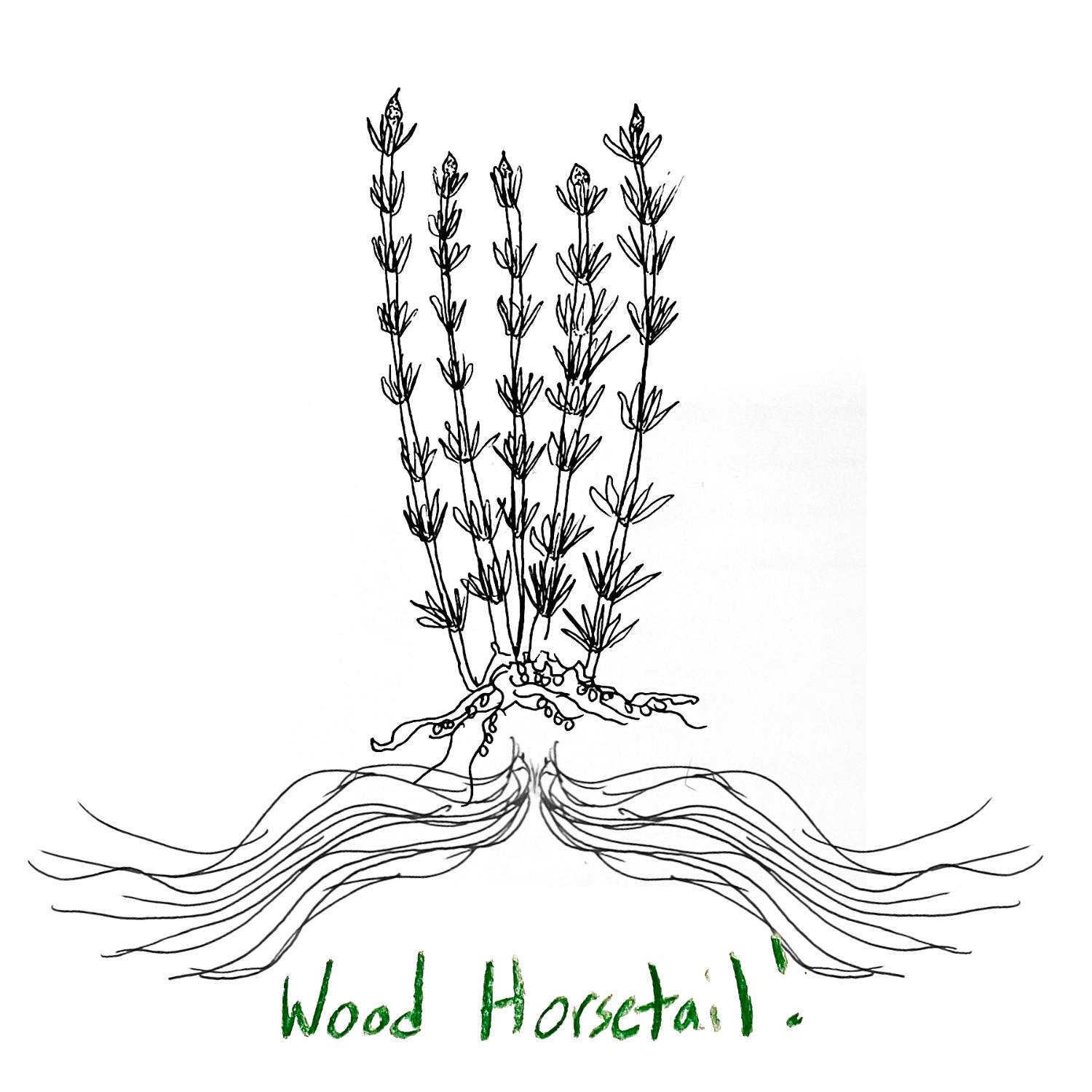
The name horsetail doesn’t come from what is above ground, but below. Horsetail roots are splitting thick, and black, like the hairs of a horse. The mass undulates far through the wetland.
The drama visible on this spare plant is in the geometry. They telescope straight up. Unbranched stems whorl from segments, that grow to hang down in the shape of layered hoop skirts. Wood horsetail stems are nearly like a lacework of needles.
Known as living fossils, ancient horsetails developed at a time when there was a lot of oxygen in the air. People don’t really talk about it, but there is less oxygen in the air than there used to be. With climate change there is even less. Smoke covering our bodies that struggle to find it. The only way humans would grow to be massive like the megafauna of our ancestors would be if we were fed boatloads of oxygen growing up and our grandparents and their grandparents.
Horsetail were more than toothpicks for dinosaurs, even though they certainly ate wood horsetail. In the same way they’re more than just a memory for us now. There are about thirty horsetails. Wood horsetail grows in the northern hemisphere in swamps or otherwise flat land where water can collect.
In the spring, sand colored heads rise on the reproductive plants. Late in the season the strobilis swells and the sporangia breaks like a pinecone and will dehisce, releasing spores into their wet environments. The joints are white with rusty sheaths that stand like the spikes on a crown. Fat at the joint. Below ground the stems regenerate easily, releasing shoots as they grow bigger and bigger because they can live for decades at least. Though they are old they look new, like infant pine trees. Usually mirroring the pine forests they live in, which have less acid in the soil. There are forests named after them in Finland: metsäkortekorpi or a wood horsetail coniferous swamp.
They seem to be direct smaller versions of their surroundings. Thus, the segments’ progressive thinning made John Napier around 1600, conceive of logarithms. He was a devout protestant Scotsman and in addition to inventing a weapon called a fire mirror and the decimal point, he created logarithms. But this telescoping technique transformed the function of math in the emergent Renaissance imagination. Before logarithms, math was long and tedious. The process slow. Logarithms sped up calculation by making substitutions.
In the Carboniferous period when horsetail developed, Gondwana veered to the cold in the South Pole while what is now China, remained warm. This time was known for a swampy land with massive trees, ferns and horsetail. The periods are split between the earlier Mississippian between 359 million to 318 million years ago and the Pennsylvanian around 318 million to 299 million years ago. During this period the earth was made up of swamps and trees that had intricate scales on them. Our world’s fossil fuels formed from the massive trees with armor-like bark, club mosses, and massive horsetails that grew up to 100 feet tall.
Sylvaticum is Latin for "of the forests.” Horsetail were among the first forest trees. During this epoch, the massive forests generated so much oxygen there were massive fauna and insects. Amphibians developed thick skin as earth that contains Northern America slowly drifted southward. Dragonflies had five foot wingspans and cockroaches were three feet long. Eggs developed during this period. Little amniotic sacs, carried beyond the bodies of mothers and into the world. The thing about the Carboniferous period was the profound that sustainability generated during this time, whose power went forward exponentially. One on whose wings we fly planes and drive cars and direct ships, one whose tremendous ability to consume light starts wars now.
When we think about deep time we must think about portals. What I mean is that we can’t think of individual days. When Napier conceived of logarithms he kind of made a time machine as he telescoped the time it would take to calculate massive or microscopic phenomena. We have to think about representations to arrive at different times or places. Mere symbols that represent millennia, for example. Burning ancient horsetail has this ability to shorten time and distance. Throughout the wetland, wood horsetail remembers monstrosity. Embedded in its DNA is its massive ancestor.
The high silica content in horsetail has been used to treat kidney stones, and it can be prepared as a diuretic. In their chemistry is an enzyme called thiaminase, which robs the body of vitamin B, so if large quantities are eaten raw they can cause serious health problems. Cook them and the thiaminase dissolves.
There was an accident on the highway and we were turned out onto the local Pennsylvanian roads, routed into the dark night, houses hugging the hills with traditional candles haloed at the windows. Arrow signs guided the car around curves so deep they were nearly circles. It was pitch dark and we had hours to go yet before we were scheduled to arrive. Set beside a wooden fence was an official state sign: “Appalachian Coal Mountains.”
We’d just had a song come up, Tyler Childers, the car console read, then: “Coal.” And I thought about the cost of making light in the dark. There is a theory that back in Mesopotamia the concept of time measured into 60 second segments was charted by the joints on our fingers. Whether this is true or not, all measurement necessarily comes out of a human’s perspective. In the song God speaks like a bad boss, a terrible overlord, connecting the request to make light and the plight of the people digging in the mines - digging coal - light requires the work to make it.
When God spoke out, "Let there be light"
He put the first of us in the ground
Sometimes these tricks look like magic. Just because there are tools and tricks to shorten time and space, things that seem like magic carpets flying us through the night, there’s a cost. One that is of human proportion. The labor it took to dig, the lungs that pay the price for the oil. The towns and communities consumed for the sake of efficiency. This is not an Appalachian story alone, but throughout the world. (Whose hands make the fuel possible? And what do they pay?)
Even the logarithm, the one that allows us to understand things far greater or far smaller than the human can perceive has its costs. We are doomed if we forget to honor the collossal time and space between then and now. Between here and there. How many phantom plants were expelled from the car, standing by the side of the road in the old coal town for us to find our beds at last? How many ghosts did we miss as we passed through?
myth for wood horsetail
0:00
-2:36
Forager Friendly?
Sure, if you know how to use it. Harvest with care. These wetland plants are valuable.
Sources
https://www.nationalgeographic.com/science/article/carboniferous
https://pmc.ncbi.nlm.nih.gov/articles/PMC7954623/
https://scholarworks.umt.edu/cgi/viewcontent.cgi?article=1112&context=tme
https://www.britannica.com/biography/John-Napier
https://www.britannica.com/science/Carboniferous-Period
https://en.wikipedia.org/wiki/Equisetum_sylvaticum
https://gobotany.nativeplanttrust.org/species/equisetum/sylvaticum/https://www.minnesotawildflowers.info/fern/woodland-horsetail
https://pfaf.org/user/Plant.aspx?LatinName=Equisetum+sylvaticum
Comments
Nothing yet. Say the first thing.
Sign in to join the conversation.