
I’ve been doing it all backwards.
Over the past 6 months, I’ve built tools to hunt for new ideas, track existing holdings, and counterpunch each thesis.
We talked about using Claude projects. Building new skills. And a first step into automation by using Claude Cowork.
But that’s not what creates real leverage when you’re investing in stocks.
These are useful tools, running on top of powerful models.
But the models will get commoditized.
And in a couple of years, everybody has these tools at their disposal.
But each investor has his edge. What makes him unique.
And that is your second brain. A living brain. That’s what you need.
Maybe your current situation looks like this:
Three months ago, you spent ninety minutes walking Claude through a thesis on a Japanese regional bank. The conversation was excellent. Claude pushed back on your assumptions, surfaced a regulatory angle you’d missed, helped you size the position.
Today you open a new chat to update the thesis. Claude knows your name. It knows your profession. It does not know the bank, the thesis, or a single thing you concluded that afternoon.
You start typing the backstory.
Again.
This is the central problem with AI as it exists today.
The frontier models are extraordinary.
But they forget a lot.
Every chat begins from roughly the same blank page, and every insight you produce evaporates the moment you close the tab.
They need context.
I’ll show you how to solve this, from simple to advanced. Here’s the outline for today:
What Claude actually remembersWhere this falls apart for serious workTaking a mental shift before going furtherThe solution from simple to more advanced:Claude projectsClaude connectorsClaude code
Beware of these mistakes
It’s not that Claude doesn’t remember anything.
In fact, Claude has 3 memory mechanisms.
Go to settings and capabilities.
You’ll see this:
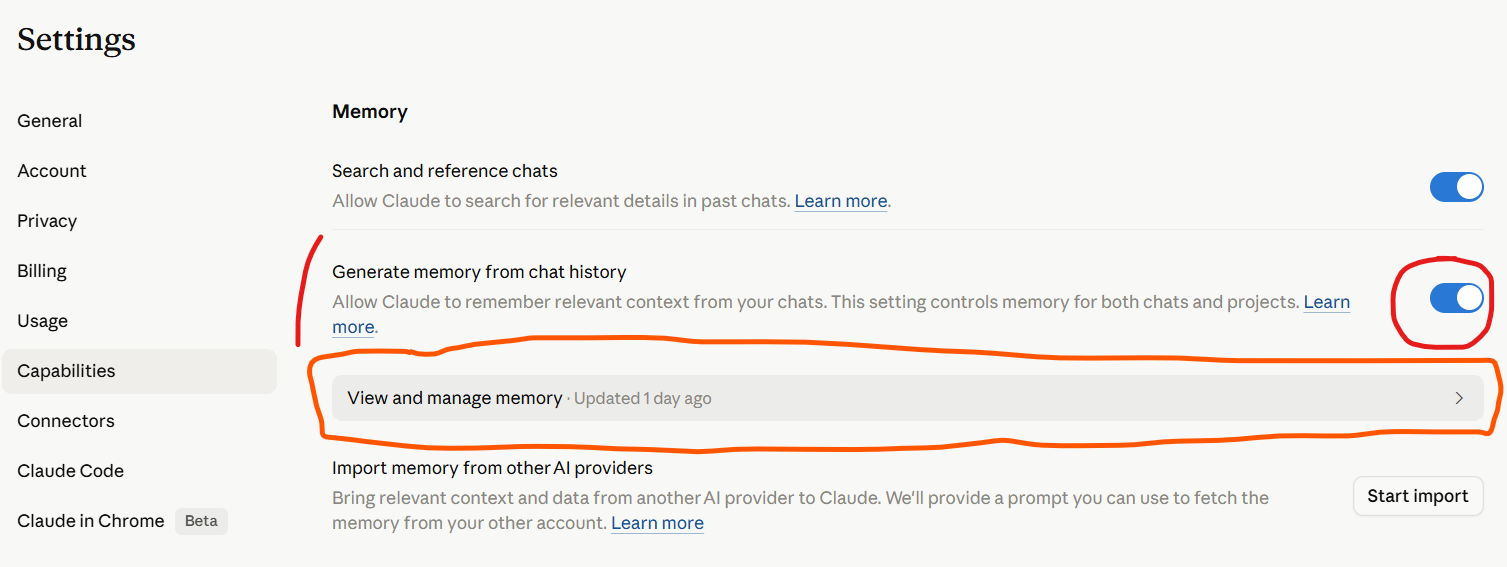
Claude reads your chats and writes a third-person profile for you. What you work on, what frameworks you use. This profile refreshes every 24 hours and will get pre-loaded into every new chat.
Click on View and manage memory to see what it has written about you.
You can adapt it in 2 ways:
Adapt the text itself (after clicking on view)
In any chat, tell Claude: “Remember that I… focus on small caps with insider ownership” -> It will add this to the memory file
This is actually useful.
You can ask Claude in any chat: “What did we conclude on that regional Japanese bank?”
Here’s a an example of a company I looked at recently:
And in the first image we showed you, you can toggle this off and on. It’s on by default.
Note: This is for paid plans only.
We talked about it in this article.
You can build a dedicated memory pool for a project. Like this:
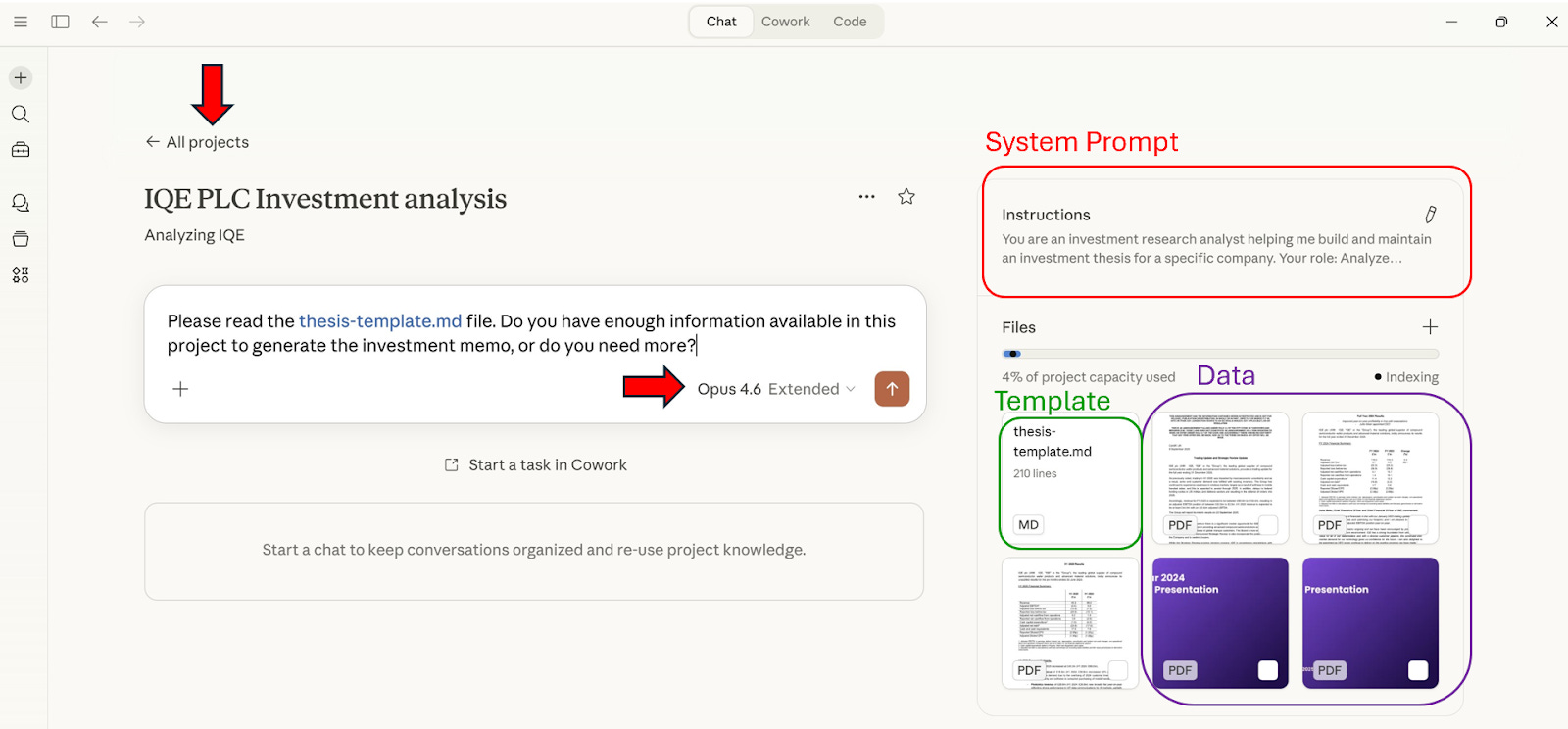
But everything you put in here is walled off from everything else. An analysis on company A will not bleed over into company B.
This can be useful, but maybe you want some part of that information to bleed over. That is not possible with projects.
If you do nothing else after reading this section, set up three or four Projects today and spend ten minutes editing your memory. That alone puts you ahead of 90% of Claude users.
Claude’s native memory is fine to have some sort of a pre-recorded introduction to each chat.
It’s not infrastructure that evolves for serious thinking.
Here are 3 reasons why it might hurt us as investors:
It’s a summary. Not an archive: Your four-hour deep dive on a small Japanese bank is boiled down into a condensed format. Yes you can search the chat, but you need to know what to search for.
There is no structural retrieval: “Show me every company I’ve researched over the past 5 years with insider ownership above 50%”. You won’t get an answer. There’s not structure in the data
There is no timeline to your thinking: When did you change your time on a position? What did you think in February and no longer holds true today, and why? The memory synthesis is just updated every day, but you lose the journey.
But there are ways to solve this, but before we get to that, we need to change our process.
Writing down notes isn’t new.
Niklas Luhmann’s Zettelkasten
Tiago Forte’s Building a Second Brain and his CODE method (Capture, Organize, Distill, Express)
Andy Matuschak’s evergreen notes
There’s a 50-year tradition of structured personal knowledge that the AI era didn’t invent.
What changed is the reader.
For most of the past decades, the reader was a future you, opening the notebook to find what past-you wrote.
The bar for keeping a note was “will I re-read this?” and let’s be honest, most people didn’t bother to re-read.
Now the reader is an LLM that will happily ingest 100% of your archive in seconds.
Keeping notes has become much more interesting. But there’s a caveat. The bar for structuring notes so an LLM can find and use it has risen.
The time has come to build an evolving second brain. Once you do, any output the LLM will give you will be of higher quality.
The format?
Markdown files.
Plain text, readable in any editor for the next 40 years. It’s an open-format, so no vendor can take it away. Markdown files in folders will be readable by whatever model dominates 2030.
Building a second brain can be done in many ways.
Pick one of these three based on how much time you want to spend on it, and what kind of result you desire.
My recommendation: Don’t overthink it.
It’s better to start small and simple than trying to concoct the most advanced second brain known to man. If you’re not doing any of these today, and decide on just one, you’ll get better results with Claude tomorrow.
I’m not going to rehash the details of what we wrote here. And although this is not a full second brain (each project is part of the full brain and cannot talk to one another), you can imagine creating a project called: Equity research. And then upload your frameworks and annual reports or data inside it.
You could probably analyze a couple of companies this way, in one single project.
If you’ve never done this before, this is the fastest way to get better results.
This is where Claude stops being a chatbot and starts acting like an analyst with access to your filing cabinet.
Start building your second brain inside your Google Drive
Keep a folder of markdown notes. You could use the following structure:
/Secondbrain for the main structure
/research with per company notes
/wiki for evergreen concepts and investing frameworks
/writings for draft or other pieces
/journals for daily or weekly logs
/inbox with unfiltered information
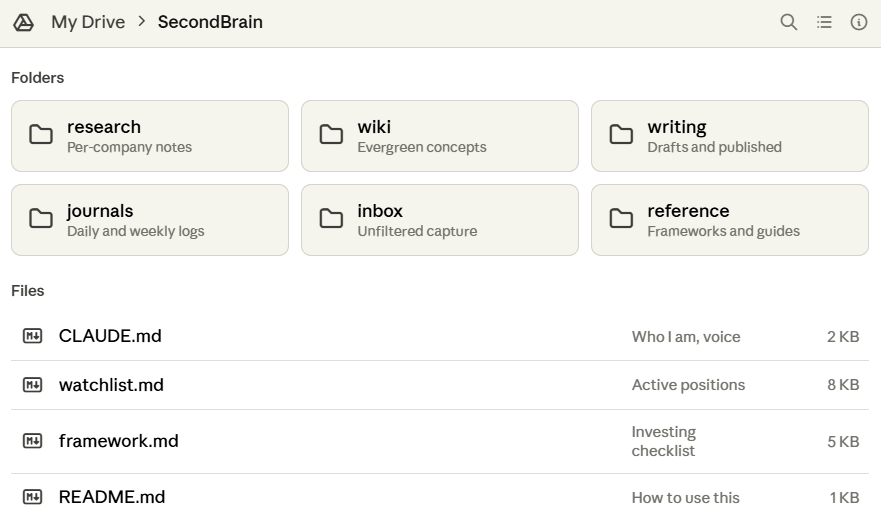
You can decide this structure yourself. You could for example have one folder per company, and inside each folder, have a structure like:
Notes
Earnings Reports
Thesis
It’s up to you.
There is no wrong or right answer. The only thing you need is to decide on a structure and stay consistent with your data capture in the future.
But do make sure to take care of how you name the files. Here’s what the LLM loves:

Never use spaces. Start with a data. Describe what it is.
Be consistent.
Note: If your current archive holds pdfs, word files, and what not, you can just upload them to Claude and ask him to convert them into md files. Or you can use MarkitDown which is a tool specifically designed for this.
I do recommend using some filing system, but I prefer what the current master of AI is doing (Andrej Karpathy).
Build a logical filing structure of markdown files. Feed your LLM the right markdown files based on the task at hand.The problem with summarizing information is you’re losing context. And our goal is to maximize context.
The goal is that your second brain lives. And evolves over time. You will be adding and maybe subtracting information all the time.
Now let’s say you have a google drive with your second brain inside it.
Now you go to Claude -> Customize -> Connectors and connect your google drive:
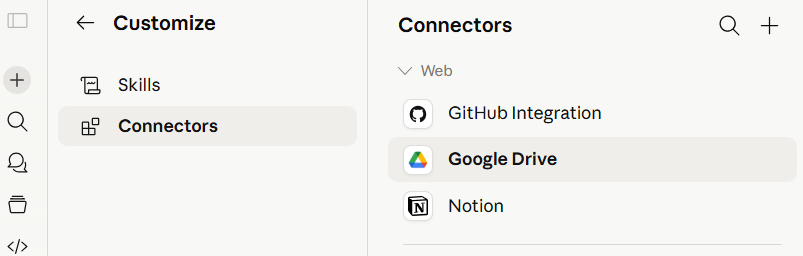
As you can see in the picture, if your brain lives in Notion, you can connect Notion too.
But there’s one problem. Claude will read your brain through the Notion MCP Connector. The readability of the data by Claude will be less clean as opposed to pure markdown files.
So what’s one thing you can do once you’ve connected google drive:
When you do research on a company, end the Claude Chat with:
Or you can also say:
This setup is a lot more powerful than not using anything.
But the tradeoff compared to our final solution below is real. Connectors are less powerful than the Claude Code setup. Claude web does not read directly against local files. It’s a bit slower.
But you now have a wiki synced over any device, whether you’re using Claude through your browser, on the desktop app or on your mobile.
If you implement this, you’re already gone a long way. Now let’s get to the final setup.
For readers who’ll open a terminal: this is the strongest setup available right now. Claude Code is Anthropic’s command-line agent.
One install and then point claude inside your SecondBrain folder.
The second brain folder you need to build is the same as in part 2. And yes, you can use Obsidian to structure this, but you don’t absolutely need it. Claude can just look through your folders without it. Obsidian allows you to easily edit the markdown files, and visualize the relationships between the different files. Claude doesn’t need it per se.
If you launch Claude Code inside your second brain folder, it now has access to your entire brain.
Here’s how memory is now structured in a typical Claude Code setup:
Global Claude.md file -> This is the file that is read at every Claude session. Antrophic recommends to keep it lean, like about 200 lines. Usually it will contain some do and not do’s for coding. But you can add rules related to investing if needed. This md file is the most similar to the memory file Claude.ai creates himself.
A simple example:
Project level Claude.md file -> Let’s say you have your second brain folder. Your second brain is focused on investing research. You can for example create a claude md file in this folder that looks like this:
That means each chat you open inside this folder will get this context loaded in.
So now your chat already has some context. It has not yet touched the files inside the second brain.
You can open Claude Code within the second brain folder, or point it towards the second brain. In any case, Claude can access it and read anything from it, depending on what you’re asking in your Claude session.
Now there’s one thing that is important.
Your journal.
When you launch a project in Claude Code, it’s common practice to keep a memory.md file and a progress.md file.
This is basically a running memory of what has happened and what still needs to happen in the future.
It’s the final piece of the puzzle in your second brain setup.
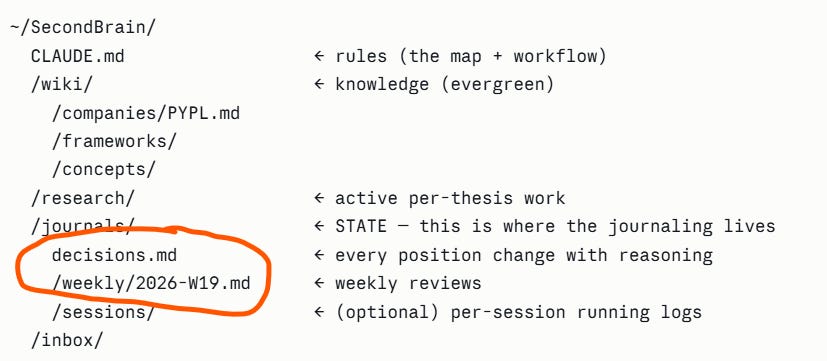
In the example above, there is a decisions.md file and weekly reviews file. This makes the brain come alive.
What’s important is to design your own system.
That system will outlive Claude or any LLM, and might be more valuable than the tools you use.
Don’t over-engineer. A 17-folder PARA hierarchy with a custom frontmatter schema you abandon in three weeks is worse than five folders and a habit you actually keep. Start with the starter blueprint above. Let structure emerge from real use. Don’t overthink it. Keep it simple and iterate.
Capture without distillation is simply hoarding. Capture information, but don’t forget to distill it. Create those md files. Weekly update your memory files. A stale brain won’t work. Note: There are ways to automate this so Claude does this automatically, but that’s food for another article.
A stale CLAUDE.md is worse than no CLAUDE.md. A file describing a thesis or workflow you’ve moved on from actively misleads Claude every session. Prune monthly. Run /memory to see what Claude has learned on its own and delete the redundancies from CLAUDE.md.
Plain text is the 10-year bet. Every format choice carries vendor risk except markdown. If you start in Notion’s proprietary blocks, you’ll regret it the day you want to try a different tool. Markdown files in folders will be readable by whatever model dominates 2030.
I hope I was able to convince you that building your second brain is worth more than the tools you use.
Whether Claude, ChatGPT or another model wins in the future does not matter.
As long as you’ve created and maintained your second brain, you can plug in any LLM you want.
If you already built your second brain, let me know in the comments how you did it!
Keep learning AI. Keep building!
Kevin (Atomical Capital)
No posts
Comments
Nothing yet. Say the first thing.
Sign in to join the conversation.