
My nephew opened a brokerage account a couple of months ago.
It’s still empty.
He’s 19. He’s in his second year of a bachelor’s degree in economics. He knows what a DCF is and the difference between a limit order and a market order, but he’s never bought a single share.
Not one.
That worried me. If I could go back in time, I would invest and compound every dollar I had.
So we made a deal.
Every week, we sit down for one hour. No more. The question we’re testing isn’t whether he can learn to invest; he can, anyone can.
The question is whether AI can take him from an empty account to his first purchase within four weeks and build enough conviction along the way for it to stick.
We could have started with some interesting stock ideas. We could have started with Claude on how it can help him.
But I chose to ask one simple question: Why do you want to invest?
I first shared my own reasons all those years ago: I made a decent living. My wife hated her job and wanted to take care of the family. So she quit.
But her quitting has a significant impact on our pension. So I ran the numbers to see how much capital I would need to build to compensate for the pension gap.
I worked out the number I had to compound at to close that gap. It’s not a small number. Whatever yours is, it determines your entire investing strategy.
Every person has their own number.
So I asked him again: Why do you want to invest? And what’s your number?
He paused. He didn’t really have one.
At 19, that’s normal. But I waited. Gave him time to think.
He would like to own a house later on. And if he could already build some capital on the day he graduates, that would be a benefit. He would have options.
So now he had his first time horizon: 4 years.
But that’s not long enough when you invest in the stock market.
He agreed. The goal was to invest for a much longer period. Graduation could be a first milestone.
Based on his approach, we decided to build a portfolio that would be a mix of ETFs and individual stocks. Exact composition unknown at this time.
My goal here is simple: To get him excited about investing in the stock market, not get too technical.
Now I wanted this investing thing to be grounded in his real-world experience. When investing becomes fun and real, people tend to stick with it. When it’s abstract, not so much.
So I borrowed Peter Lynch’s approach and asked:
Which brands do you like? What do you see around you? What are you a fan of?
He responded instantly: Uniqlo
Uni-what?
Uniqlo is a clothing brand I had never heard of. A quick Google search revealed that it’s owned by the company Fast Retailing. (Ticker: 9983)
I pulled up fiscal.ai and showed him the basic stats like revenue, earnings, and free cash flow per share:
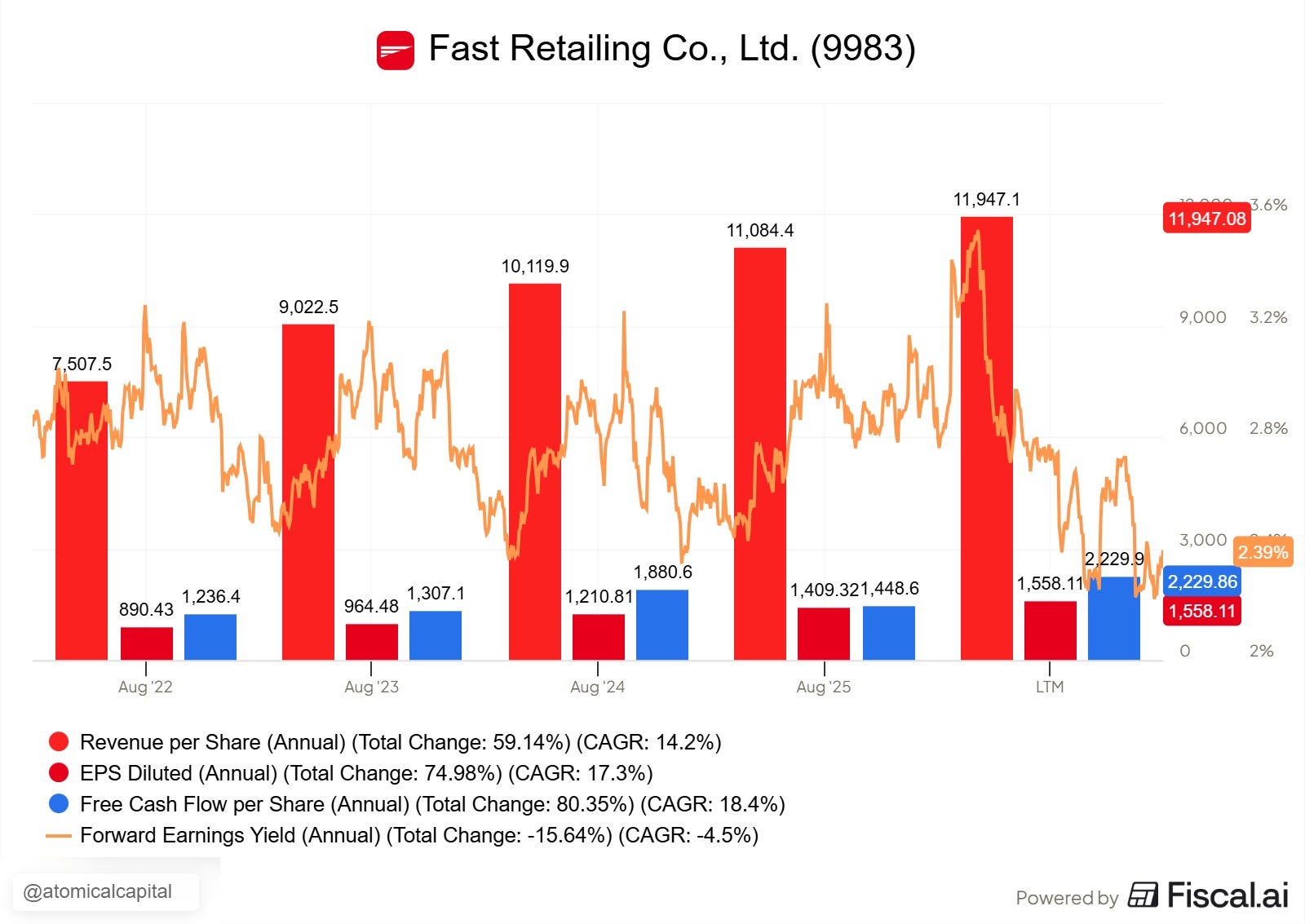
This thing is on a roll.
He said it’s durable clothing at a reasonable price.
Nice. So I asked him how this business makes money?
Besides that, they make money on the clothes they sell; he couldn’t really answer, not in detail. No worries.
Time for AI to shine: The Feynman prompt
The Feynman prompt explains any business in simple terms so that anyone can understand how it operates. You can find more details on it here.
I gave him the prompt, but you can also turn it into a skill. I use it like this:
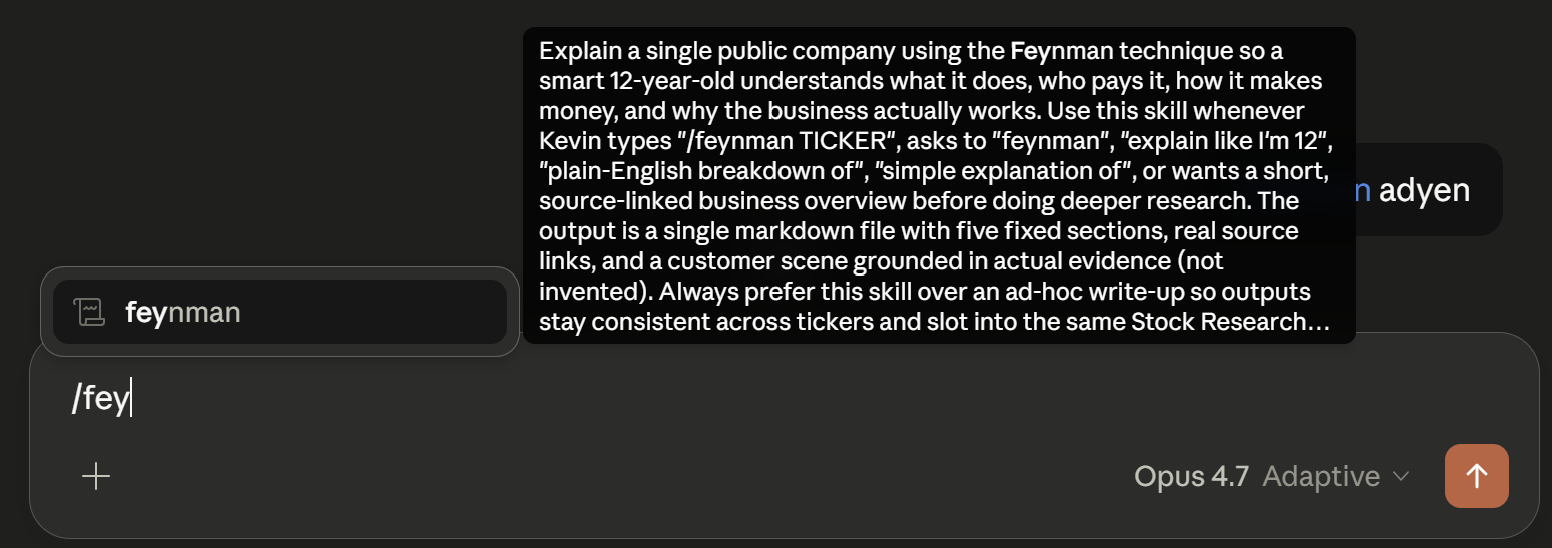
And Claude started working on it:
Here’s what we learned:
Fast Retailing is a Japanese apparel company that designs, manufactures, and sells simple, high-quality everyday clothes (mostly under the UNIQLO brand) to anyone, anywhere in the world.
Fast Retailing runs an apparel model called SPA: Specialty store retailer of Private-label Apparel. In plain English, that means they own every step of the clothing pipeline themselves.
Here is how the loop works:
Design in-house. Their R&D centers in Tokyo, New York, Paris, Shanghai, and Los Angeles design every product. No outside brands, no licenses.
Buy fabric directly. They negotiate large-volume contracts directly with material suppliers like Japan’s Toray Industries, the partner that co-developed Heattech.
Manufacture at partner factories. Production is outsourced to long-term partner factories in Vietnam, Bangladesh, China, Indonesia, and India. Many products are made in lots of around 1 million units per item.
Sell only through their own stores and websites. No wholesale partners, no department-store concessions. Every yen of margin stays in the building.
Here’s what they choose not to do.
Most apparel retailers chase fast-moving fashion trends and get punished when last season’s product goes unsold. Fast Retailing deliberately sells timeless basics
Uniqlo is the opposite of Zara.
Zara is fast fashion. New designs hit stores in two weeks. The whole point is novelty.
Uniqlo plans collections six to twelve months in advance. Same basics, year after year, in better and better materials. They have a proprietary partnership with Toray, a Japanese chemical company, to produce fabrics that nobody else can buy.
That’s the moat: Not speed, but durability, quality, and patience.
I saw he was getting excited now.
We found a brand he adored, and based on the numbers and business model, it’s a phenomenal company.
Yes.
“I’ve found the first stock I can buy”.
But then I asked him a question: It’s a great company, but is it listed at a great price?
He had no idea.
So we set out to reopen fiscal.ai and review multiples and growth rates.
And since he already learned about a discounted cash flow, I told him multiples are a shortcut to a full DCF. As long as you respect that, you are allowed to use multiples as a rule of thumb.
To make it simple, we looked at the historical PEG ratio.
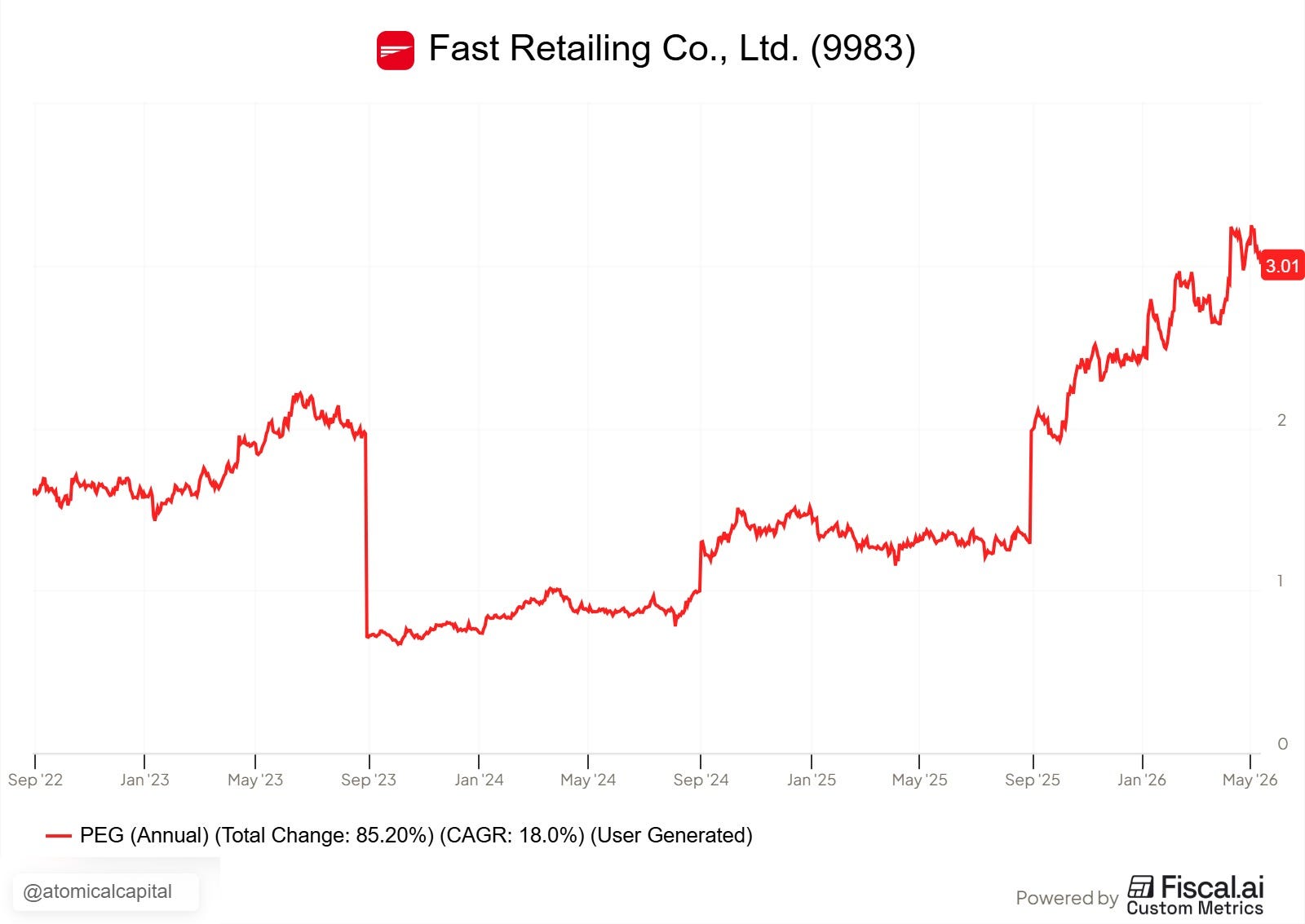
A PEG of 3 is expensive.
There was an opportunity in September 2023 (PEG of 0.7) to buy this stock at a pretty low price. You would have more than doubled your money in 3 years.
The market has priced this stock in.
My advice to him: Open a brokerage account and add it to a watchlist. Set a price alert. Move to another stock.
This is a stellar business, but a great business can be a bad investment.
So that was it for week 1. My nephew now has access to fiscal.ai and Claude with some custom prompts to look at different businesses.
He learned:
That investing serves a purpose, a why
That he can understand any business by using Claude
That a great business does not always equal a great investment
In the coming weeks, we’ll go deeper into the business, look at some ETFs, and see how this goes.
My nephew is in the driving seat. I’m just there to guide him.
If you started investing as a teenager or in your twenties, what’s the one thing you wish someone had shown you in your first month? (My nephew reads all the comments.)
Keep learning AI, keep building!
Kevin
A final note: The prompts, skills, and workflows I’m showing my nephew are part of a toolkit I’ve been building for over a year.
In the second week of June, I’m opening it up. Private beta. 30 spots. 50% off the launch price.
The point of the beta is to get one month of real feedback from serious investors before general release. That’s why the cap is small, and the price is half.
If you’re interested, you can join the other 65 already on the list:
No posts
Comments
Nothing yet. Say the first thing.
Sign in to join the conversation.