
August 26th, 2026
Greetings!
Elbridge Colby is at it again. The Under Secretary of Defense for Policy – which ostensibly makes him the third most powerful man at the Pentagon – is in Europe to push his NATO 3.0 agenda as the 32-member collective defense organization holds multiple key military and political meetings this week.
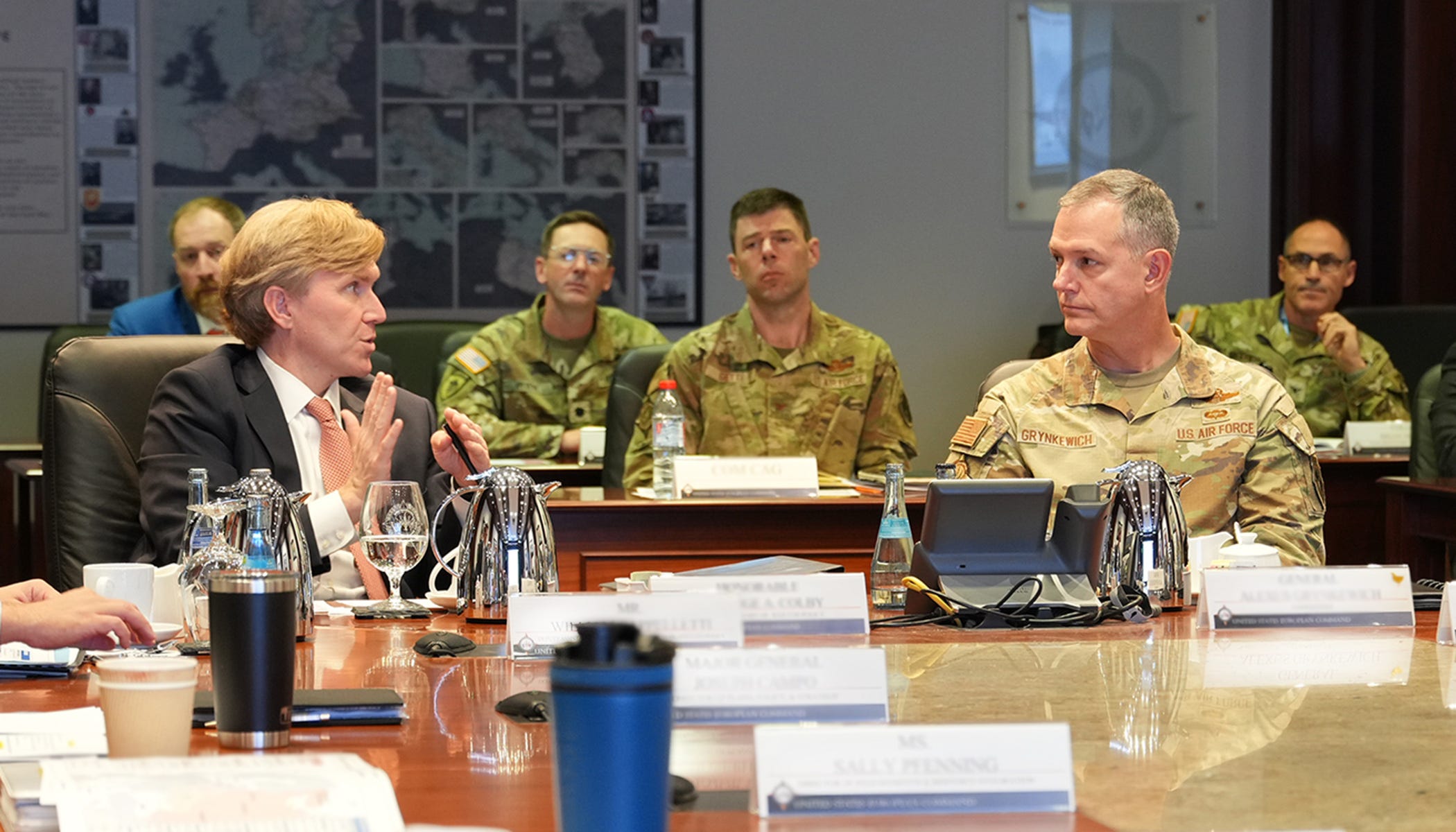
Photo credit: Elbridge Colby / X. Under Secretary of Defense for Policy Elbridge Colby (left) meets with U.S. military four-star flag officers in Stuttgart, Germany, on August 25th, including U.S. Air Force Gen. Alexus G. Grynkewich, the Commander of United States European Command and the NATO Supreme Allied Commander (right).
As Mark noted on TVP World today, Colby’s timing could not be worse given CIA Director John Ratcliffe’s trip to Moscow yesterday. Ratcliffe, as was reported this evening in the Wall Street Journal, made the abrupt visit to warn “Russia not to attack NATO countries.” CBS News later confirmed the report.
Yet, despite the urgency of that message, Colby was signaling to the Kremlin that if he gets his way, the U.S. is still operating full steam ahead to reduce its conventional military presence in Europe. It is not clear whether this was a ‘left hand, right hand’ situation wherein the Pentagon did not adequately coordinate with the White House and the CIA; however, the damage was – and is – being done.
The Trump Administration cannot on the one hand be saying to Putin: ‘Don’t!’ but on the other hand giving him reasons to believe that he should. U.S. nuclear deterrence in Europe is not enough. To be effective, it must also be paired with a robust U.S. conventional military force working in close partnership with its NATO allies.
In theory, not everything about Colby’s NATO 3.0 agenda is wrong. China is the pacing threat. Europe does need to be doing far more in terms of burden sharing. Ditto our Indo-Pacific allies in facing down Beijing.
However, his timing and timeline for implementing NATO 3.0 are wrong. Likewise, his ill-advised decoupling of Europe and the Indo-Pacific is strategically naïve.
Let’s get started understanding why.
***
NATO 3.0
Colby was not the first person to coin NATO 3.0. Others, including Anders Fogh Rasmussen, a former NATO Secretary General, Alexander Vershbow, a former U.S. diplomat and former NATO Deputy Secretary General, and Adm. James Stavridis, U.S. Navy (ret.), all used it to envision the future.
However, they defined it in opposite terms of Colby’s vision for NATO 3.0. They each saw it, in varying terms, as strengthening NATO, not prematurely diluting it as Colby is essentially advocating for as the Pentagon refocuses on China.
Briefly, for context, Colby, back in February, defined NATO 1.0 as a Cold War collective defense, wherein the U.S. partnered with Europe to conventionally deter the then Soviet Union while operating under the U.S. nuclear shield.
After the Cold War was over, he argued that “NATO transformed into something else. This version of the Alliance was typified by a shift of effort and focus away from Europe’s defense toward “out of area” operations and substantial disarmament on the Continent.
Colby argued – and he is not completely wrong – that as such, “NATO 2.0 is no longer fit for purpose.” Conventionally, he was right. The alliance – especially from a conventional weapons, munitions, and eye on future European conflicts – had become too hollowed out (in part because Europe was not spending enough on its own defense).
Strategically, however, Colby is trying to move too fast as is the Trump Administration when it comes to transitioning to NATO 3.0. By prematurely removing U.S. forces – as evidenced by the 5,000-troop drawdown plan in Germany – the Pentagon is only contributing to the further hollowing out of NATO.
***
NUCLEAR DECOUPLING
Colby, by advocating for a U.S. conventional force drawdown in Europe before European NATO allies are capable of replacing them, is – whether he grasps it or not – foolishly strategically decoupling NATO’s conventional forces from its nuclear deterrence. Doing so needlessly risks making nukes a first line of defense, not a last.
Nor is Colby’s approach happening in a vacuum. As Celeste Wallander pointed out in Foreign Affairs, “If Washington signals an unwillingness to engage in conventional military action to defend Europe, Putin will conclude that Russia has escalation dominance on the continent and may climb the conventional rungs.”
If that happens, then as Wallander warns, future U.S. presidents could face “a stark choice: concede Russian gains or leap to the nuclear rung.”
Given the stakes, it is not hard to imagine that many presidents might choose the former lacking a conventional response, especially given the time it would take to deploy U.S.-based or even Indo-Pacific U.S. troops to Europe. Given the distance, future presidents absent a robust conventional deterrence in Europe could be presented with a fait accompli.
***
EXISTENTIAL DELAY
The U.S. military prides itself on being able to emplace a U.S. Army battalion anywhere in the world within 24-hours. Yet, one brigade in the event of a future Russian move on Europe would not be enough.
Impressive as its capabilities are, the U.S. Transportation Command (USTRANSCOM) would find itself overmatched in deploying sufficient U.S. forces – air and ground – to Europe in the event of a major ground war with Russia.
Handcuffing future presidents with this kind of delay would only play into Russia’s hand. Wars, as it is often said, are won based on logistics. If the U.S. denudes itself of its ground forces in Europe too quickly, future presidents likely could not get enough troops to the frontlines fast enough to make a difference.
The whole point of forward bases – including those in Germany, Poland, and Romania – is to shorten that timeline. Lose them, and any rapid deployment of U.S. forces to Europe becomes a logistical nightmare.
Yet, that is exactly what the Trump Administration is preparing to do. As the Wall Street Journal reported in May, “The Pentagon is substantially scaling back the forces it plans to send to Europe in a crisis, a fresh step by the Trump administration to shrink its military support for North Atlantic Treaty Organization allies.”
Doing so is madness. Losing Europe to Russia – and by extension the Axis of Evil, including China – would only increase pressure against U.S. forces defending the country’s national security interests and allies in the Indo-Pacific.
***
INTEROPERABILITY ATROPHY
Benjamin Franklin often gets the credit; however, in reality credit is due to Robert Burton who first warned in his 1621 book The Anatomy of Melancholy about being “penny wise and pound foolish.”
By continuing to scale back from NATO exercises in Europe, the Trump Administration is risking not only interoperability between U.S. forces and European forces, but is dangerously undermining their ability to fight effectively as one force.
It also is depriving U.S. forces from training – and learning from that training in real time – in environments and terrain that improve U.S. readiness and multi-domain capabilities. Ideally, you fight wars overseas, not inside the continental U.S.
As just one example, defending the Suwalki Gap – the narrow strategic strip of land that connects the Baltic States to Central Europe – is a lot easier if you are training in Europe near that terrain and training with fellow NATO countries, including Poland.
Absent that, then the Pentagon is risking interoperability atrophy. In our view, that is very dangerous and extremely pound foolish.
***
EUROPE IS A LAUNCHPAD FOR U.S. FORCES
U.S. military facilities in Ramstein, Rota, Morón, Aviano, Lakenheath, Souda Bay, Lajes, and Stuttgart are not single-use installations. They are also springboards for U.S. military operations in the Middle East and Africa.
Do that and Iran wins. So too does Russia and China in Africa.
As Daniel Kochis warned last year for the Hudson Institute, “reducing the U.S. force presence in Europe would weaken American interests” elsewhere. We would go one step further and argue they will endanger them as well.
***
A BETTER VISION FOR NATO 3.0
The need for NATO 3.0 is very real. But in envisioning it, it cannot decouple Russia from China or China from Russia.
As we have long argued, they are the same threat. NATO, in that regard, must evolve to take that combined threat into consideration.
That means NATO partnering with a like-kind military alliance in the Indo-Pacific to deter Moscow and Beijing on a global basis. Putin and Chinese President Xi Jinping are partnering, so why cannot Colby see the value of building on NATO to protect U.S. interests in the Indo-Pacific instead of weakening it?
Isn’t North Korea’s increasing involvement in Russia’s war in Ukraine dispositive enough? The threats the U.S. faces are global in nature. They are not region specific and therefore no pivot can be effective.
Standing down in one region simply increases the risk in another. Colby is right about U.S. scarcity when it comes to troops, weapons, munitions, and budgets. However, the answer isn’t getting by with less, it is scaling up to do more.
***
ICYMI #1
Earlier today, we both appeared on the Main Edition of TVP World’s World News Tonight to talk about why CIA Director John Ratcliffe abruptly traveled to Moscow on Tuesday to meet with his Russian counterpart. Mark also discussed the poor timing of Undersecretary of Defense for Policy Elbridge Colby’s visit to Germany to push his NATO 3.0 plan.
Jon was featured in the opening report on Ratcliffe that starts at the 00.40 second hashmark. Mark was interviewed in-depth beginning at the 22:15 hash.
The program is in English. You can watch Mark’s standalone interview here or you can watch the full news program here. Maciej Mikos was the host.
During his segment, Mark was asked about Trump’s intentions. In referring to the President’s comments to Glenn Beckthat Ratcliffe’s visit to Moscow was “none of the above,” Mark argued it was likely all of the above, including warning Russian President Vladimir Putin to not escalate the conflict by attacking NATO-member states.
***
ICYMI #2
In a special column for the Kyiv Post, we examined Ratcliffe’s visit to Moscow and took a deep dive into the why of it.
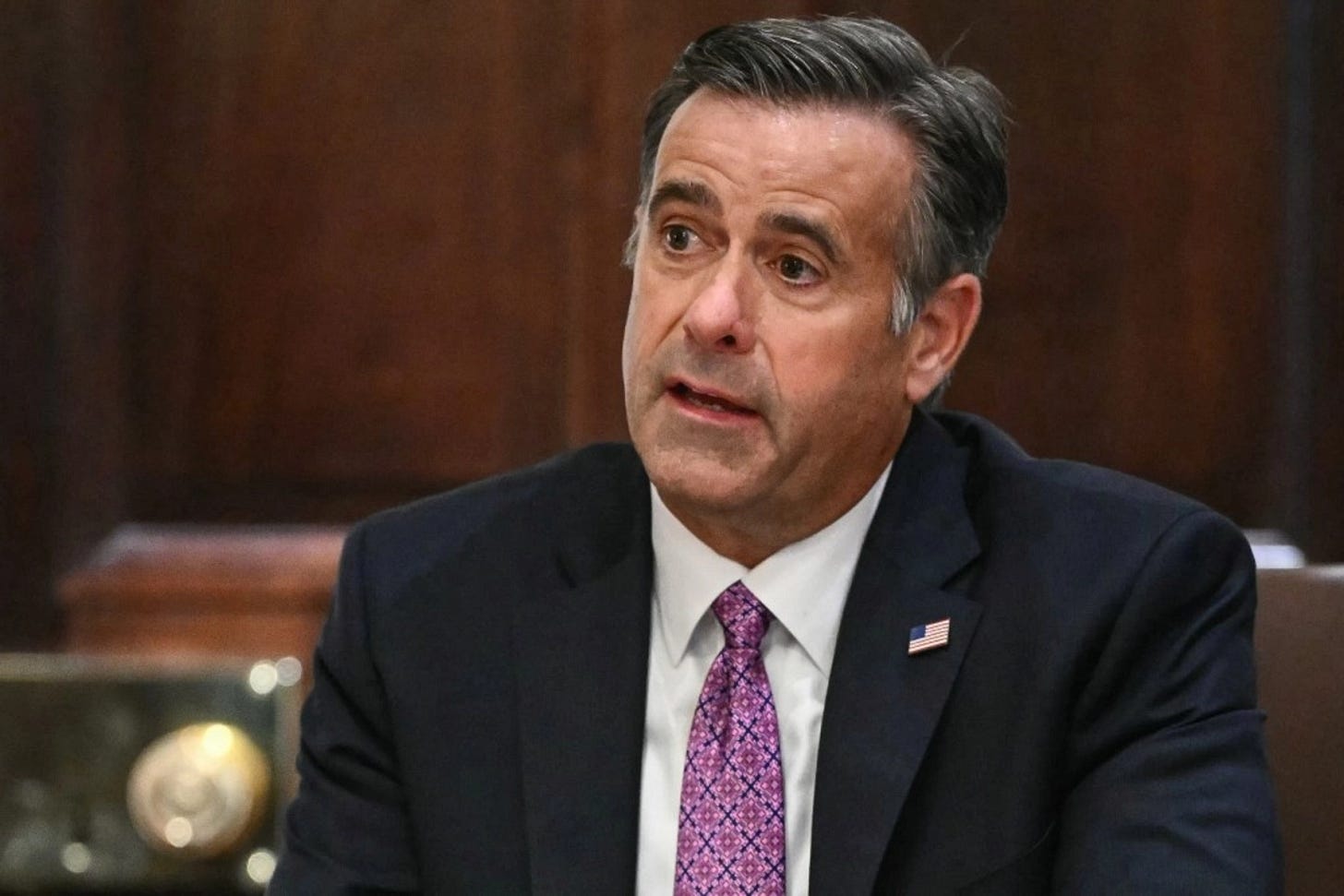
Photo credit: Mandel Ngan / AFP. CIA Director John Ratcliffe speaks during a cabinet meeting with US President Donald Trump in the Cabinet Room of the White House in Washington, D.C.
You can read it here.
***
ICYMI #3
Earlier today, Mark also appeared on Al Qahera News in Cairo, Egypt to discuss Trump’s latest claim that the Strait of Hormuz was completely clear of mines. He doubted that was the case, given how easily it is mined and the level of ongoing Iranian attacks against ships attempting to transit the strait.
Mark also pointed out that the U.S. is now capable of deploying sea drones to interdict Iranian mines so the lack of U.S. Navy sweepers operating in the Strait of Hormuz was not indicative of U.S. efforts to de-mine the strategic international waterway.
You can watch a clip here or you can watch the entire program here. Please note that the program is in Arabic.
***
ICYMI #4
Earlier in August, Mark was interviewed by Hadeel Oueis’s “American Window” program that is broadcast on Al-Janoub Al-Youm. The TV station is based in Riyadh, Saudi Arabia and focuses on covering Yemen.
Oueis has an interesting background. Originally from Syria, she was arrested for protesting against the former regime of Bashar al-Assad. She was able to leave the country and has since built a journalism career reporting from Washington, D.C.
Mark discussed the latest developments between the U.S. and Iran, including Tehran’s attempt to get the Houthis to blockade the Bab el-Mandeb Strait at the opening of the Red Sea leading to the Suez Canal.
Important note: The program incorrectly refers to Mark as a former U.S. National Security Council adviser. He never served in such a position. We only received copies of the program today and we will work to correct the network’s error.
You can watch a clip here or you can watch the full news magazine here. Please note that the program is in Arabic.
***
PROGRAMMING NOTE
Tomorrow, in our weekly Thursday 7 AM ET national security column at The Hill in Washington, D.C., we question whether or not President Trump is shifting back towards regime change in Iran, but by other means.
You can read it here when it goes live.
***
Thank you for reading. We will see you tomorrow. Please subscribe, comment & share. We truly appreciate it!
Jon & Mark
Follow Jon on X at @JESweet2022 or on Bluesky at @JonSweet.bsky.social. Follow Mark on X at @MCTothSTL or on Bluesky at @MarkToth.bsky.social.
No posts
Comments
Nothing yet. Say the first thing.
Sign in to join the conversation.