
Here’s your Tuesday Interruptrr, where you’ll find analysis, deep dives, book reviews, and guest columns. Today it’s a guest column by Mira Shah Gulati. Mira and I got into a conversation about the “cockroach movement” in India, which she just visited, recently. She sat down to write about it. She will be a freshman at Princeton University in the fall. She is an aspiring writer, lawyer, historian and an avid Law & Order SVU fan.
A reminder that I’m away this week, so no Friday roundup this week. The roundup will be back on August 7.
Thanks to everyone who subscribes and supports this newsletter. It’s $8 per month or $80 or $150 per year, with different offerings, including writing office hours and access to expert conversations. The next office hour is on Monday, August 17 at 12pm ET. —Elmira

Cockroaches are notoriously hard to kill. With access to water, they can survive for up to a month without food. Crushing them is unlikely to do anything because they can withstand over 900 times their body weight. With its penchant for resistance, the insect seems like a good name for a protest. That is what one movement in India has called itself. And now, they are launching one of the biggest challenges that Narendra Modi’s government has faced in its 12 years in power.
I recently traveled to India with my family—to Delhi, Bengaluru, and Mumbai, some of the biggest cities in the country, and hotbeds for the recent protests. But when I was there, I didn’t hear a word about the demonstrators. I didn’t see any headlines on television, or hear about it in nearby conversations. In fact, the only time I did hear about it was when I got back to the US and my Instagram reels page was flooded with videos of students on the streets of the cities I had just been to. Here’s why you should hear about them too.
Founded in late May, the Cockroach Janta Party is a spontaneous protest against Prime Minister Narendra Modi and his ruling Bharatiya Janata Party (BJP). The youth-led movement is demanding accountability and reform after years of what they see as corruption and bad governance.
The spark was a hearing in late May about fraudulent law degrees—people practicing law with unverified degrees. During the proceedings, Indian Supreme Court Chief Justice Surya Kant described these individuals, largely young people, as parasites attacking Indian society: “There are youngsters like cockroaches, who don’t get any employment or have any place in the profession. Some of them become media, some of them become social media, RTI activists and other activists, and they start attacking everyone.”
Abhijeet Dipke, a 30-year old based in Boston, joked about Kant’s comment on X, writing, “What if all cockroaches come together?”
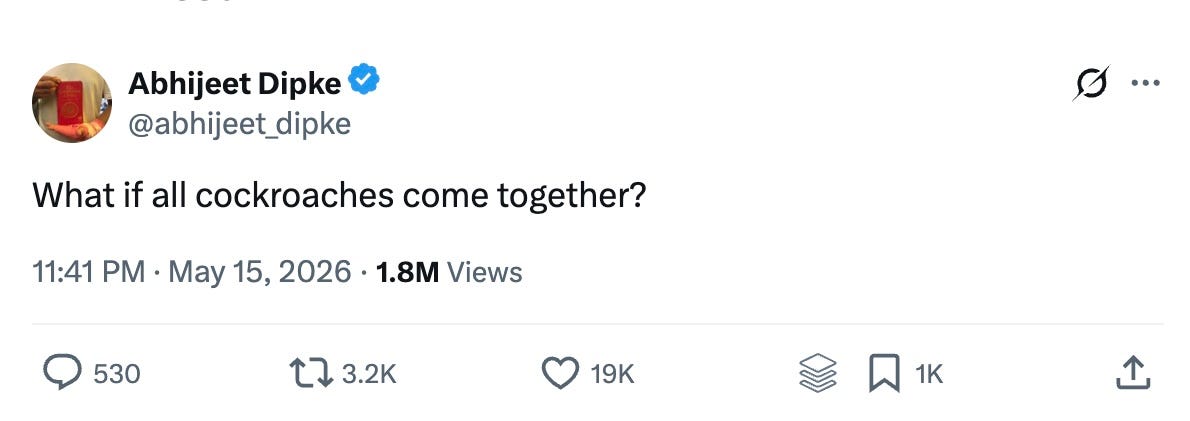
At the time, Dipke had just received a Master’s degree in public relations and was applying for jobs. Little did he know that a post on social media would send him on a plane back to India.
The comment hit a collective nerve. Thousands responded, sharing their outrage and anger at the failure to stamp out corruption, create opportunity, and improve lives. Fueled by the support, Dipke started the “Cockroach Janta Party,” complete with its own website, and manifesto. The requirements to join the party? You must be “unemployed, lazy, chronically online, and be able to rant professionally.”
But what started as a joke has grown into an unexpected platform for India’s youth. Since its inception in May, the CJP boasts over 1 million members. Its Instagram account has even more, at 24 million followers. This is almost three times that of the BJP, which often touts itself as the largest political party in the world. Where did this support come from?
India is home to the largest youth population in the world, with UNICEF reporting that the country has 371 million young people between the ages of 15 and 29. Many members of this group spend formative years studying for high-stakes examinations, which is the only way to gain entry in fields like medicine, engineering, civil services, public banks, railways, and other government-run institutions—stable and well-paying jobs in a country where the youth unemployment rate is about 17 percent and roughly 67 percent of unemployed youth hold higher education degrees.
Comments
Nothing yet. Say the first thing.
Sign in to join the conversation.