
Since I’m on an excellent European adventure, I hadn’t planned to write anything for today. But following the events in Ceuta, a Spanish territory in North Africa last week, I’m compelled to understand not so much what happened, but what has followed, within and for the European Union—and Ukraine. But let’s start with what happened.
Last Thursday, July 30, over 50,000 people overran Ceuta, a Spanish territory in North Africa. Ceuta’s population stands at around 85,000. Spain has overseen Ceuta and another sliver of territory, Melilla, that sit atop of what is today Morocco since the 16th century. Priyanka Shankar has an explainer on the Spanish enclaves, which Morocco does not recognize.
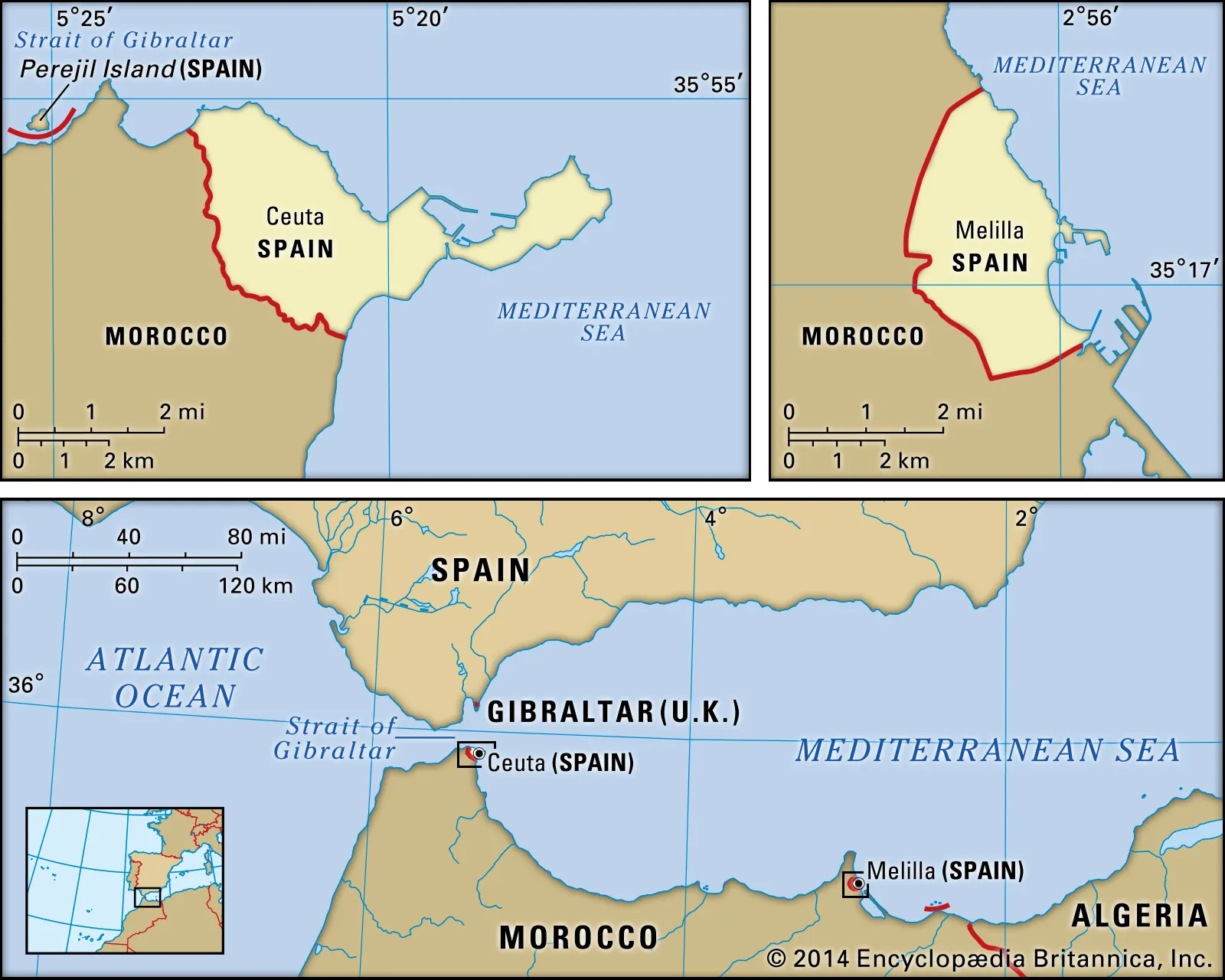
While Morocco doesn’t recognize Spain’s sovereignty of Ceuta and Melilla, it has worked with Spain to guard the territory. Yet one theory holds that following a recent trip, on July 20, that Spain’s prime minister, Pedro Sánchez, made to Algeria—Morocco’s neighbor and bitter enemy, Morocco, an otherwise heavy-handed monarchy, looked the other way when tens of thousands headed to Ceuta. Sánchez agreed to continue to import natural gas from Algeria and improve economic ties. They scheduled a bilateral summit for October in Madrid.
There is no evidence that the Moroccan government deliberately prompted the onslaught, which came following TikTok posts that pointed to a July 8 Spanish court decision that ruled that migrants arriving by sea could not be “summarily deported.” Instead, both the Spanish government and Moroccan authorities pointed to “criminal gangs.” On Monday, August 3, however, media reports that a Moroccan official said that it warned Spanish authorities that this decision would cause a problem. Spain, for its part, was dealing with massive wildfires that ripped through the country.
And while Spain and Morocco point fingers, Spain’s fellow EU countries have stuck a thumb in Sánchez’s eye—and likely their own. Rather than rushing to assist the Spanish government in mitigating the crisis, a number of European leaders freaked out. Italy’s Giorgia Meloni and Denmark’s Mette Frederiksen, leaders on the opposite ends of the political spectrum, called for Spain to be dropped from the collective European Schengen area. (So much for women being more compassionate leaders.) Finland’s interior minister echoed that. (There is no straightforward legal procedure for expelling an EU member from Schengen.)
Predictably, members of the far-right from France and Germany, along with those in the UK and the US, claimed that the migrants in Ceuta posed a danger to Europe. Except, Ceuta is not in Europe. Anyone who made it to Ceuta would still have to somehow make it to and clear immigration in Europe. What these reactions have posed for Europe is the danger of weaponizing migration. Over at the European Council on Foreign Relations, Carla Hobbs notes that “by failing to show solidarity with a member state under pressure, the EU is encouraging Morocco and others to keep using migration as a tool of coercion.”
As I noted a few weeks ago, many European leaders have been uneasy with Pedro Sánchez’s foreign policy, which has refused to cave into Trump’s demands to spend more on defense and has called out Israel’s actions in Gaza as genocide. They have blamed the crisis in Ceuta on his government’s lax immigration policies, which recently allowed over a million people to apply for work permits and residency for a year. Back in February, Sánchez outlined in the New York Times how welcoming immigration fueled economic growth. This past June, Pope Leo visited Spain largely in a show of support for Sánchez’s humanitarian approach to migration.
On August 1, Sánchez wrote a scathing letter to Ursula von der Leyen about the attacks on Spain and calls for its exclusion from the Schengen area. He writes:
Such an attitude—driven by prejudice, fake news, ignorance, or political interests—is not only contrary to European law, humanitarian law, and the principles of solidarity that unite us. It is also contrary to Europe’s long-term interests and the most basic common sense, because Ceuta is not part of the Schengen Area, because almost no irregular migrants remain unreturned, and because Spain, according to Frontex, has one of the least porous external borders in the European Union, with a number of irregular entries that is half that recorded, for example, in Italy in recent years (2021-2026).
Von der Leyen has since been working to smooth things over, as Politico points out.
But if you’re sitting in Rabat—or Ankara or, even, Moscow—you are relishing this moment that has shown how it takes very little to throw the EU into crisis. Europe’s fear of migration is stronger than its instinct for solidarity.
That’s something Turkish President Recep Tayyip Erdoğan already knew. Since the migration crisis of 2015, Europe has funnelled billions to Ankara to keep migrants and refugees out of Europe. Now, with the US distancing itself from NATO and its commitment to European security, Erdoğan has only grown in importance to Brussels. He is the man who holds the key to Europe’s borders and security. And that is something that probably makes Russian President Vladimir Putin smile.
Since Putin launched a war on Ukraine in February 2022, Europe has been broadly united against him and Russia and in its support of and for Ukraine. (Hungary’s former prime minister, Viktor Orbán was an exception). Ceuta has revealed that that support does not extend beyond Ukraine. A Europe pointing fingers at one another over migration is a Europe in disarray. Putin does not necessarily have to break the EU’s support for Ukraine directly. He can inflame the other issues that divide European societies and wait.
There are signs that’s exactly what Moscow did. According to Ukraine’s foreign minister, analysts identified more than 1,500 publications about Ceuta circulating through pro-Russian networks, including about 300 in Spanish. According to The Guardian, representatives of EU member states discussed the risk that Russian disinformation could exploit the Ceuta crisis to heighten tensions across the bloc. None of this proves that Russia is behind the false rumors that sent tens of thousands of people toward Ceuta. It does suggest that, once the crisis was underway, pro-Russian networks recognized an opening and moved in. That alone shows how easy it is to sow panic across the continent.
Spain reports that a majority of the migrants that poured into Ceuta last week have returned to Morocco. There are about 2000 people unaccounted for, along with about 72 who died. Malaika Kanaaheh Tapper has a heartwrenching story in the FT about a number of the people that tried to cross into Ceuta. It includes the story of 23-year-old Hamza who has tried to leave Morocco eight times, “driven by the hope of finding better paid work than the £400 a month he earned as an aluminium worker supporting his four siblings and widowed mother” and of 16-year-0ld Abdulaal who sold his sneakers to make it to Ceuta.
Both are people searching for a better life. Instead of trying to figure out how to give them, along with the tens of thousands of others who tried to cross into Ceuta, exactly that, Europe is focused on “protecting” its borders. Border protection is not an unreasonable endeavor. All countries need to have security and a sensible immigration system. But protection cannot come from guns, gates, and authoritarian guarantees alone. It requires standing against fear. Europe has done that in standing up to Putin, but not elsewhere. —Elmira
Thanks to everyone who subscribes and supports this newsletter. It’s $8 per month or $80 or $150 per year, with different offerings, including writing office hours and access to expert conversations. The next office hour is on Monday, August 17 at 12pm ET.
Comments
Nothing yet. Say the first thing.
Sign in to join the conversation.