
Happy birthday Steve and Jessica!
Congrats to Lourdes Martin, winner of last week’s Interruptrr book giveaway. She’ll get a copy of Sally Hayden’s, This is Also a Love Story: A Reporter’s Search for Goodness in a Cruel World. I started reading it and it’s compelling.
No newsletter next Friday, July 31. I’m on vay-cay next week. 😎
Thanks to everyone who subscribes and supports this newsletter. It’s $8 per month or $80 or $150 per year, with different offerings, including writing office hours and access to expert conversations. Also, I link to gift articles you’d otherwise have to pay for! —Elmira

On that Feminist Foreign Policy Ministerial I attended in Spain in June, Spogmay Ahmed reflects on how the movement is evolving beyond women’s representation towards challenging how power is exercised. (PassBlue)
Four US service members died this week, one in Iraq and three in Jordan. The corresponding numbers for Iranian personnel are unclear. Military Spend estimates that about 3700 Iranian civilians have died.
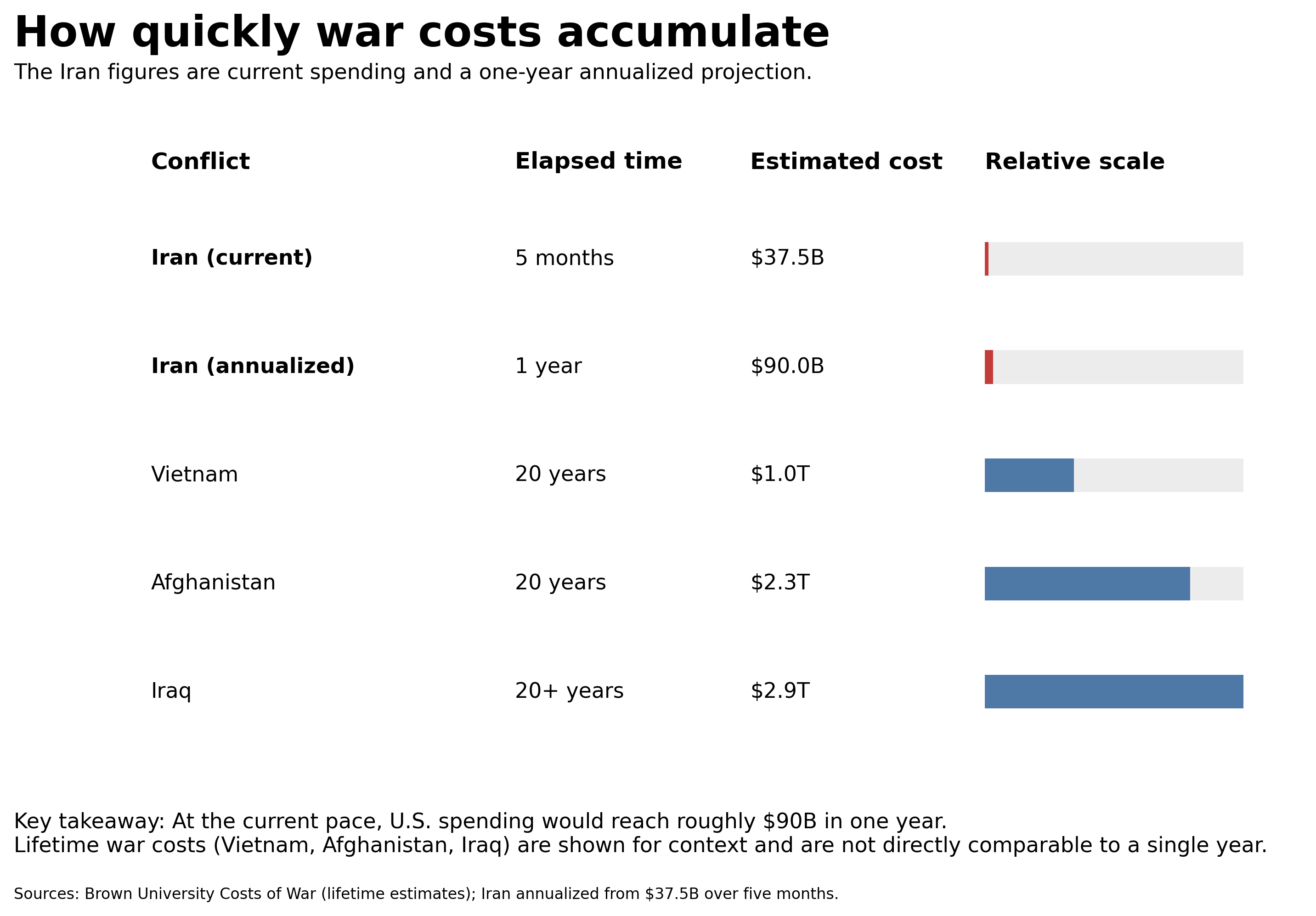
Trump definitely does not want any more casualties leading up to the midterm elections. But he’s also bent on “hitting” Iran hard, because he’s a thug and that’s what thugs do when they don’t think things through. That lack of thinking has already cost the US $37.5 billion, which is probably an under count. We don’t know the extent of damage to US bases in the Middle East, because the Trump administration won’t disclose information, citing operational security—it doesn’t want the Iranians to be able to track US actions, which if you ask me is a deliberate dodge. They just don’t want bad press.
I was curious about how much this war compares with others, so I ran the numbers through AI. It used a number of sources, including Brown University’s Costs of War.
One of the justifications Trump has cited for the war on Iran is preventing the country from having nuclear capabilities. This week, he approved a 30-year agreement to help Saudi Arabia (KSA) to develop a nuclear program. KSA claims it does not want nuclear weapons—unless Iran develops them—but to have an alternative energy source domestically, so that it can export more oil. Yeah, sure.
Its nemesis the United Arab Emirates (UAE) has a civilian nuclear program, which the US helped set up in 2009 (when Obama was president). That agreement required the UAE to sign the Nuclear Non-Proliferation Treaty (NPT) and allow the International Atomic Energy Agency (IAEA) to monitor the program. Trump’s deal does not require either from KSA, which has many concerned that this will lead to proliferation. Felicia Schwartz, Giselle Ruhiyyih Ewing, and Jerry Wu have that story, pointing out that this may tempt others in the region to seek out Russia and China for nuclear technology. (Politico)
Al Jazeera has a helpful explainer on who in the Middle East has nuclear weapons, namely Israel and Pakistan, and those who want it, Egypt and Turkey. (Al Jazeera)
Also, a reminder that the US laid the foundations for Iran’s nuclear program when Eisenhower brought the country, then under the Shah’s rule, into the Atoms for Peace program. In 1967, the US supplied Iran with a 5 mega watt nuclear reactor. (Brookings - from 2013)
In a last-minute twist, Trump posted on social media that the US-KSA deal is contingent upon Saudi Arabia normalizing relations with Israel. Employing my usual caveat that anything is possible, I’ll go out on a limb and say this deal is off. Saudi Arabia will not make nice with Israel, after its genocidal operation in Gaza, at this moment. Is there a Kalshi bet on this?
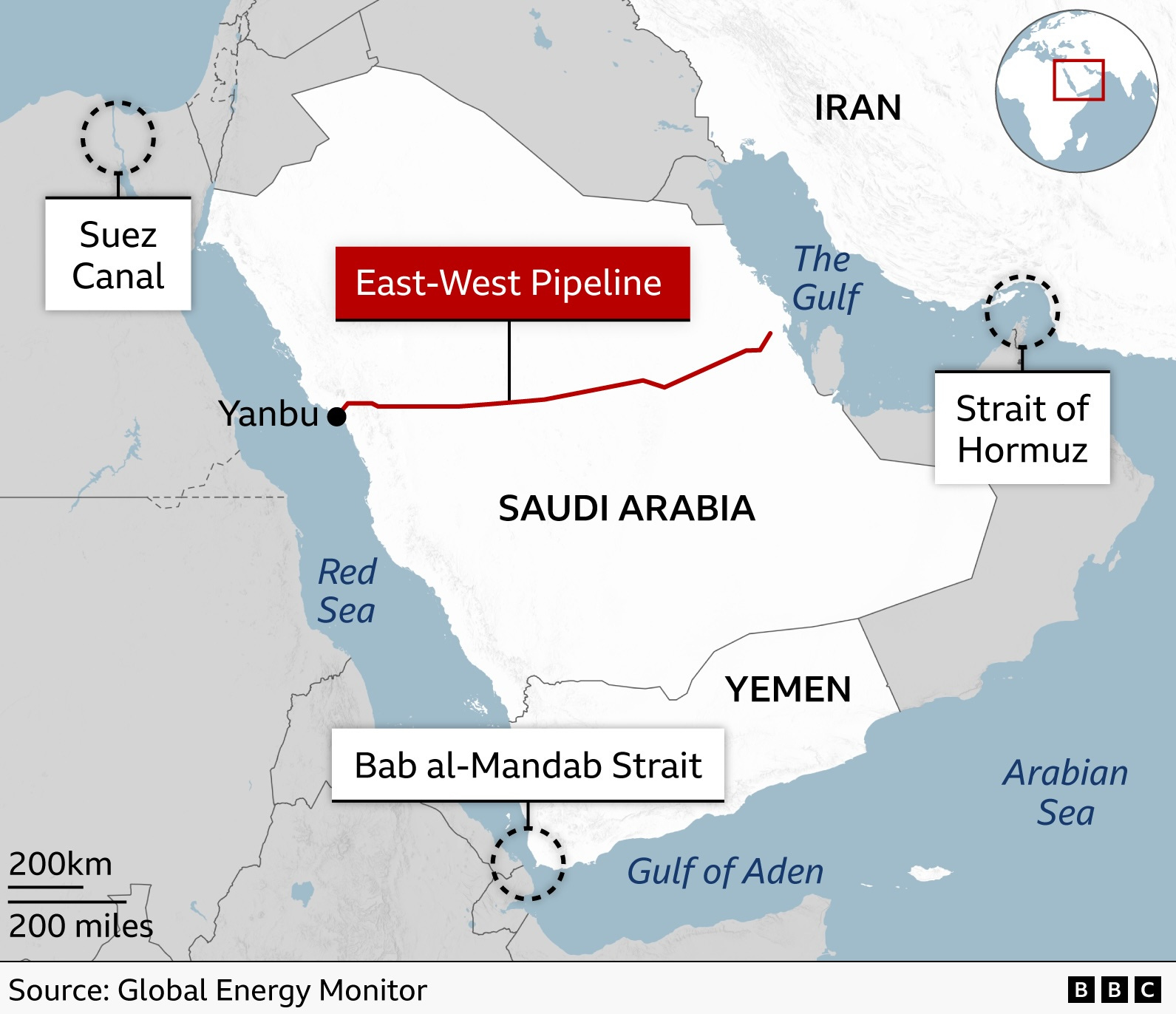
Meanwhile, back to the US-Iran war… while the Trump administration continues its scramble to reopen the Strait of Hormuz, the Iranian backed Houthis, a rebel group in Yemen, have moved to blockade the Red Sea, Saudi Arabia’s western outlet. They hit two Saudi oil tankers this week. That has caused oil prices to spike again and has many worried about the global economy. Rosemary Kelanic says that “there are no good military options for neutralizing the Houthi threat to shipping, just like there is little the US can do to deny Iran the capabilities to attack the Persian Gulf.” She notes that the US spent $7 billion in 2025 bombing the Houthis, without any results. (Responsible Statecraft)
The Houthis have remained on the sidelines of the US-Israel war on Iran, which I noted back in March, largely, as Fatima Abo Alasrar pointed out, as Arabs, the Houthis didn’t want to appear going against fellow Arabs.
But, as Annelle Sheline notes, that calculation changed when Iran sent a plane to carry a delegation of Houthis to Tehran for Ayatollah Ali Khamenei’s funeral in early July. That, she says, sparked Saudi fears that Yemen’s Houthis and Iran would strengthen ties again. Hence, when the plane returned to Yemen, Saudi Arabia bombed the runway in Sanaa, Yemen’s capital. She notes that neither the Houthis or Saudi Arabia wants to escalate into full-blown war, but the Houthis do want the Saudis to go back to a UN brokered agreement from December 2023, that enables free movement and oil and gas exports. (Foreign Policy) 🎁🔗
Lebanon’s president, Joseph Aoun, called on Trump at the White House this week. It is the first visit by a Lebanese president since 2009 and he was there for two reasons: 1) get the US to invest in an economically damaged Lebanon and 2) get the US to force Israel to withdraw from the south of the country. Israel insists that it will withdraw from Lebanon, once the Lebanese government disarms the militant Shia group, Hezbollah. So, it was no coincidence that Lebanon carried out missions to do just that just before Aoun’s White House visit, notes Samar El Kadi. (This is Beirut)
While Trump was happy to receive Aoun, he didn’t commit to forcing Israel to withdraw from the country. Instead, he said that the US would restart direct flights to Beirut, which have been suspended since 1985, after Hezbollah hijacked a TWA flight.
It’s important that Washington treat Lebanon with the same urgency as it does Iran and not as a separate issue, writes Janet Abou-Elias. She notes that the US unwillingness to use its leverage over Israel has weakened its own strategy, if one can call it that. (Inkstick)
Things are starting to unravel for Ukrainian President Volodymyr Zelensky. And it’s not just because he met with Laura Loomer, who visited the country and now has “moral clarity” on Ukraine. (AP)
Earlier this year, his chief of staff, Andriy Yermak resigned following corruption allegations. Last week, he reshuffled his cabinet, ousting his prime minister and the young and as we now know his popular defense minister, Mykhailo Fedorov. As noted last week, Fedorov is credited for bringing tech savvy to Ukraine’s military, upping its drone capabilities, which have been a key reason for the gains the country has made over the summer against Moscow. That’s largely why the people were angry at his dismissal. Ukrainians poured out onto the street, demanding that he be reinstated and that General Oleksandr Syrskyi, who at 60 didn’t get along with the 35-year-old Fedorov, go. He did replace Syrskyi with 43-year old Mykhailo Drapatyi, a Fedorov ally.
On one level, this is a clash between the young and old guard. But it also demonstrates that while Zelensky is an effective communicator and social media personality, he lacks political chops—and, perhaps, as Jaroslava Barbieri implies, self-confidence. She says that Zelensky is eager to hold onto power at a time when Ukrainians are looking at possible successors to take his place. A May 2026 poll indicates that 67 percent of Ukrainians expect Zelensky to be replaced once the war ends. (Chatham House)
Andy Burnham moved into 10 Downing on Monday. As previously noted, he’s the 7th prime minister in 10 years. Nadine Dorries believes he’ll be out by May because he has “neither a plan or a team with the required national political skills and knowledge.” Ouch. (The Daily Mail)
Maybe that’s because rather than thinking about what’s good for the country, he’s allowed himself to become wrapped up in what appears to be internal Labour Party politics. Rosa Prince has this fascinating look at Louise Haigh, who encouraged and then helped Burnham take over party leadership. She has become Burnham’s deputy prime minister, and hatchet woman, weeding out Starmer loyalists from the halls of power. (Bloomberg) 🎁🔗
These people sound as lost as the Democrats in the US.
On Monday, the State Department published a 100-page report entitled, “Cuba: The Capital of 21st Century Communism.” It claims that the island nation is a major espionage and ideological threat to the US, supporting spy networks, American activists and left-wing groups who aim to “turn America against itself.” They include the deceased George Floyd, NYC Mayor Zohran Mamdani, and Hasan Piker. That’s pretty impressive since the Cuban government can’t seem to keep the lights on or anything functioning in the country. Maya Young on how this factors into Marco Rubio’s larger “maximum pressure” campaign on Cuba. (Guardian)
The tariffs Trump slapped onto many countries back in February after the US Supreme Court threw out his “liberation day” tariffs expire today, July 24. And he’s not giving up on them. Trump has threatened to levy 50 percent tariffs on a number of Canadian products, including hockey sticks and beer. Madeline Chalecki explains that he might not be able to do that—since his excuse is that Canada’s unfair practices come as a result of Trump’s own actions. (Atlantic Council)
Trump also threatened to tariff generic drug makers up to 200 percent, which as Else Ohlen notes, will result in higher prices. (CNBC)
Ebola deaths have surpassed 1000.
Oh, and if you think it’s not enough that we’re mired in Iran and looking at Cuba, Sebastian Gorka, the National Security Council’s senior director for counterterrorism, is pushing for Trump to bomb Mali, where Islamic extremists connected to Al Qaeda have launched an insurgency and destabilized the country. The Washington Post broke the story, but I’m linking to Ellie Quinlan Houghtaling. (The New Republic)
In India, something called the “cockroach” movement has gained steam. Born this past May, after India’s Chief Justice Surya Kant called unemployed youth “cockroaches.” Abhijeet Dipke, a Gen Z communications strategist, took that and began an online satirical campaign called the Cockroach Janta Party (CJP), a riff on Narendra Modi’s Hindu nationalist BJP, Bharatiya Janata Party. Its platform called for an end to corruption, education reform, and youth job creation. Over the past week, tens of thousands backing CJP’s platform poured out onto the streets after police removed Sonam Wangchuk, who had been on a hunger strike. They were not only calling for India’s education minister to resign (over state-administered exams), but also for Modi to step down as prime minister. Surbhi Gupta sheds more light on what’s been happening. (New Lines)
Interruptrr will have a deep dive on this on Tuesday.
In Venezuela, the Trump administration has collected more than $13 billion in oil sales, but has not revealed what it has done with the money, write Ana Rodríguez Brazón, Geoff Dyer, and Chris Cook. (FT) 🎁🔗
In Nicaragua, 80-year-old Daniel Ortega, the country’s president since 2007 announced that there would be no new elections. That shouldn’t come as a surprise, since elections in the country have been a sham for several years, giving Ortega a sense of impunity, says Gema Kloppe-Santamaría. That is a result of Washington’s failed policies towards the country, which include weakening opposition groups through aid freezes and the failure to dismantle the financial networks sustaining the dictatorship. (Americas Quarterly)
Not sure if this is a fun fact: There are 31 leaders worldwide who are over 75 years old.
Hamas elected Khalil al-Hayya as its new political leader, replacing Yahya Sinwar who was killed in October 2024. (Arab Weekly)
In Turkey, a Turkish court forced the head of the main opposition party, the People’s Republican Party (CHP), Özgür Özel, to step down in May. He has now formed a new party, called the New Party, Yenı Partisi.
France became the first EU country to ban social media for children under 15. Aisha Malek has a list of other countries who have or want to do the same. (Techcrunch)
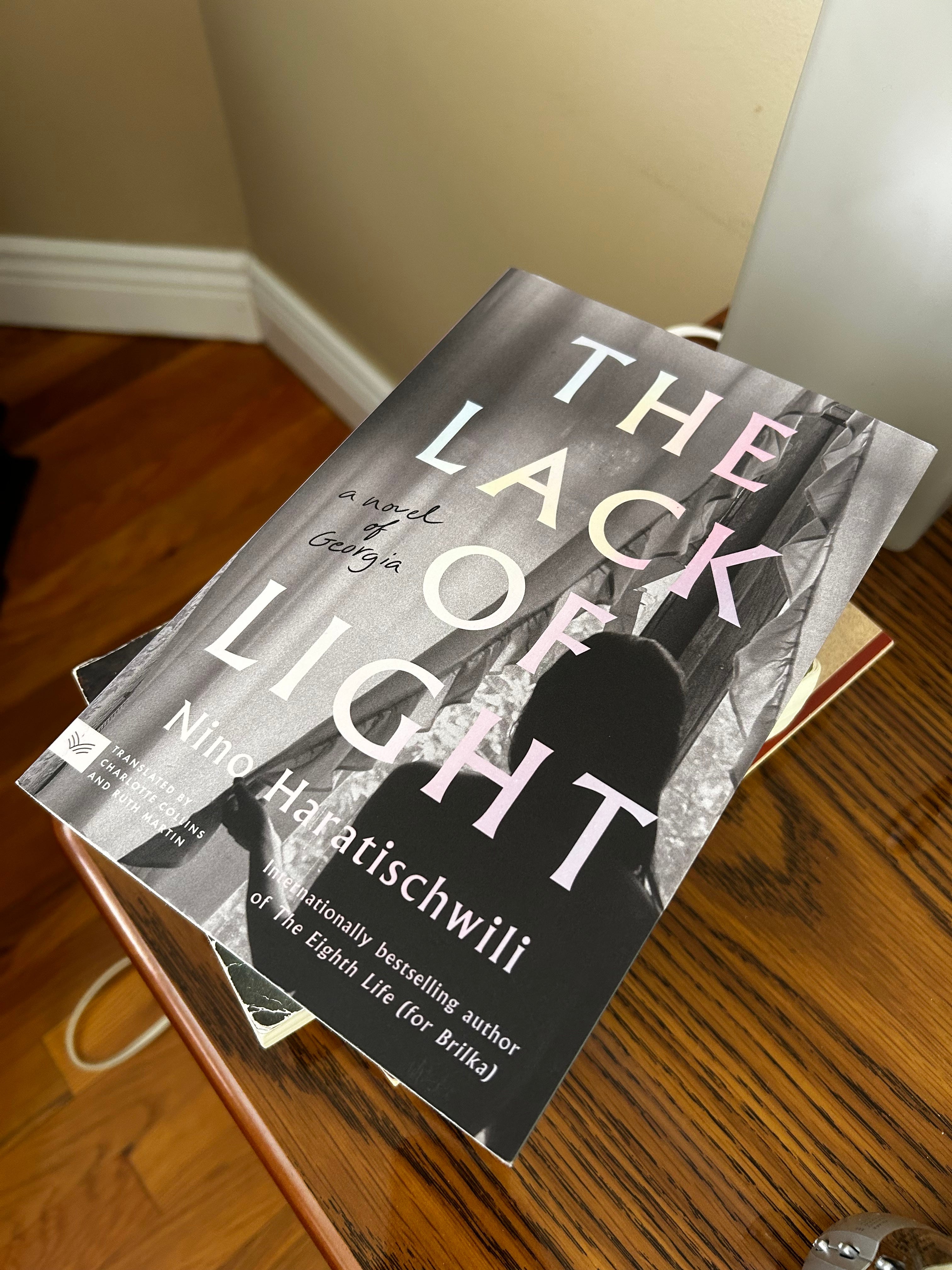
Yes, I read fiction too. I actually inhaled Yesteryear, and am thinking about putting together an online book discussion for that. Meanwhile, I picked up The Lack of Light, per Natalia Kopytnik’s book review, which inspired my dear friend Robin to pick up and recommended. It’s Elena Ferrante My Brilliant Friend-esque. Let me know what you’re reading this summer and I’ll include it here.
Would love to know what you think, or what I got wrong or left out— here’s my email.
The Wilson Center is taking applications for the 2027-2028 Research Fellowship.
Comments
Nothing yet. Say the first thing.
Sign in to join the conversation.