
Question 14 invites comment on, quoting the notice, “a presumption in favor of individual autonomy, informed consent, and religious freedom.”
For so many years, the position was that there was nothing to discuss. Informed consent was a settled matter, the recommendations were the recommendations, and anyone who wanted to talk about the difference between a recommendation and a requirement was told they had misunderstood something & was an “anti-vaxxcer”.
On Friday the Department of Health and Human Services opened a docket asking the public to discuss the issue of informed consent.
Docket No. HHS–OS–2026–0332, was filed yesterday on Friday August 21, publishing August 24, signed by the Secretary. Comments close SEPTEMBER 20, 2026. It is a Request for Information on the categories used in federal vaccine recommendations, and question 14 invites comment on, quoting the notice, “a presumption in favor of individual autonomy, informed consent, and religious freedom.”
This is a very big question and its wise of government to ask the people directly affected by the policy for a change.
Has anyone EVER seen this wise question asked by government yet? Let’s answer!
You can call this a conversion or you can call it what it more likely is, which is that government intentionally playing dumb has a shelf life and this one expired. Either way the docket is real, the deadline is real, and for thirty days the government has to accept whatever you put in it as your opinion they claim to want.
Federal vaccine recommendations sort into three categories. A routine recommendation means the default is to vaccinate everyone in the age group absent a contraindication. A risk-based recommendation is aimed at people with particular medical or occupational risk factors. The third is shared clinical decision-making, and the CDC’s own guidance says that for that category, unlike the other two, “there is no default.”
ACIP created that third bucket in 2019 to replace an older scheme of Category A and Category B recommendations, where B meant permissive. It applies it through the Evidence to Recommendations framework adopted in 2018, which contemplates exactly three outcomes — recommend for everyone in a group, recommend on the basis of shared clinical decision-making, or recommend nothing — and which grades the underlying evidence using GRADE.
The RFI asks whether that structure still works. Whether the categories should be renamed. Whether new ones should exist. Whether the middle one should survive at all.
There are eighteen questions. Three of them are load-bearing.
“Do the current categories unintentionally imply that parental permission, individual consent, or meaningful clinical discussion applies only to shared clinical decision-making recommendations? Should the framework expressly distinguish the strength of a Federal recommendation from the consent, parental-permission, and assent processes involved in administering a vaccine?”
The word doing the work in that sentence is only.
The Department is asking whether its own architecture has been communicating to clinicians and to parents that the conversation — the actual informed-consent conversation — is a feature of the optional tier. That if a vaccine is routine, there is nothing to discuss, because the discussion is what the other category is for.
That is not a fringe reading of the schedule. It is the reading the Secretary of Health and Human Services just put in the Federal Register under his own signature, phrased as an open question.
There is reason to think it is also the correct reading. In a 2018 national survey of pediatric primary care providers, only twenty-four percent could accurately define what a Category B recommendation was. A majority did not know that vaccines in that category were covered by private insurance or through the Vaccines for Children program. If the providers administering them could not describe the category, the parents consenting to them certainly could not.
The 2021 follow-up on shared clinical decision-making found the same thing wearing different clothes. Ninety to ninety-five percent of surveyed physicians said an SCDM recommendation takes more time than a routine one. Fewer than half knew SCDM vaccines were covered by insurance. Most said the category confuses patients. Electronic health record systems displayed the recommendations inaccurately or not at all.
A category nobody can define is not a safeguard. It is a filing convention.
“If new categories were adopted, what is needed to preserve access … and ensure predictable and consistent treatment under coverage requirements, program eligibility rules, the injury-compensation programs, and State law?”
The injury-compensation programs, named in an open federal docket, as a thing the public is invited to comment on.
Anyone who has spent years inside the Countermeasures Injury Compensation Program now has thirty days and a place to put it.
The HRSA figures as of July 1, 2026 are these. Of 14,146 COVID countermeasure injury claims filed, 6,562 remain undecided more than five years after the program began accepting them. Of the 7,584 that have been decided, sixty-two were compensated. The Vaccine Injury Compensation Program operating alongside it has paid roughly $5.5 billion to nearly 13,000 people, and unlike the CICP it provides a special master, a right of appeal, and compensation for pain and suffering.
The CICP provides none of those things. Which program you land in was decided by a category assignment made by people you never met, and question 6 is the government asking what should happen to that machinery if the categories change.
“…the appropriate approach where randomized controlled trial evidence is absent, infeasible, or unethical to obtain…”
Everything from 2021 forward (covid & mRNA shots) lives inside that clause.
The RFI does not pretend otherwise. It cites the 2021 Lancet review in which an international group of scientists, including two senior FDA vaccine officials, argued the evidence did not support boosting the general population and warned that deploying them anyway carried risks to vaccine confidence. It cites Offit’s 2023 New England Journal piece calling the all-ages bivalent booster recommendation, made on limited human data, “a cautionary tale.”
And it recounts September 2021, when ACIP voted against recommending boosters for adults eighteen to sixty-four on occupational grounds — members arguing the call belonged to individual benefit-risk judgment — and the CDC Director set the vote aside and extended the recommendation anyway.
The Department’s own assessment of that episode, in the notice, is that when “the deliberative advisory process reaches a narrower conclusion that is then overridden in favor of a broader, top-down recommendation,” it contributes to public doubt about whether federal recommendations reflect the process built to produce them.
That is the agency describing the absurdity of itself.
Not much, immediately, but we can’t make a difference at all ever unless we are heard on a real public record, so we may as well try to talk some sense into these people and agencies.
Section III of the notice is explicit. This “does not constitute a rule, a proposed rule, or a recommendation.” It alters no existing recommendation, no coverage requirement, no program obligation. The Department “will not respond individually to comments.”
The value is elsewhere, and it is durable.
Every comment is posted publicly and permanently, and together they become the administrative record underneath whatever HHS does next. Under the Administrative Procedure Act a court can set aside agency action as arbitrary and capricious where the agency failed to consider an important aspect of the problem — and what was in the record is how a court determines what the agency had in front of it. It sets up future litigation and that is always worthwhile!
A comment filed in September 2026 is a document a litigator can put in front of a judge in 2029. That is the entire point. You are not persuading the Secretary. You are creating evidence that the Department was reminded the law, our wishes and morality.
While one part of this government spends a week opening a thirty-day window to ask Americans about informed consent, another part of it is sitting on a question it has a regulatory obligation to answer.
Citizen Petition FDA-2025-P-1807 asks the FDA whether mRNA products meet the agency’s own published regulatory definition of gene therapy. 21 CFR 10.30 provides that the agency “shall furnish a response to each petitioner within 180 days of receipt of the petition.” The petition was filed June 17, 2025. The 180 days ran out in December.
It is August. There has been no answer, substantive or otherwise. Children’s Health Defense has been waiting on FDA-2025-P-6831 the same way. IoJ founder filed a mandamus currently underway because records and lawsuits matter to get stuff done.
HHS can stand up a public comment docket in seven days when it wants your opinion. The FDA cannot produce a yes or a no in fourteen months when a regulation orders it to. If that doesn’t make you angry you aren’t paying attention.

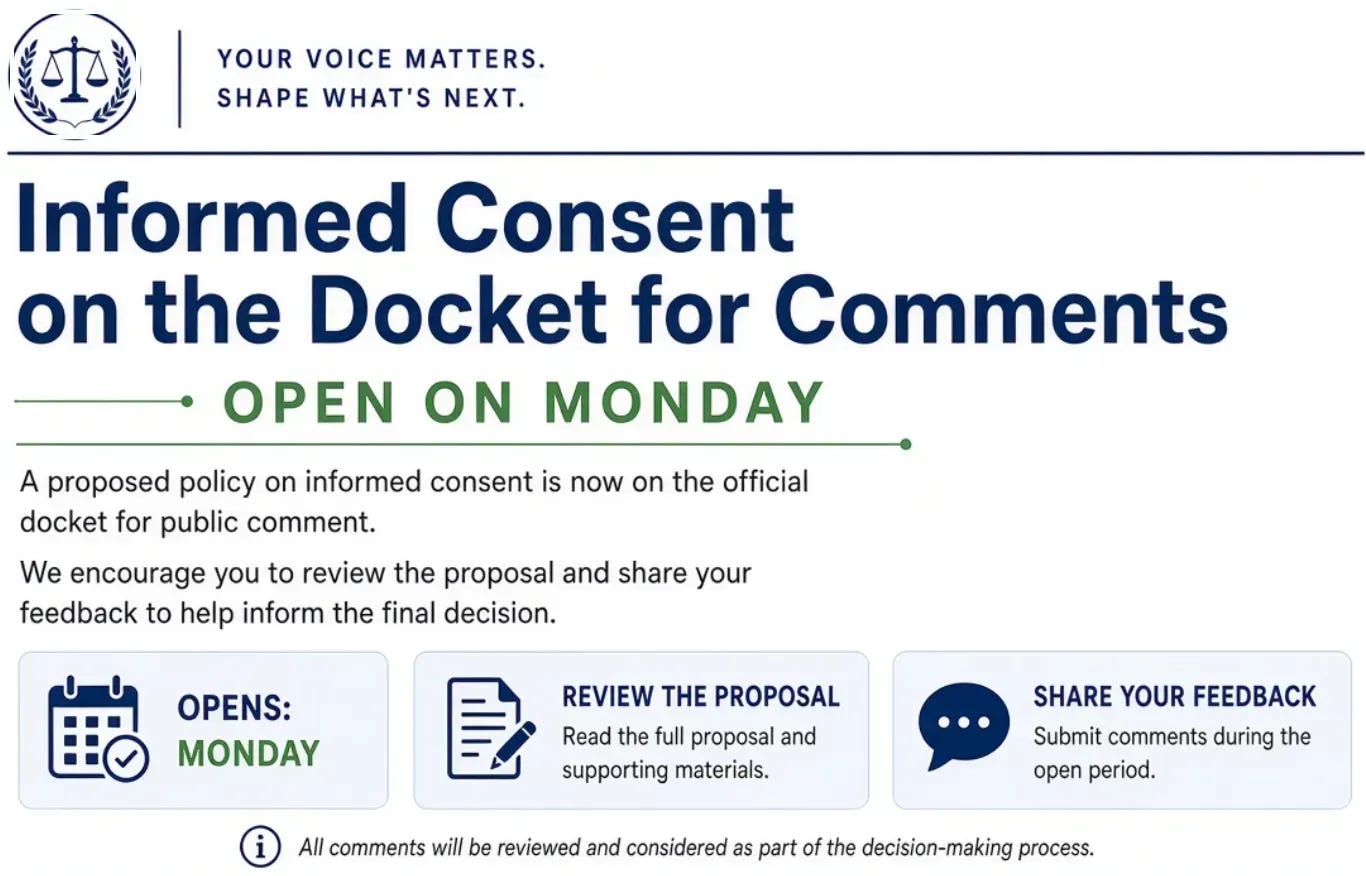
The notice was filed yesterday on August 21 but does not publish until Monday AUGUST 24 when the comment portal will go live with publication. If you go looking this weekend you may find nothing. That is not suppression, it is just how the Federal Register works.
What you need, ready for Monday.
Docket No. HHS–OS–2026–0332, RIN 0991-ZA62
Online at regulations.gov, searching that docket number
Or by mail to Cynthia Goss, 200 Independence Ave SW, Washington, DC 20201
Mailed comments must include the agency name and the docket number
Comments close SEPTEMBER 20, 2026
One caution worth taking seriously. The notice states that comments “will be posted without change … including any personal information provided.” Without change means without redaction. Whatever you submit is public under your name indefinitely, so you may want to tell your story without your address or your child’s full name.
Identical form letters get deduplicated and counted as one voice, so a paragraph in your own words is worth more than a thousand copies of someone else’s. Label which numbered question you are answering. Give dates. Attach a document if you have one — the notice explicitly encourages supporting data and citations.
Docket goes live MONDAY
IoJ will post comment ideas question by question so nobody has to start from a blank page, and on MONDAY, when the docket goes live, stay tuned here for the link and I will remind you.
Subscribe if you want this news & reminder to reach you.

Your paid subscriptions and generous donations help keep IoJ alive. If you think IoJ is doing a good job you can help support to ensure this non profit work is able to continue!
Related reading
Huge experimentation lawsuit filed
Part 2 of 7 — why the FDA will lose the mRNA question
The FDA won’t answer Children’s Health Defense either
Breaking — FDA issues gene therapy guidance
America wrote the Nuremberg Code
Comments
Nothing yet. Say the first thing.
Sign in to join the conversation.