
Six developments this month in vaccine accountability, with the primary documents. A 2021 email from Dr. Janet Woodcock. A contempt vote against Dr. Anthony Fauci. A federal court that set the FDA a deadline and got an answer in 63 days. Sixty-two people compensated out of 14,169 claims. And what each of them has to do with the the mandamus case Interest of Justice has in Washington: Eshleman vs Hegseth et al.
On May 27, 2021, the acting commissioner of the Food and Drug Administration wrote to the two most senior health officials in the federal government to report that patients were suffering unexplained injuries after COVID-19 vaccination, that the government’s surveillance systems were not capable of detecting them, and that no one was studying the problem.
The email was released to the public on Aug. 16, 2026, five years and three months after it was written.
What follows are six developments from the past several weeks, presented in order, with every underlying document linked. The final section explains what they have to do with a federal case filed in May.
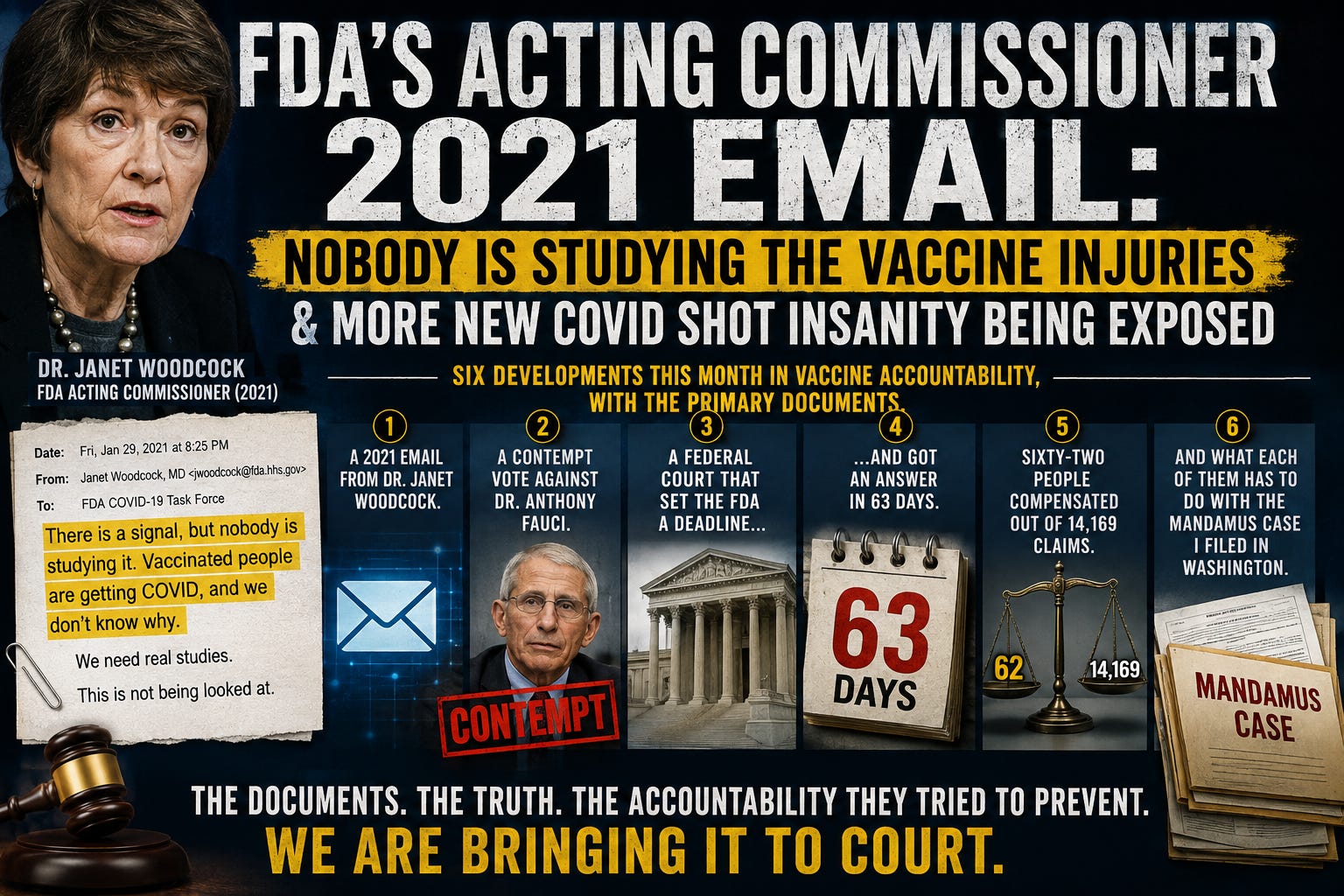
Sens. Ron Johnson (R-Wis.) and Rand Paul (R-Ky.) released the email on Aug. 16. It was obtained from Dr. Anthony Fauci’s government account and produced to the Senate by the Department of Health and Human Services. The document is available here.
Dr. Janet Woodcock, then acting FDA commissioner, wrote to Dr. Fauci and to Dr. Francis Collins, then director of the National Institutes of Health. She described reports reaching her directly from individuals, including what she called healthcare professionals, about adverse events following vaccination.
“The symptoms do not fit together into a distinctive syndrome and most are not easily quantifiable or evaluated with standard laboratory testing.”
“These problems are not the sort that a system like VAERS would be able to detect, or even a more sophisticated population-based active followup such as CDC has, or a medical record based system such as BEST.”
“I doubt the industry would support, for obvious reasons. But my experience is, that if you let a problem fester, then it will come back to bite you later and you are not prepared.”
— Dr. Janet Woodcock, May 27, 2021
In that second passage, the acting head of the FDA told the director of the NIH that the three systems the federal government relies on to detect vaccine injury would not identify what she was hearing about. Those systems are the Vaccine Adverse Event Reporting System, the CDC's active follow-up surveillance, and the FDA's own BEST program.
Dr. Woodcock did not write that the systems had failed to detect the problem yet. She wrote that they were not designed to detect it.
She proposed that a study be conducted. She wrote that industry would be unlikely to fund one “for obvious reasons.” She did not specify what those reasons were.
Dr. Fauci forwarded the email to Dr. Collins the following day. “Janet asks what we think of this?” he wrote. “We cannot ignore her. We should probably bring in CDC and see what Rochelle thinks,” a reference to Dr. Rochelle Walensky, then CDC director. According to the senators, the records reviewed to date do not indicate that Dr. Walensky was consulted.
By the end of May 2021, VAERS had received 440,025 reported adverse events worldwide and 8,650 reported deaths. Of those deaths, 3,350 — 39 percent — were reported within two days of injection.
Those figures come from the senators’ release and are worldwide totals rather than U.S. figures.
Three months before Dr. Woodcock wrote that email, on March 1, 2021, an FDA scientist named Dr. Ana Szarfman informed Dr. Peter Marks that the data-mining algorithm the agency was using to evaluate VAERS was masking safety signals. Dr. Marks was director of the FDA's Center for Biologics Evaluation and Research, the division that regulates vaccines.
Dr. Szarfman had developed an alternative algorithm. It identified roughly 25 signals the agency’s algorithm did not. That briefing is documented in the Senate Permanent Subcommittee on Investigations interim majority staff report of April 29, 2026, released with approximately 600 pages of records. The report identifies sudden cardiac death, Bell’s palsy, and pulmonary infarction among the signals. The senators’ August release adds cerebral artery occlusion, basal ganglia stroke, and agonal rhythm.
The agency did not adopt her algorithm. According to the report, officials directed her to hold off on creating and sending her data mining reports. The senators’ release states more directly that she was told to cease and desist. The FDA continued using the algorithm it had been told was concealing signals.
In March, an FDA scientist told the agency its detection system was not working. In May, the acting commissioner told the NIH that the detection systems could not see what she was being told about. The two accounts describe the same failure, 11 weeks apart. Neither resulted in a study.
On Aug. 6, 2026, the Senate Homeland Security and Governmental Affairs Committee voted to hold Dr. Fauci in contempt of Congress.
The vote followed a July 29 hearing at which Dr. Fauci appeared under subpoena and invoked his Fifth Amendment privilege against self-incrimination approximately 100 times. The same day, Sen. Johnson requested transcribed interviews with Dr. Fauci, Dr. Marks, and other former federal health officials.
Invoking the Fifth Amendment is a constitutional right and is not an admission of wrongdoing.
A congressional committee has no power to compel truthful testimony. Its only leverage is to make non-appearance costly. Contempt is the instrument a legislature reaches for once its ordinary tools have been exhausted.
This case has received almost no attention outside regulatory law circles.
In November 2023, a group in Arizona filed a citizen petition asking the FDA to establish temporary limits on 30 PFAS compounds — the class of chemicals commonly called forever chemicals — in food. The petition covered lettuce, blueberries, bread, eggs, milk, salmon, and clams, among other products.
FDA regulations at 21 CFR 10.30 provide that the agency "shall furnish a response to each petitioner within 180 days of receipt of the petition."
The agency did not respond. In January 2025, the petitioners sued for unreasonable delay under the Administrative Procedure Act. The case is Tucson Environmental Justice Task Force v. FDA, No. 4:25-cv-00035, in the U.S. District Court for the District of Arizona. The docket is public.
On April 15, 2026, the court continued proceedings until the FDA issued a response or until June 30, whichever came first. The court did not order the agency to grant the petition and did not direct what the agency should decide. It set an outside date and kept the litigation open until that date arrived.
The FDA’s response letter is dated June 17, 2026 — 13 days before the deadline.
The petition went unanswered for 959 days. After a court set a date, the agency responded in 63.
The FDA denied the petition. It stated that the science surrounding PFAS detection and health effects continues to evolve rapidly and that the petitioners had not presented sufficient evidence to require temporary tolerances, while indicating it would continue evaluating PFAS in the food supply and set action levels where appropriate. The petitioners are now moving to challenge the denial.
The outcome on the merits is not what makes the case significant. The timeline is.
Attorneys who practice before the FDA have documented this pattern for years. One firm’s analysis describes the agency’s routine practice of issuing a brief tentative response at the 180-day mark stating it has been unable to reach a decision, after which the petition enters what the authors call “a black hole of uncertainty with little to no way of knowing when, or if” a substantive response will follow.
That characterization comes from the regulatory defense bar, not from advocates.
The Arizona case indicates the delay is a matter of agency choice rather than agency capacity. The FDA produced a substantive response in nine weeks once a federal court established a date.
Individuals injured by a COVID-19 countermeasure in the United States cannot sue the manufacturer. The PREP Act bars such suits. The only avenue is the Countermeasures Injury Compensation Program, administered by the Health Resources and Services Administration.
The agency’s published data, current to Aug. 1, 2026, shows the following.
14,169 COVID-19 countermeasure claims filed, of which 11,104 allege injury or death from the vaccines.
7,790 claims decided.
6,379 claims still pending, some for years.
62 claims compensated.
Sixty-two of 7,790 decided claims is 0.8 percent. Measured against all claims filed, it is 0.4 percent.
The compensated figure has not moved between data releases. Between July and August, the program decided an additional 206 claims and compensated none of them.
A bipartisan bill introduced in July 2026 would transfer COVID-19 claims from the CICP into the older Vaccine Injury Compensation Program, raise compensation caps, extend filing deadlines, and add special masters. It has not advanced.
On Aug. 5, 2025, HHS terminated 22 mRNA vaccine projects worth approximately $500 million through the Biomedical Advanced Research and Development Authority. The department stated that the platform fails to protect adequately against upper respiratory infection.
On Aug. 5, 2026, the FDA approved Moderna’s mRNA influenza vaccine, the first mRNA influenza product licensed in the United States. The approval followed an earlier refusal-to-file decision and a subsequent reversal.
The approval was issued in two parts. Adults aged 50 to 64 received a full approval. Adults 65 and older received an accelerated approval, which carries a postmarketing confirmatory trial that has not yet been conducted.
The two positions are difficult to reconcile. One department determined the platform underperforms against respiratory infection and withdrew half a billion dollars in funding. Twelve months later the same department licensed a new product on that platform, with the confirmatory evidence for the older cohort still outstanding.
The structure of that approval — authorize first, confirm afterward — is the same structure Dr. Woodcock was describing in 2021.
A civil damages case brought by vaccine-injured Dutch citizens is scheduled for a hearing on the merits on Oct. 22, 2026, in the District Court of North Netherlands at Leeuwarden. The case names approximately 17 defendants, including Bill Gates, Pfizer Chief Executive Albert Bourla, the Dutch state, former Health Minister Hugo de Jonge, and former Prime Minister Mark Rutte, now secretary general of NATO.
Gates and Bourla have been ordered to appear in person.
One point of clarification, as this has been widely misreported. The October hearing is in Leeuwarden. Amsterdam is where the Court of Appeal handled a separate question regarding expert witnesses.
On April 9, 2026, the Amsterdam Court of Appeal ruled that the expert witness appeal was inadmissible. The court did not reach the substance of the request. It held that the petitioners had not filed the correct procedural paperwork and had not requested leave to appeal from the lower court judge. It was FIXED because procedure and justice matter.
The evidence was never evaluated - BUT IT’S ABOUT TO BE.
Sorry Bill Gates & Albert Bourla, but justice is coming… The law still matters.
Not one of them was decided on the evidence. Each was decided, or avoided, on procedure.
Dr. Woodcock’s email did not disappear because it was inaccurate. It disappeared because no rule obligated anyone to act on it. Dr. Szarfman’s signals did not disappear because she was wrong. They disappeared because nothing required the agency to adopt her algorithm. The Arizona petition sat 959 days because nothing enforceable said otherwise, and moved in 63 once a court did. The Dutch appeal failed on a leave-to-appeal requirement, and the evidence behind it was never read.
Procedure is how an agency that has already documented what it knows avoids being required to act on it. Procedure is also the only thing that puts a document in front of a judge who has to read it.
That is the theory behind the case Interest of Justice has in Washington.
Eshleman v. Hegseth et al., No. 1:26-cv-01543, in the U.S. District Court for the District of Columbia, before Chief Judge James E. Boasberg. Filed in May against the Department of Defense, HHS, and the FDA. It was filed pro se by IoJ’s co-founder, without counsel, for the plain reason that IoJ cannot afford counsel.
It is a mandamus petition, which is a narrow but POWERFUL instrument. Mandamus compels a federal officer to perform a duty the officer has no discretion to refuse — a ministerial duty. It cannot be used to persuade a court of anything. It can only be used to make an official do what a statute already told them to do.
Two counts, two departments. The first has nothing to do with the FDA & everything to do with DoD running the covid shots shit show.
Congress enacted 50 U.S.C. § 1520a in 1997. The statute is short, and its structure determines how it operates.
Subsection (a) prohibits the Secretary of Defense from conducting, directly or by contract, any test or experiment involving a chemical agent or biological agent on a civilian population.
Subsection (b) provides three exceptions, defined by purpose. A peaceful purpose related to medical, therapeutic, pharmaceutical, agricultural, industrial, or research activity. A purpose directly related to protection against toxic chemicals or biological weapons. A law enforcement purpose.
Qualifying under subsection (b) does not end the analysis. The exceptions are expressly made subject to the subsections that follow, and those subsections impose conditions.
Subsection (c) requires that informed consent be obtained from each human subject in advance of the testing on that subject.
Subsection (d) requires that within 30 days of final departmental approval of the plans, the Secretary submit to the Senate and House Armed Services Committees a report setting forth a full accounting of those plans. The subsection then provides that the experiment or study “may then be conducted only after the end of the 30-day period beginning on the date such report is received by those committees.”
If no report was received, the 30-day period never began. If that period never began, the experiment was never permitted to proceed.
That is a condition precedent. The operative word in subsection (d) is “shall.” The subsection contains no balancing test, no discretionary factors, and no judgment reserved to the Secretary, which is what makes it reachable by mandamus.
Operation Warp Speed was administered by the Department of Defense.
Interest of Justice filed a Freedom of Information Act request for those reports on March 6, 2023, case number 2023-00542-FOIA-OS. The response stated that "there are no records responsive to your request."
That is the government certifying in writing that the document does not exist. It is not an inference drawn from silence.
On June 12, 2025, Secretary of Defense Pete Hegseth testified before the House Armed Services Committee that more than 8,700 service members had been involuntarily separated for declining “an experimental COVID-19 vaccine,” and that the department was welcoming those service members back. That characterization was made under oath, to Congress, by the official now named as lead respondent.
The count asks the court to give the Secretary two options. File the report the statute requires, which concedes the department ran an experiment on a civilian population without notifying Congress. Or swear, under penalty of perjury, that no such experiment occurred.
The second option is hard to square with his own testimony. Either way, no court is asked to decide whether these products are safe or effective. A federal officer is asked to take a position in writing.
The second count concerns Citizen Petition FDA-2025-P-1807.
The FDA defines gene therapy as a product that modifies the expression of a gene or alters the biological properties of living cells. The agency's own guidance places in vitro transcribed RNA within that category. mRNA products are designed to enter cells and direct them to produce a foreign protein.
Classification carries consequences. Gene therapy products are subject to a distinct regulatory regime, including different consent requirements, different monitoring obligations, and long-term follow-up measured in years. If the classification was incorrect, none of those requirements attached, and the long-term follow-up that might have identified what Dr. Woodcock described was never required of anyone.
The petition asks the agency one question. Whether these products meet the FDA's own regulatory definition of gene therapy.
The agency has not answered. It was docketed June 17, 2025. Today is day 430, and the 180-day deadline passed in December.
Count two asks the court to require an answer, and this is where the Arizona case stops being a comparison and becomes the argument.
The two cases share everything that matters. Same agency. Same regulation, 21 CFR 10.30. Same 180-day duty. Same claim, unreasonable delay under the Administrative Procedure Act. Same requested relief — not an order telling the FDA what to decide, only an order fixing a date by which it must decide something.
The government’s first argument against any mandamus petition is that mandamus is an extraordinary remedy reserved for extraordinary circumstances. The most direct answer is that a federal court did this exact thing, to this exact agency, under this exact regulation, four months ago — and the agency complied in nine weeks.
An unanswered petition cannot be appealed. There is no ruling to challenge, no reasoning to examine, no record to review. Silence is not reviewable, which is precisely what makes it useful to an agency that would rather the question went unreached.
An answer, even a denial, is final agency action, and final agency action can be taken to a court. That is why the Tucson petitioners are litigating today instead of waiting.
Their 959 days ended because somebody asked a judge to end them. IoJ’s are still running until we can get the judge to rule - PRAY FOR MANDAMUS MAGIC!
The petition also asks the court to require the FDA to release two documents written by its own scientists — a Center for Biologics Evaluation and Research memorandum dated Nov. 28, 2025, and an Office of Biostatistics memorandum dated Dec. 5, 2025. Both concern children who died following COVID-19 vaccination.
The documents were written by agency scientists. The agency holds them. Parents have not seen them.
Dr. Woodcock wrote in 2021 that reports were arriving, that the surveillance systems could not detect them, and that no effort was being made to study the problem. Four and a half years later, the agency’s own biostatisticians were writing memoranda about pediatric deaths, and those memoranda remain unpublished.
The problem was not unstudied because no one noticed. It was unstudied in public.
The PREP Act is frequently misdescribed in this conversation. It took away the right to sue a manufacturer, and IoJ’s view is that immunity of that scope rests on representations about what these products are — representations worth testing. But no court has held that, and this petition does not ask any judge to strike the PREP Act. A mandamus petition could not do it. That is an argument for another case.
A report the Pentagon was required to hand Congress before running an experiment of BIOLOGICAL AGENTS on civilians
And
an answer from the FDA to a single question about what these products legally are. (HINT: They are NOT vaccines which can be covered by PREP Act to shield Big Pharma or given to humans in mass)
Produce the report. Answer the petition dammit. Everything else about proving covid shots are illegal follows from having something on the mandamus record.
Soon look out for IoJ’s practical guide — what a citizen petition is, how the 180-day rule operates, and how to file one.

Thank you Justice Warriors of Light & What’s Right!
The mandamus fund just created & posted 2 days ago just crossed $826. today thanks to 11 awesome donors who stepped up and stepped in to help! We are a small but mighty force!
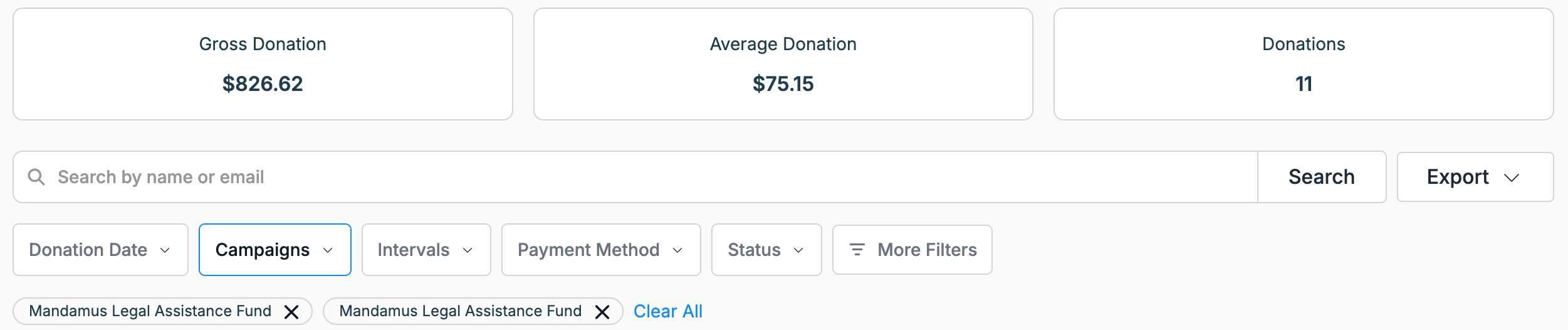
I want to be clear about who is carrying this mandamus case. I filed in my name but the people keeping this case alive are the ones sending $5 and $20 and $50 and $150 and $260 out of money they needed for something else.
If you have given already, you are the reason there is a case at all and you are heros. THANK YOU for your generous donations - your help is a GOD send!
And if you have been reading and wondering whether any of this is legit — it is. It is on a federal docket in Washington, and it is being paid for by ordinary readers.
I can’t possibly do this alone. Thank you for being part of team IoJ.
The fund is open and it’s there for one reason, which is getting an attorney’s help before the next round of motions instead of after. I’ll tell you where it stands as we get closer to trying to hire a good attorney to take on this case.
— Lady Xylie, Interest of Justice
Interest of Justice is a 501(c)(3) nonprofit. EIN 99-2410252. No corporate funding.
To everyone in that first round — you got this off the ground & an attorney to look over the initial filing when it was just me and a stack of paper and nothing else. I read every name that comes through and send you huge energetic hugs.
You all mean so much to me and I don’t have a better way to say it than that.
That’s all for today. Baby steps to justice for humanity!
Lady Xylie - IoJ
Comments
Nothing yet. Say the first thing.
Sign in to join the conversation.