
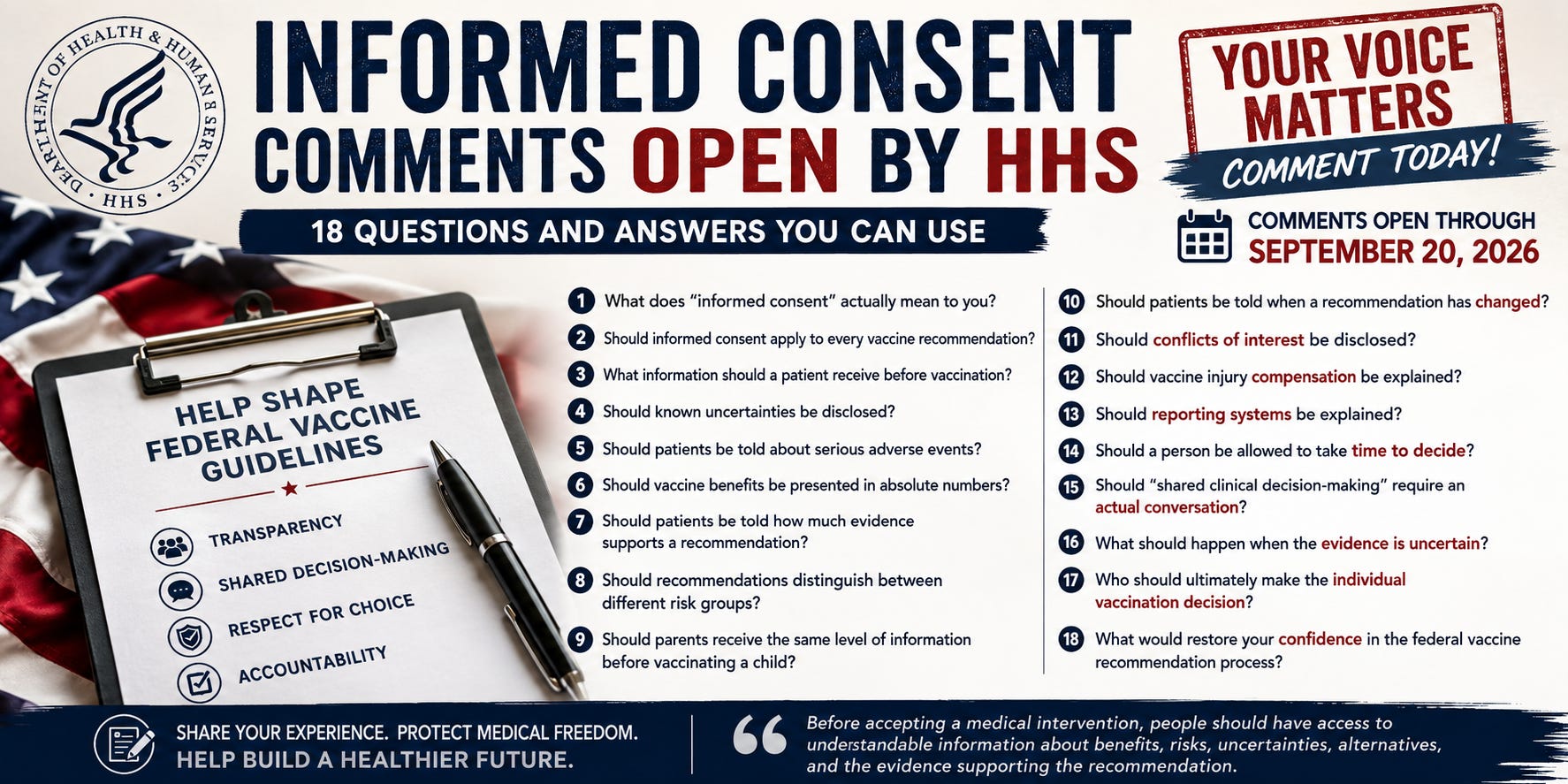
Question 3 is a confession that HHS put it in the Federal Register themselves
They're asking if their own categories imply consent doesn't apply to routine shots. Here's how to answer that one, and the other 17, before SEPTEMBER 20.
IoJ needs more paid subscribers to help us continue funding this work!
Deadline SEPTEMBER 20, 2026. Docket HHS-OS-2026-0332.
On Sat the 22nd readers were informed the US government had posted a request for comments the day before and was about to open comments. IoJ promised to give you ideas and a reminder today.
A federal agency has their comment box open right now asking your opinion on the issue of vaccine informed consent.
HHS published a Request for Information in the Federal Register today, August 24. Eighteen questions. Docket No. HHS–OS–2026–0332, RIN 0991-ZA62, signed by Secretary Robert F. Kennedy, Jr.
A Request for Information — an RFI — is not a rule. It is an agency asking the public questions before it decides what to do. Comments become part of the file. More on why that matters in a minute.
The RFI asks whether the three categories used in federal vaccine recommendations work. Those categories are routine, risk-based, and shared clinical decision-making.
Buried in there is Question 3.
HHS asks whether the current framework may “unintentionally imply that parental permission, individual consent, or meaningful clinical discussion applies only to shared clinical decision-making recommendations.”
Read it again. HHS is asking whether doctors and parents came away believing that consent matters for a handful of shots and not for the rest of them.
They did. That’s exactly what happened, and it wasn’t an accident.
Now they’ve put the question in the Federal Register and asked the public to answer it. So answer it.
Do not copy anyone’s comment. Not IoJ’s either - USE YOUR OWN VOICE!
A thousand identical comments count as one comment. Your own words about your own life count as one comment too — but yours is the one that can’t be dismissed as a form letter. Take the arguments. Write the sentences yourself.
People will tell you this is theater & pointless. Here is exactly what a comment is and isn’t.
What it isn’t. Section III of the notice says the RFI “does not constitute a rule, a proposed rule, or a recommendation,” and “The Department will not respond individually to comments.”
What it is. Federal agencies operate under the Administrative Procedure Act, 5 U.S.C. §§ 551–706. The APA is the statute that governs how agencies make decisions and when courts can overturn them.
Three pieces of it matter here.
5 U.S.C. § 553 — the notice and comment provision. Before an agency issues most rules it must publish the proposal and take public comment.
5 U.S.C. § 706(2)(A) — a court must set aside agency action that is “arbitrary, capricious, an abuse of discretion, or otherwise not in accordance with law.” In plain English, an agency has to consider the important stuff put in front of it. If it ignores a significant issue that was raised, the rule can be thrown out.
The administrative record — the pile of documents the agency had when it decided. Courts review that pile. They generally do not let an agency defend itself later with reasons it didn’t write down at the time. That rule comes from SEC v. Chenery Corp., 318 U.S. 80 (1943).
NOTHING IN GOVERNMENT OR LAW CAN HAPPEN WITHOUT A RECORD FIRST!
Three years from now a lawyer can pull the docket and says — the Department was told, in writing, on this date, and it did nothing. That sentence wins cases. It is the sentence that does not exist unless someone writes a comment. We build records.
One more piece of good news. Under Corner Post, Inc. v. Board of Governors, 603 U.S. 799 (2024), the six-year clock on an APA challenge runs from when a plaintiff is injured, not from when the rule was published. Old rules are more challengeable than they used to be. And under Loper Bright Enterprises v. Raimondo, 603 U.S. 369 (2024), courts no longer defer to an agency’s reading of a statute. Judges decide what the statute means now. That makes the statutes cited below matter more than they did three years ago, not less.
IoJ builds cases out of exactly this kind of paper. Our 132-page Citizen Petition and the federal mandamus action that followed both turn on what the agencies were told and when. Records matter, so build one for humanity NOW!

1. What does “informed consent” actually mean to you?
Should a person receive meaningful information about benefits, risks, uncertainties, alternatives, and the option to decline before receiving a vaccine?
2. Should informed consent apply to every vaccine recommendation?
Should the standard be the same whether a vaccine is routinely recommended, risk-based, or offered through shared clinical decision-making?
3. What information should a patient receive before vaccination?
Should providers clearly explain both expected benefits and reasonably foreseeable risks?
4. Should known uncertainties be disclosed?
If evidence is incomplete, conflicting, or limited for a particular age group or population, should that uncertainty be explicitly communicated?
5. Should patients be told about serious adverse events?
How should potentially serious but uncommon adverse events be presented so people can make an informed decision without either exaggerating or minimizing the risk?
6. Should vaccine benefits be presented in absolute numbers?
Would people make better decisions if benefits and risks were explained using understandable numbers rather than only relative percentages?
7. Should patients be told how much evidence supports a recommendation?
Should providers explain whether a recommendation is based on randomized trials, observational studies, expert judgment, or other evidence?
8. Should recommendations distinguish between different risk groups?
Should the risk-benefit calculation be explained separately for healthy people, people with underlying conditions, older adults, children, and other populations?
9. Should parents receive the same level of information before vaccinating a child?
Should parents be given age-specific information about benefits, risks, uncertainties, and alternatives before consenting?
10. Should patients be told when a recommendation has changed?
If federal vaccine guidance changes, should patients be informed about what changed and why?
11. Should conflicts of interest be disclosed?
Should patients be able to easily see relevant financial, institutional, or other conflicts of interest among people involved in developing vaccine recommendations?
12. Should vaccine injury compensation be explained?
If a vaccine is associated with a recognized injury for which a federal compensation program exists, should patients be told about that program before vaccination?
13. Should reporting systems be explained?
Should patients be told how suspected vaccine injuries or adverse events can be reported after vaccination?
14. Should a person be allowed to take time to decide?
Should informed consent mean more than signing a form immediately before an injection, particularly when the decision is not medically urgent?
15. Should “shared clinical decision-making” require an actual conversation?
If HHS uses shared decision-making as a recommendation category, what minimum information should a clinician and patient discuss?
16. What should happen when the evidence is uncertain?
Should federal guidance explicitly acknowledge uncertainty rather than presenting an evolving scientific conclusion as settled?
17. Who should ultimately make the individual vaccination decision?
What should be the respective roles of federal agencies, medical providers, parents, and individual patients?
18. What would restore your confidence in the federal vaccine recommendation process?
Should HHS prioritize greater transparency, disclosure of evidence, independent review, adverse-event monitoring, conflict-of-interest disclosures, public participation, or other reforms?
“I support meaningful informed consent. Before accepting a medical intervention, people should have access to understandable information about benefits, risks, uncertainties, alternatives, and the evidence supporting the recommendation. I ask HHS to make transparency and genuine shared decision-making central to federal vaccine policy.”
HHS itself says that informed consent generally requires communicating foreseeable risks, expected benefits, alternatives, relevant injury-treatment information, whom to contact with questions, and the voluntary nature of participation in the research context.

HHS asked, exactly: “Are the current categories (routine, risk-based, and shared clinical decision-making/individual-based decision-making) adequate, clear, and well understood by clinicians, patients, and parents? What evidence bears on how each category is understood in practice?”
Translation. Does anybody actually know what these words mean.
The law and the facts.
HHS answers its own question and the answer is brutal.
2018 survey of pediatric primary care providers — 24 percent could correctly define the old “Category B” recommendation.
2021 national physician survey — fewer than half knew shared-decision vaccines are covered by insurance. 90 to 95 percent said the category takes more time. Most said it confuses patients.
What to argue.
Everyone will call this a communications problem. It isn’t. It’s a consent problem, and the difference is legal.
Informed consent is derivative. It passes from the clinician to the patient. A patient cannot understand more than the person explaining understands. You cannot hand over what you don’t have.
Three out of four pediatric providers could not define the category they were working in. So the consent collected in those visits was not informed. Not because anyone lied. Because the framework was unintelligible to the people legally required to convey it.
That is not a labeling defect. That is millions of encounters where the legal precondition to a medical touching was not satisfied.
Ask them to.
State in writing that provider comprehension is a legal precondition to valid patient consent, not a communications goal.
Test comprehension before adopting any new category, and publish the results.
Refuse to adopt any category a majority of practicing clinicians cannot define in a validated survey.
Your part. Describe your last vaccine conversation. Were you told it was optional? Were you told anything about the evidence? Were you handed a form while someone was already opening the package? If you’re a provider, say what fifteen minutes actually allows.
HHS asked, exactly: “Do the current categories convey meaningful differences in the strength of the evidence, the magnitude of individual and population benefit, and the room left for individual circumstances and values? If not, how should those differences be conveyed?”
Translation. Can a parent tell, from the label, whether the science behind this is solid or thin.
The law.
ACIP already produces the answer, then deletes it.
Under the Evidence to Recommendations framework, ACIP rates evidence using GRADE — a four-point scale of high, moderate, low, very low certainty. That rating gets generated, documented, and published in workgroup materials and MMWR.
Then it disappears. A vaccine backed by high-certainty randomized trials and a vaccine backed by very-low-certainty observational data both print as “routine,” same font, no difference.
Two authorities say that’s a disclosure failure.
Canterbury v. Spence, 464 F.2d 772 (D.C. Cir. 1972) — the materiality standard. A fact must be disclosed if a reasonable person would attach significance to it in deciding whether to accept a procedure. Most states use this or a close variant.
42 U.S.C. § 300aa-26 — the Vaccine Information Statement statute. Requires the Secretary to develop VIS materials and requires providers to hand them over before administration. A pre-administration disclosure document already exists and is already mandatory.
What to argue.
The certainty rating is material. A parent told “low certainty” decides differently than a parent told “routine.” That is the Canterbury test, exactly.
HHS generates the number and withholds it from the person making the decision. There is no new authority needed to fix it. Section 300aa-26 already requires a disclosure form. Put the number on the form.
And ask for it in numbers people can use. Benefits and risks stated in absolute terms, not only relative percentages. A “50 percent reduction” means nothing without knowing fifty percent of what.
Ask them to.
Print the GRADE certainty rating on the face of the immunization schedule.
Add the certainty rating to the Vaccine Information Statement required by 42 U.S.C. § 300aa-26, in the same type size as the recommendation.
Present benefits and risks in absolute numbers, not only relative percentages.
Stop using one visual category to represent recommendations resting on wildly different evidence.
Your part. Say whether you’d have decided differently if you’d seen a certainty rating. That’s a statement about materiality. Materiality is the legal test.
HHS asked, exactly: “Do the current categories unintentionally imply that parental permission, individual consent, or meaningful clinical discussion applies only to shared clinical decision-making recommendations? Should the framework expressly distinguish the strength of a Federal recommendation from the consent, parental-permission, and assent processes involved in administering a vaccine?”
Answer this one if you answer nothing else.
What they asked. Two things. Most people will only see the first.
One — do the categories “unintentionally imply that parental permission, individual consent, or meaningful clinical discussion applies only to shared clinical decision-making recommendations?”
Two — “Should the framework expressly distinguish the strength of a Federal recommendation from the consent, parental-permission, and assent processes involved in administering a vaccine?”
Translation. Did we teach a generation of doctors that consent is a thing that comes up in one box out of three. And should we fix it by saying out loud that consent has nothing to do with which box it’s in.
The law.
CDC’s own guidance says for routine, catch-up and risk-based recommendations “the default decision should be to vaccinate.” For shared clinical decision-making, “there is no default.”
Think about that from inside a clinic. Two categories where your job is to get to yes.
Schloendorff v. Society of New York Hospital, 211 N.Y. 125 (1914) — Judge Cardozo. “Every human being of adult years and sound mind has a right to determine what shall be done with his own body; and a surgeon who performs an operation without his patient’s consent commits an assault.” Touching someone without consent is battery. That’s a tort — a civil wrong you can sue over. It applies to an injection the same as to surgery.
Cruzan v. Director, Missouri Dep’t of Health, 497 U.S. 261 (1990) — Chief Justice Rehnquist. “The principle that a competent person has a constitutionally protected liberty interest in refusing unwanted medical treatment may be inferred from our prior decisions.” That’s not state tort law. That’s the Due Process Clause of the Fourteenth Amendment. A constitutional floor under the right to refuse.
Troxel v. Granville, 530 U.S. 57 (2000) — the parental interest in the care, custody and control of children is “perhaps the oldest of the fundamental liberty interests recognized by this Court.” A fundamental liberty interest means government interference gets strict scrutiny — the government must prove a compelling interest and that its method is the least restrictive one available. That is the hardest test in constitutional law and the government usually loses it.
The Nuremberg Code, principle 1 — “The voluntary consent of the human subject is absolutely essential.” Written by American judges, at an American tribunal, under American procedural rules, in the American Zone. We wrote it.
And the structural point Boston University health law professor George J. Annas made in work we republished in full — consent is listed first, but the other nine principles must be satisfied before it is even appropriate to ask for consent at all. Consent is the last gate, not the first.
What to argue.
Consent is not a category. It’s a precondition.
It sits outside the recommendation system entirely, and it comes from four independent sources — state tort law, the Fourteenth Amendment, the parental rights line of cases, and the Nuremberg Code. Not one of them cares how strongly a federal advisory committee recommends anything.
The framework put a precondition inside a category. That is backwards, and HHS just asked whether it’s backwards.
Ask them to. Adopt the express separation HHS floated in the second half of the question. Give them the language — agencies adopt text that arrives already drafted far more often than text they’d have to write.
“The category of a Federal recommendation describes the strength of the government’s advice and the certainty of the evidence supporting it. It has no effect on the consent required to administer a vaccine. Informed consent, and parental permission where applicable, is required for every vaccine in every category, and may lawfully be withheld.”
Ask that it appear at the top of the immunization schedule and in every Vaccine Information Statement.
Your part. If you’ve ever been told a routine vaccine was not optional — by a clinic, school, pharmacy, employer, recruiter — write it down with a date. That is direct evidence the implication in Question 3 is real and operating.
HHS asked, exactly: “Should additional or different categories be adopted, such as ‘recommended, but not during infancy’ (or otherwise age-de-emphasized recommendations); ‘recommended with qualification’; or ‘shared clinical decision-making with qualification’? For any proposed category, describe its definition, its default (if any), its evidentiary basis, and its intended downstream consequences.”
Translation. Should we add more boxes.
What to argue.
Two of those three contain the word “qualification” without saying what’s being qualified. That’s the same defect that produced the comprehension numbers in Question 1.
Providers couldn’t handle two meaningful categories. Adding a fourth and fifth is predictably worse and HHS has no data suggesting otherwise.
More importantly, new boxes don’t touch the actual defect. The defect from Question 3 is that consent is a variable inside the system instead of a constant outside it. Rearranging boxes moves the variable around. It doesn’t move it out.
Then hold them to their own standard. HHS asked commenters to specify definition, default, evidentiary basis and downstream consequences for any proposed category. Demand HHS do the same, in public, before adoption. Because “downstream consequences” means the coverage, compensation and state-mandate triggers from Question 6, and those have never been publicly mapped.
Ask them to.
Split the label into two published fields — strength of the advice, and certainty of the evidence.
Apply one invariant consent statement across all categories, whatever the categories become.
Require any new category to publish its default, evidentiary basis, and full coverage, compensation and state-law consequences before adoption, through notice and comment under 5 U.S.C. § 553.
HHS asked, exactly: “What can be learned from the recommendation structures of peer bodies abroad, such as global or international health bodies of peer regulatory bodies?”
(The garbled phrase at the end is exactly how it appears in the published notice.)
Translation. Should we copy Europe.
The history.
International medical bodies are how American consent protections got weakened. The record is not ambiguous.
1954 — the World Medical Association meets in Rome, adopts five “Principles for Those in Research and Experimentation.” Splits subjects into “healthy” and “sick.” Approves proxy consent — next of kin signing for the subject, with the doctor’s conscience as the check. Neither the split nor the proxy appears anywhere in Nuremberg, which says the human subject, period.
1964 — the Declaration of Helsinki, subtitled “Recommendations to physicians by physicians.” A code written by judges gets replaced by guidance the profession wrote about itself.
1970 — Harvard’s Henry Beecher says out loud what happened.
“The Nuremberg Code presents a rigid set of legalistic demands.... The Declaration of Helsinki, on the other hand, presents a set of guides. It is an ethical as opposed to a legalistic document.... Until recently, the Western world was threatened with the imposition of the Nuremberg Code as a Western credo. With the wide adoption of the Declaration of Helsinki, this danger is apparently now past.”
Threatened. Danger. He’s describing binding consent law as a hazard, and its replacement by voluntary guidance as relief. In print. Under his own name.
Today — FDA participates in the International Council for Harmonisation. Its E6 Good Clinical Practice guideline is the working standard for trials. GCP permits waiver of consent in defined emergency research. Nuremberg permits none.
What to argue.
American law has a statutory consent floor most peer nations lack — 50 U.S.C. § 1520a(d), 10 U.S.C. § 980, 10 U.S.C. § 1107. Harmonization is not a lawful reason to go below a floor Congress set. An agency acting beyond its statutory authority is acting ultra vires — beyond its power — and that action is void.
Ask them to. Adopt a published one-directional rule. HHS may adopt a foreign or international practice only where it exceeds the U.S. statutory consent floor, never where it falls below. And require HHS to name which domestic statutory floor it is measuring against in any such proposal.
HHS asked, exactly: “If new categories were adopted, what is needed to preserve access to vaccines currently available to Americans and ensure predictable and consistent treatment under coverage requirements, program eligibility rules, the injury-compensation programs, and State law?”
Second most important question. Answer it.
They named the compensation programs. That’s the opening.
Translation. If we move a vaccine to a different box, who pays, and what happens to a family whose kid gets hurt.
The law. This is the part almost nobody knows.
There are two federal compensation systems. They are not comparable.
VICP — the Vaccine Injury Compensation Program. Created by the National Childhood Vaccine Injury Act of 1986, 42 U.S.C. § 300aa-10 et seq.
Covers vaccines on the childhood schedule subject to the excise tax
Claims heard by Special Masters in the U.S. Court of Federal Claims
A Vaccine Injury Table creates presumptions — if a listed injury appears in a listed timeframe, causation is presumed and the government has to disprove it
Discovery. Hearings. Written decisions.
Appellate review available
Attorney fees paid even when you lose — which is the only reason lawyers take these cases
CICP — the Countermeasures Injury Compensation Program. Created by the PREP Act, 42 U.S.C. § 247d-6e
Covers products deployed under a PREP Act declaration
Decided entirely inside HRSA. An Article I administrative process, not an Article III court — meaning no judge with life tenure, no jury, no independent tribunal
No discovery. No hearing. No cross-examination
Internal reconsideration only. No appeal to a court
One-year filing deadline
Causation must be shown by “compelling, reliable, valid, medical and scientific evidence.” No table. No presumptions. The claimant carries the entire burden
The numbers, as of July 1, 2026 — more than 14,000 COVID vaccine injury claims sit in CICP. Fewer than one percent of decided claims compensated. HRSA’s own March 2026 report puts VICP adjudication at two to three years. The death benefit is capped at $250,000 in both — set in 1986, never indexed for inflation.
What to argue.
Category assignment is a due process question, not a clinical one.
Due process under the Fifth Amendment requires notice and an opportunity to be heard before the government deprives you of life, liberty or property. Same child. Same injury. Same product. One classification lands you in front of a Special Master with a presumption and a right of appeal. The other lands you in an agency file with no hearing at all.
The family had no notice the classification existed. No opportunity to contest it. In most cases no knowledge it was happening.
Now add the State law piece HHS raised. The federal category feeds state school-entry statutes by incorporation. So one switch sets both how much pressure a family faces to accept a product and whether they have any remedy when it injures their child.
Those two move in opposite directions. Same switch. Nobody has ever been asked to justify that.
Ask them to.
Publish a table — every vaccine, which compensation program applies, under what conditions, with what filing deadline.
Add the applicable compensation program and deadline to the Vaccine Information Statement under 42 U.S.C. § 300aa-26. It is plainly material under Canterbury.
State in writing what happens to a claimant injured by a product that changes category mid-claim, and commit that no category change reduces an existing claimant’s pathway.
Support moving COVID-19 claims out of CICP into VICP, as H.R. 9672 would do.
Your part. If you or your family filed in either program, describe it. How long. What you were told. Whether a human being ever spoke to you. Don’t include anything you’re unwilling to have published.
HHS asked, exactly: “If categories remain the same, what modifications to timing and frequency of vaccine administration (for example, clearer presentation of flexible age ranges such as the 12-through-15-month window for the first dose of measles-containing vaccine) or guidance on administering vaccines individually versus at a single visit would help parents and clinicians understand that a vaccine is recommended while affording flexibility in timing of administration?”
Translation. Would it help if we said out loud that the window is a window.
What to argue.
The flexibility exists on paper. It doesn’t exist in practice. Three systems convert a window into a deadline before it reaches a family.
One. State school-entry rules require completion by an age, not within a window.
Two. Electronic health records show a single due date and flag anything past it as overdue. HHS’s own cited research says forecasting tools display these categories inaccurately or not at all.
Three — and nobody else will raise this. Practices are financially graded on immunization completion. The HEDIS Childhood Immunization Status measure scores a practice on how many children completed a defined series by their second birthday. Those scores feed quality reporting and value-based payment.
Which means a doctor who honors your decision to use the full window takes a measurable financial hit for doing it.
You cannot fix timing flexibility by printing it on a schedule while every downstream system punishes its use.
And there’s a fourth thing worth saying here. Consent that has to be given in the sixty seconds before an injection is not consent, it’s a signature. When a decision is not medically urgent, a person should be able to take the information home and think.
Ask them to.
Print flexible windows on the face of the schedule and state that using the full window is compliance, not delay.
Require federally-supported immunization forecasting systems to display the full permissible window instead of a single due date.
Study whether federal quality measures and value-based payment programs financially penalize clinicians who honor a family’s timing decision. Publish the findings.
State that a patient or parent may take the disclosure materials away and return to decide, without the visit being recorded as a refusal.
Number three is the one that changes behavior.
HHS asked, exactly: “What does, or what should, ‘shared clinical decision-making’ mean in the vaccination context? How, if at all, does ‘individual-based decision-making’ differ?”
Translation. Shared with who, exactly.
The law.
“Shared decision-making” comes out of medical ethics literature. It describes a process — the clinician supplies clinical information, the patient supplies values and circumstances. It never described authority over the outcome. The talking is shared. The deciding is not.
Legally the decision belongs to one party.
Adults — Schloendorff (battery) and Cruzan (constitutionally protected liberty interest in refusing treatment).
Children — a line of Supreme Court cases treating parental direction of upbringing and care as a fundamental liberty interest under the Fourteenth Amendment.
Parham v. J.R., 442 U.S. 584 (1979) — the law presumes parents act in their children’s best interests and possess what a child lacks in maturity and judgment
None of those cases contemplates the government as a co-decider. The word “shared” quietly inserts a third party into a two-party relationship. It has been doing that on federal letterhead since 2019.
Ask them to. Publish a definition.
“Shared clinical decision-making describes the process of deliberation between a clinician and a patient or parent. It does not describe shared authority over the outcome. The decision rests solely with the patient, or with the parent or guardian, who may decline. This is true in every recommendation category.”
And make them say whether “individual-based decision-making” means anything different. HHS uses both terms and has never explained the difference.
HHS asked, exactly: “Does the term ‘shared clinical decision-making’ create an unintended contrast with routine recommendations? Since shared decision-making describes a clinical process applicable to all vaccine decisions, should the Department reserve that phrase for use across all categories and instead adopt ‘conditional recommendation’ or ‘recommendation based on individualized assessment’ for recommendations whose expected benefit varies materially among individuals?”
Translation. HHS is proposing the fix to Question 3 itself.
The law.
Naming one category “shared decision-making” implies the other two aren’t. Lawyers call that expressio unius est exclusio alterius — naming one thing implies excluding the others. It’s a standard canon of interpretation and it’s exactly why the confusion in the surveys exists.
Also worth noting — “conditional recommendation” is a term of art in GRADE. It means a recommendation resting on weaker evidence or a close balance of benefits and harms. Using it accurately would import real evidentiary meaning into the schedule.
What to argue.
Support the rename. Then name the limit.
Renaming corrects an implication. It does not create a right. If HHS renames and stops, the framework ends up in exactly the same place with better vocabulary.
Ask them to. Do both. Apply the decision-making language across all categories and adopt the affirmative consent statement from Question 3. Say explicitly that you support the rename and do not consider it sufficient alone.
HHS asked, exactly: “What are the benefits of an SCDM category, including respect for autonomy, informed consent, religious conviction, and individualized clinical judgment, and what evidence supports them?”
They asked for this by name. Most people will walk past it.
The law. Three grounded benefits.
Constitutional. Parental direction of a child’s medical care is a fundamental liberty interest — Meyer, Pierce, Parham, Troxel. A category with no default is the only one of the three that operationalizes that interest instead of presuming against it. A system that presumes yes in two-thirds of cases has put a government preference ahead of a constitutionally protected one.
Religious. Free exercise doctrine has shifted hard.
Tandon v. Newsom, 593 U.S. 61 (2021) — government regulations trigger strict scrutiny whenever they treat any comparable secular activity more favorably than religious exercise.
Fulton v. City of Philadelphia, 593 U.S. 522 (2021) — a policy that permits individualized exemptions is not generally applicable, and therefore gets strict scrutiny.
A federal framework that builds individualized assessment in at the front end is far more legally defensible than one that doesn’t. HHS’s own lawyers should want that argument in the record.
Honest science. Where certainty is low, “no default” is simply the true answer. HHS says this against itself, citing Offit’s 2023 NEJM commentary calling the all-ages bivalent booster recommendation on limited human data “a cautionary tale,” and the 2025 NEJM article by FDA leadership proposing risk-stratified rather than universal COVID recommendations.
Your part. If your objection is religious, describe it plainly, in your own theological terms. Don’t turn it into policy language — the policy argument is above and it’s already made. The record needs the specific, sincerely held belief in your own words. A documented religious objection in a federal docket is evidence of religious burden if a mandate is ever litigated under Tandon or Fulton. There is no substitute for a real person describing a real conviction.
HHS asked, exactly: “What are the risks of an SCDM category, including confusion, reduced access or uptake, and time burdens in practice, and what evidence supports them?”
What to argue.
Concede the real risks first. A comment that only argues one side gets filed under advocacy. A comment that concedes and then finds a risk the agency missed is much harder to dismiss.
The documented risks are real. 90 to 95 percent of physicians report more time required. Fewer than half know it’s covered. Uptake is lower. HHS cites all of it and none of it is in dispute.
Now the risk they didn’t identify. The confusion runs both ways and HHS proposes to fix only one direction.
When “shared clinical decision-making” gets misread as “not covered,” HHS proposes education. That’s Question 12.
When “routine” gets misread as “not optional,” HHS proposes nothing.
That asymmetry is the real risk of the category system. And it’s not a risk to uptake — it’s a risk to the legal validity of consent. Which is exactly why an uptake-focused analysis is structurally incapable of detecting it.
Second risk worth naming. An intermediate category works as a pressure release valve. It lets an agency move a scientifically contested product out of political controversy without ever resolving the evidence question. The dispute doesn’t get settled. It gets reclassified.
Ask them to.
Assess risk in both directions, including the risk that non-shared categories communicate an absence of choice.
Measure documented refusals honored and coercion complaints — not only uptake. If uptake is the only instrument, only one kind of failure is visible.
HHS asked, exactly: “An SCDM recommendation, once adopted by the CDC Director, triggers the same coverage requirements as a routine recommendation, including coverage without cost-sharing under the Affordable Care Act and availability through the Vaccines for Children program. Given evidence that patients and even providers may not understand this, what steps should the Department take to educate the public and the provider community that SCDM-recommended vaccines are covered? What communication formats would most effectively ensure that an SCDM designation is not misread as a lapse in coverage or a signal that a vaccine is unavailable?”
Translation. How do we stop people thinking “shared decision” means “you’re paying for it.”
The law.
Here’s the fact almost nobody knows. Moving a vaccine into the shared-decision box does not defund it.
42 U.S.C. § 300gg-13(a)(2) requires plans to cover, without cost-sharing, immunizations “that have in effect a recommendation from the Advisory Committee on Immunization Practices.” The statute keys off the existence of a recommendation. It says nothing about categories. Same structure for VFC under 42 U.S.C. § 1396s.
So an ACIP recommendation is a statutory switch that turns on guaranteed payment no matter which of the three boxes it lands in. Worth understanding before you form an opinion about category fights, because it explains why they’re fought so hard by parties with no clinical stake.
What to argue.
HHS wants to correct one public misunderstanding — that shared-decision means unfunded. That misunderstanding is real and it hurts families without money worst, because they skip things they think they’d have to pay for. Support the correction. Say so plainly.
Then make the point HHS didn’t ask for.
An ACIP recommendation triggers four consequences. Insurance coverage. VFC eligibility. A specific injury-compensation pathway. Incorporation into state mandate law.
HHS proposes to educate the public about exactly one of them — the one whose misunderstanding lowers uptake.
The other three are equally material under Canterbury, and two of them cut the other way. If you’re going to tell a parent “this is covered,” you owe them, in the same breath, which compensation program covers them if it goes wrong, and the fact that insurance coverage creates no legal duty on them to accept the product.
That’s the argument. Complete disclosure or none. You don’t get to correct only the misunderstandings that produce the outcome you prefer. An agency that discloses selectively to move behavior in one direction is engaged in something a court could reasonably call arbitrary and capricious under 5 U.S.C. § 706(2)(A).
Ask them to. Produce one disclosure, delivered before administration under the existing 42 U.S.C. § 300aa-26 authority, covering all four consequences.
The vaccine is covered without cost-sharing, and through VFC where applicable, in every category.
Which injury program applies — VICP or CICP — and the filing deadline for each.
Whether and how this recommendation is incorporated into state school-entry law.
That coverage and recommendation create no legal obligation on the individual, and consent may be withheld.
Drafted by the Department through notice and comment. Not by manufacturers or trade associations.
HHS asked, exactly: “What supports would make SCDM work as intended, such as decision aids, provider training, documentation standards, coverage clarifications, or category-specific communication materials, and who should develop them?”
The law.
The vehicle exists and is already mandatory. 42 U.S.C. § 300aa-26 requires the Secretary to develop Vaccine Information Statements and requires providers to give them to the patient, parent or guardian before administering a covered vaccine.
A pre-administration disclosure document with a statutory mandate behind it. Everything in this docket that a person needs before deciding could go in it tomorrow. No new authority required.
What to argue.
Consolidate, don’t create. Question 1 established that providers can’t define the categories. Question 7 established they have fifteen minutes. Any support strategy built on more documents, more modules and more workflow steps fails for the same reason the current framework failed.
One page, handed over before the needle comes out. That’s a design that survives contact with an actual clinic.
Ask them to. One standardized page, pre-administration, under existing § 300aa-26 authority, containing —
GRADE certainty rating, in plain language
The recommendation category, and what it does and does not require of the recipient
Known adverse events with reported rates and the source cited
Which compensation program applies and its filing deadline
How to report a suspected injury or adverse event afterward, and where
A plain statement that consent may be withheld and declining is lawful
Manufacturer and lot number, so the product stays traceable
On “who should develop them” — the Department, through notice and comment rulemaking. Not manufacturers. Not professional trade associations. HHS asked who should write it. Answer with the conflict named out loud.
HHS asked, exactly: “What considerations should be relied upon in establishing vaccine recommendations and assigning categories, and under what conditions should each predominate? Commenters are specifically invited to address the availability, quality, and strength of evidence; the appropriate approach where randomized controlled trial evidence is absent, infeasible, or unethical to obtain; disease severity and epidemiology; individual versus population benefit; a presumption in favor of individual autonomy, informed consent, and religious freedom; and feasibility and programmatic consequences.”
What they asked. The most quotable invitation in the notice. Commenters “are specifically invited to address” — among other things — “a presumption in favor of individual autonomy, informed consent, and religious freedom.”
They asked. In writing. In the Federal Register.
The history. This is why a presumption alone is worthless.
1953 — Five years after American judges wrote the Nuremberg Code, the Secretary of Defense adopts it for the protection of research subjects. Classifies the guidelines TOP SECRET until 1974. Twenty-one years of a protection no subject could invoke because no subject was allowed to know it existed.
1953 — CIA Director Allen Dulles orders MKULTRA. Roughly 200 researchers, 80 institutions. At least two deaths. In 1973 the Director orders the records destroyed.
1958 — The Army gives Sergeant James Stanley LSD without his knowledge. He finds out in 1975, from a letter inviting him into a follow-up study of the “volunteers who participated.”
1959 — An Army Staff Study concludes that in intelligence work “the stakes involved and the interests of national security may permit a more tolerant interpretation of moral-ethical values.” Same study concludes liability can only be avoided by covering it up.
1984 — Begay v. United States, 591 F. Supp. 991 (D. Ariz.), aff’d 768 F.2d 1059 (9th Cir. 1985). Navajo uranium miners. A federal judge holds the Public Health Service’s decision not to tell them the risks of continued exposure — across a study running 1949 to 1960 — was justified “based on considerations of political and national security feasibility factors.”
1987 — United States v. Stanley, 483 U.S. 669. Supreme Court, 5 to 4. Stanley gets nothing, barred by the Feres doctrine — the judge-made rule from Feres v. United States, 340 U.S. 135 (1950), that service members can’t sue the government for injuries incident to service. Justice O’Connor, dissenting in part, calls the conduct “so far beyond the bounds of human decency that as a matter of law it simply cannot be considered a part of the military mission.” Justice Brennan writes the government “treated thousands of its citizens as though they were laboratory animals.” Both in dissent.
December 1990 — FDA grants DoD a waiver from informed consent for Desert Shield, 55 Fed. Reg. 52,814. DoD’s own words — “In all peace time applications, we believe strongly in informed consent and ethical foundations .... But military combat is different.” The operative finding was that consent was “not feasible” because some troops might refuse. The possibility of a no was the reason not to ask.
2004 — and this one is a WIN, so use it. Doe v. Rumsfeld, 341 F. Supp. 2d 1 (D.D.C. 2004). Judge Emmet Sullivan enjoins DoD’s mandatory anthrax vaccination program. The reasoning — the vaccine was not licensed for inhalation anthrax, making it an investigational product, and under 10 U.S.C. § 1107 and Executive Order 13139, service members must give informed consent to an investigational product unless the President personally waives it in writing. No waiver had been signed. Sullivan wrote that service members were being used as “guinea pigs for experimental drugs.”
That case proves the point. When the requirement is in a statute, a court enforces it. When it’s in policy, nothing happens.
What to argue.
Every episode above says the same thing. Not one of them says consent doesn’t matter. All of them say consent doesn’t apply here, for this reason, in this situation.
Which is why a presumption alone is worth nothing.
A rebuttable presumption is a legal starting point that shifts the burden of proof to whoever wants to overcome it. It only functions if two things are specified — what overcomes it, and who decides. If it can be defeated by an unwritten finding of necessity made by an unnamed official, it isn’t a presumption. It’s a preference. Every episode above ran on exactly that.
There’s a specific legal reason to demand publication. Under 5 U.S.C. § 704, courts review final agency action. An unwritten internal determination is not reviewable — nothing on paper to review, no way for an affected person to know it happened, and therefore no one with standing to sue. Requiring publication converts an invisible decision into a reviewable one.
That is the whole difference between a right and a sentiment.
Then close on the document that produced this docket. Executive Order 14420, signed August 10, 91 Fed. Reg. 53,173. Commits the government to personal autonomy and informed consent. Then states, same document, that it “does not create any right or benefit, substantive or procedural, enforceable at law or in equity by any party against the United States.”
Annas had a phrase for it. A right without a remedy. He wrote that it’s the same thing as an ethical code with no legal standing.
Ask them to.
State the presumption in published text — that in setting vaccine recommendations, HHS presumes in favor of individual autonomy, informed consent, and religious freedom.
Specify what evidence rebuts it and which official is authorized to make that finding.
Require any departure to be published in the Federal Register, signed by a named official, with written reasons — making it final agency action reviewable under 5 U.S.C. § 704 and 5 U.S.C. § 706(2)(A).
State that no emergency, exigency, or national security determination waives individual informed consent absent express statutory authorization from Congress.
Number four is seventy-nine years of history compressed into one sentence.
HHS asked, exactly: “When evidence is limited, uncertain, or evolving, how should that uncertainty be reflected in the recommendation itself, whether through category assignment, qualifying language, sunset or re-review provisions, or explicit statements of evidentiary certainty, rather than resolved silently in favor of either a universal recommendation or no recommendation?”
“Resolved silently” is HHS describing its own practice. Note that.
What to argue. Three fixes.
Publish the rating. GRADE certainty on the face of the schedule and in the VIS. Same as Question 2 — repeat it here, agencies read section by section.
Sunset low-certainty recommendations. Anything resting on low or very-low certainty evidence lapses on a stated date unless affirmatively renewed on a published record.
This one matters most and here’s why. Today a recommendation adopted on thin evidence stays in force forever unless someone finds the institutional energy to remove it. Nobody ever does. A sunset provision flips the burden — thin evidence has to be re-earned on schedule instead of coasting on inertia. That single structural change does more than any amount of language reform.
Require falsifiability. Every re-review must state what new evidence arrived, and — the important part — what evidence would have caused withdrawal.
A recommendation that can’t specify what would refute it isn’t functioning as a scientific claim. It’s a policy commitment wearing a lab coat. Make them state the refutation condition in writing, at adoption, before anybody knows how the data will come out.
And when guidance does change, patients should be told what changed and why. Not left to discover it from a different form at the next visit.
Ask them to.
Publish GRADE certainty with every recommendation.
Attach automatic sunset and re-review to any recommendation resting on low or very-low certainty evidence.
Require every recommendation to state, at adoption, what evidence would warrant withdrawal.
Publish a plain-language statement of what changed and why every time federal guidance is revised.
HHS asked, exactly: “What does the evidence show about the effects of mandates and other compulsory or high-pressure approaches on public trust, vaccine confidence, and long-run vaccination behavior? How should Federal recommendation policy account for those effects, consistent with the principle that Federal recommendations are not mandates?”
Quote this back to them. HHS wrote — “In the United States, vaccination requirements have historically been creatures of State law within constitutional limits, and Federal recommendations are recommendations, not mandates. The Department believes that distinction should be preserved and made legible to the public.”
What to argue.
Explain the mechanism. Most people have never seen it laid out.
ACIP recommends. The CDC Director adopts. It enters the published federal schedule. State school-entry statutes then incorporate that schedule by reference — the state law doesn’t list vaccines, it points at the federal document, including future changes. Employers, universities, health systems and licensing boards do the same.
Result. The federal government writes the operative content of every mandate in the country while accurately saying it mandates nothing. The writing and the coercion are performed by different parties. Neither is accountable for the other’s half.
On the empirical question, cite both sides. HHS says the literature is mixed and a comment that admits that is dramatically more credible.
Supporting the reactance concern — Schmelz, PNAS 2021, enforcement crowds out voluntary support where trust in government is weak. Sprengholz 2022, mandate-triggered reactance associated with reduced vaccination intentions and increased anti-policy activism. Bardosh, BMJ Global Health 2022.
Cutting the other way — Karaivanov 2022 (Nature Human Behaviour), Mills and Rüttenauer 2022 (Lancet Public Health), Albarracín 2021, all finding requirements raised uptake in various settings.
Acknowledge them. Then make HHS’s own point back at them — much of that evidence comes from countries with different baseline institutional trust, and uptake produced by pressure is a different good than uptake produced by confidence.
And remember what Jacobson held. A five dollar fine.
Ask them to.
Print on the face of the schedule and in every VIS — “A Federal vaccine recommendation is not a legal requirement and creates no obligation on any individual.”
Publish an analysis of how many state statutes and regulations incorporate the federal schedule by reference. That number quantifies the gap between what HHS says it does and what its output does.
Commit that HHS will not condition federal funding, grants, or program eligibility on a state’s adoption of mandates.
Your part. If you or your child were excluded from school, denied a job, discharged from service, or refused medical care over a vaccination decision — write it down with dates, plainly, no embellishment. Do it even if it feels small. There is currently no federal dataset capturing any of it. Agency records of documented harm are the raw material of every case that gets filed later.
HHS asked, exactly: “What communication practices should accompany vaccine recommendations so that they earn and keep public trust, and what lessons from COVID-19-era communication should inform them?”
What to argue.
CDC has its own doctrine and doesn’t follow it. That’s the comment.
CDC’s Crisis and Emergency Risk Communication manual instructs the agency to tell the public “what you know when you know it, tell them what you don’t know, and tell them if you will know relevant information later.”
The research HHS cites in its own notice goes further.
Van der Bles, PNAS 2020 — communicating uncertainty transparently imposes at most small costs to trust.
Petersen, PNAS 2021 — transparent communication about negative features of COVID-19 vaccines decreased acceptance short term but increased trust. Vague reassurance failed to increase acceptance and reduced trust.
Read that twice. It’s in their document. Reassurance performed worse than candor on both measures. It didn’t even buy the uptake it cost the trust for.
Second thread. HHS describes the September 2021 episode where ACIP voted against recommending boosters for adults 18 to 64 on occupational exposure grounds, and the CDC Director set the vote aside and extended the recommendation anyway. HHS’s own assessment — episodes where “the deliberative advisory process reaches a narrower conclusion that is then overridden in favor of a broader, top-down recommendation contribute to public doubt about whether Federal recommendations in fact reflect the process created to produce them.”
They wrote that about themselves. Hold them to it.
Third thread, and it belongs here. You cannot earn trust while hiding who paid. Financial and institutional conflicts of interest among the people writing recommendations should be searchable by the public in one place, before the vote, not buried in meeting minutes afterward.
Ask them to.
State what is unknown alongside every recommendation, with equal prominence to what is claimed.
Publish dissenting ACIP members’ reasoning, not just the vote count.
Require any CDC Director override of an ACIP vote to be published, signed, with written reasons, at the time it happens.
Publish all financial and institutional conflicts of interest of everyone involved in developing a recommendation, in one searchable place, before the vote.
Stop using “safe and effective” as an unqualified phrase where GRADE certainty is rated low or very low. That is precisely the vague reassurance their own cited research shows destroys trust.
HHS asked, exactly: “How should the Department measure whether a recommendation framework is succeeding, and what data should be collected and published for that purpose?”
Translation. Looks like housekeeping. It’s the most consequential question in the docket.
What to argue.
Whatever metric HHS picks becomes what the entire system optimizes toward for twenty years.
If the measure is uptake, then category naming, provider incentives, EHR defaults, communication strategy and school policy all get tuned toward whatever raises uptake. Pressure raises uptake. A framework measured by uptake drifts toward coercion by institutional gravity, without anyone ever deciding to do it.
HHS states three goals — “scientific rigor, informed choice, and public trust.” Only the first has anything resembling a metric. Informed choice has none. Which means it is currently unmeasurable, and therefore invisible in every evaluation the Department runs.
Ask them to. Adopt metrics for all three.
Informed choice — documented refusals honored without adverse consequence. Documented exclusions from school, employment or service following refusal. Coercion complaints. The proportion of administrations where a Vaccine Information Statement was demonstrably provided beforehand, which is already legally required under 42 U.S.C. § 300aa-26 and, as far as the public record shows, has never been audited.
Scientific rigor — the proportion of current recommendations resting on high-certainty evidence. The number re-reviewed annually. The number withdrawn or downgraded. A framework where nothing is ever downgraded is not reviewing anything.
Public trust — published annual trend data using the instruments HHS already cites, including KFF, Pew, and the Health Affairs agency-trust research. Reported on a schedule, not cited selectively when convenient.
And ask that all of it be published annually, disaggregated by vaccine, category and state, in machine-readable format. That last part matters because it makes independent analysis possible without a FOIA fight.
Say plainly that uptake alone must not be treated as evidence the framework is working.
HHS says commenters “need not address every question.”
Pick one. Pick three. Four honest paragraphs about the question that touches your life beats a treatise that touches none of it. A parent describing a real conversation in a real exam room is evidence. A boiler plate response is not so speak your own voice.

CLICK HERE — Federal Register, Docket HHS-OS-2026-0332
(Use the “Submit a Formal Comment” button at the top.)
Or search the docket number at regulations.gov
By mail — Cynthia Goss, 200 Independence Ave SW, Washington, DC 20201. Include the agency name and docket number.
Comments must be received no later than SEPTEMBER 20, 2026. Everything you submit becomes public, including personal information you include. Put in what you’re willing to have published. Leave out what you’re not.
When ACIP recommends a vaccine and the CDC Director signs off, four things happen automatically. By statute. Nobody votes again.
Insurance must cover it, no copay. 42 U.S.C. § 300gg-13(a)(2) — the Affordable Care Act preventive services provision. It covers immunizations “that have in effect a recommendation from the Advisory Committee on Immunization Practices.” Note what that language does NOT say. It does not say routine. Any category triggers it.
It’s free through Vaccines for Children. 42 U.S.C. § 1396s.
It enters an injury-compensation system. Which one depends on the product. That difference is enormous and Question 6 covers it.
States pick it up. State school laws point at the federal schedule instead of listing vaccines themselves. Lawyers call that incorporation by reference — one law adopting the contents of another document, including future changes to it.
Four consequences. One switch. No separate vote on any of them.
HHS says so in the notice, citing Jacobson v. Massachusetts, 197 U.S. 11 (1905). Under Jacobson, mandates are a police power — the authority of a state to regulate for health and safety. That power belongs to states, not Washington.
True as far as it goes. But because states incorporate the federal schedule by reference, the federal government writes the content of every state mandate in the country. Then truthfully says it mandates nothing.
Worth knowing what Jacobson actually approved. A five dollar fine. That’s it. Not expulsion from school. Not loss of a job. Not denial of medical care. A century of mandate architecture rests on a case about a five dollar fine.
50 U.S.C. § 1520a — bars the Secretary of Defense from conducting any test or experiment involving a biological agent on civilian populations without informed consent obtained in advance. Subsection (d) is the consent requirement.
10 U.S.C. § 980 — no federal funds for research using a human being as an experimental subject unless that person, or their legal representative, gives informed consent in advance.
10 U.S.C. § 1107 — service members must give informed consent before receiving an investigational drug, unless the President personally waives it in writing.
Those are statutes. Congress passed them. A statute is enforceable in court. An executive order generally is not, because most of them include a clause saying so.
That distinction is the entire fight, and Question 14 is where you make it.
§ 1520a(d) is the lead claim in IoJ’s federal mandamus action, Eshleman v. Hegseth et al, No. 1:26-cv-01543 (D.D.C.), before Judge Boasberg.
The people who wrote the Nuremberg Code were Americans. The people who buried it were Americans too. Which one this generation turns out to be gets decided in dockets like this one, by people who took twenty minutes on a Tuesday to write down what they actually believe.
You’re the one we have all been waiting for so speak up and save humanity!
Lady Xylie - IoJ

Comments
Nothing yet. Say the first thing.
Sign in to join the conversation.