
I’ve been thinking a lot about the different types of professional activities that we engage in and what it means to be good at them. I’m currently thinking about this on a continuum from productivity to artistry, with an additional dimension of performance (though many activities will have areas of overlap).
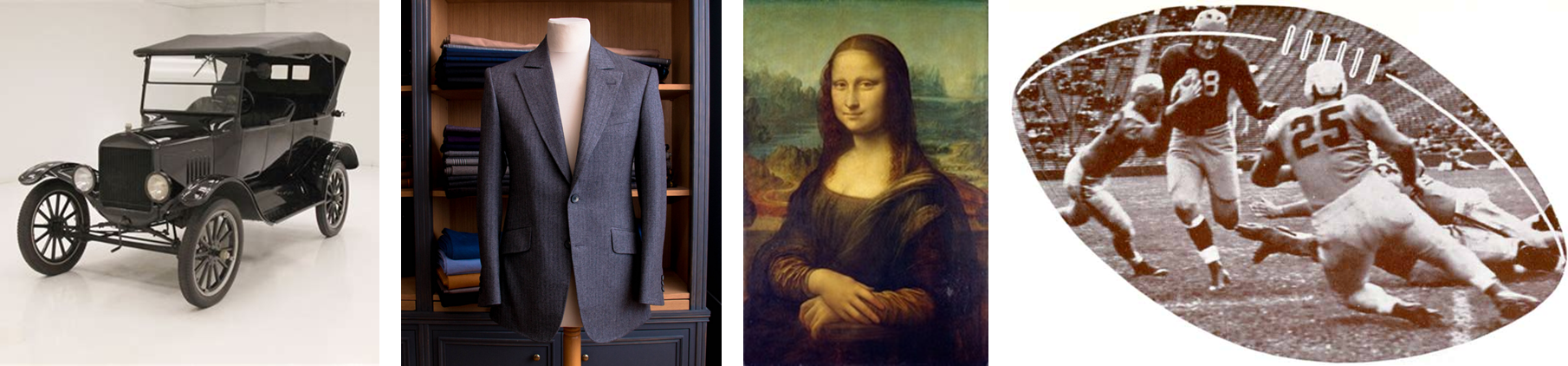
We can think of products as items (or activities) whose primary measure of value is volume; they are standardized (or largely so), and where “quality” of the work is measured solely in a binary of “is it functional” (even if the standards for functionality are very high). The screws for an iPhone are obviously in this category, but so is the iPhone itself: despite commanding a high price, they are all (essentially) the same. There’s no bespoke option, and the primary objective is to produce it with as little labor as necessary in the interest of cost-efficiency.
Then, there’s what I’d call crafts. While marketing copy might expand it to include any limited-run, high-ticket item as “craft,” I’d propose a two-part definition: first, any item that is made where the act of production is optimizing for something other than cost-minimizing efficiency (e.g., lack of waste, preservation of historical manufacturing techniques), or secondly, any service that is customized for the buyer (e.g., tailor-made clothing, plumbing repairs, or a custom-built piece of software or analysis). While these products or services (and even their methods of production) may have aesthetic components, their aim is still to serve a functional purpose and not primarily to be an artifact.
Thirdly, we have arts; those products (or services) whose relative value is in the eye of the beholder and wherein the primary measure of success is aesthetic. The Mona Lisa is neither large nor particularly optimally-suited for that spot on the Louvre wall, while conversely, in my own world of consulting, while strategic analysis may be laid out elegantly, I have yet to meet the client who cares more about its elegance more than its accuracy.
Finally, there are activities that we might classify as performances, whose primary purpose is to be witnessed (or acknowledged) by others. I’m speaking here of the performance as distinct from the recordings: the shows or concerts, not the albums. And these aren’t limited to the arts: most athletic (and even many exploratory) endeavors fall at least partially into this category too. Sir Edmund Hillary’s summiting of Everest might have led to unique discoveries, but mostly it was a feat, something inspiring and thought-provoking rather than valuable for its outcome (he didn’t stay up there, and unlike searches for the Northwest Passage, there wasn’t any clear economic value in mapping the route).
Comments
Nothing yet. Say the first thing.
Sign in to join the conversation.