
For over a year from 1875-1876, Andrew F. Crosse, a “Fellow of the Chemical Society,” detailed his extensive travels through Romania, Hungary, and Serbia in Round About the Carpathians. This is maybe the style of reading/writing that I fear most being lost to AI. There’s no “thesis” in particular, and one would be hard-pressed to say “this is a book about X” (where “X” is anything other than “Andrew Crosse’s travels”). He rambles (both literally and in his writing), discussing the history and geography of the places that he visits, (as well as commenting on the attractiveness of the women, the quality of the food, and his impressions of pretty much everything he encounters). Though his language is lovely at times, it’s not “literature” in the way that novels are, or a piece that someone would be likely to seek out for its experiential qualities alone. Crosse was not (as far as I can discern) a figure of historical import whose words would inspire detailed reflection; rather, I imagine most readers would stumble upon it out of an interest in adding some color to their understanding of the region in that era, or how it was perceived by others. And yet reading every word conveys so much more than a summary the facts enumerated within it. I could briefly discuss his route, misadventures in travel, or the historical and cultural elements with which he peppers the text. But that would elide so much of what makes this book interesting. This was the text in which I learned that the word “robot” referred to the forced labor of serfs in Hungary/Slovakia (an interesting etymology for the age of AI “agents”). There are also casually anti-Semitic comments interspersed through his anecdotes. The most egregious moment comes when his “host” asserts that “the Jew shows up and lends money for slivovitz on credit, then, having driven the peasant into debt and finding himself hated, he flees onto the next town.” Crosse’s magnanimous response is that “”If your people were less of spendthrifts and managed their affairs themselves, then the Jews would cease to find a harvest amongst you.” Which is not exactly sterling advocacy for Jewish equality, and speaks volumes in how un-noteworthy Crosse felt these comments were. He probably didn’t even think of himself as an anti-Semite, and may have felt that he was engaging respectfully with his host, and yet his contributions to the world of chemistry were not so significant to be remembered, while his bigotry is attached to his name for as long as the book exists.
[As a side note, I don’t know if Bram Stoker ever read Crosse’s work, but he published Dracula more than 20 years after, so it’s possible, and the tone of the travelogue feels so very familiar (no pun intended) that I kept expecting the transition into gothic fantasy (e.g., “The earth shook with the clap of a terrific burst of thunder. The horses stood still and shuddered in their harness, and it was with difficulty they were made to go on. It was evident the storm was right over us, for now succeeded flash upon flash of forked lightning, with thunder-claps that were instantaneous and unceasing”). When we finally get the most likely gem, however, it’s mostly a non-event: “I spent my time most agreeably in the châteaux of some of the well-known Transylvanian nobles… society is very charming in Transylvania. Nearly all the ladies speak English well, and are extremely well read in our literature.”]
A more recent geographic exploration, Renagh Holohan’s The Irish Chateaux, has a clear subject: it uses castles in France as an organizing mechanism to interview the descendants of Irish expatriates and demonstrate their influence. Many of the families described were royalists during the French Revolution, and are now so well-entrenched as to be known for their wine, horses, and, as the title suggests, chateaux. It had not occurred to me prior to reading this book that the “Hennessy” family of cognac fame were of Irish descent (though maybe Key & Peele knew). Perhaps simply because these families are her subjects, Holohan comes across as being a bit of a royalist herself, which is an odd sentiment for a 21st-century American to encounter.
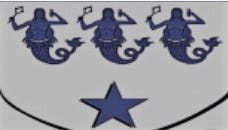
My own Irish ancestors came to the United States directly from Ireland much later, but I (relatively) recently learned that some of our McAuliffe clansmen were among the “Wild Geese” who left for military service in continental Europe. The family coat of arms was not registered until 1709, likely as a part of an effort to claim a level of nobility (and therefore the right to command troops abroad), possibly on the part of Dermot McAuliffe (who was apparently known as “Don Demetrio” in Spain). This makes a lot of sense, in hindsight: the mermaids on the coat of arms are a clear reference to traveling across the sea, and the motto “Dulce periculum” (sweet danger) is surely an apt one for a mercenary. Holohan’s investigation highlights the connections and (perhaps unintentionally) the complexity of historical mobility, in the same way that Crosse’s host’s perception of the Jewish “flight to the next town” highlights how much perceptions of refugees’ motivations are in the eyes of the beholder. Is the moneylender who flees looking for a new group of unsuspecting marks, or just trying to find a place to live in peace? Were the “Wild Geese” refugees from English tyranny, or rapacious mercenaries seeking only their own wealth and power? I don’t think that these questions have productive answers. People will move in search of better lives, and this era’s immigrants may be the defenders of the status quo in the next generation.
I wrote this reflection as part of my ongoing effort to read one book from every aisle in Olin Library.
If you know someone who might find this of interest, please share it:
And to support this effort and read more of my writing, please subscribe:
Yours on the journey,
Jacob K. Lehman
No posts
Comments
Nothing yet. Say the first thing.
Sign in to join the conversation.