
The phrase “Keep your friends close and your enemies closer” is attributed variously to Machiavelli and Michael Corleone; suffice it to say that it is seen as representative of a certain cold-blooded, manipulative character. But what if the causality runs in the other direction? Rather than choosing how “close” to keep our friends and enemies, we find that, in fact, we are prone to friendship with those nearby, and enmity with those next door? After all, your neighbors (literal or figurative) are the ones with whom you compare yourself, the ones whose externalities (loud noises, pollution, eyesores) you absorb, and those who might observe your embarrassments (real or perceived).
In Austria’s Eastern Question, Kurt Roider describes the Habsburgs’ efforts to balance the Ottomans and the Russians on their Eastern front throughout the 18th century. He describes them as being particularly concerned about sharing a border with Russia “lest they become enemies,” and I think that there are two ways to consider this: first (and what I expect he meant), is that if they became enemies for exogenous reasons, it would be concerning to have such a powerful neighbor. Having a buffer zone of other countries would provide time to react either militarily or through diplomacy before Austrian sovereignty was threatened. This makes sense at one level, but provides a game theoretical counterpoint to the notion that a larger country is stronger and/or has more global control. I cannot know how European monarchs thought about their political decisions and obligations, but whether out of a sense of personal pride or national security, I imagine that they would have felt a need to respond with military force to any incursion into their territory. To allow a neighbor (even a recognizably more powerful one) to invade without consequence would risk inviting further encroachment from others. The United States has applied this deterrent logic to the need to respond to even terrorist attacks on our citizens, and it must have loomed larger for a mid-continental country with other parties on all sides. Whether this policy (of military reaction) was stated or not, however, the state of being committed to it removes options. Having a “non-hostile” country (i.e., neither a formal ally nor an enemy) country in between allows for a real-time assessment of the situation without inherently losing face. One could choose to actively intervene on behalf of the invaded party to push back against the invader’s aggression, to provide financial or material support without troops, or to do nothing, and any of those would be defensible. Once the borders are contiguous, however, any intrusion is a direct attack on the homeland and forces a reaction. With this insight in mind, one could deliberately aim to have more alliances rather than more territory (though I don’t know of any country that has deliberately split itself into two allied territories to maximize this optionality).
The second interpretation (perhaps overly influenced by the close-reading habits I learned from Icelandic Sagas and Torah study), would read a causal connection into the “lest they become enemies,” as described in my introduction to this piece: that the act of sharing a border would in itself increase the likelihood of enmity arising between the countries. Disputes over boundary lines would be the most direct causal relationship, but there are others: non-formal conflicts between residents of each country could easily escalate to the point where it became a matter of national interest/concern. Tariffs or other trade restrictions might lead the larger neighbor to think “this would be so much more efficient if we were just all one big happy family.” The other alliances formed by either partner might raise concerns that could lead to conflict. This, in fact, seems to be at least part of the story in Russia’s invasion of Ukraine: not solely Putin’s desire to increase Russian acreage (Mongolia has a tenth of the population and is more than double the size), but out of fear/antagonism towards increasing closeness between Ukraine and NATO/the EU.
So how does one resolve conflict? There are two main concepts of treaty making outlined in the book: uti possidetis (everyone keeps what they control at the moment) and status quo ante bellum (a return to the pre-war boundaries). These are stabilizing principles, the first based on a certain pragmatism (if neither combatant is strong enough to impose its will on the other, then those boundaries may be more or less the same as if fighting were to continue, so why waste lives and resources?) while the second adheres to a concept of “not rewarding the aggressors.” But the latter still provides upside for the aggressor (if they win), and limited downside (excluding the humiliation of being beaten and the loss of life and treasure of the conflict itself). Arguably, this means that starting aggressive wars has a positive expected outcome. You could go further to correct for this issue. We could call this “status quo ante bellum cum poena,” a return to the pre-war boundaries, but with a penalty for having started the conflict. This is the Treaty of Versailles moment at the end of World War 1: Germany had to pay reparations and also lost control of valuable territory. History tells us the risk of this sort of activity, however. Rather than learning the punitive lesson of “aggression does not pay,” Germany felt aggrieved and entitled to re-expand later.
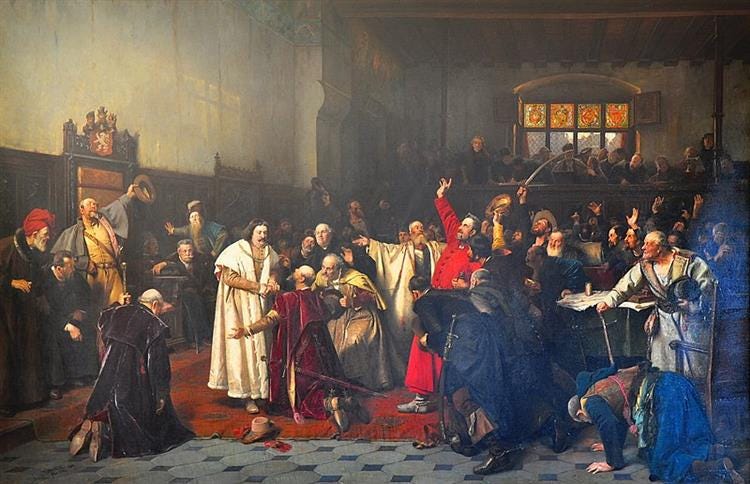
Unfortunately, I hardly remember reading Otakar Odlozilik’s The Hussite King, a biography of George of Podebrady, the Czech nobleman who became king of Bohemia in 1458. Partly that’s a function of the lag between reading and writing (I read it over 4 years ago, but the writing takes time), but also this has to do with (at least the way my mind processes) the themes/connections between topics. Other than being reasonably proximate, the geography of the region, a biography of the king of Bohemia from the mid-15th century doesn’t have a lot to connect with the 18th-century Austrian decisions. And yet, over time the connections build up: I read about Pius II back in 2018 (and wrote about it in 2021; apparently my backlog has grown), and here he is, back again, trying to navigate conflict with George. George proposed a treaty among all Christian powers, committing them to settle differences peacefully as a way to oppose the threat from the Ottoman Turks, but the Hussites were viewed as a heresy, and both Pius and his successor (Paul II) rejected the proposal. Matthias of Hungary, a former ally, turned against him in concert with rebellious Bohemian nobility, and they fought throughout Moravia/Bohemia. In both instances, nearer neighbors proved to be a greater source of conflict and enmity, despite George’s attempts to mobilize against a common (more distant) enemy.
I’ll admit to having used this strategy myself, identifying an external threat to try and build camaraderie among a team. This sometimes works in the short term, but in my experience it needs to be replaced by genuine mutual regard in fairly short order (and George of Podebrady would likely agree). After all, in professional contexts, those most similar to ourselves are our rivals for promotions or acclaim. In other contexts, political operatives who are generally on the same side of the spectrum may collaborate well until they find themselves in a cabinet together, when their differences loom larger. A leadership team that all reports to the CEO/founder can easily find itself riven by jockeying for the leader’s ear. Incentive structures can help, a little; client services firms often use business development or referral bonuses to push back against the tendency to hoard client relationships. But these introduce the cold logic of cost-benefit analysis to the situation, which could backfire. Perhaps there’s an ancillary benefit of work from home here: they mean that one’s colleagues are not quite so prominent in our consideration as they would be in a fully on-site context (for worse, but also for better). I don’t have any firm answers here; social media’s failure to bring people together, plus the historical precedent for close proximity to lead to higher risk of conflict can make it seem intractable. And perhaps this is why “Love thy neighbor as thyself” is phrased the way it is, rather than simply “love every person as thyself.” Not to reject our obligations to those further away, but rather because of the particular threat to friendship that “neighborhood” presents.
If you know of someone who might find this of interest, please share:
And to support Intellectual Odyssey and the Library Book Project (my decade-plus effort to read one book from every aisle of Olin Library), please subscribe:
With you on the journey,
Jacob
No posts
Comments
Nothing yet. Say the first thing.
Sign in to join the conversation.