
Reading time: ~7 minutes

Do you recognize yourself in this?
You haven’t opened your laptop. You haven’t checked a message. You’re still holding your coffee, and your shoulders are already up near your ears.
Nothing has happened yet. And your body is already bracing.
If you run your own business or have a demanding job, you probably know this kind of morning. Not the version where you’re tired, the version where you’re tight before you’ve done anything to earn it. You’ll spend the next ten hours convinced you’re “just anxious,” or “not a morning person,” or the one I hear most in my practice - “there’s something wrong with how I handle stress.”
There’s a simpler explanation, and it isn’t a character flaw. It’s a well-documented piece of physiology, and once you know it’s there, it changes what you do about it.
Every morning, in the first half hour or so after you wake up, your cortisol level spikes sharply, and predictably. Researchers call this the cortisol awakening response, or CAR, and it was first described in the mid-1990s by the psychologist Jens Pruessner and colleagues. It isn’t part of your regular daily cortisol rhythm. It’s a separate event, layered on top of it, tied specifically to the transition from sleep to waking.
Here’s the part that matters for the question of why you feel keyed up before your day has technically started: the leading explanation for the CAR, known as the anticipation hypothesis, holds that this surge exists to prepare your body for what it expects the day to demand of it (Fries, Dettenborn, & Kirschbaum, 2009).
Your nervous system isn’t just waking your body up. It’s placing a bet on how hard today is going to be, and mobilizing resources accordingly, before you’ve looked at your calendar, before you know what’s actually in your inbox.
And the size of that bet isn’t random. Studies have repeatedly found that the CAR runs larger on days people anticipate as more demanding: heavier workloads, higher-stakes obligations, more social or evaluative pressure (Clow, Thorn, Evans, & Hucklebridge, 2004).
Maybe part of you expects today to include being watched, tested, or found wanting. A client call you're dreading. A launch you're not sure will land. A decision you've been putting off. Your body can register that expectation, and it starts spending resources on it before you're consciously thinking about it at all.
This is not a metaphor. It’s measurable, in saliva, in a lab.
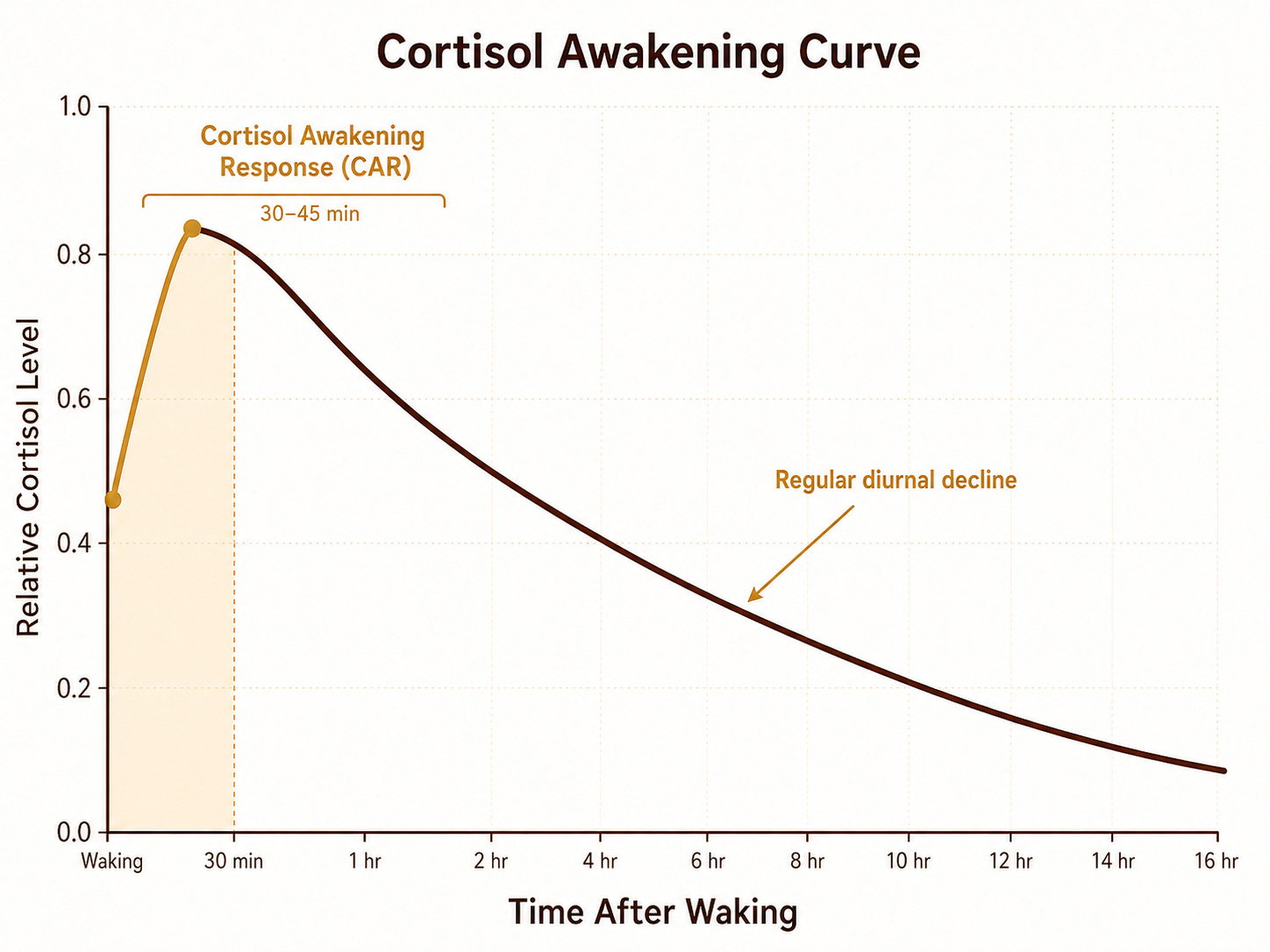
Here’s where a lot of well-meaning advice misses the mark. If your tightness in the morning were purely about your thoughts (worry, rumination, catastrophizing) then thinking your way out of it should work. Reframe the thought, calm the body.
But the CAR isn’t downstream of a thought you’re having. It’s an endocrine event, tied to the sleep-wake transition itself, running partly on a schedule your conscious mind doesn’t set (Clow, Thorn, Evans, & Hucklebridge, 2004).
You can be genuinely at peace with your to-do list and still wake up tight, because your body is responding to a broader pattern. It is responding to how demanding your days have been lately, how much recovery you’ve actually gotten, not just what’s on today’s agenda.
This is precisely why “just don’t worry about it” so reliably fails to help. You’re not being asked to override a thought. You’re being asked to override a hormone that already fired forty minutes before you had the thought.
A single tense morning isn’t the concern. Bodies are built to handle acute spikes and come back down.
The concern is what happens when this activation runs often, for a long stretch, without enough recovery in between; which describes the average week for a lot of business owners I work with, people whose job is, structurally to be evaluated constantly: by clients, by the market, by their own bank balance.
Neuroendocrinologist Bruce McEwen, who spent much of his career studying exactly this, gave it a name: allostatic load; the cumulative physiological cost of stress-response systems that keep firing, or that fail to shut back off efficiently once the demand has passed (McEwen, 1998; McEwen & Stellar, 1993).
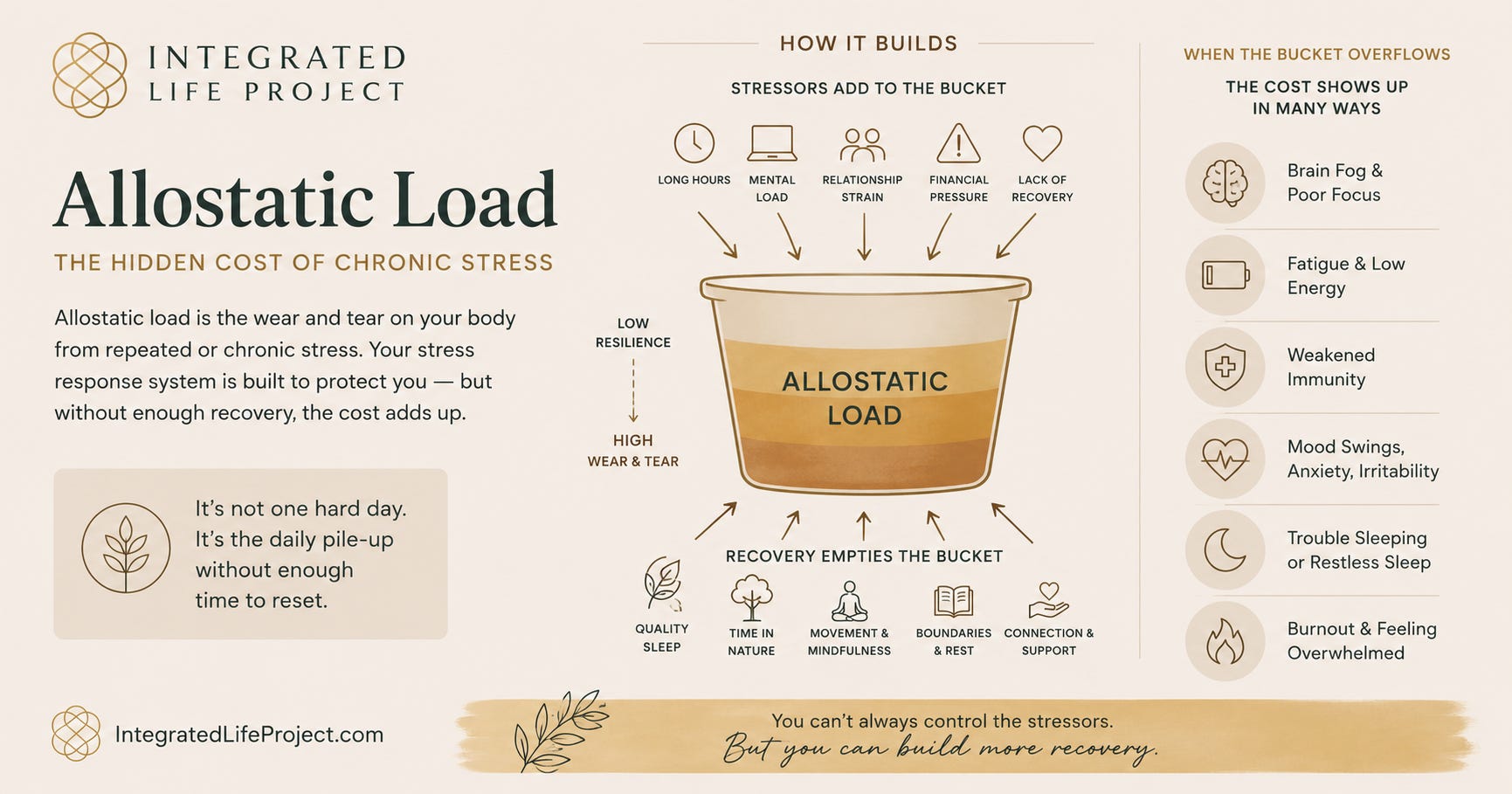
Allostatic load isn’t an abstraction. It’s been linked, across a large body of research, to measurable biological risk like cardiovascular strain, immune dysregulation, and, notably for anyone whose business depends on their thinking, impaired cognitive performance (Seeman, McEwen, Rowe, & Singer, 2001). The very system meant to protect you, running on a hair trigger for months at a time, starts to cost you the sharpness and steadiness you need to actually run your business.
So if you’ve noticed that your judgment feels worse on weeks that are only moderately busier than usual, that’s consistent with what this research describes. It’s not that you’re getting weaker. It’s that the system covering your baseline has been quietly overdrawn for a while.
Not everything here is within your control, and I want to be honest about that rather than oversell a fix. You can’t consciously override a hormonal response with willpower any more than you can talk your heart rate down mid-sprint.
What you can do is stop treating the tight-before-anything-happened feeling as evidence of a problem with you, and start treating it as information about your baseline. A few places that actually move the number, according to the same body of research:
Look at recovery, not just workload. Allostatic load research consistently points to insufficient recovery between demands, not the demands themselves, as the more damaging pattern (McEwen, 1998). A brutal Tuesday followed by a genuinely quiet Wednesday costs you less than a week of moderate-but-unbroken stressors.
Notice what you’re waking up expecting. Since anticipated demand appears to drive the size of the morning spike (Fries et al., 2009), the specific thing you’re dreading tomorrow morning is worth naming tonight. The goal is not to eliminate the feeling, but to stop mistaking a hormonal forecast for a verdict on your competence.
Don’t wait for a crisis to check in on this. Because allostatic load accumulates quietly, well before it becomes symptomatic, the moment to pay attention is exactly the one where everything still looks fine from the outside.
You didn’t imagine the tightness. It’s real, it’s physiological, and it has a name. What you do next is decide whether to keep spending your mornings confused about where it came from, or start treating it as data your body is handing you for free.
This article is for educational purposes and does not provide medical diagnosis or individualized treatment recommendations.
“What does your body usually feel like before your day has actually started?
Reply below — I read every one.”
This is the first in a five-part series on the physiological patterns that quietly shape high performing individuals — long before burnout has a name. Next: the specific cost of feeling watched, even when no one’s actually watching.

Lisa Bollow is a therapist, neuroscience-informed performance strategist, and founder of Integrated Life Project. Her work examines how nervous system regulation, emotional clarity, and cognitive capacity shape leadership, decision-making, well-being, and sustainable performance, integrating clinical insight, neuroscience, and practical strategies for high-functioning individuals and leaders.
Read more on Substack: https://integratedlifeproject.com
Connect on LinkedIn: https://www.linkedin.com/in/lisagoodwinbollow
View my Psychology Today profile: https://www.psychologytoday.com/profile/1572857
References
Clow, A., Thorn, L., Evans, P., & Hucklebridge, F. (2004). The awakening cortisol response: Methodological issues and significance. Stress, 7(1), 29–37.
Fries, E., Dettenborn, L., & Kirschbaum, C. (2009). The cortisol awakening response (CAR): Facts and future directions. International Journal of Psychophysiology, 72(1), 67–73.
McEwen, B. S. (1998). Stress, adaptation, and disease: Allostasis and allostatic load. Annals of the New York Academy of Sciences, 840(1), 33–44.
McEwen, B. S., & Stellar, E. (1993). Stress and the individual: Mechanisms leading to disease. Archives of Internal Medicine, 153(18), 2093–2101.
Pruessner, J. C., Wolf, O. T., Hellhammer, D. H., Buske-Kirschbaum, A., von Auer, K., Jobst, S., Kaspers, F., & Kirschbaum, C. (1997). Free cortisol levels after awakening: A reliable biological marker for the assessment of adrenocortical activity. Life Sciences, 61(26), 2539–2549.
Seeman, T. E., McEwen, B. S., Rowe, J. W., & Singer, B. H. (2001). Allostatic load as a marker of cumulative biological risk: MacArthur studies of successful aging. Proceedings of the National Academy of Sciences, 98(8), 4770–4775.
Comments
Nothing yet. Say the first thing.
Sign in to join the conversation.