
Reading time: ~7 minutes

You opened four tabs before you finished reading the first one. You answered a Slack message mid-sentence in an email. You picked your phone up to check a shipping notification and put it back down twelve minutes later, having read three other things you didn’t plan to read. Or maybe you responded to a social post and got lost scrolling for 30 minutes.
None of it felt like much in the moment. By the end of the day, you’ve done a lot and finished very little. You feel wrung out, and you can’t point to what actually took it out of you.
There’s a name for what happened, and it isn’t a focus problem you need to muscle through. It’s a measurable cost, and researchers have been quantifying it for over two decades.
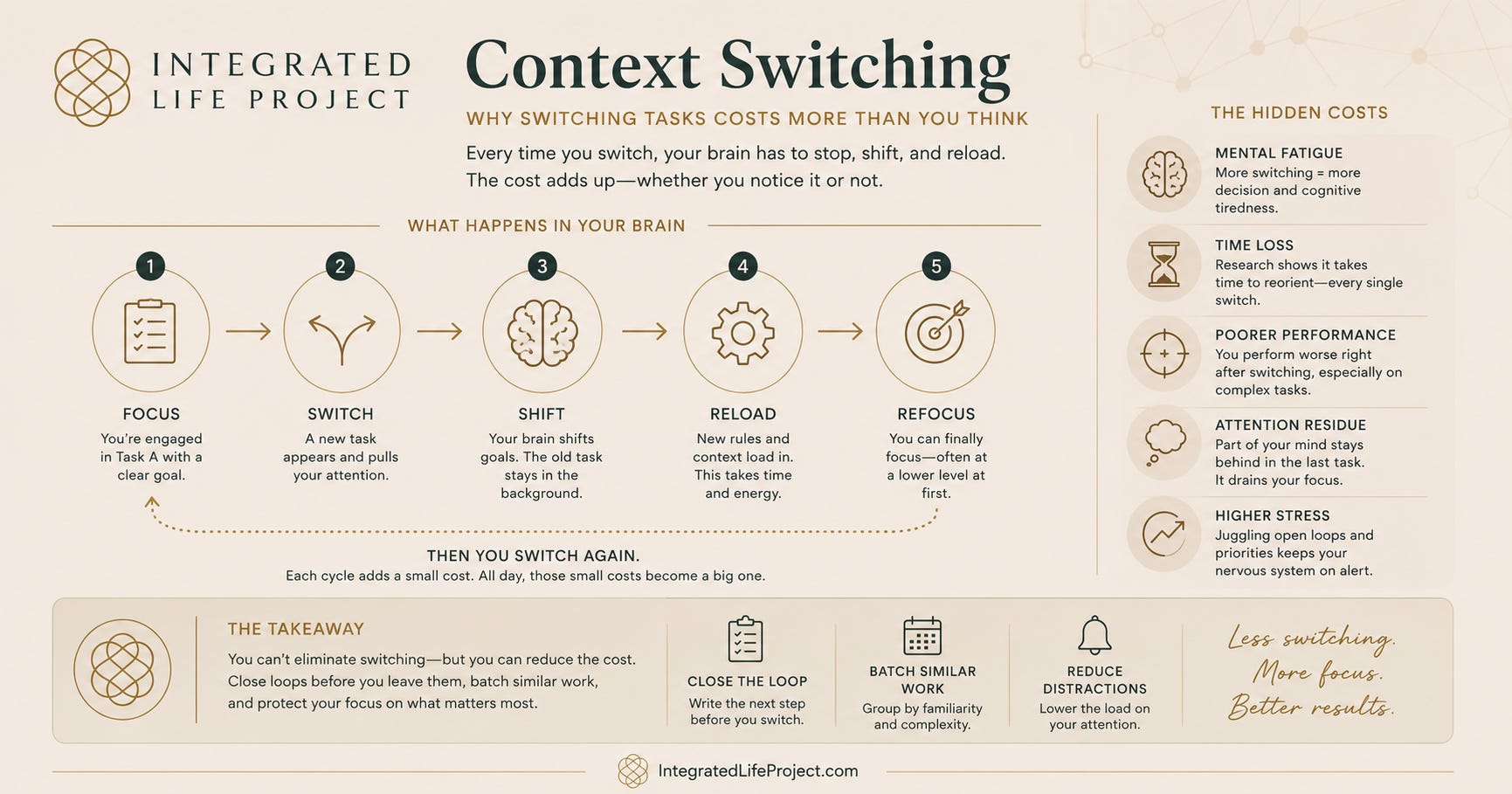
Every time you move from one task to another, your brain has to do real work before it can perform the new task well. Cognitive psychologist David Meyer and colleagues, in a set of now-classic experiments, found that this handoff happens in two distinct stages: first the goal shifts (”I’m doing this now, not that”), then the rules for the new task have to load in (”here’s how this one works”) (Rubinstein, Meyer, & Evans, 2001).
Both stages take time. Neither is optional. And the cost isn’t fixed. It gets worse the less familiar the new task is, and worse again the more complex its rules are. A quick check of a familiar app costs you a little. Switching into unfamiliar, high-stakes work costs you a lot more than it feels like it should.
Here’s the detail that matters most for anyone running their own business: these costs are additive. They stack, switch after switch, all day, whether or not you notice them individually.
It gets worse than a simple handoff fee. Organizational psychologist Sophie Leroy found that when you move to a new task before finishing the last one, part of your attention doesn’t come with you. It stays lodged in the task you left (Leroy, 2009).
Leroy calls this attention residue, and her research found it hits hardest under two conditions: when the prior task was left incomplete, and when it was time-pressured or emotionally loaded. Which means the task you’re most tempted to abandon mid-stream, the tense client email, the proposal you’re not sure about, is exactly the one most likely to keep quietly occupying your mind while you try to do something else.
You’re not imagining that you’re “still thinking about” the last thing. You are. Measurably so, according to Leroy’s data, and it’s actively taking up room your current task needs.
Not all switching happens on equal footing. Psychologist Michael Eysenck and colleagues, in what’s known as attentional control theory, found that anxiety specifically degrades the part of your attention system responsible for staying on a goal-directed task and resisting distraction (Eysenck, Derakshan, Santos, & Calvo, 2007). Anxious attention doesn’t just wander. It gets actively pulled toward anything that might signal a problem.
Running a business of your own tends to keep some baseline concern about being evaluated humming in the background. A client’s silence after a proposal. A launch you haven’t heard results on yet. A conversation you’re not sure went well. None of that has to be a dramatic crisis to pull at your attention. According to this research, it only has to register as something that could matter to your standing, and it starts competing for the same limited attentional resources your current task needs.
This is part of why a scattered day feels different from a simply busy one. It isn’t only that you’re doing many things. It’s that a piece of your attention is standing guard, watching for evaluation, on top of everything else you’re trying to do.
There’s a comforting story a lot of entrepreneurs tell themselves here: “I’m just good at multitasking. I’ve built up a tolerance for this.” The research doesn’t back that up.
Stanford researchers Eyal Ophir, Clifford Nass, and Anthony Wagner compared people who habitually multitask across media with those who don’t, expecting the heavy multitaskers to show an advantage at switching, given how much practice they get. They found the opposite. Heavy multitaskers performed worse at filtering out irrelevant information and were more susceptible to distraction from things that didn’t matter to the task at hand (Ophir, Nass, & Wagner, 2009).
In other words, the habit of scattering your attention doesn’t train you out of the cost. If anything, it seems to erode the filter that would otherwise protect you from it.
You can’t eliminate task switching. Running a business requires it. But the same research points to a few things that measurably reduce the cost.
Close the loop before you leave it, even briefly. In her follow-up work, Leroy found that writing down a clear next step for an unfinished task, before switching away from it, reduced the attention residue that followed. You don’t have to finish the task. You have to tell your brain where it’s picking back up.
Batch by familiarity, not just by type. Since switch costs grow with unfamiliarity and rule complexity (Rubinstein et al., 2001), grouping your most unfamiliar, highest-stakes work into single unbroken blocks costs you less than threading it between routine tasks.
Take notification pressure seriously, not just literally. Since heavy multitasking is linked to a weaker filter for irrelevant input (Ophir, Nass, & Wagner, 2009), the goal isn’t willpower to ignore your phone. It’s reducing how often the filter has to work at all.
None of this makes you a more disciplined person. It makes you someone working with a nervous system that has documented limits, instead of one quietly overriding them all day and calling it productivity.
What’s the task today that you’re most likely to leave half-finished?
Reply and tell me. I read every one.
This is the second in a five-part series on the physiological patterns that quietly shape a high performing individual’s day. Next: the specific cost of feeling watched, even when no one’s actually watching. Subscribe to get the series and future articles.

Lisa Bollow is a therapist, neuroscience-informed performance strategist, and founder of Integrated Life Project. Her work examines how nervous system regulation, emotional clarity, and cognitive capacity shape leadership, decision-making, well-being, and sustainable performance, integrating clinical insight, neuroscience, and practical strategies for high-functioning individuals and leaders.
Read more on Substack: https://integratedlifeproject.com
Connect on LinkedIn: https://www.linkedin.com/in/lisagoodwinbollow
View my Psychology Today profile: https://www.psychologytoday.com/profile/1572857
References
Eysenck, M. W., Derakshan, N., Santos, R., & Calvo, M. G. (2007). Anxiety and cognitive performance: Attentional control theory. Emotion, 7(2), 336–353.
Leroy, S. (2009). Why is it so hard to do my work? The challenge of attention residue when switching between work tasks. Organizational Behavior and Human Decision Processes, 109(2), 168–181.
Ophir, E., Nass, C., & Wagner, A. D. (2009). Cognitive control in media multitaskers. Proceedings of the National Academy of Sciences, 106(37), 15583–15587.
Rubinstein, J. S., Meyer, D. E., & Evans, J. E. (2001). Executive control of cognitive processes in task switching. Journal of Experimental Psychology: Human Perception and Performance, 27(4), 763–797.
Comments
Nothing yet. Say the first thing.
Sign in to join the conversation.